Mobile Navigation

  • National
    • Policy
      • High Expectations
      • Quality Choices
      • Personalized Pathways
    • Research
    • Commentary
      • Gadfly Newsletter
      • Flypaper Blog
    • Events
    • Scholars Program
  • Ohio
    • Policy
      • Priorities
      • Media & Testimony
    • Research
    • Commentary
      • Ohio Education Gadfly Biweekly
      • Ohio Gadfly Daily
  • Charter Authorizing
    • Application
    • Sponsored Schools
    • Resources
  • About
    • Mission
    • Board
    • Staff
    • Career
Home
Home
Advancing Educational Excellence

Main Navigation

  • National
  • Ohio
  • Charter Authorizing
  • About

National Menu

  • Topics
    • Accountability & Testing
    • Advanced Education
    • Career & Technical Education
    • Charter Schools
    • Curriculum & Instruction
    • ESSA
    • Evidence-Based Learning
    • Facilities
    • Governance
    • Personalized Learning
    • Private School Choice
    • School Finance
    • Standards
    • Teachers & School Leaders
    • Think Again
  • Research
  • Commentary
    • Gadfly Newsletter
    • Flypaper Blog
    • Gadfly Podcast
  • Events
  • Scholars Program

Topics

Displaying 2761-2790 of 17507 results
Commentary
7.31.2019

How much knowledge is necessary for comprehension?

Robert Pondiscio

There’s an image I like to use when describing the role of prior knowledge and vocabulary in reading comprehension: Think of a reading passage like a game of Jenga, where you take turns removing one block at a time from a tower of blocks. Imagine that every one of those blocks is a bit of background knowledge or an essential vocabulary word.


Commentary
7.31.2019

The relationship between suspensions and arrests

David Griffith, Ph.D.

A new study published in Justice Quarterly by Thomas Mowen, John Brent, John and Boman tries to quantify the effect of suspensions on students’ odds of criminal justice involvement. However, like its many predecessors, it comes up short.

Commentary
7.30.2019
Charter Schools

Hidden from the headlines

Headlines about colossal mismanagement issues in Ohio charters—the biggest being the ECOT meltdown—dominate the school choice narrative in the Buckeye State. These stories raise the question: Why are Ohio charters so bad? This query and the dominant narrative that flows from it have long provided cover for charter opponents, even as some of the negative coverage is well-deserved. But it’s the wrong question—and it distracts us from a bigger, far more compelling story.

Commentary
7.30.2019

NEW REPORT: Discipline Reform through the Eyes of Teachers

David Griffith, Ph.D., Adam Tyner, Ph.D.

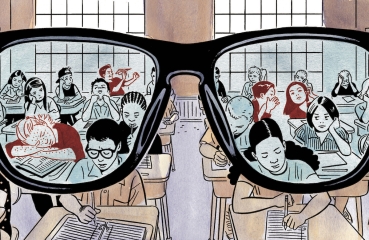
The debate over school discipline reform is one of the most polarized in all of education. Advocates for reform believe that suspensions are racially biased and put students in a “school-to-prison pipeline.” Opponents worry that softer discipline approaches will make classrooms unruly, impeding efforts to help all students learn and narrow achievement gaps. "Discipline Reform through the Eyes of Teachers" examines this complex issue with a nationally representative survey of more than 1,200 teachers in grades 3–12.

Commentary
7.29.2019

The U.S. Commission on Civil Rights embraces alternative facts

There’s an old Mark Twain saying that there are “lies, damned lies, and statistics.” But without any statistics to support its point, the U.S. Commission on Civil Rights has stamped its imprimatur on the central lie of school discipline reform, that “students of color as a whole, as well as by individual racial group, do not commit more disciplinable offenses than their peers.”

Commentary
7.26.2019

Mandatory retention: A policy whose time has come

Dale Chu

Last month, Alabama’s Governor Kay Ivey signed the Alabama Literacy Act into law, making the state the nineteenth to require third grade reading retention.

Commentary
7.25.2019

In defense of education’s Wham-O Pudding essay contests

Are essay-based group competitions good for educational innovation? 

Commentary
7.24.2019

Education policy helped these states beat the socioeconomic curve

Michael J. Petrilli

Rapidly improving economic conditions among the country’s poorest families during the 1990s may have been responsible for much of the progress in student achievement we saw in the 2000s. It’s a provocative and compelling national picture. But what about at the state level? Were those where child poverty declined the most the same states where the “below basic” rate dropped the most? In a word, no. There’s a clear reformy slant to the list of high-fliers from that era, and from more recent history, too.

Commentary
7.24.2019

Causes and consequences of America’s broken gifted education system

We read Chester Finn’s recent Flypaper column, “Public attitudes toward gifted education: Supportive, complacent, incomplete,” with great interest and painful recognition.

Commentary
7.24.2019

No apologies for “no excuses” charter schools

Robert Pondiscio

When The New York Times ran an article earlier this month on the “growing backlash” against urban charter schools, Greg Richmond, President of the National Association of Charter School Authorizers (NACSA), offered

Commentary
7.24.2019

Widening excellence gap

Chester E. Finn, Jr.

The ever-vigilant Jack Kent Cooke Foundation has issued a short (two-page!), trenchant issue brief—closer, really, to an infogram—showing how the “excellence gap” in American schools has actually worsened over the past two decades.

Commentary
7.24.2019

A debate about unschooling

Robert Pondiscio

“How can you tell if someone’s a vegan?” goes the common joke. “Don’t worry. They’ll tell you.” You can change the joke to unschoolers and it works almost as well, at least among libertarians. “Let me ask you something,” a libertarian will say when he finds out you work in education. “Have you ever heard of John Holt?” Or John Taylor Gatto.

Commentary
7.23.2019
Accountability & Testing

It’s not grade inflation, it’s the education industry

A number of New York City public schools recently learned that even though close to 100 percent of their students earned passing grades, less than 10 percent were able to pass the standardized state exams. A common explanation is that teachers are lowering expectations and inflating grades, possibly due to the pressure of the city’s bureaucrats’ desire to achieve equitable racial and socioeconomic outcomes. This has some truth, but it actually misunderstands the problem. The students’ inability to demonstrate their learning stems from the most prominent educational theory by which teachers have been trained over the past fifteen years. In essence, the failure of the students is an internal educational problem.

Commentary
7.17.2019

A rising economic tide + reform + resources = better results for kids

Michael J. Petrilli

Much of the academic progress of the NCLB era may have stemmed from dramatically declining child poverty rates. But other things were also happening that deserve credit, like ed reform and more education resources. So it's likely that these three things were a winning combination. The good news is that we’re living in the midst of an economic boom today, and states are opening their wallets again. If policymakers stick with the reform part of this trifecta, it may work as well now as it did twenty years ago.

Commentary
7.17.2019

The federal Charter Schools Program: A short, opinionated history, part I

Chester E. Finn, Jr.

This essay is part of the The Moonshot for Kids project, a joint initiative of the Fordham Institute and the Center for American Progress. It will run in three parts, with the second and third appearing in future issues of the Education Gadfly Weekly.

Commentary
7.17.2019

Tell high school students the truth about college readiness

Aaron Churchill

Proficiency standards may feel like a wonky topic, but they have real-world consequences.

Commentary
7.17.2019

Scaling up proven charter school models

Amber M. Northern, Ph.D.

The challenge of “scaling up” in education is well documented and the cause of considerable dismay.

Commentary
7.17.2019

The implementation and impacts of reforms in Louisiana

Jessie McBirney

Louisiana’s education system has had a rough go, historically. One of the poorest states in the nation, Louisiana sees lower-than-average graduation rates and scores below average on every NAEP test subject.

Commentary
7.12.2019

Musings on the moonshots

A few months ago, I looked at the quite laudable CZI/Gates “Moonshot” effort. There I made a technical point about their somewhat randomly chosen goal: moving students from the fiftieth to the ninety-eighth percentile on math over the course of ten years. It was too big.

Commentary
7.10.2019

A hypothesis: NCLB-era achievement gains stemmed largely from declining child poverty rates

Michael J. Petrilli

There’s a strong relationship between a child’s socioeconomic status and his or her academic outcomes, so it stands to reason that improved economic conditions for lots of children should be associated with achievement gains. And indeed, that’s precisely what we saw in the decades before the Great Recession struck. But are those two trends linked?

Commentary
7.10.2019

Public attitudes toward gifted education: Supportive, complacent, incomplete

Chester E. Finn, Jr.

The Institute for Educational Advancement recently completed an elaborate survey of public views toward many aspects of the education of gifted children and the results are enlightening, sobering—and complicated.

Commentary
7.10.2019

In Chicago, a new early-warning indicator for elementary schools

Dale Chu

At its first meeting last month after a changing of the guard, the Chicago Board of Education approved changes to the School Quality Ratings Polic

Commentary
7.10.2019

How to help students think critically

Robert Pondiscio

Consensus is rare in education, but if there’s broad agreement on anything pertaining to schooling, it’s on the need for students to develop critical thinking ability. But that’s where the consensus ends. Some perceive critical thinking as a content-neutral, generic skill that can be taught, practiced, and mastered in the abstract.

Commentary
7.10.2019

Little rhyme or reason in special needs designations for students

Jeff Murray

A designation of special needs for a K–12 student can generate a sigh of relief from some parents and a howl of outrage from others. Such a designation can also be the basis of a successful outcome for some students and the beginning of a long struggle for others to attain proper supports.

Commentary
7.9.2019

Beyond special education as we know it

Pay attention! The times they are a ‘changing as we move beyond special education as we’ve known it for forty-plus years. In his courageous, thought-provoking piece, Kalman R.

Commentary
7.9.2019

Sometimes it takes more than a nudge: Reflections on running the College Match Program

At the end of May, the College Board released a study about an inexpensive intervention that held the promise of increasing the number of high-achieving, low-income high school students who attended more selective colleges, where re

Commentary
7.1.2019

Charter schools and teacher diversity

A new study of North Carolina public schools finds that black students in charter schools are more likely to have black teachers than their regular public school counterparts, and that the positive

Commentary
7.1.2019

Sounding the alarm for boys in our schools

Erika Sanzi

Legendary actress Meryl Streep recently garnered a considerable amount of media attention during a Vanity Fair panel about the second season of HBO’s series “Big Little Lies.” Much to the surprise of many, Streep was highly critical of the phrase “toxic masculinity,” asserting tha

Commentary
6.27.2019

New Rhode Island school commissioner says she wouldn’t send her children to a Providence school

Erika Sanzi

Angélica Infante-Green did not pull any punches when answering questions about a devastating report released yesterday by Johns Hopkins University Institute for Education Policy.

Commentary
6.26.2019

Child poverty is down sharply since the start of the ed reform era

Michael J. Petrilli

U.S. student outcomes improved significantly from the late 1990s until the onset of the Great Recession, especially in math, but also in reading, science, writing, U.S. history, and civics. Gains were greatest for lowest-achieving students, students of color, and at the fourth and eighth grade levels. But it's possible that a certain change outside of school explains at least some of these gains: the vastly improving condition of the nation’s poorest families.

Pagination

  • First page « First
  • Previous page ‹ Previous
  • Page 89
  • Page 90
  • Page 91
  • Page 92
  • Current page 93
  • Page 94
  • Page 95
  • Page 96
  • Page 97
  • Next page Next ›
  • Last page Last »

Type

  • Book (10)
  • (-) Commentary (17507)
  • Event (51)
  • Podcast (383)
  • Report (258)
  • Video (98)

Topics

  • Accountability & Testing (398)
  • Advanced Education (228)
  • Career & Technical Education (68)
  • Charter Schools (1003)
  • Curriculum & Instruction (1463)
  • ESSA (110)
  • Evidence-Based Learning (812)
  • Facilities (18)
  • Governance (1237)
  • Personalized Learning (36)
  • Private School Choice (121)
  • School Finance (121)
  • Standards (131)
  • Teachers & School Leaders (1367)

Date

  • 2026 (328)
  • 2025 (367)
  • 2024 (378)
  • 2023 (373)
  • 2022 (381)
  • 2021 (397)
  • 2020 (382)
  • 2019 (352)
  • 2018 (407)
  • 2017 (463)
  • 2016 (596)
  • 2015 (537)
  • 2014 (632)
  • 2013 (486)
  • 2012 (362)
  • 2011 (2382)
  • 2010 (1934)
  • 2009 (1480)
  • 2008 (1912)
  • 2007 (494)
  • 2006 (503)
  • 2005 (439)
  • 2004 (434)
  • 2003 (515)
  • 2002 (606)
  • 2001 (311)
  • 1969 (56)
Fordham Logo

© 2026 The Thomas B. Fordham Institute
Privacy Policy
Usage Agreement

National

P.O. Box 110
Burke, VA 22009

202.223.5452

[email protected]

Ohio

P.O. Box 82291
Columbus, OH 43202

614.223.1580

[email protected]

Sponsorship

130 West Second Street, Suite 410
Dayton, Ohio 45402

937.227.3368

[email protected]