Mobile Navigation

  • National
    • Policy
      • High Expectations
      • Quality Choices
      • Personalized Pathways
    • Research
    • Commentary
      • Gadfly Newsletter
      • Flypaper Blog
    • Events
    • Scholars Program
  • Ohio
    • Policy
      • Priorities
      • Media & Testimony
    • Research
    • Commentary
      • Ohio Education Gadfly Biweekly
      • Ohio Gadfly Daily
  • Charter Authorizing
    • Application
    • Sponsored Schools
    • Resources
  • About
    • Mission
    • Board
    • Staff
    • Career
Home
Home
Advancing Educational Excellence

Main Navigation

  • National
  • Ohio
  • Charter Authorizing
  • About

National Menu

  • Topics
    • Accountability & Testing
    • Advanced Education
    • Career & Technical Education
    • Charter Schools
    • Curriculum & Instruction
    • ESSA
    • Evidence-Based Learning
    • Facilities
    • Governance
    • Personalized Learning
    • Private School Choice
    • School Finance
    • Standards
    • Teachers & School Leaders
    • Think Again
  • Research
  • Commentary
    • Gadfly Newsletter
    • Flypaper Blog
    • Gadfly Podcast
  • Events
  • Scholars Program

Reports

Displaying 181-210 of 258 results
Report
10.4.2007
Accountability & Testing

The Proficiency Illusion

Deborah Adkins, G. Gage Kingsbury, Michael Dahlin, John Cronin

NCLB allows each state to define proficiency as it sees fit and design its own tests. This study compares state tests to benchmarks laid out by the Northwest Evaluation Association to evaluate proficiency cut scores for assessments in twenty-six states. The findings suggest that the tests states use to measure academic progress and student proficiency under NCLB are creating a false impression of success, especially in reading and especially in the early grades.
Report
9.18.2007
Governance, Teachers & School Leaders

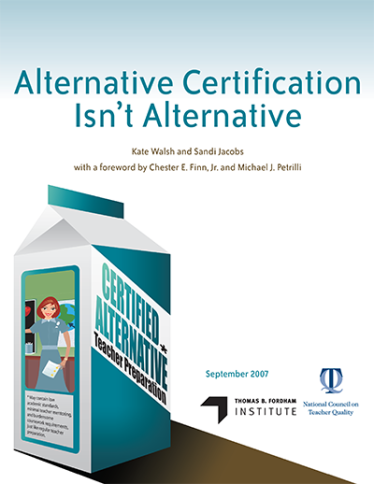
Alternative Certification Isn't Alternative

Kate Walsh, Sandi Jacobs

At first glance, the explosive growth of 'alternative' teacher certification--which is supposed to allow able individuals to teach in public schools without first passing through a college of education--appears to be one of the great success stories of modern education reform. But, as this report reveals, alternative certification programs have so far failed to provide a real alternative to traditional education schools. In fact, they represent a significant setback for education reform advocates.

Report
7.11.2007
Curriculum & Instruction, Governance

Beyond the Basics: Achieving a Liberal Education for All Children

Chester E. Finn, Jr., Diane Ravitch

America's true competitive edge over the long haul is not its technical prowess but its creativity, its imagination, its inventiveness. And those attributes are best inculcated not by skill-drill or 'STEM' but through liberal arts and sciences, liberally defined. Thus argues this new Fordham volume, edited by Chester E. Finn, Jr. and Diane Ravitch, which also explores what policymakers and educators at all levels can to do sustain liberal learning and sketches an unlovely future if we fail.

Report
4.11.2007
Governance

The Autonomy Gap

Steven Adamowski

Though most public school principals believe that effective leadership of their schools requires authority over personnel decisions (e.g., staff selection, deployment, dismissal), they report having little such authority in practice. Based on a series of interviews with a small sample of district and charter-school principals, the report shows that most district principals encounter a sizable gap between the extent and kinds of authority that leaders need to be effective and the authority that they actually have.

Report
4.1.2007
Accountability & Testing, Governance

Crystal Apple: Education Insiders' Predictions for No Child Left Behind's Reauthorization

Michael J. Petrilli, Coby Loup

January 8, 2007, was the fifth birthday of the No Child Left Behind Act. This isn't just another milestone to be celebrated (or mourned). The law is now due for an update from Congress. But will NCLB be reauthorized on schedule? What changes are likely? No one knows for sure, but the ubiquitous 'Washington insiders' might be in a better position than others to cast prognostications. While not a 'representative sample' of thousands, their inside knowledge adds valuable insight.

Report
1.29.2007
Evidence-Based Learning, Curriculum & Instruction

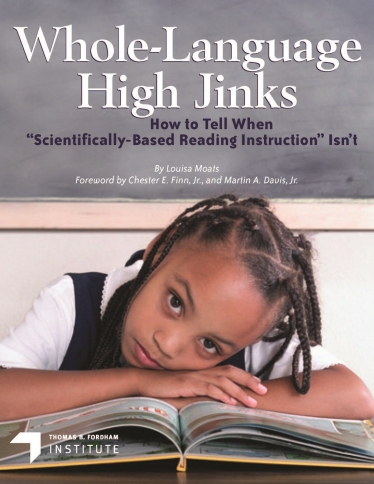
Whole-Language High Jinks

Louisa Moats

If you thought whole-language reading instruction had been relegated to the scrap heap of history, think again. Many such programs (proven to be ineffective) are still around, but they're hiding behind phrases like 'balanced literacy' in order to win contracts from school districts and avoid public scrutiny. Louisa Moats calls them out in Fordham's new report, Whole-Language High Jinks.

Report
11.30.2006
Accountability & Testing, Charter Schools

2006 Thomas B. Fordham Foundation Sponsorship Accountability Report

Terry Ryan, Kathryn Mullen

For information on Fordham's unique role as a charter school sponsor in Ohio, there's no better source than The Thomas B. Fordham Foundation Sponsorship Accountability Report 2005-06. The report offers a comprehensive account of Fordham's sponsorship policies and practices-as well as individual profiles of all Fordham-sponsored schools. Included in the profiles are descriptions of each school's educational program, school philosophy, and overall academic performance based on state achievement data.

Report
11.1.2006
Accountability & Testing

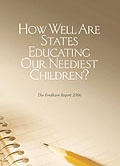
The Fordham Report 2006: How Well Are States Educating Our Neediest Children?

The Fordham Report 2006: How Well Are States Educating Our Neediest Children? appraises each state according to thirty indicators across three major categories: student achievement for low-income, African-American, and Hispanic students; achievement trends for these same groups over the last 10-15 years; and the state's track record in implementing bold education reforms. It finds that just eight states can claim even moderate success over the past 15 years at boosting the percentage of their poor or minority students who are at or above proficient in reading, math or science.

Report
8.29.2006
Standards

The State of State Standards 2006

Michael J. Petrilli, Chester E. Finn, Jr.

Two-thirds of schoolchildren in America attend class in states with mediocre (or worse) expectations for what their students should learn. That's just one of the findings of Fordham's The State of State Standards 2006, which evaluates state academic standards. The average state grade is a 'C-minus'--the same as six years earlier, even though most states revised their standards since 2000.

Report
8.29.2006
Accountability & Testing, Standards

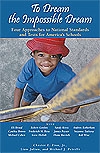
To Dream the Impossible Dream: Four Approaches to National Standards and Tests for America's Schools

Michael J. Petrilli, Chester E. Finn, Jr.

Education policy leaders from across the political spectrum flesh out and evaluate several forms that national standards and testing could take.

Report
6.27.2006
School Finance, Governance

Fund the Child

Everyone agrees that education funding today is a mess. But a broad, bipartisan coalition now urges a new method of funding our public schools--one that finally ensures the students who need the most receive it, that empowers school leaders to make key decisions, and that opens the door to public school choice. It's a 100 percent solution to the most pressing problems in public school funding--and it's called Weighted Student Funding.

Report
6.6.2006
Standards

The State of State World History Standards 2006

Chester E. Finn, Jr., Martin A. Davis, Jr., Walter Russell Mead

Is America's K-12 education system preparing students for life in a global village? Unfortunately, it is not. Renowned historian Walter Russell Mead, author of this report, found that thirty-three states deserved D or F grades for their world history standards.

Report
5.3.2006
Charter Schools

Trends in Charter School Authorizing

Michael J. Petrilli, Chester E. Finn, Jr., Rebecca Gau

Belatedly, policymakers and researchers are recognizing that quality charter schools depend on quality charter school authorizing. This report presents findings from a pioneering national examination of the organizations that sponsor, oversee, and hold accountable U.S. charter schools. Its primary aim is to describe and characterize these crucial but little-known organizations.

Report
5.2.2006
Charter Schools

Playing To Type? (2006)

Dick Carpenter, Chester E. Finn, Jr.

Most discussions of charter schools assume that they are monolithic. This study, the first of its kind, categorizes the nation's charter schools into a robust typology according to their educational approaches. It also provides demographic information by type,how many are in each category, what their student populations look like, and so forth,and makes a first attempt at comparing their test scores. The result is a much richer and more accurate picture of the charter school universe.

Report
3.16.2006
Teachers & School Leaders

Fwd: Teacher Education: Coming Up Empty

Kate Walsh

The nation's leading teacher educators made a startling admission last year in their tome, Studying Teacher Education, by conceding there's little evidence that what happens in ed schools helps in the K-12 classroom. Kate Walsh explores why teacher educators are ignoring the achievement gap and, thus, consigning their field to irrelevance.

Report
12.7.2005
Standards

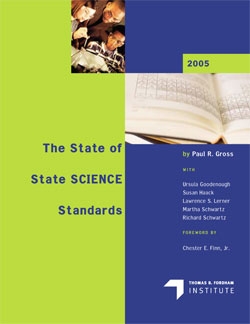
The State of State Science Standards 2005

Chester E. Finn, Jr., Martha Schwartz, Lawrence S. Lerner, Susan Haack, Paul Gross, Richard Schwartz, Ursula Goodenough

Science education in America is under attack, with "discovery learning" on one flank and the Discovery Institute on the other. That's the core finding of this comprehensive review of state science standards, the first since 2000. Written by pre-eminent biologist Paul R. Gross, The State of State Science Standards 2006 finds that even though the majority of states have reworked, or completely re-written, their science standards over the past five years, we're no better off now than before. The good news is that many of the standards are easily fixed. The public's anxiety about the future of our nation's scientific prowess is palpable,and reasonable. How serious are we in addressing their concerns?

Report
10.24.2005
Curriculum & Instruction, Standards

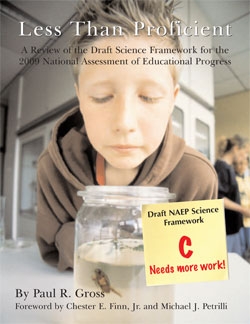
Less Than Proficient

Michael J. Petrilli, Chester E. Finn, Jr., Paul Gross

Almost every week a new report or commission decries the decline of America's preeminence in science, and calls for the nation's education system to raise standards in order for our economy to remain competitive with the rest of the world. Within this context, the National Assessment Governing Board is preparing to launch a new science assessment for 2009. Curriculum developers and textbook writers are likely to follow its lead. Fordham couldn't help but wonder: is the draft science Framework up to the challenge? Using much the same criteria applied in the Foundation's state science standards reviews (due out this December), our reviewers answered: no. As author (and esteemed biologist) Paul R. Gross wrote, The Framework is an interesting start, but there is much work to be done if it is to achieve its potential usefulness.

Report
9.14.2005
Accountability & Testing, Curriculum & Instruction

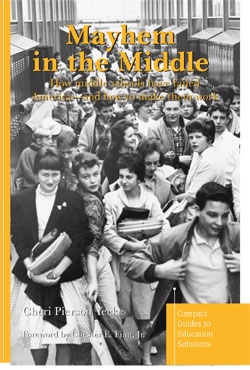
Mayhem in the Middle: How middle schools have failed America, and how to make them work

Chester E. Finn, Jr., Cheri Pierson Yecke

American middle schools have become the places "where academic achievement goes to die." So says Cheri Yecke, K-12 Education Chancellor of Florida and author of the new Fordham report Mayhem in the Middle: How middle schools have failed America, and how to make them work. Today's middle schools have succumbed to a concept of "middle schoolism" in which a strong academic curriculum is traded for one that focuses more on emotional and social development, and less on learning the basics. And the achievement data reflects "middle schoolism's" results. In 1999, U.S. eighth graders scored nine points below average on the TIMSS assessment of math. What's more, these same eighth graders had outperformed the average by 28 points as fourth graders in 1995! According to Fordham President Chester E. Finn, Jr., "Trying to fix high schools while ignoring middle schools is like bandaging a wound before treating it for infection."

Report
9.8.2005
Accountability & Testing, Teachers & School Leaders

Personality Test: The dispositional dispute in teacher preparation today, and what to do about it

William Damon

The standards of the National Council for Accreditation of Teacher Excellence (NCATE) are of critical import for America's future teaching corps and will wield disproportionate influence for decades to come. Over the past fifteen years, 25 states have outsourced the approval of teacher preparation programs to NCATE by adopting or adapting its standards as their own; the other 25 have various 'partnerships' with the organization. Which makes it all the more disturbing that central to these standards is the call for teachers to possess certain 'dispositions' such as particular attitudes toward 'social justice.' As Professor William Damon of Stanford University explains in Fordham's latest Fwd: Arresting Insights in Education, NCATE's framing of the 'dispositions' issue has given education schools 'unbounded power over what candidates may think and do.' This is leading to (understandable) charges of ideological arm-twisting and Orwellian mind-control.

Report
8.24.2005
School Finance, Charter Schools

Charter School Funding: Inequity's Next Frontier

Sheree Speakman, Chester E. Finn, Jr., Bryan C. Hassel

Of all the controversies swirling around the nation's charter schools, none is more hotly contested than the debate over funding. Into the fray leaps Charter School Funding: Inequitys Next Frontier, the most comprehensive and rigorous study ever undertaken of how public charter schools are funded, state by state, and how their revenues measure up to dollars received by district-run schools.

Report
7.21.2005
Governance, Private School Choice, Standards

Fwd: It's All About the Kids

Martin A. Davis, Jr.

In just more than five years, Mary Anne Stanton has led 13 Catholic schools from high-poverty Washington, D.C. neighborhoods into a consortium that has not only strengthened each school's financial health, but has also greatly improved the academic performance of the children the schools are charged with educating. To get there, she's installed a new standards-based curriculum, shaken up old bureaucratic approaches, and streamlined operations. In its latest Fwd: Arresting Insights in Education, the Thomas B. Fordham Foundation presents a compelling story of just how much change can be made by one determined school leader with a vision.

Report
5.5.2005
Standards

Fwd: Half Empty or Half Full?: Florida's voluntary pre-Kindergarten standards

Amy Wilkins

In 2002, when its voters approved a ballot measure calling for universal pre-Kindergarten by 2005-06, Florida joined a handful of states in which all children are eligible for free, publicly funded education in the year prior to Kindergarten. The passage of the referendum was cause for great optimism among those aware of the power of high-quality pre-K programs to prepare children, particularly low-income children, to meet the challenges of K-12 education. But as with any public policy initiative, the devil is in the details. In designing the half-day Voluntary Pre-Kindergarten program (VPK), the Florida legislature faced competing demands. How did they balance the trade-offs? Amy Wilkins of the Education Trust lays it out in Fordham's latest Fwd: Arresting Insights in Education.

Report
1.5.2005
Standards

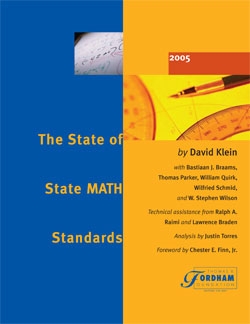
The State of State Math Standards 2005

W. Stephen Wilson, Bastiaan J. Braams, Chester E. Finn, Jr., Wilfried Schmid, Ralph A. Raimi, William Quirk, Thomas Parker, Lawrence Braden, David Klein

States still have far to go in setting rigorous, high quality expectations for K-12 math instruction. Although a majority have replaced or revised their math standards since 2000, many have failed to make substantial improvements. The review was led by David Klein, Professor of Mathematics at California State University-Northridge, and evaluates the content, writing quality, and clarity of K-12 math standards in each state. Klein and his team attribute many of the shortcomings to overuse and wrong applications of manipulatives and calculators; wrong-headed guidance from the National Council of Teachers of Mathematics; and lack of true mathematics competence among those writing the standards.

Report
1.5.2005
Standards

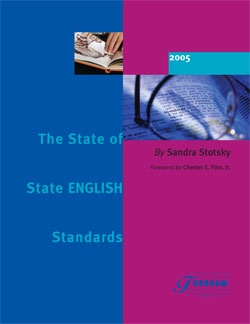
The State of State English Standards 2005

Chester E. Finn, Jr., Sandra Stotsky

Do states' current English/language arts and reading standards expect what they should? Are they demanding enough? Clear enough? Are states using them to guide not only the curriculum and assessment system for students but also their teacher-training programs? Sandra Stotsky, research scholar at Northeastern University and former senior associate commissioner in the Massachusetts Department of Education, finds that most states have revised or replaced their standards since 2000 and made some improvements, especially to K-8 standards. However, major shortcomings remain in other areas including high school literature requirements.

Report
12.3.2004
Governance

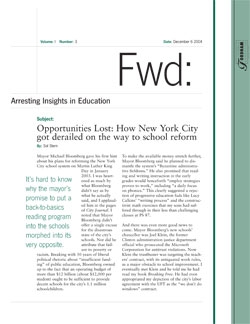
Fwd: Opportunities Lost: How New York City got derailed on the way to school reform

Sol Stern

How did New York City's experiment in school reform, once so promising, become such a mess? Author Sol Stern explains in this third edition of Fordham's new Fwd: series of short articles of interest to K-12 education reformers.

Report
9.29.2004
Curriculum & Instruction

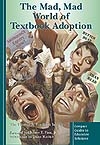
The Mad, Mad World of Textbook Adoption

Chester E. Finn, Jr., Diane Ravitch

Statewide textbook adoption, the process by which 21 states dictate the textbooks that schools and districts can use, is fundamentally flawed. It distorts the market, entices extremist groups to hijack the curriculum, enriches the textbook cartel, and papers the land with mediocre instructional materials that cannot fulfill their important education mission. Tinkering with it won't set it right, concludes this latest Fordham Institute report. Legislators and governors in adoption states should eliminate the process, letting individual schools, individual districts, or even individual teachers choose their own textbooks.

Report
9.7.2004
Charter Schools, Private School Choice, Teachers & School Leaders

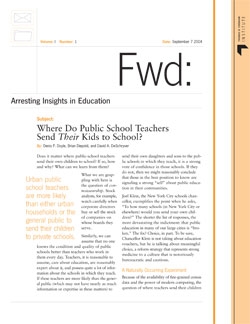
Fwd: Where Do Public School Teachers Send Their Kids to School?

Brian Diepold, Denis P. Doyle, David A. DeSchryver

Does it matter where public-school teachers send their own children to school? If so, how and why? What can we learn from them?

Report
4.13.2004
Curriculum & Instruction

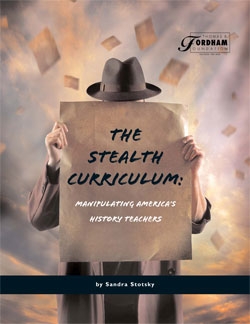
The Stealth Curriculum: Manipulating America's History Teachers

Sandra Stotsky

Widely used supplemental materials may be dangerous to educational health! These works often include hefty doses of political manipulation and ideological bias, courtesy of their authors. This study casts a wary glance toward materials that seldom come under scrutiny. This study is the fifth in a series dedicated to reforming social studies education.

Report
2.26.2004
Curriculum & Instruction

A Consumer's Guide to High School History Textbooks

Diane Ravitch

A Consumer's Guide to High School History Textbooks is a summary review of 12 widely used U.S. and world history textbooks.

Report
1.30.2004
Accountability & Testing, Standards

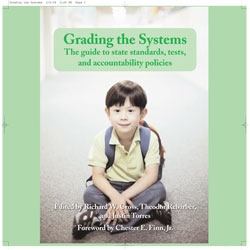
Grading the Systems: The guide to state standards, tests, and accountability policies

Chester E. Finn, Jr., Richard W. Cross, Theodor Rebarber

Co-published by the Thomas B. Fordham Foundation and AccountabilityWorks, with support from the Smith Richardson Foundation, this report looks at six elements of K-12 accountability systems in 30 different states. Each state is rated on standards, test content, alignment of tests to standards, test rigor, testing trustworthiness and openness, and accountability policies. The major conclusion: while some states have the basis of a sophisticated and rigorous accountability system in place, no state has every element of a serious standards-based education reform package in place. And few states are as open to evaluation as they ought to be.

Pagination

  • First page « First
  • Previous page ‹ Previous
  • Page 1
  • Page 2
  • Page 3
  • Page 4
  • Page 5
  • Page 6
  • Current page 7
  • Page 8
  • Page 9
  • Next page Next ›
  • Last page Last »

Type

  • Book (10)
  • Commentary (17478)
  • Event (51)
  • Podcast (380)
  • (-) Report (258)
  • Video (98)

Topics

  • Accountability & Testing (44)
  • Advanced Education (15)
  • Career & Technical Education (4)
  • Charter Schools (45)
  • Curriculum & Instruction (34)
  • ESSA (6)
  • Evidence-Based Learning (4)
  • Governance (78)
  • Personalized Learning (4)
  • Private School Choice (8)
  • School Finance (30)
  • Standards (49)
  • Teachers & School Leaders (37)

Date

  • 2026 (8)
  • 2025 (7)
  • 2024 (8)
  • 2023 (9)
  • 2022 (5)
  • 2021 (7)
  • 2020 (6)
  • 2019 (7)
  • 2018 (7)
  • 2017 (9)
  • 2016 (8)
  • 2015 (4)
  • 2014 (13)
  • 2013 (18)
  • 2012 (17)
  • 2011 (19)
  • 2010 (7)
  • 2009 (9)
  • 2008 (11)
  • 2007 (7)
  • 2006 (9)
  • 2005 (9)
  • 2004 (7)
  • 2003 (9)
  • 2002 (4)
  • 2001 (8)
  • 2000 (9)
  • 1999 (5)
  • 1998 (11)
  • 1997 (1)
Fordham Logo

© 2026 The Thomas B. Fordham Institute
Privacy Policy
Usage Agreement

National

P.O. Box 110
Burke, VA 22009

202.223.5452

[email protected]

Ohio

P.O. Box 82291
Columbus, OH 43202

614.223.1580

[email protected]

Sponsorship

130 West Second Street, Suite 410
Dayton, Ohio 45402

937.227.3368

[email protected]