Mobile Navigation

  • National
    • Policy
      • High Expectations
      • Quality Choices
      • Personalized Pathways
    • Research
    • Commentary
      • Gadfly Newsletter
      • Gadfly Podcast
      • Flypaper Blog
      • Events
    • Covid-19
    • Scholars Program
  • Ohio
    • Policy
      • Priorities
      • Media & Testimony
    • Research
    • Commentary
      • Ohio Education Gadfly Biweekly
      • Ohio Gadfly Daily
  • Charter Authorizing
    • Application
    • Sponsored Schools
    • Resources
    • Our Work in Dayton
  • About
    • Mission
    • Board
    • Staff
    • Career
Home
Home
Advancing Educational Excellence

Main Navigation

  • National
  • Ohio
  • Charter Authorizing
  • About

National Menu

  • Topics
    • Accountability & Testing
    • Career & Technical Education
    • Charter Schools
    • Curriculum & Instruction
    • ESSA
    • Evidence-Based Learning
    • Facilities
    • Governance
    • High Achievers
    • Personalized Learning
    • Private School Choice
    • School Finance
    • Standards
    • Teachers & School Leaders
  • Research
  • Commentary
    • Gadfly Newsletter
    • Flypaper Blog
    • Gadfly Podcast
    • Events
  • COVID-19
  • Scholars Program
High Expectations

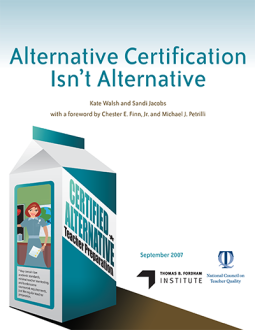
Alternative Certification Isn't Alternative

Kate WalshSandi Jacobs
Foreword by:
Chester E. Finn, Jr.
Diane Ravitch
9.18.2007
9.18.2007

At first glance, the explosive growth of "alternative" teacher certification--which is supposed to allow able individuals to teach in public schools without first passing through a college of education--appears to be one of the great success stories of modern education reform. From negligible numbers twenty years ago, alternatively prepared candidates now account for almost one in five new teachers nationwide. That's a "market share" of nearly 20 percent. As longtime supporters of alternative certification, we should be popping champagne, declaring victory, and plotting our next big win, right? Not so fast. As the old cliché says, if it looks too good to be true, it probably is.

"Alternative Certification Isn't Alternative" reveals that alternative certification programs, contrary to their original mission, have not provided a real alternative to traditional education schools. In fact, they represent a significant setback for education reform advocates.

Here are the report's main points:

  • Entry standards are abysmally low: Two-thirds of the programs surveyed accept half or more of their teacher applicants; one-quarter accept virtually everyone who applies.
  • Rather than providing streamlined and effective coursework, about a third of the programs require at least 30 hours of education school courses-the same amount needed for a Master's degree.
  • Most disturbing, nearly 70 percent of alternative programs studied in the report are run by education schools themselves. Education schools have kept their market monopoly by moving into the alternative certification business.

In short, policymakers, reform advocates, and philanthropists who think they have "won" the battle in favor of alternative certification should think again. Twenty-five years later, concerns about the quality of education schools remain--as does the need for bona fide alternatives: swifter, better, surer, cheaper ways to address teaching aspirations on the one hand and workforce quality and quantity problems on the other. So put away the champagne. Much heavy lifting lies ahead.
Related Resources

In A Nutshell brief of the report


Policy Priority:
High Expectations
Topics:
Governance
Teachers & School Leaders
DOWNLOAD PDF

Kate Walsh is president of the National Council on Teacher Quality (NCTQ). Prior to NCTQ, Walsh worked extensively on education reform in both the public and private sectors, including, The Abell Foundation, Baltimore City Public Schools, the Core Knowledge Foundation and as founder and director of The Baraka School, an internationally recognized boarding school in Kenya established to educate at-risk boys from…

View Full Bio

Sandi is Vice President for Policy at the National Council on Teacher Quality. Most recently she worked at the U.S. Department of Education as a Senior Education Program Specialist for the Reading First and Comprehensive School Reform Demonstration programs. Prior to that, she taught 4th and 5th grade for nearly a decade at Public School 9 in Brooklyn. Ms. Jacobs was a Presidential Management Intern and a charter corps…

View Full Bio

Related Resources

view
High Expectations

America’s Best and Worst Metro Areas for School Quality

Thomas B. Fordham Institute12.8.2021
NationalReport
view
High Expectations

America’s Best and Worst Metro Areas for School Quality

Thomas B. Fordham Institute12.8.2021
NationalReport
view
High Expectations

America’s Best and Worst Metro Areas for School Quality

Thomas B. Fordham Institute12.8.2021
NationalReport
Fordham Logo

© 2020 The Thomas B. Fordham Institute
Privacy Policy
Usage Agreement

National

1016 16th St NW, 8th Floor 
Washington, DC 20036

202.223.5452

[email protected]

  • <
Ohio

P.O. Box 82291
Columbus, OH 43202

614.223.1580

[email protected]

Sponsorship

130 West Second Street, Suite 410
Dayton, Ohio 45402

937.227.3368

[email protected]