Commentary
Teachers & School Leaders
Teacher outs Trump official for being a loner and eating glue—in the third grade
By Erika Sanzi
By Erika Sanzi

On this week’s podcast, Jim Shelton, who is about to step down from the helm of the Chan Zuckerberg Initiative’s education efforts, joins Mike Petrilli and David Griffith to discuss the whole-child approach to personalized learning. On the Research Minute, Amber Northern examines how coaching programs affect teachers’ instructional practices and student achievement.
On this week's podcast, Ben Castleman, an assistant professor at the University of Virginia, and Ethan Fletcher, a managing director at ideas42, join Mike Petrilli and David Griffith to discuss Ben and Ethan’s collaborative project to improve college access and completion, Nudges, Norms, and New Solutions. On the Research Minute, Amber Northern looks at nudges, too, in this case the role of information and incentives in getting students to fill out their FAFSA forms.
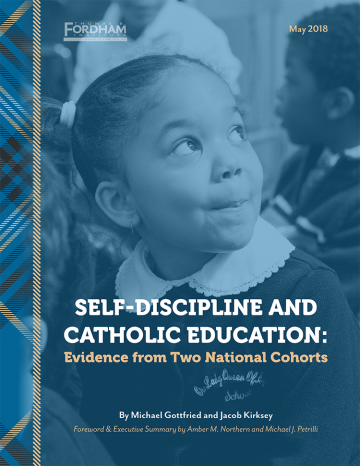
Regardless of where you stand on the debate currently raging over school discipline, one thing seems certain: Self-discipline is far better than the externally imposed kind.
STEM education is, by design, integrative. It strives to emulate the real-world work of engineers within a teaching environment.
On this week's podcast, Roberto Rodríguez, president and CEO of Teach Plus, joins Mike Petrilli and Alyssa Schwenk to discuss race and poverty in education. During the Research Minute, David Griffith examines whether authorizers are making it harder for people of color to win charter contracts.
Louisiana gets a ton of education-related attention, most of it focused on the Recovery School District and the proliferation of charter schools in New Orleans. While these reforms are certainly worth a close look, it’s the state’s quieter efforts on curriculum that may be truly changing the game for students and teachers.
Schools have long failed to cultivate the innate talents of many of their young people, particularly high-ability girls and boys from disadvantaged and minority backgrounds. This failure harms the economy, widens income gaps, arrests upward mobility, and exacerbates civic decay and political division.

To give some added oomph to excellent teacher preparation, the Council of Chief State School Officers launched the Network for Transforming Educator Preparation (NTEP) in 2013. Its purpose is to identify states with track records of innovative teacher preparation and support them in their efforts to implement aggressive and lasting improvements.
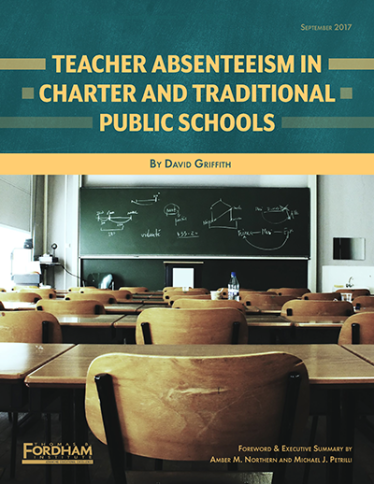
Research confirms what common sense dictates: Students learn less when their teachers aren’t there. According to multiple studies, a ten-day increase in teacher absence results in at least ten fewer days of learning for students.
On this week's podcast, special guest Constance A. Lindsay, a research associate at the Urban Institute, joins Mike Petrilli and Brandon Wright to discuss New York City’s controversial new plan to use its Absent Teacher Reserve Pool to fill its teacher vacancies. During the Research Minute, Amber Northern examines an imperfect study of classrooms’ use of technology.
On this week's podcast, special guest Thomas Toch, director of FutureEd at Georgetown University, joins Mike Petrilli and Alyssa Schwenk to discuss teacher reform in Washington, D.C. During the Research Minute, Amber Northern examines how well principals’ evaluations differentiate teacher performance.
On this week's podcast, special guest Joshua Starr, CEO of Phi Delta Kappa International, joins Mike Petrilli and Alyssa Schwenk to discuss Fordham's new report What Teens Want From Their Schools: A National Survey of High School Engagement. During the Research Minute, Amber Northern examines early results from Joseph Waddington's and Mark Berends's ongoing study of the Indiana Choice Scholarship Program.
On this week's podcast, special guest Eric Eagon, a senior director at the PIE Network, joins Mike Petrilli and Alyssa Schwenk to discuss why policymakers ought to pay more attention to teachers and administrators. During the Research Minute, Amber Northern examines the peer effects of computer-assisted learning.
If you want a good cry mixed in with some inspiration, watch noted human rights lawyer and activist Bryan Stevenson give a searing account of bias against the poor and young men of color in a TED Talk about an Injustice.

A new teacher’s pension is supposed to be a perk. The truth is that for the majority of the nation’s new teachers, what they can anticipate in retirement benefits will be worth less than what they contributed to the system while they were in the classroom, even if they stay for decades.
Countless studies have demonstrated that teacher quality is the most important school-based determinant of student learning, and that removing ineffective teachers from the classroom could greatly benefit students.
In Common Core Math in the K-8 Classroom: Results from a National Teacher Survey, Jennifer Bay Williams, Ann Duffett, and David Griffith take a close look at how educators are implementing the Common Core math standards in classrooms across the nation.

Whether the goal is to enhance instruction, create a culture of excellence, or broaden education options for parents, it’s nearly impossible to improve schools without strong leaders. This is hardly news; much evidence has indicated the importance of effective principals for decades.

Over the past decade, the English government has revamped that country’s approach to school leadership. At the center of the reform is the sensible idea that school leadership needs to be a team endeavor. While not a new idea—there’s been for years plenty of discussion about “distributed leadership” on both sides of the pond—the Brits got busy actually making it happen as opposed to jawboning about it. Central to their leadership structure is the formalization of three levels of school leaders, each with distinct roles and responsibilities: headteachers who lead schools (equivalent to the principal’s role in the U.S.), senior leaders or deputy heads who assist the headteacher (similar to the vice principal role in American education but...

The number of non-teaching staff in the United States (those employed by school systems but not serving as classroom teachers) has grown by 130 percent since 1970. Non-teachers—more than three million strong—now comprise half of the public school workforce. Their salaries and benefits absorb one-quarter of current education expenditures.
A school’s leader matters enormously to its success and that of its students and teachers. But how well are U.S. districts identifying, recruiting, selecting, and placing the best possible candidates in principals’ offices? To what extent do their practices enable them to find and hire great school leaders? To what degree is the principal’s job itself designed to attract outstanding candidates?
In the overwhelming majority of American classrooms, pupils are divided roughly equally among teachers of the same grade in the same school. Parceling them out uniformly is viewed as fair to teachers—and doing otherwise might be seen as unfair. Parents might wonder, too.

At first glance, the recent teacher-retirement reforms in Ohio seem to bring good fiscal news to school systems in the Buckeye State. Thanks to Senate Bills 341 and 342—and a series of cutbacks on retiree healthcare—the Cleveland Metropolitan School District is projected to spend less on retirement costs in 2020 than it does today. But these reforms come at a big price.

One of three technical reports on retirement costs and school-district budgets.

This new policy brief by Nathan Levenson, Managing Director at the District Management Council and former superintendent of Arlington (MA) Public Schools, offers informed advice to school districts seeking to provide a well-rounded, quality education to all children in a time of strained budgets. Levenson recommends three strategies: prioritize both achievement and cost-efficiency; make staffing decisions based on student needs, not student preferences; and manage special-education spending for better outcomes and greater cost-effectiveness.

This timely study represents the most comprehensive analysis of American teacher unions’ strength ever conducted, ranking all fifty states and the District of Columbia according to the power and influence of their state-level unions.

This report, authored by Superintendent Mike Miles, takes a detailed look at the Harrison (CO) School District 2's Pay-for-Performance Plan. The Harrison Plan confronted the dual challenges of defining an effective teacher and identifying all the things that demonstrate her effectiveness. This how-to guide is meant to serve as a tool and model for Ohio’s school districts.
Will the move toward virtual and “blended learning” schools in American education repeat the mistakes of the charter-school movement, or will it learn from them? The Thomas B. Fordham Institute, with the support of the Charles and Helen Schwab Foundation, has commissioned five deep-thought papers that, together, address the thorniest policy issues surrounding digital learning. The goal is to boost the prospects for successful online learning (both substantively and politically) over the long run.