Whether the goal is to enhance instruction, create a culture of excellence, or broaden education options for parents, it’s nearly impossible to improve schools without strong leaders. This is hardly news; much evidence has indicated the importance of effective principals for decades. Yet reform strategies have largely lacked a coherent plan to upgrade leadership, even though it’s clearly a fundamental piece of the school improvement puzzle. This neglect is likely unintentional. Many states simply don’t know how to strengthen their cadre of leaders.
This is understandable. Most of the action around school leadership happens at the local level, far from state capitals. It is, after all, districts (and charter schools) that recruit, select, and place school leaders, and develop their expertise (or not). It’s easy for state officials and advocacy groups to prioritize leadership. Knowing which policy levers to pull is a lot harder.
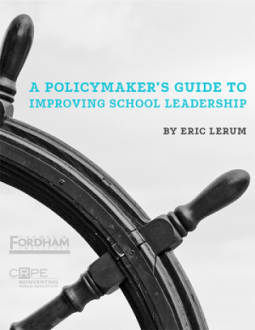
That’s where A Policymaker's Guide to Improving School Leadership comes in. This online resource was designed to help policymakers and advocates focus on what makes a great principal—and how to get more of them in the schools that need them most.
We teamed up with our friends at the Center on Reinventing Public Education (CRPE) to produce the toolkit and recruited author Eric Lerum—an experienced education reform analyst and advocate—to generate the content.
Explore the website to see how states are developing their own strategies to strengthen leadership, as well as model legislation drafted by experts in the field.
The solutions presented in A Policymaker's Guide to Improving School Leadership are organized around five key policy areas:
- Pathways and Pipelines – How do principals become principals? What do preparation programs look like? What does it take to become a principal? How do districts and schools grow and recruit school leaders? How can states influence all of this for the better?
- Distributed Leadership – How can teachers lead from within their schools? How can principals delegate some of their authority to teachers? What role might states play?
- Autonomy and Empowerment – What authority do principals have to make decisions regarding personnel and budgets? Are principals empowered to move quickly and flexibly to meet the needs of their students, educators, and families? Which state policies might be standing in the way?
- Principal Evaluation – How are principals evaluated by district leaders? Is their performance measured by multiple indicators of school success, including the student progress and staff growth and satisfaction? Should states encourage a particular approach?
- Retention and Compensation – How are districts incentivizing the best principals to continue to lead? Do districts have the flexibility and tools to make school leadership an attractive long-term career prospect? How can states help?
Have we piqued your interest? You can find A Policymaker's Guide to Improving School Leadership here.
Additional resources:
- Quality in Adversity: Lessons from Ohio's best charter schools (Fordham Institute, 2016)
- Lacking Leaders: The Challenges of Principal Recruitment, Selection, and Placement (Fordham Institute, 2014)
- Missing Out on Strong School Leaders? A Survey of Principal Hiring and Support in Washington State (CRPE, 2014)
- Principal Concerns: Leadership Data and Strategies for States (CRPE, 2012)