Mobile Navigation

  • National
    • Policy
      • High Expectations
      • Quality Choices
      • Personalized Pathways
    • Research
    • Commentary
      • Gadfly Newsletter
      • Flypaper Blog
    • Events
    • Scholars Program
  • Ohio
    • Policy
      • Priorities
      • Media & Testimony
    • Research
    • Commentary
      • Ohio Education Gadfly Biweekly
      • Ohio Gadfly Daily
  • Charter Authorizing
    • Application
    • Sponsored Schools
    • Resources
  • About
    • Mission
    • Board
    • Staff
    • Career
Home
Home
Advancing Educational Excellence

Main Navigation

  • National
  • Ohio
  • Charter Authorizing
  • About

National Menu

  • Topics
    • Accountability & Testing
    • Advanced Education
    • Career & Technical Education
    • Charter Schools
    • Curriculum & Instruction
    • ESSA
    • Evidence-Based Learning
    • Facilities
    • Governance
    • Personalized Learning
    • Private School Choice
    • School Finance
    • Standards
    • Teachers & School Leaders
    • Think Again
  • Research
  • Commentary
    • Gadfly Newsletter
    • Flypaper Blog
    • Gadfly Podcast
  • Events
  • Scholars Program

The Education Gadfly Weekly

Sign Up to Receive Fordham Updates

We'll send you quality research, commentary, analysis, and news on the education issues you care about.
Thank you for signing up!
Please check your email to confirm the subscription.

The Education Gadfly Weekly: The swirling private-school universe

Volume 22, Number 28
7.7.2022
7.7.2022

The Education Gadfly Weekly: The swirling private-school universe

Volume 22, Number 28
view
High Expectations

The swirling private-school universe

The universe of private elementary-secondary schooling in America today is diverse and confusing, with innumerable twists and turns in efforts to use public funds to help families access schools that suit them—including private schools of all colors and stripes. But the virtue of these institutions is that they’re different, which also means very different from each other. Which complicates the quest to deploy public dollars to assist families to choose them.

Chester E. Finn, Jr. 7.7.2022
NationalFlypaper

The swirling private-school universe

Chester E. Finn, Jr.
7.7.2022
Flypaper

Hope and progress for gifted education

Brandon L. Wright
7.6.2022
Flypaper

On the persistence of the achievement gap

David Armor
7.7.2022
Flypaper

Investing in the teacher workforce

Jessica Poiner
7.5.2022
Ohio Gadfly Daily

Does keeping students with the same teacher for multiple years boost outcomes?

Nathaniel Grossman
7.7.2022
Flypaper

The Education Gadfly Show #827: The debate over “no zeroes” grading policies

7.5.2022
Podcast

Cheers and Jeers: July 7, 2022

The Education Gadfly
7.7.2022
Flypaper

What we're reading this week: July 7, 2022

The Education Gadfly
7.7.2022
Flypaper
view

Hope and progress for gifted education

Brandon L. Wright 7.6.2022
Flypaper
view

On the persistence of the achievement gap

David Armor 7.7.2022
Flypaper
view
Investing in teachers SR image

Investing in the teacher workforce

Jessica Poiner 7.5.2022
Ohio Gadfly Daily
view

Does keeping students with the same teacher for multiple years boost outcomes?

Nathaniel Grossman 7.7.2022
Flypaper
view

The Education Gadfly Show #827: The debate over “no zeroes” grading policies

Michael J. Petrilli, Daniel Buck, Amber M. Northern, Ph.D. 7.5.2022
Podcast
view

Cheers and Jeers: July 7, 2022

The Education Gadfly 7.7.2022
Flypaper
view

What we're reading this week: July 7, 2022

The Education Gadfly 7.7.2022
Flypaper
view

The swirling private-school universe

Chester E. Finn, Jr.
7.7.2022
Flypaper

The Supreme Court’s 6-3 decision in Carson v. Makin, telling Maine it must not deny tuition assistance to families solely because the private schools they choose are religious, may not make a huge difference on the ground in the Pine Tree State, since liberal legislators had already inserted a “poison bill” into the law authorizing such aid. They now deny “town tuitioning” payments to any private school, secular or sectarian, that discriminates on the basis of gender identity and sexual orientation.

That constraint hasn’t fazed the several dozen secular private schools—mostly small and in small towns—that already participate. It likely won’t cause indigestion for some of Maine’s religious schools. But it’s apt to prove unacceptable to the two conservative Christian schools whose religiousness is what kicked off the lawsuit. They’ve signaled that they won’t take the money if it means changing their curricula or admission standards.

Welcome to the complicated universe of private elementary-secondary schooling in America circa 2022 and the innumerable twists and turns of efforts to use public funds to help families access schools that suit them.

It’s a big universe, too: more than 30,000 schools (in 2019)—roughly one-fourth the total—enrolling some 4.7 million pupils (9 percent) and employing half a million teachers. Charter schools and homeschooling are coming on strong, but private schools still offer the most options.

This sector is far older than public education and infinitely more varied, such that bean counters have difficulty even sorting its schools into coherent categories.

The latest big federal survey (2015) reported that “Sixty-seven percent of private schools, enrolling 78 percent of private school students...had a religious orientation or purpose.”

The one-third that are secular contains most of America’s big-name prep schools and upscale “independent” schools. But it also contains thousands of “special education” schools for youngsters with disabilities, with attendance often paid by their school districts, as well as thousands of “special emphasis” schools that range from Montessori to science, from agriculture to giftedness.

On the far larger sectarian side, subcategories proliferate, as do vast differences in scale. The 2015 survey reported twenty-eight different groupings plus 304 schools described as religious but fitting into none of the groups.

Much the largest, as has been true for more than a century, are Roman Catholic schools, of which there were 7,000, enrolling almost two-fifths of all private school pupils. But Catholic schools have been closing for decades and their enrollment share has slowly eroded. In 1993 for example, statisticians counted 2,300 more schools than in 2015. As for pupils, the number in Catholic schools in 2019 (1.7 million) was down 15 percent from ten years earlier.

The second biggest religious-school cluster in 2015 was the messy category dubbed “Christian” schools. Perhaps surprisingly, it does not include such traditional denominations as Episcopal (354 schools), Methodist (289), Presbyterian (323), Adventist (795), Baptist (1863), or Lutheran (several flavors, totaling about 1,500). It certainly doesn’t include Jewish schools (1,120) or Islamic (293). And it’s unclear where to place Amish schools—a whopping 2,105, say the enumerators, but with cautions about data reliability.

The “Christian” category numbers about 6,000 schools and has been expanding, by some gauges expanding as fast as the Catholic sector has shrunk. It incorporates vast, multi-campus school empires, as well as tiny institutions with just a couple of teachers. What they have in common, above all, is that, along with religious instruction and religious formation, they strive to buttress the beliefs, principles, and morals of parents who seek them out. Overwhelmingly, that means conservative.

Parents who opt for any form of private education for their daughters and sons ordinarily seek something different from—and often better than—what’s on offer in local public schools. Safety is frequently a consideration, as, sometimes, is having classmates who look like their kids.

Those who opt for sectarian schools typically also seek to instill a belief system and religious observance in their children. (Not always. For inner-city families, the local parochial school may be the only—or only affordable—alternative to dire neighborhood schools. Hence many thousands of non-Catholic Black children attend Catholic schools.)

But when choosing Christian schools in particular, along with the usual motives, parents often search for escape and protection from the “wokeness,” political correctness, amorality, and Godlessness that they observe in other schools, both public and private. It’s no surprise, then, that schools with a mission to serve such families may run afoul of government rules, prohibitions, and watchdogs.

Such issues can arise even when little or no money is on the table, as states conventionally license private schools even to operate and be recognized as places that satisfy compulsory-attendance laws for children. This gets really gnarly in the homeschool sector but presents challenges for some schools, too. Ohio, for example, (confusingly) “charters” private schools, a designation that brings many benefits, including potential access to the Buckeye State’s several voucher programs. But state chartering is optional in cases of “truly held religious beliefs,” and Ohio’s list of “non-chartered, non-tax supported” schools numbers 500-plus. These are schools (or sometimes home-schoolers calling their kitchen tables schools) willing to forego all public recognition and aid in order to avoid all forms of government entanglement.

Some of these schools are miniscule, others substantial. The Agape Christian Academy, for example, enrolls some 250 pupils from kindergarten through high school on two campuses. Its stated mission is “To work together with the home and church to provide each student with a Christ centered, quality education.”

Such schools are admonished by the state to abide by core norms, such as obeying fire laws and promoting only students “who have met the school’s educational requirements.” But it’s all self-reported. Rarely do state officials check. And there’s little they can do about miscreants.

Ohio’s list of “chartered” private schools has 729 entries, ranging from Cleveland’s posh Western Reserve Academy to the eight-one-pupil St. Mary of the Assumption elementary school in little Van Wert on the Indiana border. A whopping 588 of those schools took part this past year in at least one voucher program—but 141 did not.

Reasons vary. Some schools don’t need the money or don’t have room for more pupils. Some have exotic specialties or idiosyncratic admissions requirements. But others simply prefer to avoid the additional entanglements that come with the king’s shilling, even though Ohio rules with a fairly light hand and is relaxed about religious schools.

It’s one of thirty-one states, predominantly red and purple, that, according to the American Federation for Children, now have at least one “private school choice program”—a number that omits Maine and Vermont with their century-old “tuitioning” options for towns too small to operate their own public schools. Not all such programs are “publicly funded” in the usual sense, as the “tax credit” versions simply reduce monies that would otherwise enter government coffers. But almost none is unrestricted. Some voucher programs, such as Florida’s pioneering “Mackay Scholarships,” are entirely for youngsters with disabilities. And many programs are means-tested, such that families qualify only if their income falls below a prescribed threshold.

For school-choice supporters, recent decades have seen huge progress. But the strings are tighter in some jurisdictions than others, and thousands of private schools, including many with precarious finances, insist on minimizing government entanglements, particularly any that bear on curriculum, admissions, and employment. For them, those end-of-year state tests of reading and math are anathema. So are non-discrimination rules that they fear may oblige them (for instance) to teach children about transgenderism or the race-tinged “1619 project.” It can be important to a sectarian school to hire only co-religionists. And more.

Yes, it’s a diverse and confusing universe. But the virtue of private schools is that they’re different. And that means very different from each other, too.

view

Hope and progress for gifted education

Brandon L. Wright
7.6.2022
Flypaper

Editor’s note: This is the first edition of “Advance,” a new newsletter from the Thomas B. Fordham Institute that will be written by Brandon Wright, our Editorial Director, and published every other week. Its purpose is to monitor the progress of gifted education in America, including legal and legislative developments, policy and leadership changes, emerging research, grassroots efforts, and more. You can subscribe on either the Fordham Institute website or the newsletter’s Substack.

The case for gifted education—or advanced education, honors education, or whatever one decides to call it—is simple. Every student deserves educational experiences that help them reach their full potential. Some children, due to high achievement, ability, or potential, require something more than can be provided in the average classroom geared toward the average student. Schools should therefore offer distinctive and high-quality advanced programs and services for those who would benefit from them. These students come from every racial, ethnic, and socioeconomic background, so for American education to fail in this regard is to fail some of the country’s most marginalized children.

Yet failure has tended to be the norm for decades, most notably for those very children. One-third of schools don’t devote any time or effort, during school, after school, or on the weekend, to their gifted students. Among those that do, “programs” may be nothing more than meager supplements that are unlikely to make much of a difference to achievement. In schools that manage to offer more robust programming, the staff often consists of teachers who have not been trained to educate these students. And regardless of whether schools avoid all the preceding pitfalls, virtually all under-identify and therefore under-serve low-income, Black, Hispanic, and Native American children.

But glimmers of hope are appearing on the gifted horizon. Through self-reflection, high-quality research, external pressure, and on-the-ground work, the field is improving. And that ongoing progress—tracking it, celebrating it, examining it, critiquing it when it runs afoul—is what this new newsletter is about.

Future issues, to be published every other week, will also be shaped by my experiences in the field. I’ve been writing about and researching gifted education for a decade, including a 2016 book coauthored with Chester Finn, a handful of reports for the Fordham Institute, and scores of editorials and policy articles in newspapers and education outlets. I’m also a consumer. As a child, I participated in a substantial—and, as I know now, very rare—full-time pullout program between fourth and eighth grade, wherein I was grouped with other advanced students for almost all instruction, complete with different teachers, specialized curricula, and faster and deeper instruction. This program was especially formative for me, in many good and a few bad ways, and it prompted my lasting interest in this realm of K–12 education.

All this experience solidified in me two simple truths about gifted education: It is a clear and substantial good, and it can be much better than it is in most places and has been for decades. Two recent developments have given me hope that many others are coming to believe this, too. They suggest that high-quality advanced programs will persist in America and, just as importantly, that they will serve more of the children who would benefit from them—and deserve to benefit from them—especially kids from underserved backgrounds. The first development happened in San Francisco last month. The second took place over Zoom last week.

During the pandemic, San Francisco’s school board voted to suspend merit-based admissions at Lowell High School, the area’s most prestigious institution, and install a lottery-based system that was open to all students. Many residents, especially Asian-American voters, were incensed by the decision. And earlier this year, driven in no small part by the Lowell reform, the city overwhelmingly voted to recall three school board members, with more than 70 percent supporting each member’s ouster.

Last month, those efforts bore fruit when the board voted 4-3 to reinstate the school’s merit-based system, meaning entry will again be determined by applicants’ grades and test scores. Important, too, was the board majority’s commitment to, as the San Francisco Chronicle reported, “confront the real equity problems in the district while also supporting academic excellence.” Hispanic and Black students make up 12 percent and 2 percent of Lowell students, respectively, despite those figures being 28 percent and 6 percent citywide. So leaders have significant work to do in identifying many more of the marginalized students who would benefit from what Lowell has to offer—even if a majority of its present pupils are Asian-Americans, a marginalized population in its own right. For this to succeed, they should start well before it’s time to apply to Lowell. As my colleague Mike Petrilli has shown, the achievement and instructional gaps that lead to discrepancies in these programs open as early as kindergarten, and the more they widen the harder they are to overcome.

The second development, which occurred over Zoom, was the second meeting of the National Working Group on Advanced Education. There’s twenty of us, including academics, practitioners, and advocates, and we’re truly diverse in terms of ideology, race, gender, and geography. In this second of four gatherings, we covered four topics: supports for advanced students who are Black, Hispanic, and/or low-income; support for educators of advanced students; high-quality instructional materials; and how best to use ability or achievement grouping. (A full summary will soon be published on Fordham’s website.)

For a very long time, gifted education has been both excessively standardized and exclusive. It has generally erred in considering “giftedness” to be an inherent trait that a student either has or doesn’t, and it has treated it as applying to virtually all academic subjects, regardless of each child’s unique strengths and weaknesses. This has caused at least two significant problems. One is that students who are advanced in a given subject but aren’t, according to the school, “gifted” have been excluded from whatever passes for gifted programming in that subject. The second is that schools and their identification procedures for these offerings have been, almost everywhere, plagued by bias against students who are Black, Hispanic, low-income, and come from other underserved backgrounds. Many children from these populations who could and should enjoy the benefits of these programs have therefore been excluded—or at least never been sought out and included.

Everyone in our group agreed that these are problems that need to be solved. But members also offered ample evidence that efforts are already underway to chip away at them. They talked, for example, of a push toward a personalized “continuum of services” that replaces binary “gifted or not” thinking. This attempts to give individual students what they need in each academic subject. As the National Association for Gifted Children explains, these services range from students receiving services in regular classrooms, to learning in a mix of regular classes and some advanced ones, to being grouped most of the time with other advanced students, to skipping grades entirely.

Other members also summarized fantastic work in transforming gifted education so it better supports, identifies, and retains students from underserved backgrounds. For example, one member explained how he and colleagues had taken an off-the-shelf program for advanced students and made it culturally relevant. In a low-performing school that predominately served Black students from a low-income community, they took an afterschool math program and paired it with basketball, which they designed specifically for Black males. Combining the activities in this manner helped the school increase the number of Black students identified as gifted from four to thirty-five in just four years.

The working group member said this worked, in part, because early success helped alleviate teachers’ “gifted referral fatigue.” This is a term coined by Dr. Tarek Grantham, a professor at the University of Georgia and a member of that working group, that represents his observations of teacher referral patterns. For years, educators had seen potential in many of their Black male students and referred them to gifted programming, but they kept being rejected, so the referrals ceased. It also helped students who started the program stick with it because it offset the effects of “stereotype threat.” This is where a person’s performance in a given situation is hindered by negative stereotypes about the abilities of that person’s groups. Black males, the member said, were worried about how they’d perform or what their peers would think of them. The work done by the program leaders to ease these concerns helped them retain more students and ensure that they kept receiving its benefits.

It's wonderful and striking that, in America as we pass Independence Day 2022, such a diverse group can agree on a unified way to accomplish so many things: getting more schools to adopt more gifted education services, especially those that educate marginalized populations; ensuring that such services are high quality and flexible and meet individual student needs; making those services more inclusive by offering them to every child who may realistically benefit; communicating all of this in a manner that emphasizes the benefits for those from underserved backgrounds; and implementing culturally responsive adaptations so as to much better prepare, identify, retain, and support marginalized students in advanced programs.

Gifted education is a fine thing when done well. For far too long, it hasn’t been. But with support for maintaining it in places as progressive as San Francisco, as well as a bipartisan vision for doing it better everywhere and for students of all backgrounds, there is hope that the progress already underway will continue.

Future editions of the newsletter will give updates on how that progress is going, including legal and legislative developments, policy and leadership changes, emerging research, grassroots efforts, and more. If you have any ideas, leads, questions, or concerns, please email me at [email protected]. My hope is that we can help advance this field together.

—

QUOTE OF NOTE

“‘[Success] doesn’t make us unhappy,’ Dr. Lubinski said. ‘People who choose to be highly successful in their careers shouldn’t worry that they’re putting themselves at risk for medical or psychological harm.’ This might sound intuitive to anyone other than Freud. Of course success doesn’t make us unhappy! But what’s remarkable is how counterintuitive it happens to be.”

—“The happiness data that wrecks a Freudian theory.” The Wall Street Journal, Ben Cohen, June 30, 2022.

—

THREE RECENT STUDIES TO STUDY

  • “The Challenges of Achieving Equity Within Public School Gifted and Talented Programs,” by Scott J. Peters. Gifted Child Quarterly, Volume 66, Issue 2, 2022.
    “K–12 gifted and talented programs have struggled with racial, ethnic, socioeconomic, native language, and disability inequity since their inception... The purpose of this article is to outline why such inequity exists and why common efforts to combat it have been unsuccessful. In the end, poorly designed identification systems combined with larger issues of societal inequality and systemic, institutionalized racism are the most likely culprits.”

  • “Reflections on Experiences at a Residential Science and Math High School: An Alumni Survey,” by Hope E. Wilson. Journal for the Education of the Gifted, Volume 44, Issue 4, 2021.
    “This study examines the results of a retrospective survey from one [residential science high school that focuses on science, technology, engineering, and mathematics], including alumni for more than 20 years after graduation. The results indicate that the alumni have high levels of educational attainment and careers in STEM fields. In addition, the alumni perceive their experiences at the RSHS to have been positive, and that the RSHS prepared them for their educational pursuits, careers, social experiences, and future leadership positions.”

  • “Psychological Well-Being of Intellectually and Academically Gifted Students in Self-Contained and Pull-Out Gifted Programs,” by Trent N. Cash and Tzu-Jung Lin. Gifted Child Quarterly, Volume 66, Issue 3, 2022.
    “This study examined the psychological well-being of students enrolled in two gifted programs with different service delivery models. Students...reported different patterns of psychological well-being when compared with students in the no gifted services control group.”

—

WRITING WORTH READING

  • “Johns Hopkins summer programs canceled as some students are en route.” The Washington Post, Donna St. George, June 27, 2022.

  • “Helping gifted students get through summer.” The Washington Post, Letters to the Editor in response to news of cancelled Johns Hopkins summer programs, July 1, 2022.

  • “The happiness data that wrecks a freudian theory.” The Wall Street Journal, Ben Cohen, June 30, 2022.

  • “NYC’s specialized high schools continue to admit few Black, Latino students, 2022 data shows.” Chalkbeat, Christina Veiga, June 15, 2022.

  • “3 Out of 4 Gifted Black Students Never Get Identified. Here’s How to Find Them.” Education Week, Sarah D. Sparks, June 03, 2022.

  • “How to narrow the excellence gap in early elementary school.” Thomas B. Fordham Institute, Michael J. Petrilli, June 2, 2022.

—

FYI

NAGC22 registration is now open

Happening in Indianapolis from November 17–20, this will be the National Association of Gifted Children’s 69th Annual Convention. Each year, it’s the largest gathering devoted to gifted and talented education. As its prospectus notes, the “convention will bring 2,000+ attendees in person from around the world who are dedicated to supporting the needs of high-ability children.” Learn more.

view

On the persistence of the achievement gap

David Armor
7.7.2022
Flypaper

I read Mike Petrilli’s very interesting article “How to narrow the excellence gap in early elementary school” in Fordham’s June 2 Education Gadfly Weekly. He observes that “...many more Black and low-income students are achieving at high levels in kindergarten, especially in reading, than in later years. This indicates that something is causing the excellence gap to widen in the early years of elementary school. (Other achievement gaps tend to grow during these early years, as well.)”

I have been studying the achievement gap for many years using various data sources, beginning with the Coleman Report data in the mid-sixties and more recently with a number of statewide databases. In my experience, and from the data I have examined, the Black-White achievement gap remains fairly constant from third grade through the end of middle school (eighth grade). The gap issue is less clear for the high school grades, since most statewide achievement testing programs do not test all of the high school years.

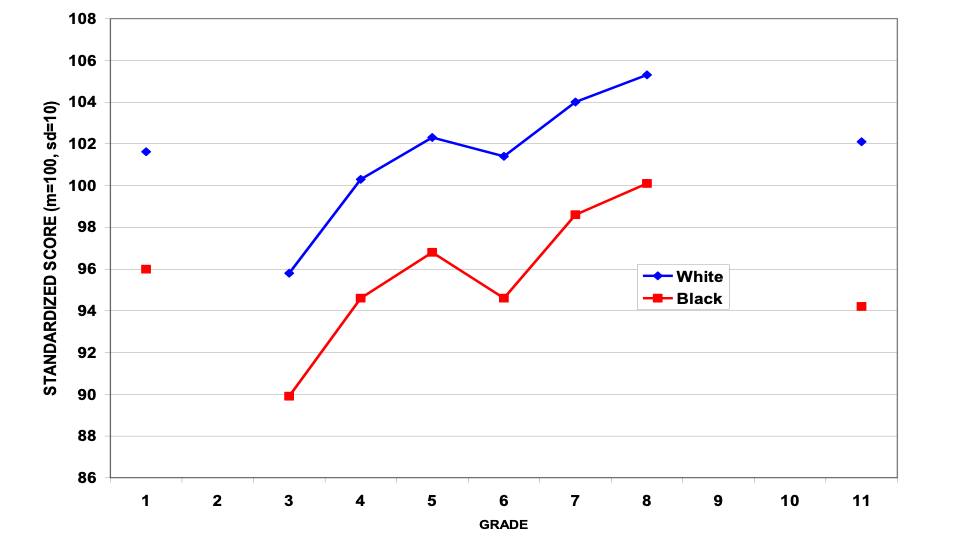
The charts below show achievement scores for two states, one in the Border South for the year 2012 and one in the South for the years 1999 to 2005. For the Border South state in figures 1–3, achievement scores are designed to reflect academic growth between grades three and eight. This state also has achievement scores for first grade and eleventh grade, but they are not calibrated to show growth (relative to grade three to eight scores). For the South state in Figure 4, tests are normed to equal the same mean and standard deviation for each grade three to eight.

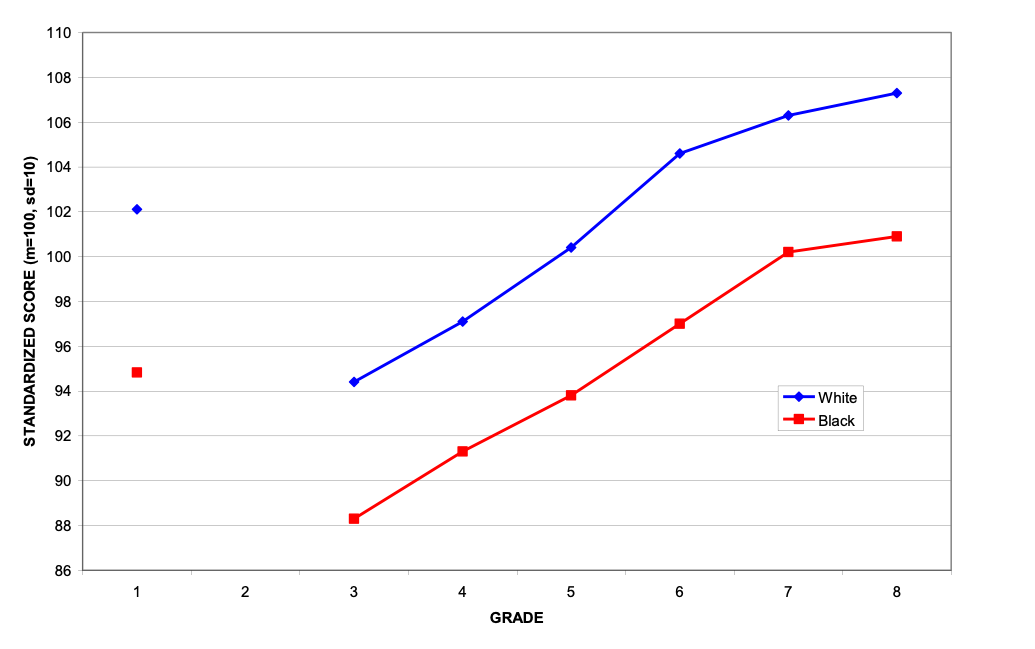
Figure 1 shows mean reading scores for grades one, three to eight, and eleven. The scores have been standardized to have a mean of 100 and standard deviation of 10. The Black-White reading gap is about 0.6 SD’s in grade one, and it is very close to 0.6 in grades three through grade eight. The gap widens somewhat to 0.8 in eleventh grade.

Figure 1. Statewide reading scores for Black and White students, 2012

1

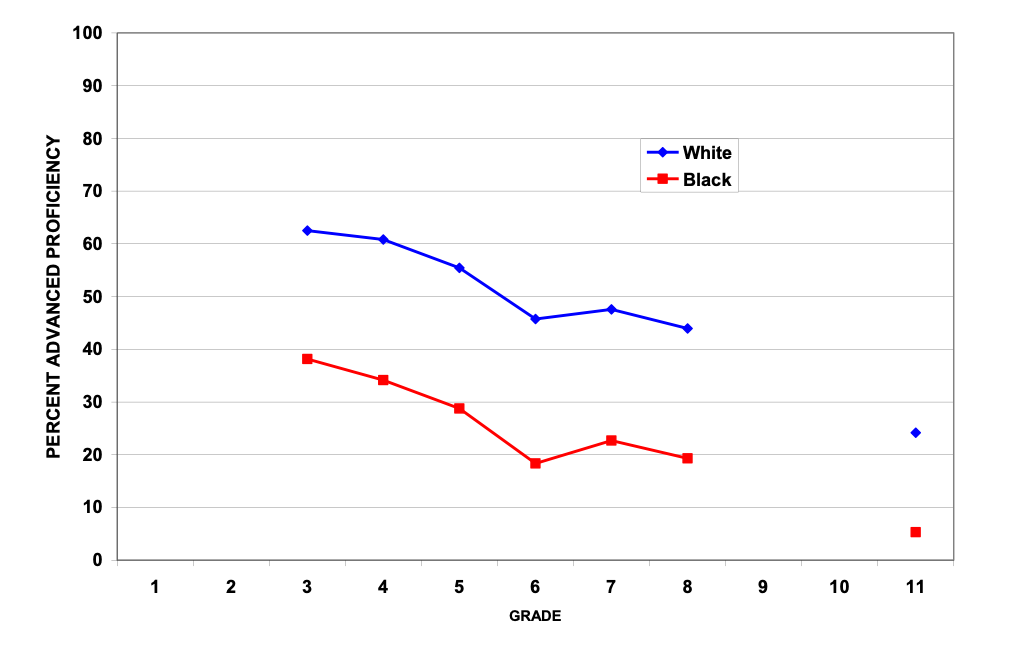
The Petrilli article was focused on “excellence,” and his examples refer to the highest scoring category on NAEP, which is “Advanced.” Although state achievement testing can use different terminology, in this state they use the same four levels as NAEP—Advanced, Proficient, Basic, and Below Basic—for all tested grades except first grade. Figure 2 shows the percent scoring “Advanced” in reading proficiency on the state reading exam for grades three to eight and grade eleven. The gap starts out at 24 percentage points in grade three, widens slightly to 27 points in grades four to six, then narrows slightly to 25 points in grades seven and eight. In grade eleven, the excellence gap narrows significantly to 19, which is a positive result.

Figure 2. Statewide percentage of Advanced proficiency for Black and White students, 2012

2

Figure 3 shows the gap for average math achievement for grade one and grades three to eight in the Border South state. Again, we see a relatively constant gap of 0.7 SD’s for grade one and approximately 0.6 for grades three to eight, although it does widen to nearly 0.8 for grade six. A single math achievement score is not available for high school grades because math courses diverge into separate subject matters, such as algebra, geometry, and trigonometry.

Figure 3. Statewide math scores for Black and White students, 2012

3

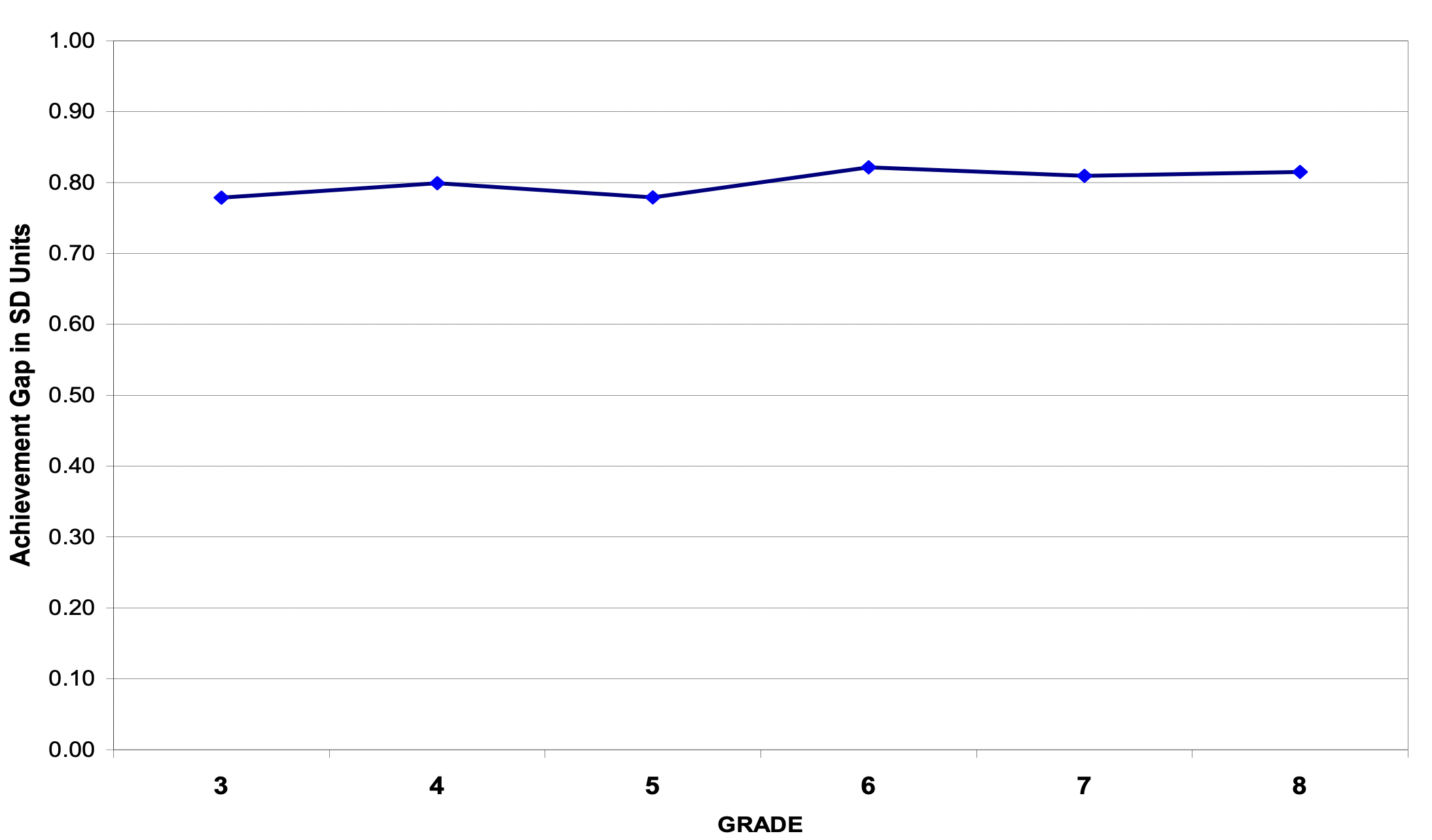
Finally, Figure 4 shows the statewide math achievement gap for Black and White students in a large southern state. Here the gap is a little larger, averaging about 0.8 standard deviations for all grades, but it varies only slightly from one grade to the next. The smaller variation may be due to the fact that these data follow the same cohort as the cohort ages from grade three to grade eight.

Figure 4. Statewide math scores for Black and White students, 1999 grade thee to 2005 grade eight

4

At least in these two states, achievement gaps do not change appreciably over the school years. On the one hand, this is good news for those concerned about schools making the achievement gap worse. On the other hand, it does not appear to shrink, either, which should motivate policy leaders to find methods that can help close the gap. Since many different school reforms have not had much impact on achievement gaps, successful policies may well have to take place before schooling starts, since the gap exists before children start school. 

view
Investing in teachers SR image

Investing in the teacher workforce

Jessica Poiner
7.5.2022
Ohio Gadfly Daily

Research shows that many talented students shy away from a career in education due to salary concerns. As a result, increasing teacher salaries is often pitched as a potential solution for teacher shortages. But a recent paper from the Annenberg Institute at Brown University challenges the assumption that salary increases are the best method for investing in the teacher workforce by examining an alternative set of benefits and estimating how attractive teachers found them in comparison to salary bumps.

To determine teacher preferences, the researchers used an online survey that was emailed to teachers between November 2020 and January 2021. The final sample included a total of 1,030 teachers. Similar to the national teacher workforce, the sample was 75 percent female, 81 percent white, and contained a roughly equal share of primary and secondary teachers. Unlike the national workforce, however, the sample skewed slightly less experienced, and under-represented teachers from rural areas.

The survey presented teachers with pairs of hypothetical teaching jobs and asked them to identify which school they preferred. The researchers defined each school according to seven features: salary, childcare benefits, class size, and four key support roles—school counselors, nurses, special education specialists (paraprofessionals and co-teachers), and instructional coaches. The values were randomly assigned, and teachers were asked to hold constant all unstated features of the schools via the following prompt: If two schools were otherwise identical in every way—same building, same principal, same teaching assignment, same students—which school would you prefer?    

Results reveal that teachers valued working in a school that provided a full-time nurse, full-time counselor, full-time special education paraprofessional, and a full-time special education co-teacher as much or more than a 10 percent increase in salary. On the other hand, teachers valued a three-student reduction in class size and one hour of instructional coaching per month less than they valued a 10 percent salary increase. Unsurprisingly, preferences for childcare benefits depended on the size of the benefit and whether the teacher currently had children. 

The researchers classified a benefit as cost effective if the amount teachers were willing to sacrifice in additional salary to receive the benefit exceeded the per-teacher cost of offering it. Assuming an average teacher salary of $60,000 and an average of thirty-three teachers per school (both of which were, indeed, the national averages at the time of the survey), the researchers estimate that investments in nurses and counselors are highly cost effective. The average teacher is willing to forego a 13 percent salary increase ($7,800) to work in a school with a nurse, which is more than five times the per-teacher cost of employing one. Findings regarding school counselors were similar. The researchers estimate that working in a school with one full-time counselor is worth $7,487 in salary equivalents to teachers, while working at a school that employs two full-time counselors is worth $9,952. These equivalents are, respectively, worth more than four times and almost three times the per-teacher cost of employing one or two full-time counselors.

Teachers were most willing to sacrifice a pay raise for special education staffing, which isn’t surprising in light of recent research showing that the percentage of students with disabilities in teachers’ classes was associated with an increase in the odds of turnover. Survey results indicate that the average teacher would be willing to forego a 12.5 percent salary increase for full-time support from a paraprofessional, and a 16.6 percent increase for full-time support from a co-teacher. Unfortunately, the costs of offering this one-on-one support are much higher than estimates indicating what teachers are willing to pay. Based on the benefit to teachers alone, it’s difficult to justify the expense of adding special education support to every classroom. But like nurses and counselors, these support staff also benefit students and families, who aren’t included in this study and may make the cost more palatable for school leaders.

Teachers were least willing to pay for smaller class sizes. The offer of instructional coaching did not appear to strongly influence teacher preferences, either, though estimates indicate that coaches are worth roughly $2,500 in salary equivalents, which is more than double the approximate per teacher cost. As for childcare benefits, eligible teachers valued a 10 percent salary increase and a $3,000 per-child subsidy (with a $6,000 annual cap) similarly, but preferred the 10 percent increase over a benefit of only $1,500 per child. Interestingly, the researchers observed that teachers who didn’t have children still seemed to find a hypothetical school that offered childcare benefits more attractive than a school that didn’t.

Overall, these findings indicate that many teachers prefer investments in support staff rather than increases in salary, class-size reductions, or more instructional coaching. The paper offers several plausible explanations as to why. First, support staff such as counselors, nurses, and special education specialists provide services to students that are necessary and help ensure they’re ready to learn. Teachers recognize these needs and understand the importance of meeting them, but they may feel ill-prepared or unable to do so. Second, surrounding teachers with student-based support professionals frees up time so they can focus on core instructional duties. Allowing teachers to focus on teaching can in turn lead to academic gains for students. Third, sharing the responsibility for students’ well-being among a variety of professionals can reduce teacher stress and prevent burnout, which is crucial for retention.

The big takeaway here for policymakers and district leaders is that while salary matters, it shouldn’t be the exclusive focus when it comes to recruitment and retention efforts. Teacher preferences also matter immensely, as research indicates that working conditions have a strong influence over teachers’ employment decisions. To effectively invest in the teacher workforce, leaders should focus on a broad set of benefits, and that includes offering teachers what they say they want.

Source: Virginia S. Lovison and Cecilia H. Mo, “Investing in the Teacher Workforce: Experimental Evidence on Teachers’ Preferences” Annenberg Institute at Brown University (February 2022).

view

Does keeping students with the same teacher for multiple years boost outcomes?

Nathaniel Grossman
7.7.2022
Flypaper

The relationship between teacher and student has profound effects on learning. A new study explores whether schools can strengthen this relationship over time by keeping students with teachers for more than one year.

Teacher effectiveness is traditionally viewed as a fixed characteristic: Some teachers produce greater student achievement, others not so much. The goal of school leadership is to hire and retain the former and separate from the latter. However, recent scholarship suggests that teacher effectiveness is instead “dynamic and context-specific, evolving over time.” Certain teachers are more effective at teaching certain students. And as this relationship grows and deepens, better results are produced.

The study uses student and teacher information from the Tennessee Education Research Alliance, which compiles data from the Tennessee Department of Education. The Volunteer State—long a champion of education reform—gathers sophisticated data about its students, so much so that all students can be linked to specific teachers in tested grades and subjects. This makes it possible to analyze almost all public school students in grades three through eight from spring 2007 to 2015, and most of their high school counterparts from 2007 to 2017, a dataset of almost 3.7 million students.

The study defines a repeat student-teacher match as a student having the same teacher for more than one school year. This broad definition encompasses various permutations. One form of repeat matching is looping, when a teacher moves to the next grade level with the same class of students. While practiced in some elementary schools, less than 2 percent of all teachers are loopers. “Unintentional looping” is far more common in the elementary grades. A teacher may be reassigned to a different grade in between school terms and turn out coincidentally have some students she/he has taught before, although the match isn’t always intentional.

Even more common are repeat matches in middle and high school. In these situations, many teachers are responsible for multiple classes in a given subject. A high school math teacher might teach algebra to freshmen, geometry to sophomores, and precalculus to juniors. Along the way, the same students may enroll in two of the classes or even all three. (The study omits students who repeat a grade with the same teacher.)

The researchers find that 44 percent of the sampled students had at least one repeat teacher over the course of their education, most commonly in the upper grades. Though just 2 percent of fourth grade students had a repeat teacher in a given school year, 11 percent of eighth grade students had one.

By using the Tennessee data to create statistical models, the researchers estimated students who had repeat matches would see a variety of benefits. Overall, having a repeat teacher was associated with an increase in test scores of 1.9 percentage points. Broken down by subject, the increase was 3.2 percentage points in math and 1.5 percentage points in English language arts. The effect of repeat relationships was stronger in math for high school students (+4.1 percentage points) than for students in grades three to eight (+2.4 percentage points). The reverse was true for ELA, where the effect was stronger for students in grades three to eight (+1.3 percentage points) than high school students (+0.7 percentage points). Positive effects were also seen in estimated behavioral outcomes. Having a repeat experience with a teacher reduced student absences by 0.5 percentage points and suspensions by 1 percentage point. All of these findings were statistically significant.

Differences became apparent when the estimates were broken down by student demographics. Students who were high performers the previous school year and White female students saw the biggest bump in academic achievement when repeating with a teacher. Lower performing students and Black and Hispanic males saw the largest reductions in absences, truancy, and suspensions. Having a repeat teacher reduced absences 3 percent for Black and Hispanic males.

The study has implications for school staffing. If there is evidence that extending relationships between students and teachers improves learning and behavioral outcomes, school leaders should make it standard practice. Intentional looping—mentioned above as accounting for less than 2 percent of teaching assignments—might become the norm in more elementary schools. Likewise, enrollment in middle and high school classes should prioritize keeping students and teachers together. Entire classes would not need to be preserved, as the study also demonstrated that classes of 50 percent repeaters had spillover effects for the students in the class who had not repeated.

The study suggests that rather than being a fixed quality, effectiveness is dynamic and dependent on the relationship between teachers and students. Multiple studies have shown the beneficial of having a teacher of color for students of similar backgrounds. Further research may suggest even more specific teaching relationships in which students may thrive. However, simply repeating a grade with a teacher may not be a panacea for low student achievement. More information is needed about the effects of repeating a grade with a minimally effective or ineffective teacher. And if a teacher needs multiple school years with a student to produce results, were they that effective to begin with? It’s a research area that demands more study.

SOURCE: Leigh Wedenoja, John Papay, and Matthew A. Kraft, “Second Time’s a Charm? How Sustained Relationships from Repeat Student-Teacher Matches Build Academic and Behavioral Skill,” EdWorkingPaper: 22-590, retrieved from Annenberg Institute at Brown University (June 2022).

view

The Education Gadfly Show #827: The debate over “no zeroes” grading policies

7.5.2022
Podcast
 

On this week’s Education Gadfly Show podcast, Daniel Buck, a teacher and a Fordham senior visiting fellow, joins Mike Petrilli to discuss “no zeroes” grading policies and why he thinks they’re the worst of all worlds. Then, on the Research Minute, Amber Northern reviews a study on how high-stakes testing affects teacher turnover and the distribution of teachers across grades and schools.

Recommended studies referred to in this episode:

  • Daniel Buck’s first Fordham post arguing against these policies, which launched a subsequent debate: “A ‘no zeroes’ grading policy is the worst of all worlds,” June 16, 2022. 
  • Douglas Reeves’s response to Buck: “Revisiting ‘The Case Against the Zero’: A response to Daniel Buck,” June 23, 2022.
  •  And finally, Daniel Buck reply to Reeves: “Let’s not get reckless with grading: Replying to Douglass Reeves,” June 23, 2022. 
  • The study Amber reviewed on the Research Minute: Dillon Fuchsman, Tim R. Sass, and Gema Zamarro, “Testing, Teacher Turnover and the Distribution of Teachers Across Grades and Schools,” Education Finance and Policy (April 2022).

Feedback Welcome!
Have ideas on our podcast? Send them to our podcast producers Pedro Enamorado at [email protected] or Lilly Sibel at [email protected] 
 

view

Cheers and Jeers: July 7, 2022

The Education Gadfly
7.7.2022
Flypaper

Cheers

  • Progressive school leaders in San Diego support extra pay for teachers in shortage areas, despite fierce resistance in the past. —Voice of San Diego
  • Teachers can now use CRISPR curriculum kits to help students better understand biotechnology, biomedical ethics, and new career options. —The New York Times
  • “Teaching all aspects of the U.S.’s story will help de-politicize education and foster democracy.” —William J. Bennett
  • Iowa’s governor signs a bill that expands open-enrollment to permit transfers to any public K–12 school in the state at any time. —RadioIowa

Jeers

  • Journalism’s public health coverage during the pandemic made many mistakes and contributed to America’s declining trust in the media. —The Grade
  • “Behavioral issues, absenteeism at schools increase, federal data shows.” —The Washington Post
  • Concerns rise about lowering the bar for teacher standards as “states relax teacher certification rules to combat shortages.” —Education Week
view

What we're reading this week: July 7, 2022

The Education Gadfly
7.7.2022
Flypaper
  • A fifty-year longitudinal study of over 2,000 gifted students finds no connection between success and unhappiness. —The Wall Street Journal
  • The story of Glenn Youngkin’s rise to political prominence in Virginia through education. —Time
Fordham Logo

© 2026 The Thomas B. Fordham Institute
Privacy Policy
Usage Agreement

National

P.O. Box 110
Burke, VA 22009

202.223.5452

[email protected]

Ohio

P.O. Box 82291
Columbus, OH 43202

614.223.1580

[email protected]

Sponsorship

130 West Second Street, Suite 410
Dayton, Ohio 45402

937.227.3368

[email protected]