Mobile Navigation

  • National
    • Policy
      • High Expectations
      • Quality Choices
      • Personalized Pathways
    • Research
    • Commentary
      • Gadfly Newsletter
      • Flypaper Blog
    • Events
    • Scholars Program
  • Ohio
    • Policy
      • Priorities
      • Media & Testimony
    • Research
    • Commentary
      • Ohio Education Gadfly Biweekly
      • Ohio Gadfly Daily
  • Charter Authorizing
    • Application
    • Sponsored Schools
    • Resources
  • About
    • Mission
    • Board
    • Staff
    • Career
Home
Home
Advancing Educational Excellence

Main Navigation

  • National
  • Ohio
  • Charter Authorizing
  • About

National Menu

  • Topics
    • Accountability & Testing
    • Advanced Education
    • Career & Technical Education
    • Charter Schools
    • Curriculum & Instruction
    • ESSA
    • Evidence-Based Learning
    • Facilities
    • Governance
    • Personalized Learning
    • Private School Choice
    • School Finance
    • Standards
    • Teachers & School Leaders
    • Think Again
  • Research
  • Commentary
    • Gadfly Newsletter
    • Flypaper Blog
    • Gadfly Podcast
  • Events
  • Scholars Program

The Education Gadfly Weekly

Sign Up to Receive Fordham Updates

We'll send you quality research, commentary, analysis, and news on the education issues you care about.
Thank you for signing up!
Please check your email to confirm the subscription.

The Education Gadfly Weekly: Social and emotional learning is just character education and a thesaurus

Volume 19, Number 26
6.26.2019
6.26.2019

The Education Gadfly Weekly: Social and emotional learning is just character education and a thesaurus

Volume 19, Number 26
view

Child poverty is down sharply since the start of the ed reform era

U.S. student outcomes improved significantly from the late 1990s until the onset of the Great Recession, especially in math, but also in reading, science, writing, U.S. history, and civics. Gains were greatest for lowest-achieving students, students of color, and at the fourth and eighth grade levels. But it's possible that a certain change outside of school explains at least some of these gains: the vastly improving condition of the nation’s poorest families.

Michael J. Petrilli 6.26.2019
NationalFlypaper

Child poverty is down sharply since the start of the ed reform era

Michael J. Petrilli
6.26.2019
Flypaper

Improving disadvantaged students’ college outcomes with charter-district collaboration

6.26.2019
Flypaper

Social and emotional learning is just character education and a thesaurus

Robert Pondiscio
6.26.2019
Flypaper

Four key education policies that will be decided in the next ten days

Jessica Poiner
6.21.2019
Ohio Gadfly Daily

Four tips for SEL advocates

Alexandria Myrick
6.26.2019
Flypaper

The Education Gadfly Show: Research, practice, and the feds

6.26.2019
Podcast
view

Improving disadvantaged students’ college outcomes with charter-district collaboration

Richard Whitmire 6.26.2019
Flypaper
view

Social and emotional learning is just character education and a thesaurus

Robert Pondiscio 6.26.2019
Flypaper
view
Conference committee predictions

Four key education policies that will be decided in the next ten days

Jessica Poiner 6.21.2019
Ohio Gadfly Daily
view

Four tips for SEL advocates

Alexandria Myrick 6.26.2019
Flypaper
view

The Education Gadfly Show: Research, practice, and the feds

Michael J. Petrilli, Amber M. Northern, Ph.D., David Griffith, Ph.D., Elizabeth Albro 6.26.2019
Podcast
view

Child poverty is down sharply since the start of the ed reform era

Michael J. Petrilli
6.26.2019
Flypaper

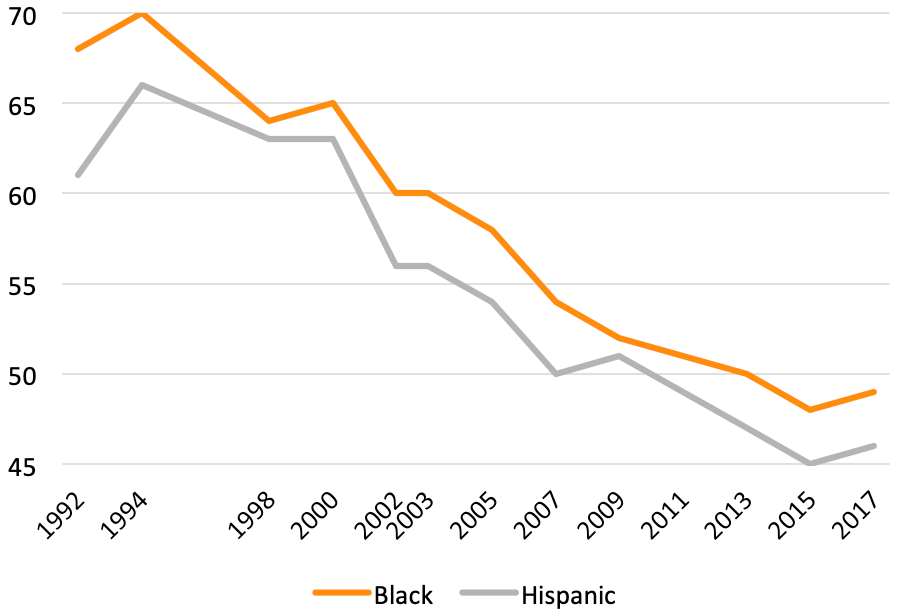
Over the last few weeks, I’ve presented evidence that student outcomes in America improved significantly from the late 1990s until the onset of the Great Recession. The progress was greatest and most widespread in math, but also strong in reading, and pretty good in science, writing, U.S. history, and civics. In all of these cases, gains were greatest for the lowest-achieving students, for students of color, and at the fourth and eighth grade levels. With just a few exceptions, the trends for twelfth grade have generally been flat.

See for example this impressive picture:

Figure 1. Percentage of fourth graders reading Below Basic on NAEP
mp1

However, these positive trends don’t necessarily mean that America’s schools got better over this time. Something that changed outside of school could explain at least some of these gains. And there’s a likely candidate for that “something”: vastly improving economic conditions for the nation’s poorest families over this period.

If that statement caused you to do a double-take, you probably aren’t alone because this progress is one of the best-kept secrets in American life. Especially so for those of us in education, since we’re used to equating poverty rates with free-and-reduced-priced-lunch rates, which are increasingly unreliable proxies.

So let’s state it clearly: America’s children are much less likely to be poor today than they were in the 1980s and 90s. In fact, poverty rates for white, black, and Latino children have each been cut by about 50 percent since A Nation at Risk.

This is a great achievement, one made possible by a growing economy and smart, compassionate policies embraced to some degree by leaders on both sides of the aisle. Let’s take a closer look at the numbers.

Child poverty rates over time

As with educational outcomes, it’s important to disaggregate child poverty rates by race and ethnicity, both because averages might not tell the whole story, and because the rising Latino share and shrinking white share of the population might give us a distorted view of what’s happening, given that Latino children are, on average, more likely to be poor than white children.

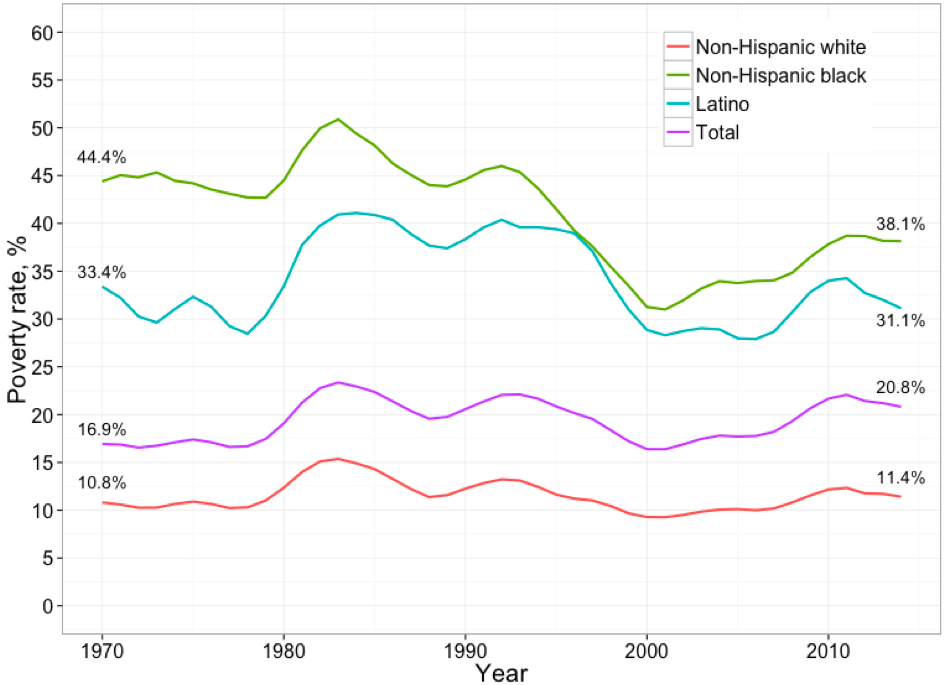
So let’s start by looking at child poverty rates for the three major racial groups according to the standard poverty measure. 

Figure 2: Child poverty rates according to the standard poverty measure, by race and year
mp2

Source: Nolan, Laura; Garfinkel, Irwin; Kaushal, Neeraj; Nam, JaeHyun; Waldfogel, Jane; and Wimer, Christopher, “Trends in Child Poverty by Race/Ethnicity: New Evidence Using an Anchored Historical Supplemental Poverty Measure," Journal of Applied Research on Children: Informing Policy for Children at Risk: Vol. 7: Iss. 1, Article 3. Available at: http://digitalcommons.library.tmc.edu/childrenatrisk/vol7/iss1/3.

What we see is a spike in child poverty right around the time of A Nation at Risk in 1983, then declines through the 1980s until the 1989 recession, huge progress in the booming 1990s—especially for black and Latino children—and then rising poverty in the 2000s and especially with the onset of the Great Recession. After all of that, i.e., when we look across the whole period from 1970 to the present, black child poverty rates are down sharply, Latino rates are down modestly, and white rates are up modestly.

Yet the standard child poverty rate has many flaws, as virtually everyone who studies the topic will tell you. The poverty line was set back in the 1960s as an estimate of what a family of a given size would need for food, clothing, and shelter. Every year since, the Census Bureau has simply adjusted the line based on inflation.

That leaves a lot to be desired. For one, it doesn’t take into account differences in cost of living, so the line is the same if a family lives in pricey San Francisco or low-cost West Virginia. Second, it’s not clear whether the overall inflation rate is the right one to use, or whether something more targeted to what poor families actually consume might be better. Most importantly, it doesn’t account for money from government programs and policies—like SNAP benefits (food stamps) and the Earned Income Tax Credit. These have grown significantly in recent years, so ignoring them warps the picture dramatically.

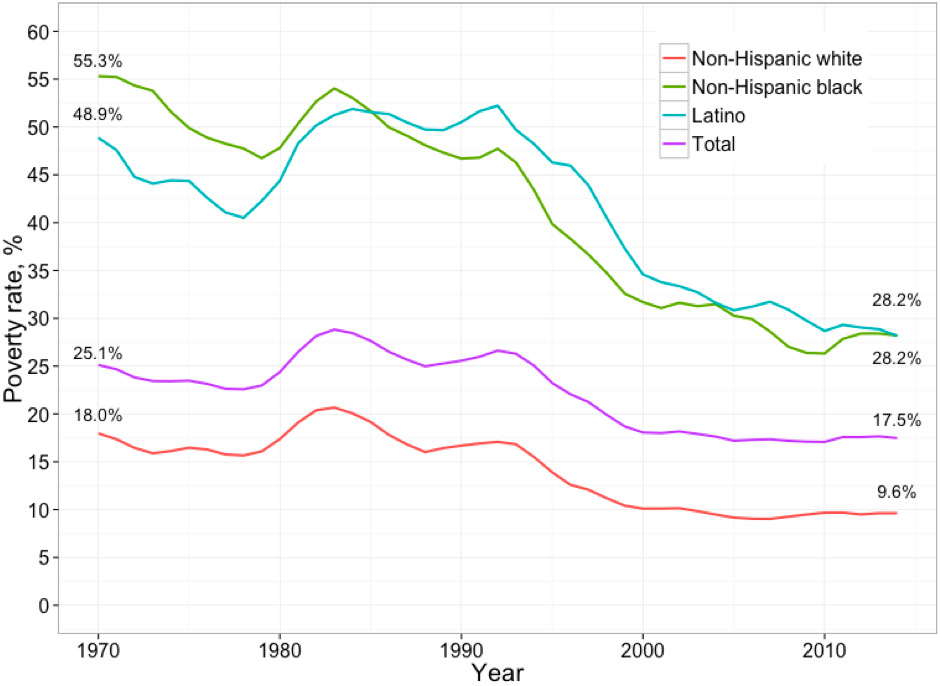
Thankfully, in 2011, the Census Bureau and Bureau of Labor Statistics developed the “supplemental poverty rate,” which corrects these and other flaws. (A comprehensive overview of the measure is available here.) And a group of scholars has estimated the historic child poverty rate, by race, according to this new measure. Here’s what it looks like:

Figure 3: Child poverty rates according to the supplemental poverty measure, by race and year
mp3

Source: Nolan, Laura; Garfinkel, Irwin; Kaushal, Neeraj; Nam, JaeHyun; Waldfogel, Jane; and Wimer, Christopher, “Trends in Child Poverty by Race/Ethnicity: New Evidence Using an Anchored Historical Supplemental Poverty Measure," Journal of Applied Research on Children: Informing Policy for Children at Risk: Vol. 7: Iss. 1, Article 3. Available at: http://digitalcommons.library.tmc.edu/childrenatrisk/vol7/iss1/3.

Now we see a more impressive story about change over time. Child poverty was much higher than we thought when the data series began back in 1970, but fell sharply for black and Latino children in the 1980s until the 1989 recession. Starting again around 1993, we see a long and steep decline in poverty rates for black and Latino children—one that continues all the way until the aftermath of the Great Recession, when it flat-lines. White children do better over this time period, as well.

According to the supplemental poverty measure, child poverty rates were at or near their all-time highs around the time A Nation at Risk was released in 1983, and since then have declined 48 percent for black children, 46 percent for Latino children, and 54 percent for white students. That is remarkable progress!

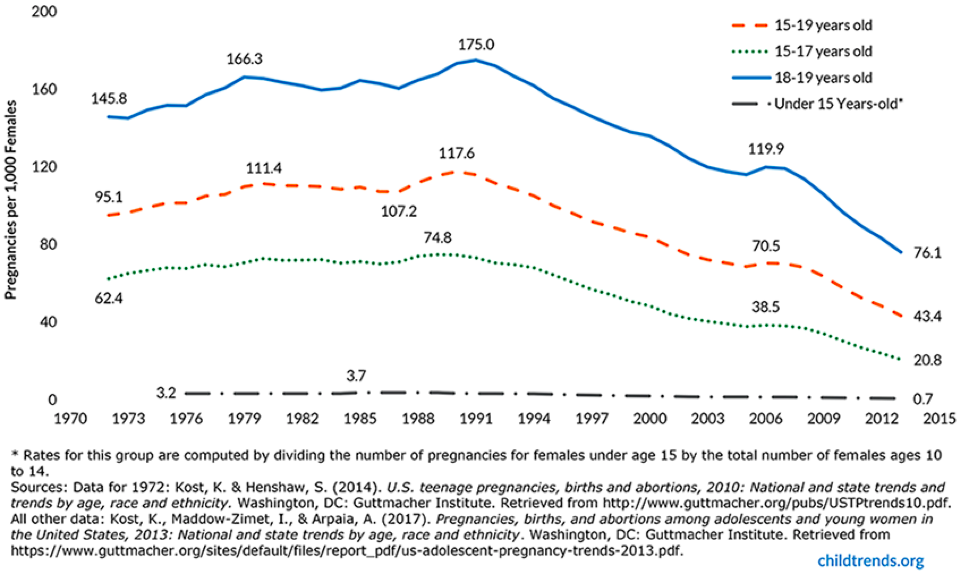
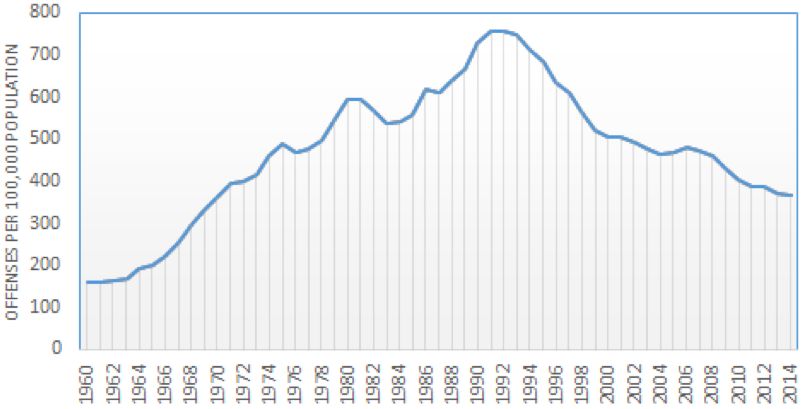
Nor are these the only social trends that look so promising. Teenage pregnancy rates peaked in the early 1990s and then started their spectacular fall; likewise with violent crime. So not only are fewer children today poor, they are also much less likely to be raised by a teenaged mother, and much less likely to be living in a violent neighborhood.

Figure 4. Pregnancy rates for adolescent females, by age and selected years, 1973–2013
mp4

Figure 5. U.S. violent crime rate, 1960–2014
mp5

Source: Lori Robertson, “Dueling Claims on Crime Trend,” FactCheck.org (July 13, 2016), based on FBI Uniform Crime Reports.

Things have gotten better.

What all this means for K–12 education will be the subject of future posts, though let’s acknowledge that there’s long been a strong relationship between a child’s “socioeconomic status” and their academic outcomes, in general. And that when poor families become less poor, their kids tend to do better in school. So it stands to reason that improved social conditions for lots of children should be associated with improved results on achievement tests and graduation rates—which is precisely what we’ve been seeing.

In the meantime, let’s celebrate the fact that our country has made real progress in the War on Poverty. When we hear people argue that we should “fix poverty first”—before trying to fix our schools, or expect too much from them—we should acknowledge that, while we haven’t ended poverty, we’ve made a big dent. It’s good to know that, even in the case of vexing social problems, progress is possible.


view

Improving disadvantaged students’ college outcomes with charter-district collaboration

6.26.2019
Flypaper

When I started researching The B.A. Breakthrough, I had no idea that a college admissions scandal would erupt, exposing how rich families can game the system—shenanigans low-income families can’t play. Nor did I know that the College Board would devise an “adversity score” to explain test result differences between have and have-not students.

It was impossible to know that U.S. News & World Report would tweak its college rankings system to reward universities that produce better-than-expected results with low-income students. I also had no idea that the Pew Research Center would update its college completion data to further reveal the problem: a vast increase in the number of low-income students seeking a college degree, but a near flatlining of those actually winning degrees.

These are not disconnected noises. These are important signals pointing to a struggle over the American Dream: In a time when widening economic gaps seem unclosable, is it still possible for low-income students to move up to the middle class?

Education is an imperfect vehicle for upward mobility, but it’s the best and probably only vehicle we’ve got. If these students can’t move up, what does that say about the future of the country?

Two years of research into that question leads me to this conclusion: There’s still hope for the American Dream. Yes, we’ve failed miserably in the past to ensure that low-income students have a crack at that dream, but there’s considerable hope this can turn around—especially with the increasing public attention paid to the problem. Explaining that optimism is what The B.A. Breakthrough is all about. (See the book’s microsite, and read select chapters, right here)

I’ve found that the best way to explain a book is to talk about why you started researching it in the first place. For me, that requires dipping back into previous research and writings.

This story starts with The Bee Eater, a book about Michelle Rhee and her run as chancellor of D.C. public schools from 2007 to 2010. I thought her reforms might be a last best chance to turn around a troubled urban district, and I wanted to be a witness.

When it became clear she was about to get the boot—the result of Adrian Fenty failing to win re-election as mayor—I not only had to move my deadline up by eight months; I had to change the way I looked at public education. So much for last chances—at least that’s how it looked at the time.

So I decided to investigate what charter schools had to offer students in low-income neighborhoods. As a narrative device, I chose to follow Rocketship Public Schools—a California charter network—for a year. At the time, Rocketship was a tiny organization with big, and seemingly impossible, ambitions: to grow at unprecedented speed and eventually solve the national achievement gaps.

Before the year was up, it became clear that Rocketship’s grandiose goal was fanciful. Some major wheels came off. Rocketship schools continue to do some great work, but Rocketship-scale solutions to our education challenges just aren’t happening.

But something interesting happened with that book. Rocketship’s challenges led me to look at what other charter networks had to offer, especially when it comes to college success. That’s what the network’s founders promised prospective parents: Sign up your kid, and the chances that child will earn a degree will vastly increase.

To figure out whether that promise was actually being fulfilled, I researched the struggles the networks endured trying to get there. Their initial college success wasn’t what they hoped it would be. But I also reported on their recovery and how they learned to truly boost those degree-earning rates.

Today, those big, well-established networks like KIPP and YES Prep, most of them in our largest cities, have alumni earning degrees at rates two to four times the national average for low-income students.

When I started researching a book on that topic, I quickly realized—with the help of higher education experts—that there was a lot more happening in this space.

Actually, there are three big things happening, all of them hopeful:

First, the charter networks have pioneered a breakthrough. And they are passing along lessons learned to a few traditional school districts that are brave enough to collaborate with charters.

Second, foundations are funding really smart college counseling that is offered in traditional high schools with low-income students—schools that lack those resources. The College Advising Corps comes to mind, but it is one of many such resources.

These counselors do more than make sure all college-aspiring students have their forms filled out and ready to go. The students get steered away from iffy commuter universities where the odds of earning a degree are low and are instead steered into other universities—yes, some of them also commuter universities—where the degree-earning odds are far better.

Third, pushes by groups such as the Aspen Institute’s College Excellence Program are showing progress. Universities are making first-generation students more comfortable on campuses, tracking their progress and stepping in when they need help. Elite colleges that never admitted community college transfers are changing their ways.

And it’s not just urban students. Recently I was in Virginia’s Shenandoah Valley and picked up a local weekly in Luray—the Pages News and Courier—to read a profile of a local student who, while at Luray High School, took dual credit courses at the local community college, and was going to Harvard on a full-ride scholarship. A white, rural student now part of the breakthrough.

What I find encouraging is that for the most part, these three threads are not controversial. Funding seems good for smart college counseling. Some big players, such as Bloomberg Philanthropies, are committed. The Aspen Institute is making good progress on its American Talent Initiative, and it’s clear from multiple reports that colleges are trying harder to ensure that their first-generation students succeed.

The only controversial leg here is the charter schools. Clearly, the progressive left has moved away from charters. The cap on charters is not likely to get lifted in New York, and a more serious moratorium on charters seems possible in California.

But even if there are setbacks, it’s too late to erase the record of what’s already happened with charter school alumni. Under a moratorium, the number of charter alumni will still grow, just not as fast as their founders had hoped. The college success rates experienced by those alumni will become additional facts on the ground.

Also hopeful: Already, some traditional school districts are collaborating with charter networks to help their alumni earn degrees, a trend likely to grow. Why would more traditional districts work with charter networks, when they usually view them as pernicious competitors? Because the districts will realize that collaborations are a win-win for them. They don’t lose any students to charters, and big funders are likely to step in to pay for expert college counselors. That’s what happened in San Antonio.

We’re clearly on the cusp of a breakthrough. The only question is whether we have the resolve to build on the groundwork set by foundations, charters and some pioneering districts and colleges to truly break through.

This essay was first published by The 74.

view

Social and emotional learning is just character education and a thesaurus

Robert Pondiscio
6.26.2019
Flypaper

More than most fields and professions, education has a remarkably poor grasp of its own history. One of the reasons we are so susceptible to fads is because so few of us recognize that the Shiny New Thing is so often a recycled idea and a Ted Talk. (True story: I once witnessed a top editor of Edutopia stunned to learn that project-based learning was a one-hundred-year-old pedagogy, not the product of George Lucas’s fertile imagination). In education, there is very little new under the sun.

Jay Greene, bless him, knows his history. In a thoughtful and bracing new report for the American Enterprise Institute, Greene, the chair of the Department of Education Reform at the University of Arkansas, points out that social and emotional learning (SEL) is essentially character education and a thesaurus: contemporary concerns for impulse control, self-efficacy, empathy, teamwork, and problem-solving have roots “deeply enmeshed in moral and religious precepts” going back over 2,000 years. SEL enthusiasts are “entirely right that schools need to attend to these broader educational goals, just as they do to specific academic content,” Greene writes. “My concern is that they are likely to fall far short if they fail to acknowledge the moral and religious roots of SEL, do not consider how past efforts have managed to succeed, and attempt to reinvent those past efforts from scratch on a technocratic foundation that is at odds with what allows SEL to be effective.”

In other words, don’t expect much if you try to divorce SEL from the religious and moral foundations that make it meaningful, and which represent “a set of educational priorities that are as old as education itself.” Greene brilliantly connects the dots between SEL’s priorities and the cardinal virtues described by Socrates in The Republic (prudence, courage, temperance, and justice), which were subsequently incorporated into Christian theology. “There is nearly a one-to-one correspondence between the cardinal virtues and the core SEL competencies as identified by the Collaborative for Academic, Social, and Emotional Learning (CASEL),” Greene observes.

But what’s the harm in stripping character ed from its roots, if that’s the cultural and secular sugar required to make the medicine go down? That’s “neither possible nor desirable,” Professor Greene insists. SEL goals lose their potency and meaning as mere abstractions. Their success over millennia is attributable to “the alignment of the moral and religious convictions of the students and their families with the instruction they are receiving [in school].” Furthermore character education is “more likely to succeed if it is being reinforced, or at least not being contradicted, in students’ homes,” he writes. And I agree.

To his credit and surprisingly, Greene, a vocal school choice proponent, cautions that choice “would help but is not necessary for effective SEL.” The “voluntary community of shared value” borne of choosing to live in areas and neighborhoods among like-minded people of similar backgrounds and worldviews is “sufficient for effective SEL even absent school choice,” he notes. The greater threat is any attempt by a technocratic elite to manage SEL goals via “centrally measuring and incentivizing them.” Instead, secular technocrats and other proponents should “embrace the opportunity for local and voluntary communities to align SEL with their moral preferences.” SEL instruction can only be effective “if local communities authentically adopt and pursue it, which requires that they be allowed to put their own moral preferences into SEL abstractions,” Greene insists before observing in virtually the next breath that most of his advice “cuts against the grain of the modern education reform movement. “The main challenge with SEL is not how to do it, but what social and political conditions allow any approaches to be effective,” he concludes.

Greene’s paper is the third in a series of SEL papers from AEI. Last month, Mike McShane looked at hard lessons learned from the flawed rollout of Common Core that SEL advocates might profit from (reviewed on Flypaper today, as well); Fordham’s own Checker Finn and AEI honcho Rick Hess kicked the series off with advice to prevent SEL from becoming a distraction to “the centrality of academic instruction.” Collectively the papers are broadly respectful and supportive of the overarching goals of SEL enthusiasts, while offering important cautions. And history lessons.

SOURCE: Jay P. Greene, “The moral and religious roots of social and emotional learning,” American Enterprise Institute (June 2019).

view
Conference committee predictions

Four key education policies that will be decided in the next ten days

Jessica Poiner
6.21.2019
Ohio Gadfly Daily

As budget season winds down, lawmakers face the tall task of reconciling some vastly different proposals from the governor’s office, the House, and the Senate on a variety of issues in the budget bill, House Bill 166. The majority of these decisions will be worked out in conference committee, which must complete its work by June 30. Here’s a synopsis of four education policies that will most certainly be discussed and, from a policy perspective, our take on the best path forward.

Academic distress commissions

The debate about what to do with academic distress commissions (ADCs), the state’s mechanism for intervening in chronically underperforming school districts, has been a white-hot issue. The governor’s proposal—which originated with the Ohio Department of Education—and the House provisions appear quite different on the surface, but both would spell the end of ADCs as we know them. The Senate added another proposal to the mix via an amendment that was debated last week in its Education Committee, but it failed to make it into the Senate approved budget. That’s unfortunate because the Senate’s plan appears to strike the best balance between local control and accountability. It calls for instituting improvement efforts in schools after just one year of poor performance and adding greatly needed transparency to turnaround efforts.

Bottom line: Of the myriad ADC proposals, the amendment discussed by the Senate strikes the best balance between local autonomy and maintaining some state oversight if local efforts fall short. This amendment didn’t make the Senate’s final cut, but it could—and should—still be discussed in conference committee.

Graduation requirements

Like ADCs, graduation requirements have also been a hot topic in the Buckeye State. Despite the consistent media coverage, neither the executive nor House budget provisions identified a long-term solution. The Senate, on the other hand, has proposed a comprehensive set of graduation requirements that are objective, comparable, and valid. Eagle-eyed observers will recognize it as the proposal offered by Ohio Excels, the Alliance for High Quality Education, and Fordham—and recently praised by the editorial boards at the Columbus Dispatch and Akron Beacon Journal.

Bottom line: Given the strength of this proposal—and the need to avoid yet another round of contentious debate—lawmakers would be wise to move forward with the graduation requirements proposed by the Senate.

Quality charter school funding

In his budget, Governor DeWine proposed an increase of $30 million per year in state aid for high-performing charter schools. This funding is sorely needed because Ohio charters face significant funding shortfalls. The money would be targeted specifically at high-poverty charters, and schools would receive more funding per pupil for economically disadvantaged students. The House ratified the DeWine proposal. The Senate kept it, too, though it decreased the total funding allocation to $20 million. This significant cut would reduce the amount of per-pupil funding allocated to quality charters. Accepting the Senate reductions will force quality, high-poverty charters to continue to operate with large funding shortfalls, diminishing the likelihood that they replicate or expand.

Bottom line: Governor DeWine’s charter funding proposal is a major step forward in narrowing Ohio’s longstanding charter funding gaps and growing excellent new charter schools. His proposal should move forward as introduced.

Vouchers

Neither the governor’s budget nor the House’s provisions included significant changes to Ohio’s five voucher programs. The Senate, however, made important updates to EdChoice, which offers state-funded scholarships to students who attend low-performing schools, as well as low-income students. The biggest change would expand eligibility for income-based scholarships to all students entering grades K–12 beginning in 2020–21. Only students in grades K–5 were eligible during FY 2019, so the number of eligible students will essentially double. Since income-based EdChoice is funded via a line-item appropriation, the funding appropriated matters immensely. Fortunately, the Senate matched expanded eligibility with a $50 million increase for FY 2021. This means that thousands of low-income students could have access to school choice options that were previously unavailable.

Bottom line:  The conference committee should continue to build on Ohio’s long commitment to giving all low-income families access to quality choice options and maintain the Senate’s proposed EdChoice expansion.

***

It’s always hard to predict what will make the final cut in Ohio’s complicated budget process. But as lawmakers hammer out compromises during upcoming conference committee meetings, we’re hopeful that none of these essential policies will end up on the cutting room floor. 

view

Four tips for SEL advocates

Alexandria Myrick
6.26.2019
Flypaper

Social and emotional learning (SEL), which focuses on teaching children soft skills like self-awareness, self-discipline, social awareness, relationship skills, and responsible decision-making, has gained popularity, with advocates pushing for curriculum changes in schools. With popularity, however, comes danger, warns a report by Michael McShane for the American Enterprise Institute. Starting from the belief that SEL proves valuable in the process of child development, McShane seeks to glean lessons from Common Core’s political struggles to offer advice to SEL advocates who wish to facilitate smooth and effective implementation.

He details four major lessons. First, advocates of the learning method should fine-tune the definition of SEL, leaving no room for ambiguity, and they should be sure to make stakeholders believe it’s a worthy cause to support. After explaining the challenges Common Core advocates faced, McShane writes “You can’t convince someone to support something if you don’t know what it is.” That said, he also mentions that advocates should do their best to ensure that parents, teachers, and local citizens know exactly what SEL is and why implementing it would be in their best interest.

Second, proponents should work actively with states and local education agencies to develop the capacity to successfully implement SEL. Although he admits that this may be the hardest step, he believes that this is the only way to accomplish a durable coalition of support for the approach. One of the reasons for Common Core’s struggles was that many states were implementing the standards before they had the capacity to take on all that the standards’ instructional shifts required, causing them to fall short of its promise. McShane encourages SEL advocates to ask themselves some questions before pushing adoption: Is there enough space in schools’ current curricula for SEL? Are educators fully equipped and prepared to teach it? Is there an agreed method for teaching it effectively? And does SEL fit the priorities that states, schools, and districts already have?

Third, McShane thinks it is imperative for proponents to beware of last-minute bandwagoners. Common Core suffered from all types of random, last minute “supporters” who ended up doing nothing more than tarnishing its name, such as publishers that slapped “Common Core–aligned” to textbooks that were nothing of the sort. He thinks SEL advocates should be ready and willing to call out companies and organizations that appear to have bad intentions.

His final lesson for SEL backers is to be cautious of how the approach is branded. Common Core was pitched with policymakers in mind, but quickly became a target for angry parents and teachers who did not like the approach the standards required. To avoid having that same target on its back, SEL needs highly selective branding.

McShane’s tips can be helpful in guiding advocates of social and emotional learning towards future success. Comparing it to Common Core, it’s clear that there are many unexpected ways things can go wrong. But if advocates are careful enough they can avoid many of the risks that arise when the popularity of a given policy grows.

SOURCE: Michael Q. McShane, “What social and emotional learning advocates can learn from Common Core,” American Enterprise Institute (May 2019).

view

The Education Gadfly Show: Research, practice, and the feds

6.26.2019
Podcast
 

On this week’s podcast, Elizabeth Albro, Commissioner of the IES National Center for Education Research, joins Mike Petrilli and David Griffith to discuss ways to increase the effect of evidence on classroom practice. On the Research Minute, Amber Northern examines how charter schools in North Carolina affect long-term outcomes.

Amber's Research Minute

Andrew McEachin, Douglas L. Lauen, Sarah C. Fuller, and Rachel M. Perera, "Social Returns to Private Choice? Effects of Charter Schools on Behavioral Outcomes, Arrests, and Civic Participation," retrieved from Annenberg Institute at Brown University (June 2019).

Fordham Logo

© 2026 The Thomas B. Fordham Institute
Privacy Policy
Usage Agreement

National

P.O. Box 110
Burke, VA 22009

202.223.5452

[email protected]

Ohio

P.O. Box 82291
Columbus, OH 43202

614.223.1580

[email protected]

Sponsorship

130 West Second Street, Suite 410
Dayton, Ohio 45402

937.227.3368

[email protected]