Mobile Navigation

  • National
    • Policy
      • High Expectations
      • Quality Choices
      • Personalized Pathways
    • Research
    • Commentary
      • Gadfly Newsletter
      • Flypaper Blog
    • Events
    • Scholars Program
  • Ohio
    • Policy
      • Priorities
      • Media & Testimony
    • Research
    • Commentary
      • Ohio Education Gadfly Biweekly
      • Ohio Gadfly Daily
  • Charter Authorizing
    • Application
    • Sponsored Schools
    • Resources
  • About
    • Mission
    • Board
    • Staff
    • Career
Home
Home
Advancing Educational Excellence

Main Navigation

  • National
  • Ohio
  • Charter Authorizing
  • About

Chad L. Aldis
3.24.2026
House Workforce Higher Ed testimony on HB 644 image
Getty Imagses/gnagel
Listen to this article
Loading the Elevenlabs Text to Speech AudioNative Player...

NOTE: Today, the Ohio House Workforce and Higher Education Committee heard testimony on House Bill 644. The bill would, among other things, create an incentive structure for Ohio colleges to better support students through their postsecondary education and to earn a degree or credential. Fordham’s Vice President for Ohio Policy provided the following proponent testimony.

Ohio has made meaningful progress in expanding access to higher education, but access alone does not guarantee success. Too many students, especially those from low-income backgrounds, enroll in college but do not complete a credential. That reality carries real consequences for individuals, families, and the state’s workforce. House Bill 644 represents a practical, research-driven effort to improve those outcomes.

Overview of House Bill 644

At its core, House Bill 644 is about encouraging colleges to invest in strategies that have been shown to work. The bill creates a dedicated fund and competitive grant opportunity that allows public institutions to pilot, expand, and evaluate programs aimed at improving student success.

Rather than funding initiatives based on good intentions alone, the proposal emphasizes approaches supported by credible research and measurable results. Institutions seeking support must clearly articulate how their proposed efforts will improve outcomes such as retention, completion, and time to degree, and how those efforts will be evaluated over time.

The bill also places a strong focus on serving students who face the greatest barriers to success, ensuring that new investments are aligned with Ohio’s broader goals around equal opportunity and workforce readiness.

Why Evidence-Based Investment Matters

We are not starting from scratch when it comes to improving college completion. A growing body of research shows that certain types of student support—such as structured course pathways, proactive advising, and targeted financial assistance—can significantly improve both graduation rates and long-term earnings.

One of the most compelling examples comes from Lorain County Community College’s SAIL program, which is built on the nationally recognized ASAP model. Evaluations of the ASAP approach in Ohio found that students receiving these supports completed degrees at substantially higher rates than their peers—35 percent compared to 19 percent after three years (and 46 percent to 31 percent after eight years).

The benefits extend well beyond graduation. Years after participating, students in these programs are earning more, with average wages about 14 percent higher than comparable students who did not receive the same support. These results demonstrate that well-designed interventions can meaningfully change students’ trajectories.

Why a Competitive Grant Program Makes Sense

House Bill 644 takes a disciplined approach by requiring institutions to compete for funding based on the strength of their proposals. This ensures that resources are directed toward colleges that are ready to implement thoughtful, research-backed strategies and not just another mandate that puts another program on their plate.

This structure also helps address a common challenge in higher education finance. Ohio rightly rewards institutions for improved outcomes in its funding system, but there can be a delay between when a program is launched and when those results actually generate improvement. A targeted grant program can help institutions cover the upfront costs needed to get effective programs off the ground.

In this way, the bill supports innovation while maintaining accountability. Colleges must define clear goals, measure progress, and plan for long-term sustainability beyond the initial grant period.

Conclusion

House Bill 644 is a strong example of policy grounded in evidence and focused on results. It creates a pathway to extend a successful program in Lorain while at the same time opening the door to more innovative efforts. By encouraging institutions to adopt proven models, Ohio can move more quickly toward a system where student success is the norm rather than the exception.

This bill will likely help more Ohioans earn meaningful credentials, improve their economic prospects, and contribute to the state’s long-term prosperity.

Thank you for the opportunity to provide testimony.
Policy Priority:
Public Testimony
Topics:
Personalized Learning
Chad L. Aldis
3.24.2026
Senate Ed testimony on SB 328 image
Getty Images/zrfphoto
Listen to this article
Loading the Elevenlabs Text to Speech AudioNative Player...

NOTE: Today, the Ohio Senate Education Committee heard testimony on Senate Bill 328. It would, among other things, improve on the state’s workforce readiness and career-connected learning initiatives for K-12 students. Fordham’s Vice President for Ohio Policy provided the following proponent testimony.

Ohio has made real progress over the past several years in expanding career-connected learning. Students have more opportunities today than they did a decade ago. But despite that progress, too many students still move through school without a clear sense of what comes next or how their education connects to their future.

Senate Bill 328 takes an important step toward fixing that. This testimony will focus on three parts of the bill that will likely have the greatest impact: the middle school career exploration requirement, the new approach to academic and career planning, and the return on investment initiative.

Let’s start with middle school.

One of the most valuable aspects of this bill is that it doesn’t wait until high school to begin career-related conversations. It requires schools to provide students in grades 6 through 8 with meaningful exposure to careers, including hands-on experiences, financial literacy, and at least one structured career coaching session.

That matters more than it might seem at first glance.

Right now, we typically expect students to make important decisions early in high school—what courses to take, whether to pursue career-technical education, how to think about college or training programs—without ever having explored their interests in a serious way. For many students, those decisions are made with very little context.

This bill helps change that by making sure students have time before high school to explore options, reflect on their strengths, and think about what they might want to pursue. Research and experience both tell us that those early exposure opportunities—job shadowing, career speakers, and even simple interest inventories—can make a real difference in how students engage with school and the choices they later make.

It’s much easier to build a coherent pathway when students have had a chance to see what’s out there.

That leads directly to the second piece: academic and career planning.

Senate Bill 328 asks students, beginning in eighth grade, to create a plan that goes beyond just earning a diploma. Instead of focusing narrowly on graduation requirements, students will be asked to think about their interests, their goals, and the steps needed to get where they want to go.

That shift is significant.

Too often, planning in high school is treated as a compliance exercise—something to check off rather than something that meaningfully guides decisions. The approach in this bill is different. Plans must be updated each year, they must reflect real experiences like career exploration and work-based learning, and families are expected to be part of the process.

That combination—starting earlier, revisiting plans regularly, and involving families—makes it much more likely that these plans will actually matter.

And frankly, they need to. As we’ve seen, many students graduate without a clear sense of direction, which makes the already difficult transition to college or the workforce even harder. Helping students connect their coursework to real goals is one of the most practical ways to address that problem.

Finally, I want to touch on the return on investment initiative.

Ohio has invested a great deal in education and workforce programs. But it’s often hard for students, families, and policymakers to see which pathways are leading to strong outcomes. This initiative is designed to change that by connecting data across agencies and making it more useful and accessible.

That includes information on things like employment outcomes, wages, and how well different programs are preparing students for what comes next.

That kind of transparency is long overdue.

Students and families should be able to see, in clear terms, what different pathways lead to. Educators should have better feedback on what’s working. And policymakers should be able to make decisions based on evidence, not guesswork.

Taken together, these three components—early career exploration, meaningful planning, and better data—fit together in a way that strengthens the overall system.

Students explore options earlier. They build and refine a plan over time. And the state provides clearer information about which pathways deliver results.

That’s a coherent approach, and it builds directly on the work that Ohio has already done.

Senate Bill 328 doesn’t try to reinvent everything. Instead, it fills in some important gaps and makes existing efforts more connected and more effective. It’s a good bill, and I would urge you to pass it without too many changes. Some of the amendments that have been discussed, especially around the middle school career exploration requirement, pose a significant risk of watering down the requirement to the point of making it almost irrelevant. I urge you to resist those efforts.

Thank you again for the opportunity to testify.

Policy Priority:
Public Testimony
Topics:
Career & Technical Education
Jessica Poiner
3.23.2026
Equity and auto enrollment blog image
Getty Images/Natalia Bodrova
Listen to this article
Loading the Elevenlabs Text to Speech AudioNative Player...

Last year, the Ohio Senate unanimously passed Senate Bill 19. The legislation, which is currently being considered by the House Education Committee, aims to improve student achievement by providing academic intervention services to those who score at the lowest level (“limited”) on state assessments in math or English language arts. It’s also designed to support high achievers by requiring public schools to enroll any student in grades 3–7 who scores at the two highest levels on their state math exam (“accomplished” or “advanced”) in an advanced math course the following year.

For the typical seventh grader, this would mean enrolling in Algebra I during eighth grade. Plenty of students already do that, so it’s important to recognize that Senate Bill 19 isn’t a start-from-scratch effort. Instead, it aims to ensure that all seventh graders who demonstrate readiness have access to algebra in eighth grade—something that isn’t happening today and is keeping high-ability students from pursuing advanced math and science courses when they reach high school and STEM majors when they reach college.

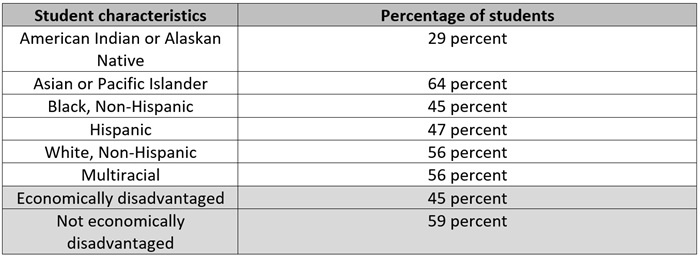
State level data show us how many students are being overlooked for advancement. During the 2023 school year, more than 23,000 seventh graders scored accomplished or advanced on the state’s math assessment. These students are considered to be on-track for college. Their scores are a clear indicator that they’re ready for more challenging work. Testing data indicate that high-ability students taking Algebra I in eighth grade almost universally perform well on the state’s end-of-course exam. And yet, more than half of them (55 percent) weren’t enrolled in algebra during eighth grade and thus didn’t take the end-of-course exam in 2024. That’s nearly 13,000 students who missed out on advanced math opportunities despite proving their readiness.

High-achieving low-income and minority students are more likely than their peers to miss out on advanced math. Less than 50 percent of Black, Hispanic, and American Indian/Alaskan native students who scored in the top two levels took algebra in eighth grade, while 56 percent of their White peers did so. A similar gap exists based on income: Just 45 percent of economically disadvantaged students who scored accomplished or advanced were enrolled in Algebra I in eighth grade, compared to 59 percent of their more affluent peers.

Chart 1. Percentage of seventh graders who scored accomplished or advanced on Ohio’s 7th grade math exam and took the Algebra I exam the following year

Equity and auto enrollment blog chart 1

There are several reasons why these gaps exist. One is that some schools offer fewer opportunities for students to take advanced math. According to a nationally representative survey of teachers and principals published by the RAND Corporation in 2023, only 65 percent of principals in urban schools with middle grades said they offered Algebra I compared to 86 percent of principals in suburban schools. In Ohio, a majority of students who attend urban schools are Black or Hispanic and economically disadvantaged. The RAND survey results suggest these students are less likely to have access to algebra courses than their suburban counterparts, who are predominantly White and affluent. The state-level data outlined above seems to suggest the same.

Even when low-income and minority students attend schools that offer advanced math courses, they can still miss out on the opportunity to enroll. The RAND survey found that nearly one-quarter of principals said teacher nominations were included as part of the selection process for taking Algebra I before high school. That’s concerning, the RAND researchers say, because “previous research demonstrates that use of subjective measures—especially teacher nominations—during the enrollment process is a known contributor to persistent disparities in representation in advanced math courses.”

Senate Bill 19’s automatic enrollment policy would help Ohio address both these issues. Districts and schools that haven’t been offering advanced courses would be required to do so. And every student who demonstrates their academic readiness would have access to Algebra I regardless of whether they have a teacher or parent to advocate for them.

Some stakeholders have expressed concern that taking Algebra I instead of a typical eighth-grade math course could inadvertently cause students to miss out on important concepts and skills they’ll need down the road. Senate Bill 19 is structured in a manner meant to assuage these concerns, as it requires schools to begin identifying students for advanced coursework as early as third grade. Moreover, the bill requires districts to adopt a comprehensive math placement policy that includes a curriculum plan beginning in third grade and a timeline for how students will be prepared to be placed in Algebra I. Districts that align their policies and practice with state law should have plenty of time to identify algebra-bound seventh graders and provide accommodations to ensure they don’t miss out on important content.

For anyone still on the fence, it might be helpful to consider data from other states that have established similar policies and are seeing positive results. Federal Way School District in Washington State was one of the first to establish an automatic enrollment policy. After just one year of implementation, the number of students of color who took an advanced course jumped from 35 percent in 2009–10 to 61 percent in 2010–11. Even with this sizable increase, the course pass rate remained high (94 percent). A high school in Colorado Springs found that students who were automatically enrolled in AP courses based on prior performance had higher AP exam scores than their peers who self-enrolled. And after passing automatic enrollment legislation in 2018, a whopping 92 percent of eligible students in North Carolina were placed in advanced math courses during the 2025–26 school year.

Senate Bill 19 is a golden opportunity for Ohio to level the playing field for disadvantaged students by identifying high-achievers early and offering them support through a prescribed academic sequence. Like other statewide policies, automatic enrollment will require rigorous implementation. But the benefits for students are numerous. The sooner these policies can get underway, the better it will be for Ohio kids.

Policy Priority:
Standards & Accountability
Topics:
Curriculum & Instruction
Richard Kahlenberg
3.23.2026
Diverse high school students
Getty Image/Ridofranz
Listen to this article
Loading the Elevenlabs Text to Speech AudioNative Player...

This Thursday, the Montgomery County (Maryland) School Board is slated to vote on a proposal that would begin to address a long-festering problem in the state’s largest school district. The Montgomery County Public Schools (MCPS) system is, as a whole, wonderfully diverse, and yet for too long, many of its individual schools have been highly segregated. A promising new plan would use regional public school choice among magnet and specialty programs, rather than compulsory busing, to bring children of different backgrounds together to learn.

The school system’s student population boasts a stunning array of races and ethnicities: It is 35 percent Hispanic, 24 percent White, 22 percent Black and 14 percent Asian American. Systemwide, 45 percent of pupils are eligible for subsidized meals (which is available to students in a family of four making about $60,000 or less). The remaining 55 percent students are middle or upper class.

And yet the student populations in the system’s 25 high schools range dramatically from a 7 percent low-income and working-class population at Walt Whitman in Bethesda, where most students are White or Asian, to a 71 percent low-income and working-class population at John F. Kennedy in Silver Spring, where most students are Black or Hispanic.

This matters because segregation thwarts the central goals of public education: to promote academic achievement and social mobility and to foster good democratic citizenship and social cohesion.

When I met with schools superintendent Thomas Taylor in October, he told me he visited all Montgomery County high schools and saw tremendous disparities. He recently offered a plan—on which the school board is slated to vote March 26—to reduce inequalities by allowing greater choice of public schools programs within six carefully-drawn regions.

By creating several zones of choice, Taylor says he can cut down on long commutes required under the existing system of county-wide magnets. And he can offer free transportation to students, something MCPS has not always provided in the past. That’s important because, for struggling families, choice without transportation is not really choice.

Importantly, the six regions are consciously drawn to provide the opportunity for students to choose an integrated school population. In the past, in addition to county-wide choice, MCPS offered some regional choice programs within a consortium of schools that were demographically similar. The new choice system, however, purposefully crosses divides.

Region 1, for example, includes both affluent Whitman and Northwood, where 60 percent of students are eligible for subsidized meals. Region 3, meanwhile, includes both Kennedy High School, with its concentrations of poverty, and Walter Johnson, where just 20 percent of students are eligible for free or reduced-price meals. Each high school will offer specialty programs such as International Baccalaureate or public service for students in the region. Taylor says that when a regional program proves highly popular and cannot accommodate everyone who wants to attend, slots will be filled with an eye to integrating the schools by income.

The new plan is backed by loads of research. Reducing concentrations of school poverty is one of the best ways to raise academic achievement. Some of the strongest evidence comes from Montgomery County itself. In 2010, Heather Schwartz, a researcher at the RAND corporation, published a study that compared two strategies: efforts by the school board to spend an extra $2,000 per pupil in higher-poverty schools and a housing initiative that allowed low-income students to live with their families in lower-poverty neighborhoods and attend lower-poverty schools. The integration strategy proved far more effective and cut the achievement gap between low-income and middle-income students by half in math, and by one-third in reading. Most of the positive results stemmed from the student’s school rather than their neighborhood.

Research also strongly supports the idea that integrated schools reduce racial prejudice and produce higher levels of social cohesion. In integrated schools, students of different races, religions, and income levels can learn what they share as Americans. To take advantage of this approach, MCPS will need to move away from a controversial idea adopted by the prior administration that sought to reinforce “students’ sense of racial, ethnic, and tribal identities” rather than commonality.

The regional choice program has strong support from Montgomery County’s Black and Brown Coalition and the Montgomery County NAACP, but critics of the plan raise a couple of important objections. Some worry that with a proliferation of magnet schools, quality will be diluted. In particular, skeptics are concerned about the fate of three selective county-wide magnet schools, the highly-regarded STEM magnets at Montgomery Blair High School and Poolesville High School, and the International Baccalaureate program at Richard Montgomery High School. Under a regional magnet system, these programs, and other similar programs, will each draw upon a pool of about 26,000 students, rather than the full complement of Montgomery’s 157,000 students. Detractors point out that those programs will become less competitive and conceivably hurt some high-achieving students. But districts much smaller than Montgomery’s support superb selective high schools. San Francisco’s legendary Lowell High School and Boston’s fabled Latin High School, to take two examples, each draw upon a pool of about 50,000 students.

More generally, the conscious design of the regions to be integrated greatly increases the chances that offerings will be strong across the regions. Affluent families, who have the time and resources to fight for excellence, are found in each of the six regions.

Another concern raised by a group of parents and teachers is that the particular themes chosen by administrators (such International Baccalaureate, humanities, and language and medical science and health care) may not end up being attractive to students and parents in each of the regions. But a system of public school choice should always be dynamic. If, in fact, some magnet themes prove not to be “magnetic”—that is, they don’t attract sufficient interest from students—the menu of options can be tweaked to reflect more precisely what families in a particular region desire. The most important first step is for the school board to establish a sound regional choice structure that allows for free transportation to economically and racially integrated schools. Over time, the district should remain open to refinements in programming based on data about which programs are over-chosen and which are under-chosen.

The bottom line is this: Integrated schools are better for kids and for society. MCPS’s plan for regional magnet programs are a big step in the right direction.

Policy Priority:
High Expectations
Topics:
Governance
Jeff Murray
3.23.2026
Gadfly Bites logo
Listen to this article
Loading the Elevenlabs Text to Speech AudioNative Player...

News stories featured in Gadfly Bites may require a paid subscription to read in full. Just sayin’.

  1. Every staff member in Bucyrus City Schools has now completed the credentials needed to be certified as a Career Advisor to district students. This press-release-published-as-news puts it forward as an Ohio first and a notable milestone. As I read it, I was reminded that most career-related credentials kids earn in school these days are pretty well useless, as well as the wise words of a renowned film icon: “When everyone is super, no one will be.” (Crawford County Now, 3/22/26)

  2. Staying in Ohio’s hinterlands, I suppose the elected president of the elected school board that voters put in charge of Lima City Schools doesn’t really have the motivation to say anything other than this baseless, mindless rah-rah about the institution he runs and how it is the panacea for everything that ails everyone everywhere if we’d all just get on board. But if I were a private or charter or homeschool parent who still paid taxes in his district, I might not be able to take his exclusionary, pie-in-the-sky, deceptively us-versus-them words so imperturbably. YMMV. (Lima News, 3/20/26) Sublimely, though, our last clip today is a look at 47 private school students who have recently completed nearly 600 random acts of kindness in the community via their school’s “Help to Others” Club. What school, you ask? Why Lima Central Catholic High School, of course. I love it! (Hometown Stations, 3/20/26)

Did you know you can have every edition of Gadfly Bites sent directly to your Inbox? Subscribe by clicking here.

Policy Priority:
School Funding
Topics:
Governance
The Education Gadfly
3.20.2026
Gadfly Guy
Listen to this article
Loading the Elevenlabs Text to Speech AudioNative Player...

WHAT WE’RE READING

Matt Barnum examines the evidence spurring the ed-tech backlash, looking at research by Jared Cooney Horvath and others raising the alarm over Chromebooks and similar school-based technology. Matt isn’t completely sold, but concludes that schools have good reason to ask whether their tech investments are doing more harm than good. —Chalkbeat


Editor's note: This was first published on Mike Petrilli's Substack, SCHOOLED, a twice-weekly free Substack and email newsletter restarting the education-reform conversation.

Click here to subscribe for:

  • Sharp analysis of the week’s biggest K–12 debates

  • Curated commentary from across the ed-policy world

  • Lively discussion—including reader reactions and pushback

The Education Gadfly
3.20.2026
Gadfly Guy
Listen to this article
Loading the Elevenlabs Text to Speech AudioNative Player...

CHEERS

A federal judge ordered Texas to process Islamic school applications and to extend the application window for families for its $1 billion school choice program. No Islamic schools made it onto the state’s approved list, despite hundreds of Christian schools being accepted. “The appearance of this reeks,” said U.S. District Judge Alfred Bennett. And as Neal McCluskey put it, “Excluding Islamic schools defeats the purpose of school choice.” —Naaz Modan, K–12 Dive

JEERS

In an op-ed for Fox News, Corey DeAngelis urges Tennessee lawmakers to go further than their proposed immigration status verification bill and bar undocumented children from public school entirely. Anticipating the inevitable legal challenges, he says that “a victory for Tennessee could dismantle Plyler [v. Doe] nationwide, inspiring a cascade of similar reforms,” as if keeping kids out of school will solve both school funding challenges and the nation’s immigration woes. —Fox News


Editor's note: This was first published on Mike Petrilli's Substack, SCHOOLED, a twice-weekly free Substack and email newsletter restarting the education-reform conversation.

Click here to subscribe for:

  • Sharp analysis of the week’s biggest K–12 debates

  • Curated commentary from across the ed-policy world

  • Lively discussion—including reader reactions and pushback

Jeff Murray
3.20.2026
Ohio charter news logo
Listen to this article
Loading the Elevenlabs Text to Speech AudioNative Player...

Stories featured in Ohio Charter News Weekly may require a paid subscription to read in full.

Ohio’s charter sector is on the grow!

A brand new charter school—Portage Leadership Academy—will be opening in Ravenna this fall, serving students in grades K-5. Even better: PLA will continue the educational legacy of a building recently closed by the local school district. Meanwhile, student enrollment has been growing steadily at Sheffield Academy in Lorain County since it opened four years ago. School leaders are adding four modular classrooms to accommodate even more students starting next school year.

Enrollment slump in D.C.

Charter schools in Washington, D.C., are not immune to the enrollment declines afflicting the district. Here’s a look at Capital Village Public Charter School—whose governing board voted to close the six-year-old charter at the end of this school year after a precipitous decline in student numbers—and some others whose operators have made the same decision recently.

Ohio’s transportation pilots

School Transportation News this week gave us some welcome details on two pilot programs testing out student transportation innovations here in Ohio, both looking at ditching big yellow buses and instead utilizing smaller, more-nimble vehicles. One pilot, in central Ohio, has already concluded, with some positive impacts on student attendance and parental satisfaction but costing a ton. The second one, largely serving students with special needs in Montgomery County, hasn’t had quite as measurable an impact but is more cost-effective and is planned to continue through the 2027 fiscal year. Fascinating stuff.

Parental push in Georgia

A group of parents in tiny Dublin, Georgia, have been working for nearly a year to establish a charter school in their town. Middle Georgia Preparatory Academy would focus on STEM, the arts, and hands-on learning. The local elected school board has been fighting the effort all the way, voting to reject the organizer’s application last December. Undaunted, the group this week appealed to the Georgia State Charter Schools Commission. “Education isn’t one size fits all,” said Dublin mom Brittany Lancaster. “Every child learns differently, and that’s what I like about this school — it’s just going to be another opportunity for parents to have their children succeed.” Here’s wishing them all good fortune in their effort.

Last call for registrations for the Ohio Charter School Leadership Summit

Ohio’s premier annual gathering of charter school leaders, policy makers, and industry experts is less than 2 weeks away! An exciting roster of speakers and guests has been confirmed, including U.S. Senator Bernie Moreno, Ohio Senate Education Chair Andrew Brenner, Ohio House Education Chair Sarah Fowler Arthur, Ohio Department of Education and Workforce Director Stephen Dackin, and others. There’s still time to register for the event, which will be held on Wednesday, April 1, from 9:00 am to 4:00 pm in Columbus. Click this link for registration and more information on this opportunity to foster collaboration, share perspectives, and join the forward-looking conversations that support long-term success.

*****

Did you know you can have every edition of the Ohio Charter News Weekly sent directly to your Inbox? Subscribe by clicking here.

Policy Priority:
School Choice
Topics:
Charter Schools
Jeff Murray
3.20.2026
Gadfly Bites logo
Listen to this article
Loading the Elevenlabs Text to Speech AudioNative Player...

News stories featured in Gadfly Bites may require a paid subscription to read in full. Just sayin’.

  1. Only one clip to talk about today, but I assume all 8 of my diehard Gadfly Bites subscribers (or perhaps their electronic avatars instead—I mean, who even knows who’s reading things these days?) will be paying attention. AI is all the rage in the bougie northeast Ohio suburb of Fairview Park. Supe says he’s applying for every grant he can find to pay for new AI-powered tools for his students and for teachers’ professional development on same. Next on his list of righteous robo-toolage to help boost creativity, critical thinking, and problem solving: Khanmigo. But don’t worry, he says: “We’re taking it deliberately slow. We’re not unleashing it so that everybody has access to it because we really want teachers to go through the training and learn how to integrate it into their classroom.” Cool. And indeed AI is not “just another tool,” he adds. “We want it to be used deliberately for instruction. We’re not trying to replace teachers with technology. We’re trying to let the teachers become designers of content that they can then help coach kids through. AI could be a powerful tool to do that.” But slowly, though. (Cleveland.com, 3/20/26)

Did you know you can have every edition of Gadfly Bites sent directly to your Inbox? Subscribe by clicking here.

Policy Priority:
School Funding
Topics:
Governance
Bruno V. Manno
3.19.2026
U.S. Department of Labor
American Backroom/Flickr
Listen to this article
Loading the Elevenlabs Text to Speech AudioNative Player...

Republicans have spent decades promising to abolish the U.S. Department of Education. Usually, the threat has been more symbolic than serious. It’s been a reliable applause line in conservative politics, rarely followed by serious structural change.

The Trump administration, however, has moved beyond slogans. It has not offered a blueprint for reorganizing federal education policy—beyond returning the K–12 parts to the states. But through a series of interagency agreements, it has begun shifting education programs to other agencies of the federal government.

According to Education Week, 118 programs have been transferred, including initiatives related to community schools, family engagement, workforce preparation, and international higher-education oversight.

This appears driven more by politics than by any carefully reasoned theory of governance. Critics are right to see in it the familiar GOP hostility toward this department in particular that proceeds the Trump administration, layered onto this administration’s broader desire to hollow out the federal bureaucracy. Rick Hess has rightly described the effort as uneven and improvised. Simply moving a program from one agency to another does not automatically shrink Washington’s footprint or return authority to states and localities. Money, rules, and regulations can remain very much in place.

Still, even clumsy political action can surface a legitimate policy question. Which makes this moment interesting. What if the real issue is not whether the Department of Education survives intact but whether some federal education programs might actually work better outside it?

That is not a crazy question. In fact, it is one that the country has wrestled with previously. Before Congress created ED in 1979, federal education programs were spread across the federal government, primarily within the old Department of Health, Education, and Welfare, but also in agencies connected to labor, research, and foreign affairs. The creation of a standalone department was meant to elevate education as a national priority and give it a stronger institutional home. But it was not universally embraced. (Nor did all that much consolidating actually occur.)

Checker Finn reminds us that the opposition included serious thinkers and public figures, not just anti-government ideologues. Harvard sociologist David Riesman opposed the move, as did teachers union president Albert Shanker and Senator Daniel Patrick Moynihan, for whom Finn was then working. Their concern was not that education lacked national importance. It was that isolating it within a single agency might obscure how deeply it is connected to other domains of public life: work, family, health, research, citizenship, and economic development. Consolidation also implied, Riesman noted, that there’d be just one funding spigot that could be turned off rather than many, which he saw as particularly risky for research universities.

That older debate now feels newly relevant. The Department of Education today serves as the central administrative hub for K–12 aid, college student loans and grants, civil rights enforcement, research, and a wide array of grants to states, districts, colleges, and nonprofits. Some of those responsibilities may logically belong together in one department—for example, K–12 grants to schools serving low-income students and K–12 grants to schools for special education services.  

But not every K–12 grant program in the department’s current portfolio has this same close alignment. Take workforce preparation. Over the past decade, policymakers across the political spectrum have emphasized the need for stronger links between education and employment. Career pathways, apprenticeships, industry-recognized credentials, and career-connected learning are no longer peripheral concerns. They are central to how many states, districts, and postsecondary institutions are thinking about opportunity.

If some of those functions were housed in the Department of Labor, that would not necessarily weaken them. It might well strengthen them. Programs meant to connect students and workers to jobs could benefit from living closer to employment data, labor-market strategy, and workforce systems. In that case, education policy would be treated not just as schooling or college policy but as part of a broader opportunity agenda tied to work and mobility.

The same logic of placing programs in existing federal departments or agencies applies to programs involving family engagement, wraparound services, and community schools. These efforts often depend on coordination with health systems, youth services, mental health supports, and family assistance programs. Those systems are typically housed outside the education world already. Locating some of these initiatives closer to the Department of Health and Human Services could, at least in theory, create stronger alignment between what schools are being asked to do and the agencies better equipped to support those functions.

Even some higher-education or international-exchange functions may fit awkwardly inside a department whose identity is still shaped largely by domestic K–12 schooling and student aid. So a more distributed structure might make sense for certain specialized programs, depending on their purpose.

Seen one by one, these transfers may look like administrative housekeeping. Seen together, they suggest a more provocative possibility. Some education programs may work better when embedded in the policy domains they actually touch.

That does not mean the case for distribution is open-and-shut. Far from it. The strongest argument for a cabinet-level Education Department was always coherence. Put related programs in one place, reduce fragmentation, and create a visible institutional champion for education inside the executive branch.

Ironically, as Finn points out, the creation of the new Department of Education didn’t create this coherence because it didn’t consolidate federal education programs in that new department. He writes, “…how random (and political) it was back in 1979 to decide what would go into that newborn agency.” Many education-related programs remain dispersed to this day across a host of federal Departments and agencies, creating “a true conundrum.”

That point should not be lost on what is happening today. Once programs begin scattering across agencies, lines of authority blur. Coordination gets harder. States, districts, and colleges may have to navigate multiple federal bureaucracies rather than one. And programs housed in agencies with different missions can lose focus.

That last risk is especially important. A labor agency may emphasize efficiency and placement over educational quality. A health agency may see schools mainly as service-delivery sites rather than academic institutions. Education, after all, is not just a supporting instrument for other policy goals. It has its own purposes and obligations. These are not trivial objections. They help explain why Congress created the department in the first place.

All of this is why this debate should not be reduced to a familiar binary of “save the department” versus “shut it down.” The more useful question is functional. Which federal responsibilities genuinely benefit from being centralized in a Department of Education? And which might be better positioned elsewhere, where they can connect more directly to the systems or parts of society that they are supposed to influence? That is a harder question than partisans on either side usually want to ask. It requires distinguishing between symbolic attachment to an agency and serious thinking about institutional design.

For now, the Trump administration’s program transfers do not amount to a coherent reform agenda. They remain a patchwork administrative experiment, and perhaps a temporary one. Moreover, Congress is not close to abolishing the Department of Education. A future administration could reverse much of what has been done.

But this much-argued episode has done one useful thing: It has reopened a debate that has been dormant for too long. It’s a debate conservatives ought to want. And it is one that liberals should also be willing to have. Because if Washington is going to keep playing a major role in education, and it will, the least it can do is make sure that role is organized on purpose rather than by habit.

Topics:
Governance

Pagination

  • First page « First
  • Previous page ‹ Previous
  • Page 47
  • Page 48
  • Page 49
  • Page 50
  • Current page 51
  • Page 52
  • Page 53
  • Page 54
  • Page 55
  • Next page Next ›
  • Last page Last »
Fordham Logo

© 2026 The Thomas B. Fordham Institute
Privacy Policy
Usage Agreement

National

P.O. Box 110
Burke, VA 22009

202.223.5452

[email protected]

Ohio

P.O. Box 82291
Columbus, OH 43202

614.223.1580

[email protected]

Sponsorship

130 West Second Street, Suite 410
Dayton, Ohio 45402

937.227.3368

[email protected]