State board's graduation fix falls woefully short
Note: This blog originally appeared in a slightly different form as a guest commentary in the Cleveland Plain-Dealer.


By Tom Gunlock
On this week's podcast, Checker Finn, Alyssa Schwenk, and Brandon Wright discuss the ongoing debate about whether school accountability is best done via the parent marketplace or state assessments. During the Research Minute, Amber Northern examines whether struggling students are more likely to leave charter schools than traditional public schools.
NOTE: The Thomas B. Fordham Institute occasionally publishes guest commentaries on its blogs. The views expressed by guest authors do not necessarily reflect those of Fordham.
Countless studies have demonstrated that teacher quality is the most important school-based determinant of student learning, and that removing ineffective teachers from the classroom could greatly benefit students.
Eleven weeks ago, in High Stakes for High Achievers: State Accountability in the Age of ESSA, the Fordham Institute reported that current K–8 accountability systems in most states give teachers scant reason to attend to the learning of high-achieving youngsters.
On this week’s podcast, Mike Petrilli, Alyssa Schwenk, and Robert Pondiscio discuss states’ neglect of high achievers and how ESSA might prompt them to do better. During the research minute, Amber Northern reports on the good news about narrowing socioeconomic gaps in kindergarten readiness.
No Child Left Behind meant well, but it had a pernicious flaw: It created strong incentives for schools to focus all their energy on helping low-performing students get over a modest “proficiency” bar. Meanwhile, it ignored the educational needs of high achievers, who were likely to pass state reading and math tests regardless of what happened in the classroom.
On this week’s podcast, Mike Petrilli and Alyssa Schwenk refute the idea that CTE is at odds with college, critique draft ESSA regulations’ neglect of high-achievers, and discuss a New York City lawsuit alleging the city’s schools are unsafe. During the Research Minute, Amber Northern explains charter high schools’ effects on long-term attainment and earnings.
Evaluating the Content and Quality of Next Generation Assessments examines previously unreleased items from three multi-state tests (ACT Aspire, PARCC, and Smarter Balanced) and one best-in-class state assessment, Massachusetts’ state exam (MCAS). The product of two years of work by the Thomas B.
Test refusals may force reformers to rethink their priorities. Robert Pondiscio
The era of judging New York City Schools on academics is over. Robert Pondiscio
The testing “opt-out” movement is testing education reform’s humility.
Promising early signs that the standards are working. Jane Song
Parents should use the threat of test refusal to demand a well-rounded education for their kids.
What is the critical mass of opt-outs and to what might it lead?
Arne Duncan was half right about those “white suburban moms.” Robert Pondiscio
An open letter to the candidates. Tim Shanahan
It takes more than a "gut feeling" to know how a school is doing
When we talk about high standards, accountability, and school choice, one essential element is often overlooked: giving parents and education leaders information they can actually use. It’s one thing to produce data, but quite another to make it useful—easily understood, comparable, and actionable.
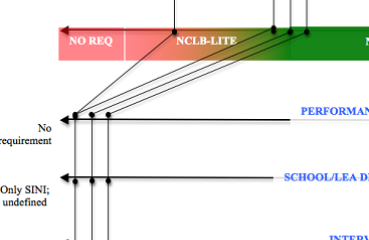
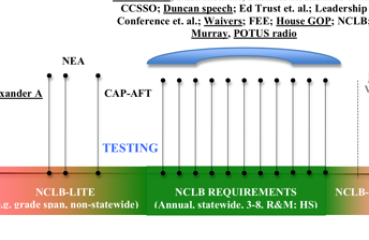
A few weeks ago, I used a graphic to show the four dimensions of federal accountability, each of which has a range of options. I then used this graphic to show the consensus for preserving NCLB testing.
A couple weeks ago, I created a graphic to help explain the contours of the debate about federal accountability in the ESEA reauthorization process.
Busting myths, but not much to cheer about
It’s fascinating—and telling—how rapidly the zillion issues tucked away in the Elementary and Secondary Education Act have been distilled down to arguments about testing.
All the pro-testing talking points you’ll ever need. Robert Pondiscio
The word around town is that support for annual testing among rank-and-file members of Congress—in both chambers and on both sides of the aisle—is dangerously low. They are constantly hearing complaints from their constituents about the overuse and abuse of standardized tests, and many are eager to do something about it.
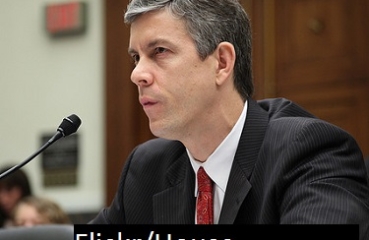
As I wrote last week, with the ESEA reauthorization process heating up, lots of advocates are now trying to influence the congressional deliberations. Secretary Duncan weighed in this morning.