Report
Standards
Common Core in the Districts: An Early Look at Early Implementers
by Katie Cristol and Brinton S. Ramsey Foreword by Amber M. Northern and Michael J. Petrilli
by Katie Cristol and Brinton S. Ramsey Foreword by Amber M. Northern and Michael J. Petrilli

Children cannot be truly literate without knowing about history, science, art, music, literature, civics, geography, and more. Indeed, they cannot satisfactorily comprehend what they read unless they possess the background knowledge that makes such comprehension possible.

Among the shortcomings of the NGSS is its acute dearth of math content, even in situations where math is essential to the study and proper understanding of the science that students are being asked to master. Also problematic is the alignment of NGSS math with the Common Core State Standards for mathematics. Appendix L of the NGSS seeks to explain the alignment and apply math more thoroughly to NGSS science. This commentary by Johns Hopkins mathematician appraises that appendix. Download Commentary on Appendix L: Alignment of the Next Generation Science Standards with the Common Core State Standards for Mathematics to read the appraisal.
With states weighing whether to adopt the Next Generation Science Standards (NGSS), a new analysis from the Thomas B. Fordham Institute compares the existing science standards of thirty-eight states with the NGSS and with exemplary standards from three other states. (The thirty-eight are those states with standards that are either “clearly inferior” to the NGSS or “too close to call,” based on our Final Evaluation of the Next Generation Science Standards and The State of Science Standards 2012.)
In the final evaluation of the Next Generation Science Standards (NGSS), the Thomas B. Fordham Institute grants the standards a C grade. The NGSS grade is superior to grades we granted to the science standards of sixteen states and the PISA framework in the State of State Science Standards 2012 but inferior to those of twelve states and the District of Columbia, as well as the NAEP and TIMSS frameworks.
The Thomas B. Fordham Institute has provided big-picture feedback and detailed, standard-specific commentary for the second draft of the Next Generation Science Standards—standards that done right, set a firm foundation upon which the rest of science education across the states will be constructed. In our comments on the first draft, we concluded that “the NGSS authors have much to do to ensure that the final draft is a true leap forward in science education.” In comments on Draft II, we address to what extent NGSS writers have moved closer to a set of K–12 science standards that even states with strong standards of their own would do well to adopt.

In May, Achieve unveiled and solicited comments on the first draft of the Next Generation Science Standards, the product of months of work by a team of writers from twenty-six states. This document provides commentary, feedback, and constructive advice that Fordham hopes the NGSS authors will consider as they revise the standards before the release of a second draft later this year.
In April 2012, Texas adopted new math standards. Fordham reviewed the draft standards and found them to be a modest improvement. But not by much, and they remain inferior to the Common Core math standards. Download the review to learn more.
Rigorous standards and aligned assessments are vital tools for boosting education outcomes but they have little traction without strong accountability systems that attach consequences to performance. This pilot study lays out the essential features of such accountability systems, intended to add oomph to new common standards and aligned assessments.
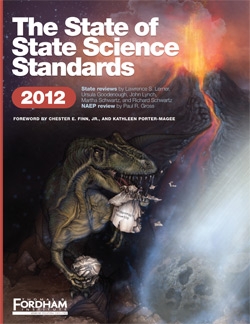
American science performance is lagging as the economy becomes increasingly high tech, but our current science standards are doing little to solve the problem.
Representatives from twenty states are hard at work developing Next Generation Science Standards—and using as their starting point the National Research Council's recently released Framework for K-12 Science Education. This review of that framework, by Paul R. Gross, applauds its content but warns that it could wind up sending standards writers off track. This appraisal find much to praise in the Framework but also raises important concerns about a document that may significantly shape K-12 science education in the U.S. for years to come. Download to learn more.
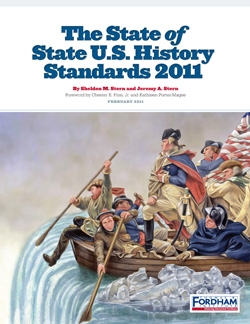
Reviewers evaluated state standards for U.S. history in grades K-12. What they found is discouraging: Twenty-eight states—a majority—deserve D or F grades for their academic standards in this key subject. The average grade across all states is a dismal D. Among the few bright spots, South Carolina earns a straight A for its standards and six other jurisdictions—Alabama, California, Indiana, Massachusetts, New York and the District of Columbia—garner A-minuses. (The National Assessment's "framework" for U.S. history also fares well.) Read on to learn how your state scored.
This study weighed existing state education standards against the Common Core education standards. The findings? The Common Core standards were clearer and more rigorous than English language arts standards in 37 states and math standards in 39 states.
How should the "common core" state standards be governed? Who will "own" these standards (and related assessments) 20 years from now? To stir smart thinking about important aspects of these issues, the Fordham Institute invited knowledgeable experts to write background papers.
The Fordham Institute's expert reviewers have analyzed the draft Common Core K-12 education standards (made public on March 10) according to rigorous criteria. Their analyses lead to a grade of A- for the draft mathematics standards and B for those in English language arts. Read on to find out more.
Expert reviewers appraise the Common Core drafts -- which outline college and career readiness standards in reading, writing, speaking and listening, and in math -- and also evaluate the reading/writing and math frameworks that undergird the National Assessment of Educational Progress (NAEP), the Trends in International Mathematics and Science Study (TIMSS) and the Programme for International Student Achievement (PISA). How strong are these well-known models?
Whether the United States should embrace national standards and tests is perhaps today's hottest education issue. For guidance in addressing it, this report looks beyond our borders. How have other countries navigated these turbid waters? What can we learn from them? Expert analysts examined national standards and testing in Brazil, Canada, China, France, Germany, India, the Netherlands, Russia, Singapore and South Korea.
Two-thirds of schoolchildren in America attend class in states with mediocre (or worse) expectations for what their students should learn. That's just one of the findings of Fordham's The State of State Standards 2006, which evaluates state academic standards. The average state grade is a 'C-minus'--the same as six years earlier, even though most states revised their standards since 2000.

Education policy leaders from across the political spectrum flesh out and evaluate several forms that national standards and testing could take.
Is America's K-12 education system preparing students for life in a global village? Unfortunately, it is not. Renowned historian Walter Russell Mead, author of this report, found that thirty-three states deserved D or F grades for their world history standards.

Science education in America is under attack, with "discovery learning" on one flank and the Discovery Institute on the other. That's the core finding of this comprehensive review of state science standards, the first since 2000. Written by pre-eminent biologist Paul R. Gross, The State of State Science Standards 2006 finds that even though the majority of states have reworked, or completely re-written, their science standards over the past five years, we're no better off now than before. The good news is that many of the standards are easily fixed. The public's anxiety about the future of our nation's scientific prowess is palpable,and reasonable. How serious are we in addressing their concerns?
Almost every week a new report or commission decries the decline of America's preeminence in science, and calls for the nation's education system to raise standards in order for our economy to remain competitive with the rest of the world. Within this context, the National Assessment Governing Board is preparing to launch a new science assessment for 2009. Curriculum developers and textbook writers are likely to follow its lead. Fordham couldn't help but wonder: is the draft science Framework up to the challenge? Using much the same criteria applied in the Foundation's state science standards reviews (due out this December), our reviewers answered: no. As author (and esteemed biologist) Paul R. Gross wrote, The Framework is an interesting start, but there is much work to be done if it is to achieve its potential usefulness.
In just more than five years, Mary Anne Stanton has led 13 Catholic schools from high-poverty Washington, D.C. neighborhoods into a consortium that has not only strengthened each school's financial health, but has also greatly improved the academic performance of the children the schools are charged with educating. To get there, she's installed a new standards-based curriculum, shaken up old bureaucratic approaches, and streamlined operations. In its latest Fwd: Arresting Insights in Education, the Thomas B. Fordham Foundation presents a compelling story of just how much change can be made by one determined school leader with a vision.
In 2002, when its voters approved a ballot measure calling for universal pre-Kindergarten by 2005-06, Florida joined a handful of states in which all children are eligible for free, publicly funded education in the year prior to Kindergarten. The passage of the referendum was cause for great optimism among those aware of the power of high-quality pre-K programs to prepare children, particularly low-income children, to meet the challenges of K-12 education. But as with any public policy initiative, the devil is in the details. In designing the half-day Voluntary Pre-Kindergarten program (VPK), the Florida legislature faced competing demands. How did they balance the trade-offs? Amy Wilkins of the Education Trust lays it out in Fordham's latest Fwd: Arresting Insights in Education.
States still have far to go in setting rigorous, high quality expectations for K-12 math instruction. Although a majority have replaced or revised their math standards since 2000, many have failed to make substantial improvements. The review was led by David Klein, Professor of Mathematics at California State University-Northridge, and evaluates the content, writing quality, and clarity of K-12 math standards in each state. Klein and his team attribute many of the shortcomings to overuse and wrong applications of manipulatives and calculators; wrong-headed guidance from the National Council of Teachers of Mathematics; and lack of true mathematics competence among those writing the standards.
Do states' current English/language arts and reading standards expect what they should? Are they demanding enough? Clear enough? Are states using them to guide not only the curriculum and assessment system for students but also their teacher-training programs? Sandra Stotsky, research scholar at Northeastern University and former senior associate commissioner in the Massachusetts Department of Education, finds that most states have revised or replaced their standards since 2000 and made some improvements, especially to K-8 standards. However, major shortcomings remain in other areas including high school literature requirements.
Co-published by the Thomas B. Fordham Foundation and AccountabilityWorks, with support from the Smith Richardson Foundation, this report looks at six elements of K-12 accountability systems in 30 different states. Each state is rated on standards, test content, alignment of tests to standards, test rigor, testing trustworthiness and openness, and accountability policies. The major conclusion: while some states have the basis of a sophisticated and rigorous accountability system in place, no state has every element of a serious standards-based education reform package in place. And few states are as open to evaluation as they ought to be.

Is there any subject as disheveled, distorted and dysfunctional as social studies? As part of our continuing effort to revitalize the subject of social studies, the Thomas B. Fordham Institute offers Effective State Standards for U.S. History: A 2003 Report Card. This groundbreaking and comprehensive state-by-state analysis of K-12 education standards in U.S. history was prepared by Sheldon Stern, historian at the John F. Kennedy Presidential Library in Boston for more than 20 years. It evaluates U.S. history standards in 48 states and the District of Columbia on comprehensive historical content, sequential development, and balance.
More than one-third of the states get low grades for the standards they have developed for teaching evolution, according to this new report. This report is the first comprehensive analysis of how each state handles evolution in its science standards for the public schools.
Science as a search for truth has come under attack from both the left and the right. This report explores four case studies of threats to the integrity of science education.