Mobile Navigation

  • National
    • Policy
      • High Expectations
      • Quality Choices
      • Personalized Pathways
    • Research
    • Commentary
      • Gadfly Newsletter
      • Flypaper Blog
    • Events
    • Scholars Program
  • Ohio
    • Policy
      • Priorities
      • Media & Testimony
    • Research
    • Commentary
      • Ohio Education Gadfly Biweekly
      • Ohio Gadfly Daily
  • Charter Authorizing
    • Application
    • Sponsored Schools
    • Resources
  • About
    • Mission
    • Board
    • Staff
    • Career
Home
Home
Advancing Educational Excellence

Main Navigation

  • National
  • Ohio
  • Charter Authorizing
  • About

National Menu

  • Topics
    • Accountability & Testing
    • Advanced Education
    • Career & Technical Education
    • Charter Schools
    • Curriculum & Instruction
    • ESSA
    • Evidence-Based Learning
    • Facilities
    • Governance
    • Personalized Learning
    • Private School Choice
    • School Finance
    • Standards
    • Teachers & School Leaders
    • Think Again
  • Research
  • Commentary
    • Gadfly Newsletter
    • Flypaper Blog
    • Gadfly Podcast
  • Events
  • Scholars Program
High Expectations

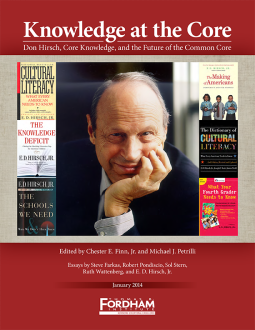
Knowledge at the Core: Don Hirsch, Core Knowledge, and the Future of the Common Core

1.22.2014
1.22.2014

Children cannot be truly literate without knowing about history, science, art, music, literature, civics, geography, and more. Indeed, they cannot satisfactorily comprehend what they read unless they possess the background knowledge that makes such comprehension possible. Yet most American primary schools have been marching in the opposite direction: treating reading only as a “skill” and pushing off history, science, art, and music “until later.”

This problem grows more serious with the advent of the Common Core State Standards for English Language Arts, which take for granted that children expected to meet those standards are being supplied with a content-rich curriculum. In far too many U.S. schools, however, that is simply not happening.

So what should we do?

Commit to implanting a sequential, content-rich curriculum in the country’s elementary and middle schools.

The essays in Knowledge at the Core: Don Hirsch, Core Knowledge, and the Future of the Common Core restate the case for such a curriculum and chart a course for the future. They also pay tribute to the decades of scholarship, service, and reform commitment of E. D. (Don) Hirsch, Jr., author of Cultural Literacy (and three other prescient books on education reform) and founder of the Core Knowledge Foundation.

DOWNLOAD Knowledge at the Core: Don Hirsch, Core Knowledge, and the Future of the Common Core as an eBook.

Kindle Download (.mobi) - Instructions on how to add the e-book to your Kindle

Nook Download (.epub)

WATCH selected panels and speeches from "A tribute to the work of E. D. Hirsch, Jr." that took place on December 4, 2013 at the Carnegie Library in Washington D. C.

Opening remarks by Sol Stern

The state of Core Knowledge: past and present

Accelerating the adoption of content-rich curricula

Keynote address by E. D. Hirsch, Jr.

____________

If you have questions about the book, please email Amber Northern.

Policy Priority:
High Expectations
Topics:
Standards
Tags: Common Core Core Knowledge Foundation English studies Sol Stern Washington
DOWNLOAD PDF

Related Resources

view
High Expectations

State Accountability in the Transition to Common Core

Victoria McDougald 5.29.2014
NationalReport
view
High Expectations

Common Core Math in the K-8 Classroom: Results from a National Teacher Survey

Jennifer M. Bay-Williams, Ann Duffett, David Griffith, Ph.D. 6.23.2016
NationalReport
Fordham Logo

© 2026 The Thomas B. Fordham Institute
Privacy Policy
Usage Agreement

National

P.O. Box 110
Burke, VA 22009

202.223.5452

[email protected]

Ohio

P.O. Box 82291
Columbus, OH 43202

614.223.1580

[email protected]

Sponsorship

130 West Second Street, Suite 410
Dayton, Ohio 45402

937.227.3368

[email protected]