Mobile Navigation

  • National
    • Policy
      • High Expectations
      • Quality Choices
      • Personalized Pathways
    • Research
    • Commentary
      • Gadfly Newsletter
      • Flypaper Blog
    • Events
    • Scholars Program
  • Ohio
    • Policy
      • Priorities
      • Media & Testimony
    • Research
    • Commentary
      • Ohio Education Gadfly Biweekly
      • Ohio Gadfly Daily
  • Charter Authorizing
    • Application
    • Sponsored Schools
    • Resources
  • About
    • Mission
    • Board
    • Staff
    • Career
Home
Home
Advancing Educational Excellence

Main Navigation

  • National
  • Ohio
  • Charter Authorizing
  • About

National Menu

  • Topics
    • Accountability & Testing
    • Advanced Education
    • Career & Technical Education
    • Charter Schools
    • Curriculum & Instruction
    • ESSA
    • Evidence-Based Learning
    • Facilities
    • Governance
    • Personalized Learning
    • Private School Choice
    • School Finance
    • Standards
    • Teachers & School Leaders
    • Think Again
  • Research
  • Commentary
    • Gadfly Newsletter
    • Flypaper Blog
    • Gadfly Podcast
  • Events
  • Scholars Program

Advanced Education

Displaying 211-240 of 266 results
Commentary
6.1.2016
Advanced Education

The importance of parent intuition and observation in recognizing highly creative children

In my work with hundreds of families, I have observed one common truth: Parents are the experts on their own children, especially when it comes to giftedness. Parents often observe certain characteristics in their children and view them as positive traits—until those same characteristics are regarded negatively in school.


Commentary
5.25.2016
Advanced Education

The importance of robust state gifted policies

If you had a magic wand and could change one thing to ensure the availability of great gifted education services for students in your community, what would it be? A state mandate? More funding? A wide array of service requirements based on what we know about giftedness and best practices for promoting the development of high-ability learners?

Commentary
5.12.2016
Advanced Education

Racial bias in gifted and talented placement, and what to do about it

The following text is an excerpt from Aiming Higher Together: Strategizing Better Educational Outcomes for Boys and Young Men of Color, an Urban Institute report authored by Ronald F. Ferguson of Harvard University.

Commentary
5.10.2016
Advanced Education

Honoring giftedness in the black community

At the turn of the twentieth century, scholars and politicians alike were wrestling with a new America. It was the end of Reconstruction, and race relations in the country were coming to the fore of the national conversation. Sociologists and politicians were embroiled in contentious discussions that would shape the nation’s development.

Commentary
5.4.2016
Advanced Education

Students need opportunities to flex their creative muscles

Although we consider creativity and critical thinking two of the most important skills today, children often have limited opportunities to flex their creative muscles. Parents and teachers need to encourage creative children to find at least one outlet, along with venues and audiences to showcase their work.

Commentary
4.29.2016
Advanced Education

America's Report Card: We're still ignoring low-income high-achievers

Chester E. Finn, Jr., Brandon L. Wright

Last week, the Department of Education released the 2015 Nation’s Report Card for twelfth graders. As with the fourth- and eighth-grade scores provided last fall, there was little to celebrate. In the core subjects of math and reading, average scores held firm at the same unimpressive level they’ve been at since 2009.

Commentary
4.21.2016
Advanced Education

No child is just born gifted: Creating and developing unlimited potential

Observing what a young person is capable of is always exciting. Many of the limits we thought children had do not seem to be as absolute as we once believed. The more we study children, the more we discover that our beliefs are limited, not the abilities of kids.Are children born gifted?

Commentary
4.19.2016
Advanced Education

San Antonio's plan to serve high-achievers

Over the past year, the Thomas B. Fordham Institute has published numerous articles (including a book) explaining how schools across the country are overlooking high-achieving poor students.

Commentary
4.6.2016
Advanced Education

Trump's rise is a wake-up call for education reformers

Robert Pondiscio

By Robert Pondiscio

Commentary
4.6.2016
Advanced Education

Dispelling the myths around gifted education

How often have you heard, “Gifted students will do fine on their own?” This is just one of the many myths that become barriers to properly educating millions of high-potential students. The following is a list of the most prevalent myths in gifted education, accompanied by evidence rebutting each of them.

Commentary
4.4.2016
Advanced Education

Let's ensure that all kids have access to gifted programs in Illinois

As a parent of three young children in Chicago Public Schools, I’m starting to get nervous.

Commentary
3.30.2016
Curriculum & Instruction, Advanced Education

How tracking can raise the test scores of high-ability minority students

David Griffith, Ph.D.

By David Griffith

Commentary
3.23.2016
Advanced Education

Challenges to the pursuit of equity in excellence

A recent report showing low levels of participation by black, Hispanic, and low-income students in the gifted and talented programs of Montgomery County underscores the significant challenges befo

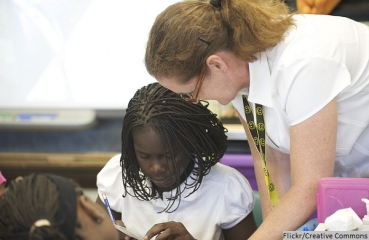
Student in a classroom
Commentary
3.16.2016
Curriculum & Instruction, Advanced Education

High-potential students thrive when school districts develop sustainable gifted services

Dina Brulles

The goal of gifted programs should reflect that of any other educational program: to engage students with appropriately challenging curricula and instruction on a daily basis and in all relevant content areas so that they can make continual academic growth.

Student in a classroom
Commentary
3.10.2016
Advanced Education

One size may fit most, but certainly not the gifted and talented

Last fall, the National Bureau of Economic Research (NBER) published a working paper by researchers Thomas S. Dee and Hans Henrik Sieversten titled The Gift of Time? School Starting Age and Mental Health. The well-developed study quantifies the effects of predicating enrollment in formal schooling on the mental health of students.

Commentary
3.2.2016
Advanced Education

Leaving talent on the table: Fixing gifted education in America

Talk is cheap.For decades, elected officials, education leaders, and others have consumed much oxygen talking about the challenges facing our nation from countries doing a much better job developing their academic talent.Despite this the reality is that we have largely failed to address this concern as many of our most talented children are being overlooked and uncultivated.

Commentary
2.3.2016
Advanced Education

Breaking the artificial ceilings we place over gifted and talented children

On January 23, the Economist sent a clear warning to world leaders about the ways that “governments are systematically preventing [youth] from reaching their potential.” In the article “Young, gifted and held back,” authors point to many polici

Undefined
9.30.2015
Advanced Education

The "Genius" edition

A suburban college readiness gap, rethinking the high school graduation age, fracking’s effect on male dropout rates, and racial density in high schools.

Book
9.15.2015
Advanced Education

Failing Our Brightest Kids: The Global Challenge of Educating High-Ability Students

Chester E. Finn, Jr., Brandon L. Wright

In Failing Our Brightest Kids, Chester E. Finn, Jr. and Brandon L. Wright argue that for decades, the United States has focused too little on preparing students to achieve at high levels.

Commentary
4.15.2015
Advanced Education

Equal Talents, Unequal Opportunities: A Report Card on State Support for Academically Talented Low-Income Students

No state does right by its “high flyers,” and most do an awful lot wrong. Michelle Lerner

Commentary
3.25.2015
Advanced Education

What Works in Gifted Education: Documenting the Effects of an Integrated Curricular/Instructional Model for Gifted Students

Amber M. Northern, Ph.D.

Another good idea limited by flawed assessments. Amber M. Northern, Ph.D.

Commentary
2.25.2015
Advanced Education

Life in the Fast Lane: Effects of Early Grade Acceleration on High School and College Outcomes

Amber M. Northern, Ph.D.

Kids who skip grades stay ahead of the pack. Amber M. Northern, Ph.D.

Commentary
2.23.2015
Advanced Education, Curriculum & Instruction

NEW from Fordham: Common Core and America's High-Achieving Students

The Education Gadfly

While the merit and politics of the Common Core State Standards (CCSS) have been much debated and discussed, one topic has been virtually ignored: What do the standards portend for America’s high-ability students?  In a new brief from Fordham, Jonathan Plucker, professor of education at the University of Connecticut’s Neag School of Education, provides guidance for districts

Commentary
2.2.2015
Charter Schools, Advanced Education

In defense of New York City's selective high schools

Derrell Bradford

This post was originally published in a slightly different form by the CUNY Institute for Education Policy.

Commentary
11.25.2014
Advanced Education, Curriculum & Instruction

Punishing achievement in our schools

Chester E. Finn, Jr.

President Obama’s contempt for the Constitution, and Secretary of Education Arne Duncan’s unfortunate disregard of that document, have been loudly and justly decried by critics of executive overreach. Less heralded, but equally troubling, is the mission creep of the Office for Civil Rights as it works to reshape the education world and to right whatever alleged wrongs it thinks it sees.

Commentary
11.12.2014
Curriculum & Instruction, Advanced Education

How to challenge voracious young readers

Give ‘em great books and get out of the way. Peter Sipe

hands raised
Commentary
6.17.2014
Advanced Education

The NYT’s gifted education ‘debate’ needs to expand

Brandon L. Wright

In its “Room for Debate” series recently, the New York Times published a quartet of opinion pieces discussing the value of gifted and talented programs.

hands raised
Commentary
4.22.2014
Advanced Education

Why does America produce so few low-income high-achieving students?

Brandon L. Wright

We know from international data—PISA, TIMSS, and so on—that other countries produce more “high achievers” than we do (at least in relation to the

Commentary
1.17.2014
Advanced Education

Yes, gifted programs improve learning

Brandon L. Wright

A recent study examined whether gifted programs benefit students at the margin: those who barely “made the cut” for admission into a program and those who barely missed it.

Commentary
12.6.2013
Advanced Education, Charter Schools

Quick hits for a Friday

Checker Finn, chagrined at the lack of attention to gifted education in the U.S., has decided to study what other nations do.

Pagination

  • First page « First
  • Previous page ‹ Previous
  • Page 1
  • Page 2
  • Page 3
  • Page 4
  • Page 5
  • Page 6
  • Page 7
  • Current page 8
  • Page 9
  • Next page Next ›
  • Last page Last »

Type

  • Book (2)
  • Commentary (227)
  • Event (5)
  • Podcast (12)
  • Report (15)

Topics

  • Accountability & Testing (503)
  • (-) Advanced Education (266)
  • Career & Technical Education (84)
  • Charter Schools (1115)
  • Curriculum & Instruction (1589)
  • ESSA (129)
  • Evidence-Based Learning (833)
  • Facilities (25)
  • Governance (1409)
  • Personalized Learning (51)
  • Private School Choice (139)
  • School Finance (167)
  • Standards (190)
  • Teachers & School Leaders (1450)

Date

  • 2026 (14)
  • 2025 (19)
  • 2024 (30)
  • 2023 (41)
  • 2022 (31)
  • 2021 (13)
  • 2020 (15)
  • 2019 (22)
  • 2018 (2)
  • 2017 (1)
  • 2016 (39)
  • 2015 (7)
  • 2014 (5)
  • 2013 (9)
  • 2012 (7)
  • 2011 (5)
  • 2009 (2)
  • 2008 (1)
  • 2007 (1)
  • 2004 (1)
  • 1998 (1)
Fordham Logo

© 2026 The Thomas B. Fordham Institute
Privacy Policy
Usage Agreement

National

P.O. Box 110
Burke, VA 22009

202.223.5452

[email protected]

Ohio

P.O. Box 82291
Columbus, OH 43202

614.223.1580

[email protected]

Sponsorship

130 West Second Street, Suite 410
Dayton, Ohio 45402

937.227.3368

[email protected]