Mobile Navigation

  • National
    • Policy
      • High Expectations
      • Quality Choices
      • Personalized Pathways
    • Research
    • Commentary
      • Gadfly Newsletter
      • Flypaper Blog
    • Events
    • Scholars Program
  • Ohio
    • Policy
      • Priorities
      • Media & Testimony
    • Research
    • Commentary
      • Ohio Education Gadfly Biweekly
      • Ohio Gadfly Daily
  • Charter Authorizing
    • Application
    • Sponsored Schools
    • Resources
  • About
    • Mission
    • Board
    • Staff
    • Career
Home
Home
Advancing Educational Excellence

Main Navigation

  • National
  • Ohio
  • Charter Authorizing
  • About

National Menu

  • Topics
    • Accountability & Testing
    • Advanced Education
    • Career & Technical Education
    • Charter Schools
    • Curriculum & Instruction
    • ESSA
    • Evidence-Based Learning
    • Facilities
    • Governance
    • Personalized Learning
    • Private School Choice
    • School Finance
    • Standards
    • Teachers & School Leaders
    • Think Again
  • Research
  • Commentary
    • Gadfly Newsletter
    • Flypaper Blog
    • Gadfly Podcast
  • Events
  • Scholars Program

The Education Gadfly Weekly

Sign Up to Receive Fordham Updates

We'll send you quality research, commentary, analysis, and news on the education issues you care about.
Thank you for signing up!
Please check your email to confirm the subscription.

The Education Gadfly Weekly: Slouching toward aristocracy

Volume 19, Number 14
4.3.2019
4.3.2019

The Education Gadfly Weekly: Slouching toward aristocracy

Volume 19, Number 14
view
Quality Choices

Are career-tech students preparing for jobs that actually exist?

To our knowledge, no study has empirically examined the degree to which CTE course-taking in high school aligns with the kinds of work available in local labor markets, as our newest report does. It shows that the country needs local business, industrial, and secondary and postsecondary education sectors to join hands. At the top of their to-do list should be better integration of what is taught in local high school CTE programs with the skills, knowledge, and positions needed in area labor markets, both now and in the future.

Amber M. Northern, Ph.D., Michael J. Petrilli 4.3.2019
NationalFlypaper

Are career-tech students preparing for jobs that actually exist?

Amber M. Northern, Ph.D. | Michael J. Petrilli
4.3.2019
Flypaper

Slouching toward aristocracy

Robert Pondiscio
4.3.2019
Flypaper

Five lessons from my time on the Maryland State Board of Education, part II

Chester E. Finn, Jr.
4.3.2019
Flypaper

Re-weaving the fabric of character

Chester E. Finn, Jr.
4.2.2019
Flypaper

The prevalence and effects of math anxiety

Jeff Murray
4.3.2019
Flypaper

The Education Gadfly Show: CTE and local labor markets

4.3.2019
Podcast

How Aligned is Career and Technical Education to Local Labor Markets?

4.3.2019
Report

Education 20/20: William Damon & Robert P. George

3.1.2019
Event
view

Slouching toward aristocracy

Robert Pondiscio 4.3.2019
Flypaper
view

Five lessons from my time on the Maryland State Board of Education, part II

Chester E. Finn, Jr. 4.3.2019
Flypaper
view

Re-weaving the fabric of character

Chester E. Finn, Jr. 4.2.2019
Flypaper
view

The prevalence and effects of math anxiety

Jeff Murray 4.3.2019
Flypaper
view

The Education Gadfly Show: CTE and local labor markets

Michael J. Petrilli, David Griffith, Ph.D., Amber M. Northern, Ph.D., Cameron Sublett 4.3.2019
Podcast
view

How Aligned is Career and Technical Education to Local Labor Markets?

Cameron Sublett, David Griffith 4.3.2019
Report
view

Education 20/20: William Damon & Robert P. George

3.1.2019
Event
view

Are career-tech students preparing for jobs that actually exist?

Amber M. Northern, Ph.D. | Michael J. Petrilli
4.3.2019
Flypaper

Not long ago, the New York Times ran a revealing article titled “The Typical American Lives Only 18 Miles From Mom.” Based on a comprehensive survey of older Americans, the authors reported that, “Over the last few decades, Americans have become less mobile, and most adults—especially those with less education or lower incomes—do not venture far from their hometowns.” In fact, “the median distance Americans live from their mother is eighteen miles, and only 20 percent live more than a couple of hours’ drive from their parents.”

The implications they drew from that compelling statistic focused on child and elder care. But there’s a big message for education, too: If young people aren’t going far from home, then their hometowns need to do far better at readying them to succeed at local colleges and in careers. Which makes it more important than ever that high school career and technical education (CTE) programs mesh with real-world job opportunities in their own and nearby communities. Yet to our knowledge no study has empirically examined the extent to which that message has been heard—that is, the degree to which CTE course-taking in high school aligns with the kinds of work available in local labor markets.

It’s not because the field thinks that’s unimportant. In fact, the recent reauthorization of the Carl D. Perkins Career and Technical Education Act—the principal federal education program supporting CTE—expressly aims to “align workforce skills with labor market needs.” But it does little to define or operationalize such alignment. Likewise, a recent report by ExcelinEd admonishes states to phase out “dead end” CTE programs that “do not reflect labor market demand” and “develop new programs of study to address gaps in industry demand.”

But broad goals and exhortation won’t get it done, and forging better connections is hard when you don’t know what those gaps in industry demand look like.

So we embarked on finding out—meaning to determine whether students in high school CTE programs are more likely to take courses in in-demand and/or high-wage industries, both nationally and locally. Reliably answering those questions, however, meant connecting multiple dots. It required mapping the zillion different CTE courses offered in U.S. high schools first to their associated “career clusters” then to real-world occupations, as categorized by the Bureau of Labor Statistics.

Those dots, to the best of our knowledge, have never been joined before—and we knew it wouldn’t be easy. Fortunately, Cameron Sublett, associate professor of education at Pepperdine University, was undeterred. Having previously examined the link between high school CTE course-taking and postsecondary credentials, Dr. Sublett was keen to see whether that same course-taking might relate to local labor market demand.

Fordham’s uber-talented senior research and policy associate, David Griffith, agreed to co-write the report with him.

After much troubleshooting, Dr. Sublett succeeded in linking nationally representative data on CTE course-taking from the High School Longitudinal Survey to employment data from the Bureau of Labor Statistics, making it possible to address these central research questions: To what extent do national CTE course-taking patterns at the high school level reflect the current distribution of jobs across fields and industries? To what extent is CTE course-taking in high school linked to local employment and industry wages? And how do patterns of CTE course-taking differ by student race and gender?

The analysis yielded four key findings.

  1. Many fields that support a significant number of U.S. jobs see little CTE course-taking in high school.
  2. In most fields, students take more CTE courses when there are more local jobs in those fields.
  3. Paradoxically, in most fields, students also take fewer CTE courses when local wages are higher. In other words, it appears that CTE is connecting students with jobs that are locally plentiful (per the previous takeaway) but relatively low-paying by industry standards.
  4. Although national CTE course-taking patterns differ significantly by race and gender, all student groups exhibit similar responses to local labor market demand.

In part, these results show that CTE programs need to do a better job of connecting students with higher-paying jobs. As recent research from the Brookings Institution and others finds, different sectors in the economy have vastly different opportunities for the kind of good jobs that allow people to make it into the middle class, especially in the absence of a college degree. But we also have a hard time finding fault with students taking CTE courses in industries that support more local jobs, even if they earn lower wages. Any job is better than no job for young people just getting started.

Regardless of how you view that trade-off, we are not suggesting that high school CTE courses should bear the full burden of connecting students to the local job market—or even that today’s local job market should govern what kids study in preparation for tomorrow’s careers.

What we are suggesting—and what these results show—is that the country needs the local business, industrial, and secondary and postsecondary education sectors to join hands. At the top of their to-do list should be better integrating what is taught in high school CTE programs with the skills, knowledge, and positions needed in local labor markets, both now and in the future—perhaps through more paid work apprenticeships and “sector strategies” that incorporate high school CTE into employer-driven partnerships that focus on regional, industry-specific needs.

In a handful of cities, such as Louisville and Nashville, industry and education leaders are already collaborating to make that vision a reality for their students. For the sake of all of the young Americans who will live no more than eighteen miles from mom, we hope that more communities follow in their footsteps.

view

Slouching toward aristocracy

Robert Pondiscio
4.3.2019
Flypaper

A little over a year ago, Education Week ran an op-ed arguing for “gradeless classrooms” and an “end to the perpetual lies” that numbers and letters tell about learning. “Honor and merit rolls would disappear. There would be no school valedictorian,” wrote an ed guru named Mark Barnes, weaving a breathless tale of schooling utopia. “Clubs that celebrate high performers would disband. Many colleges and universities would change how they admit incoming freshmen, and academic scholarships would need a makeover.”

Doug Lemov responded pointedly, almost plaintively. “The problem is that when I close my eyes and imagine a world without GPAs and report cards and tests, I don’t see Utopia,” he wrote in a blog post. “I see aristocracy.”

There will always be scarcity of high-end educational opportunities, so you have to have some way to sort it out, Lemov noted. “Meritocracy is the best way to do that, and meritocracy requires valuation,” he wrote. “When there is no grounds to judge, the elites will win all the perquisites. This is to say that when meritocracy disappears, aristocracy returns.”

Doug is a friend, so I’m biased. But in my opinion, he has done as much to advance social justice as any educator of his generation. Urban charter schools are the one unambiguous victory of the education reform era, putting the children of tens of thousands of low-income families of color on a path to college, and giving them as good a shot at upward mobility as we have currently have on offer in America. The instructional practices of many of those schools and countless others have been profoundly influenced by Lemov’s “taxonomy” as enumerated and codified in Teach Like a Champion and other books. His reward has often been abuse at the hands of critics who conflate orderly classrooms with colonialism, or who see children walking through hallways in straight lines as practice for prison. But they’ve got it backward: The children in those schools are on their way to becoming doctors, lawyers, and entrepreneurs, not felons. If there is racism at work in these high-performing charter schools (none dare call them “no excuses” schools anymore) it lies mostly within the hearts of their critics, particularly those of a certain caste—armchair social justice warriors who’ve never known a moment of fear or uncertainty over their own children’s path to college, nor any real threats to their families’ continued prosperity.

Aristocracy is returning with a vengeance. It may appear that we’re having an acute anti-privilege moment in education, driven by the Varsity Blues college admissions scandal and the ritual annual hand-wringing over the paltry numbers of black and Hispanic students admitted to New York City’s specialized high schools. But the responses and “fixes” being offered are more likely to make things worse.

If the devil’s greatest trick was to convince the world that he didn’t exist, an even greater one is being pulled off by the privileged and powerful. They have convinced their enemies to protect and extend their advantages by dismissing objecting merit under the banner of fighting for social justice. The cold, hard fact is that everything in education can and will be gamed by the affluent and privileged. That’s what privilege is. Utopian fantasies to dismantle it by persuasion, public shaming, and technocratic manipulation are naïve, unworkable or illegal. You can’t eliminate or embarrass privilege; you can only limit its influence. Yet we seem exhausted by the effort.

In the aftermath of the Varsity Blues scandal, a familiar litany of fixes is on offer to make college admissions more fair and equitable: Get rid of the common application; stop participating in the U.S. News college rankings that drive the academic and prestige arms race; and, of course, stop requiring the SAT and ACT standardized tests for college admissions. But nearly every solution to make college admissions more fair would make it more subjective. And that ensures that those who are already winning the race would maintain and extend their lead.

In a perceptive essay in The Washington Post, Jonathan Wai, Matt Brown, and Christopher Chabris observed that if the SAT were merely a test of wealth, as its critics insist, then privileged parents would not have to cheat. “In reality, they had to fake intellectual ability—the one thing they could not buy.” Campaigning to remove standardized tests from college admissions, they noted, would serve precisely the interests of “the worried one-percenter.” It would “increase the importance of extracurricular activities, interviews and athletics, and wealth provides many more options for gaming these squishy metrics,” they wrote. Advantage, aristocrats, and moneyed status-seekers.

The line between mere advantage-seeking and outright cheating and fraud is easily drawn: It is just in front of where you stand. Thus, with a clear conscience, progressive parents living in affluent zip codes can congratulate themselves for bravely choosing public schools for their children. When they employ one or more of a standing army of SAT test-preppers, it’s not an exercise in privilege hoarding but merely ensuring that their children put their best foot forward. The Varsity Blues scandal resonates so deeply because it's a scam that elites can comfortably condemn. The next level down gets uncomfortable quickly. Behind them in line, as privilege diminishes, advantages of race, class, income, and intact families come into play. At this level, the privileged need surrogates to fight their battles. Social justice warriors have eagerly entered the fray on the side of the aristocracy, arguing not to grow the number of elite educational opportunities for outstanding low-income students, but to dilute their quality and ration them in the name of equity.

All the black students offered a seat this year at New York City’s ultra-selective Stuyvesant High School could carpool together in an SUV. And their numbers are shrinking. Thirteen scored high enough on the entrance exam to earn a seat two years ago; ten last year. This year, just seven out of a freshman class of 895. Those numbers are depressing and paint an alarming picture of the education children of color have been subjected to from kindergarten until the day they sit for the competitive entrance exam. So naturally, New York Mayor Bill de Blasio and his schools chancellor, Richard Carranza, want scrap the exam entirely and admit to Stuyvesant, Bronx Science, and a handful of other so-called exam schools the top 7 percent of students from each of the city’s middle schools.

An analysis by New York City’s Independent Budget Office shows that under this scenario, 77 percent of the lowest-achieving 500 students admitted would not be proficient in English, compared with 32 percent at present. For math, the shift in academic readiness would be seismic. Had the 7 percent solution been in place for the 2017–18 school year, the analysis showed, none of the 500 lowest-scoring incoming students would be proficient in math. It strains credulity to suggest this would not dilute significantly the selective high schools’ academic quality—and, in time, the advantage that comes from attending them.

At a town hall meeting in Queens last month, congressional phenom Alexandria Ocasio-Cortez showed an intuitive grasp of the dilemma, noting that her own public school teachers didn’t understand her potential. “It wasn’t until I took a high-stakes test where I scored in the 99th percentile across the board where they figured out I did not need remedial education,” she told the crowd. “It took a test instead of understanding the child in front of them.” Her father tested into Brooklyn Tech, another of the city’s selective high schools, and left his Bronx apartment at 5:00 every morning to attend, “because it was seen as his only opportunity to have a dignified life. And he loved his experience at Brooklyn Tech, because he went to a good school.”

AOC correctly pointed out that fighting over seats in selective schools is “exactly what happens in a scarcity mindset,” but won sustained applause when she wondered aloud “why every school isn’t a Brooklyn Tech-caliber school.” The moment parents start feeling their local schools aren’t good enough, she insisted, “is the moment we should start fighting to improve them. Not to reject them.” A noble sentiment, but this is a sacrifice that no affluent parent is ever asked to consider or make. The moment they start feeling their local schools aren’t good enough is the moment they call the movers, or apply to private schools.

A sane and equity-minded public policy would seek to maximize elite educational opportunities and increase their number, not to ration them or water them down, and would seek to extend them to every qualified low-income student who can do the work. Instead, the impulse is to further ration access, kick students from an overrepresented ethnic minority out so that those from underrepresented groups might take their place, a calculation that makes sense only to those steeped in the dogma of intersectionality. Even in their relative infancy, New York City’s charter schools send black and brown graduates to competitive universities by the hundreds, numbers the exam schools cannot hope to match, and—significantly—they do so with no entrance exams or other bars to entry. Yet here, too, the impulse is not to grow these egalitarian opportunities, but to ration them. The city has bumped up against its legislated charter cap and there is little visible urgency to raise it—at least, not from City Hall.

It seems to have occurred to none of New York’s charter school leaders to use the current controversy over the specialized high schools to argue for more schools, more seats, and more opportunities for low-income students. Instead, in a scathing op-ed in the New York Daily News, KIPP’s Richard Buery attacked “the meritocracy myth” held up by “paid school consultants, tutors, and prep courses, some starting as early as kindergarten.” Students from affluent families those with parents “in the know” have a leg up, he wrote. “That includes poor Asian families who spend hundreds of hours and thousands of dollars prepping for the exam.” The argument is doubly odd: Low-income parents sacrificing and investing so that their children might have more opportunity is something we have historically celebrated, not condemned or fought over. Moreover, the success of KIPP and its charter school peers in getting low-income black and brown students to and through college is a proof point that merit is not a myth, but needs the opportunity to self-identify, to be nurtured, and to grow.

It’s an unsatisfying challenge to defend the meritocracy; it is a weak defense to say only that the alternatives are far worse. But they are foreseeably far worse. When you remove merit from the system, dismiss any hope of identifying it or pretend it does not exist at all, the advantages accrue to those who do not need to rely on merit to advance their interests. Every argument for subjectivity is an argument for aristocracy.

Likewise, it is completely understandable that those who hunger for social justice would attack the various institutions and mechanisms that appear at a glance to prop up privilege. But in doing so, they risk ceding even more to a ruling class and fighting over their crumbs.

This essay was first published by The 74.

view

Five lessons from my time on the Maryland State Board of Education, part II

Chester E. Finn, Jr.
4.3.2019
Flypaper

This is the second installment of an essay originally published by Education Next. The first included two of the five lessons the author learned during his time serving on the Maryland State Board of Education. This entry covers the other three.

Third, do your utmost to control the agenda and contain the interruptions. Every organization with a board is capable of drowning that board in so much paperwork, so many information items, and such a long list of trivial issues for review as to prevent board members from even getting enough airtime to present their ideas and raise other matters. What’s more, any veteran executive (and every state superintendent comes from that tribe!) knows that control comes from managing the agenda, paper flow, and lines of communication. At our agency, save for a handful of carefully vetted exceptions, staffers, and board members were barred from communicating directly. Everything had to channel through the front office.

The education field brings one more distraction that keeps boards from engaging with real policy issues: the impulse to fill the board’s limited time together with celebrations and recognitions of every sort. Yes, great schools and educators deserve plaudits and yes, one way of conferring those is through face time and photo ops with the state board. But the ceaseless parade of time-consuming presentations by, and accolades for, the this-or-that-of-the-year eat big chunks of what might otherwise be productive efforts to make decisions—which would ultimately lead to more education successes worthy of celebration.

After some false starts, our board leaders got better at holding planning sessions to fix the next meeting’s agenda and, in the course of the meeting, members were invited to suggest items for future meetings. But that didn’t stop the paperwork from requiring a wheelbarrow to transport, didn’t open lines of communication with agency professionals, and didn’t halt the aforementioned parade of time-consuming (albeit pleasant and gratifying) recognition events.

Fourth, be aware that sunlight sometimes burns. Many states have “government in the sunshine” or “open-meeting” laws. Maryland’s is pretty rigid: Save for obvious “executive session” matters such as personnel and quasi-judicial issues, pretty much every policy body and its sub-units must not only hold all meetings in public but must also give public notice of when and where it will meet. There’s an elaborate enforcement mechanism and a bunch of enforcement-minded attorneys.

I dare not deny the public’s right to know, and I won’t argue that rules like these weren’t meant to serve the public interest. Still, they make it exceptionally difficult for members of a board like ours to brainstorm, horse-trade, compromise—and obtain the sometimes-sensitive information that often makes for better policy. Consider the executive session when—this happened—we were considering the appeal of a district’s denial of a family’s petition to send their child to a different school. Our attorney said we were only allowed (under current regulations and precedents, blah, blah, blah) to base our ruling on whether the local board had correctly followed its own policies; we were not allowed to consider what might have been in the child’s or family’s best interest. So we started talking about whether we could change the regs so as to allow us to weigh what might be best for the child’s education. Swiftly, the attorney pounced and declared that, under the open-meeting rules, we had to hold that conversation during a public session.

That was doubtless true under the law, but it was also a fast way to freeze the pipes! Not just because, when we returned to public session, we would have had a full agenda (including beaucoup recognitions and presentations) but, even more, because as we started to feel our way toward a possible new policy in a complex and sensitive realm, it would have been next to impossible to make real progress in public, where we weren’t likely to get any staff support and where every vested interest in the state—the Maryland education/political establishment is notoriously hostile to school choice in every form—would have noted every word a board member uttered. Yes, I suppose we could have scheduled a “retreat” and gone off to hide somewhere, or held off-line phone conversations that never engaged a quorum of board members at the same time, but that would have been a costly, semi-dishonest way to create a forum in which a potentially important policy change could have gotten the kind of consideration it deserves.

Note, too, that the public sessions—now also on streaming video in Maryland—give board members with other agendas the opportunity to strut for their own audiences. This becomes a real issue when (a real example) a board member is also running for elective office and wants support from some of the very constituencies that are watching the meeting and listening to what everyone says and how everyone votes. You might think the visibility would constrain showboating and vote-pandering, but I’ve seen examples where it works just the other way.

Fifth and finally, despite all of the foregoing, don’t give up. It’s not totally hopeless. Moments of opportunity arise. Stars have been known to align. Gains, however incremental, can be made. Once in a while, the step backward is only a half-step, and then you can inch forward again.

Constrained as we were by legislators, we still managed to create a wholly new school-accountability system that was—and is—better than anything that preceded it. (Schools now get “star” ratings, for example. Gifted kids qualify as a “subgroup” whose progress must be disclosed. There’s more.) Our efforts to overhaul high-school-graduation requirements and teacher-certification practices, though resisted by stakeholders’ addiction to the status quo, coincided with the work of an influential statewide education-reform commission and produced a unified array of worthwhile, if imperfect, recommendations for change. And on those occasions when the state superintendent’s own priorities turned out to align with the board’s—well, even the bureaucracy could end up helping more than hindering!

I never despaired, but I’ve been at this sort of thing too long to be patient, and my fellow board members were too often subjected to my impatience, which occasionally morphed into outrage. But it’s hard to be patient when kids’ futures are hostage to a great, big, all-but-immovable system that’s more attuned to grownup priorities than to theirs, and when the governance of that system is encumbered by so many of its own structural and political woes.

view

Re-weaving the fabric of character

Chester E. Finn, Jr.
4.2.2019
Flypaper

As I gird my loins for several upcoming events where we will wrangle over the “social and emotional learning” approach to educating-the-whole-child, I benefited—and perhaps you could, too—from a conceptual reset, courtesy of a fine new book by Anne Snyder, who leads the “character initiative” at the Philanthropy Roundtable, of which Fordham is a member and where I once had the honor of serving on the board.

Though billed as “a wise giver’s guide to supporting social and moral renewal,” The Fabric of Character is no simple how-to-do-it manual for clueless rich folk and neophyte foundation staffers. It consists of beautifully wrought case studies of six outstanding “character-building” (or rebuilding) organizations, presented with a framework of sixteen “questions” that, in the author’s judgment, should be answered affirmatively by any enterprise that hopes to succeed in this realm. In fact, they strike me as questions that successful outfits in any realm should grapple with, such as “Does the organization have a particular identity, a thick set of norms that gets passed on to its members?” “Are there opportunities for growth and tests of character?” “Are members of the organization empowered to act, create, initiate?” And thirteen more.

Note, too, that all six entities profiled in this volume benefit from exceptional leaders—visionary, tireless, steadfast, committed. (That seems to me broadly true of all successful enterprises.)

Three of Snyder’s case studies hold particular salience for us in the education space, for those applying themselves to character education, and for those struggling to forge a robust link between it and SEL.

One is postsecondary, a fascinating look at Wake Forest University, helmed by a president who says “Character is the most pressing issue of our day, and one that institutions of higher education struggle to address.” He has set about to address it in multiple ways that will reward the attention of all who are troubled by the moral wasteland and illiberal education on offer at far too many U.S. colleges and universities.

A second case profiles a private preK–8 school network in Indianapolis—The Oaks Academy—that I had not previously encountered. Its “Christ-centered” classical education partakes of Indiana’s voucher program, enrolls about eight hundred youngsters from all sorts of backgrounds (and is growing), and immerses them in “the power of learning to find and use one’s moral muscle.” Its students, half of them poor and minority, do very well on state assessments, but they’re gaining far more than that—including what appears to be an exceptionally well-formulated blend of SEL and character education.

The third on-point profile—another such blend—is a program I wish I had known about sooner: The Positivity Project, based in Raleigh, now working in almost five hundred schools and seeking to expand to more. In other words, as the case study is titled, it’s “Character Education at Scale.” I am much impressed by the project’s itemization of twenty-four “character strengths” and wish they had been adopted by the Collaborative for Academy, Social and Emotional Learning (CASEL), the main advocacy outfit in the SEL space, in place of the generic items on its well-known “competencies wheel.” The Positivity folks aren’t ashamed of listing qualities such as “self-control,” “prudence,” and “gratitude,” along with “love of learning,” “integrity,” and “perseverance.” It’s not that they’re inherently in conflict with CASEL-style SEL. It’s that the SEL folks, while (to their credit) admitting “academics” into the temple, never offer a full-throated endorsement of character, at least not as defined in Snyder’s excellent little book.

Seeking to advance that definition, she helpfully distinguishes between two “main categories” of character: “the individualistic view, which tends to be concerned with behaviors like honoring one’s word”; and “the communitarian view” that “understands character in terms of a broad set of spiritual and moral longings that can only be satisfied through a web of vibrant communities.” She then declares that “somewhere between these two views is the truest vision. Somewhere between our need for traditional character-builders and our longing for innovative community-makers is where this inquiry needs to begin, and actually where American renewal has always begun.”

Hear, hear—and hoorah!

view

The prevalence and effects of math anxiety

Jeff Murray
4.3.2019
Flypaper

In the U.S. we call it “math phobia”; in the U.K. they call it “maths anxiety.” Either way you dub it, a negative emotional reaction to mathematics, which can manifest as a fear of or aversion to doing math-related work, is a real threat to mathematical competency. A new summary of research from the University of Cambridge adds a huge amount of detail to the picture of what causes math phobia in young people and what if anything can be done to mitigate its effects.

A 2014 report from the British organization National Numeracy showed that, while 57 percent of U.K. adults were functionally literate, just 22 percent reached the level of functionally numerate. Even worse, that rate was sinking fast. Theorizing that math anxiety could be a contributing factor, a team of researchers from Cambridge set out to examine the problem through a series of studies.

The first step: Create a survey instrument that measures math anxiety (MA) in young people, as distinct from wider test anxiety and general anxiety. This they did using an existing instrument originally geared to American adults, adjusted for U.K. educational terminology and substituting developmentally appropriate mathematical operations in the questionnaire. It was then rigorously field-tested for reliability and validity.

The next step: Use the new survey instrument, tests of math and reading ability, and interviews to determine the prevalence of math anxiety among young people. The Cambridge team studied 1,757 students from a mix of urban and rural schools throughout South East England. The sample consisted of 830 primary school students (eight and nine year olds) and 927 secondary school students (twelve and thirteen year olds). Each group of children was about evenly split between girls and boys.

The researchers found that 11 percent of the sample exhibited high MA, but they also noted that MA, regardless of intensity level, was moderately negatively correlated with mathematics performance across the entire sample. In fact, a large majority of students in this sample with high MA had average or above average math performance, a surprising result that hinted at a more complex interplay between math anxiety and math performance than had been previously theorized.

A subsequent study with a different group of 1,720 primary and secondary students delved further into that interplay, with a focus on anxiety profiles, age, and gender differences. Students were tested to determine levels of general anxiety, test anxiety, and math anxiety. Based on all these measures, students were then grouped into four “profiles” along a continuum of low to high anxiety.

Younger students exhibited less anxiety overall than older students and tended to have more similar anxiety scores across the different measures, meaning that levels of general anxiety and academic anxiety were similar for a given student. Far more of the older students evidenced a high-anxiety profile, but were more likely to have one specific area of anxiety in which they rated more highly than the other areas. Girls were more likely to exhibit across-the-board anxiety, while boys were more likely to be highest in one specific area. Consistent with the other studies, MA correlated moderately negatively with math test performance. However, the other two areas measured within the anxiety profile appeared to interact with the correlation in unexpected ways. Age and gender appeared to influence a student’s anxiety profile, leading researchers to conclude that interventions to successfully mitigate MA would need to take into account a host of factors previously not considered.

Finally, the Cambridge team conducted a qualitative study into the experiences and origins of math anxiety. They studied a small group of 120 primary and secondary students with varying levels of MA and 200 students without any signs of it. Interview questions covered a wide range of previous experiences with mathematics, and students also kept a diary documenting any memorable mathematics experiences that occurred over the course of the study period.

Differences in classroom experiences between students with and without MA fell into predicable patterns—with anxious students reporting high levels of negative feeling toward math and four times as many negative experiences. Division problems led the list of most problematic areas for students with high MA (also a source of concern for students without it), followed by fractions, decimals, and percentages. As to the origins of MA, a majority of students currently with high MA recalled that their anxiety grew when they perceived their assignments getting harder or when lowered school marks gave them “evidence” that the work was getting harder. However, a variety of other factors emerged near the top. These include confusion generated by students being taught by multiple teachers, fear of being mocked by peers, and moving up in class level when not feeling “ready” for what they perceived to be harder work. It is important to note that all of the students in the study had more or less the same experience with math—progression, specific assignments, and teachers—in their respective primary and secondary school careers.

It is, the researchers assert, each student’s experience that seems to matter. In that vein, the Cambridge team recommends several human-centric mitigation efforts. To wit, teachers and parents need to be aware that their own attitudes toward math might influence a child’s math anxiety and that gender stereotypes about mathematics suitability and ability must be avoided. Peers, too, should understand that the work itself is the most important part of math class, not comparisons between individuals. Though not a specific recommendation of the researchers, it stands to reason in the face of all this evidence that passing students along from math class to math class without mastery of concepts and skills—especially at the youngest ages—is a recipe for disaster.

SOURCE: Emma Carey, et. al., “Understanding Mathematics Anxiety: Investigating the experiences of UK primary and secondary school students,” Centre for Neuroscience in Education, University of Cambridge (March 2019).

view

The Education Gadfly Show: CTE and local labor markets

4.3.2019
Podcast
 

On this week’s podcast, Cameron Sublett, associate professor of education at Pepperdine University, joins Mike Petrilli and David Griffith to discuss the findings of Fordham’s newest report, How Aligned is Career and Technical Education to Local Labor Markets?, that he and Griffith coauthored. On the Research Minute, Amber Northern examines how the New Leaders’ Aspiring Principals Program prepares school leaders for success.

Amber’s Research Minute

Susan M. Gates et al., “Preparing School Leaders for Success Evaluation of New Leaders’ Aspiring Principals Program, 2012–2017,” RAND Corporation (February 2019).

view

How Aligned is Career and Technical Education to Local Labor Markets?

4.3.2019
Report

The recent reauthorization of the Carl D. Perkins Career and Technical Education Act—the principal federal education program supporting career and technical education (CTE)—expressly aims to “align workforce skills with labor market needs.”

How Aligned is Career and Technical Education to Local Labor Markets?, co-authored by Pepperdine University associate professor Cameron Sublett and Fordham Institute senior research and policy associate David Griffith, examines whether students in high school CTE programs are more likely to take courses in high-demand and/or high-wage industries, both nationally and locally. By linking CTE course-taking data from the High School Longitudinal Survey to employment data from the Bureau of Labor Statistics, it seeks to answer three central research questions:

  • To what extent do national CTE course-taking patterns at the high school level reflect the current distribution of jobs across fields and industries?
  • To what extent is CTE course-taking in high school linked to local employment and industry wages?
  • How do patterns of CTE course-taking differ by student race and gender?

Overall, the study finds that many fields that support a significant number of U.S. jobs see little CTE course-taking in high school, suggesting the potential for greater alignment in these areas.

Students are also more likely to take courses in fields that support more local jobs, but less likely to do so when those jobs are high-paying, suggesting that today’s CTE is connecting kids with jobs that are plentiful but low-paying by industry standards.

Finally, although national CTE course-taking patterns differ significantly by race and gender, all student groups exhibit similar responses to local labor market demand.

Because numerous studies suggest that Americans have become less mobile in recent decades, it’s more imperative than ever that the local business, postsecondary, and K–12 education sectors join hands to strengthen the connection between high school CTE programs and the local job market.

Only then will labor market “alignment” become more than a buzzword.


How aligned is CTE course-taking in 10 cities to local labor market demand?

Our study also includes CTE course-taking and employment data for ten metropolitan areas:

  • Atlanta-Sandy Springs-Marietta, GA
  • Boston-Cambridge-Quincy, MA-NH
  • Chicago-Joliet-Naperville, IL-IN-WI
  • Detroit-Warren-Livonia, MI
  • Houston-Sugar Land-Baytown, TX
  • Indianapolis-Carmel, IN
  • Los Angeles-Long Beach-Santa Ana, CA
  • New York-Northern New Jersey-Long Island, NY-NJ-PA
  • Phoenix-Mesa-Scottsdale, AZ
  • Seattle-Tacoma-Bellevue, WA

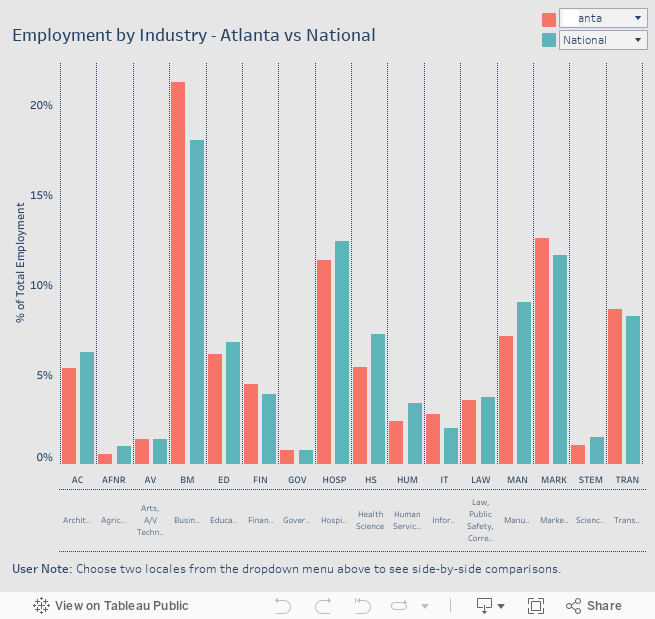
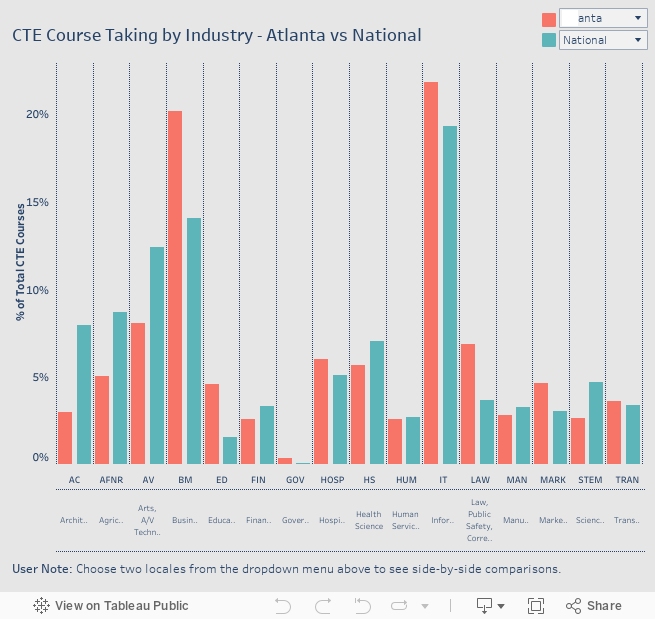
Using the interactive features below, readers can compare the data for these locations and for the country as a whole. As users will see, the specifics of the CTE story differ by location. But in most areas, there is little CTE activity in the fields that support the most local jobs. So there’s plenty of room for improvement.

Interactive Figure 1 - Employment by Industry

Example: National vs. Atlanta
Nationally, 6.2 percent of Americans are employed in the Architecture and Construction fields, compared to 5.3 percent in Atlanta.

800 ) { vizElement.style.width='655px';vizElement.style.height='619px';} else if ( divElement.offsetWidth > 500 ) { vizElement.style.width='655px';vizElement.style.height='619px';} else { vizElement.style.width='100%';vizElement.style.height='777px';} var scriptElement = document.createElement('script'); scriptElement.src = 'https://public.tableau.com/javascripts/api/viz_v1.js'; vizElement.parentNode.insertBefore(scriptElement, vizElement); //-->


Interactive Figure 2 - CTE Course-taking by Industry

Example: National vs Atlanta
Nationally, 7.9 percent of high school students take at least one CTE course in Architecture and Construction, compared to 3.0 percent in the Atlanta metro area.

800 ) { vizElement.style.width='655px';vizElement.style.height='619px';} else if ( divElement.offsetWidth > 500 ) { vizElement.style.width='655px';vizElement.style.height='619px';} else { vizElement.style.width='100%';vizElement.style.height='777px';} var scriptElement = document.createElement('script'); scriptElement.src = 'https://public.tableau.com/javascripts/api/viz_v1.js'; vizElement.parentNode.insertBefore(scriptElement, vizElement); //-->
view

Education 20/20: William Damon & Robert P. George

3.1.2019
Event

The provocative Fordham-Hoover “Education 20/20” speaker series resumes on March 26th with another star-studded duo.

William Damon will launch with the contention that schools must foster a sense of purpose in all their students and that a key strategy is to inculcate in each a “positive attachment to one’s society,” i.e. patriotism. Then Robert P. George will explain why, in both schools and colleges, good education means knowledge-seeking via open intellectual debate that challenges “one’s premises and most fundamental beliefs and values.”

William Damon is director of the Stanford Center on Adolescence, Professor of Education at Stanford, and a senior fellow at the Hoover Institution. He argues that in recent years, U.S. schools have sacrificed their obligation to educate the whole child, including fostering a sense of purpose in every student. Yet progressive hostility to real citizenship education, skittishness about distinguishing right from wrong, and over-emphasis on the pluribus over the unum have made it harder to foster that sense in young people.

In particular, Damon suggests that civic education’s failure to teach patriotic ideals has weakened students’ attachment to community and country. To combat this trend, conservatives need to champion civics and history curricular reforms in K–12 schools—and in the institutions that prepare their teachers—that foster civic purpose.

Robert P. George is McCormick Professor of Jurisprudence at Princeton University and Director of the James Madison Program in American Ideals and Institutions. He discusses the causes of—and potential cures for— “illiberalism,” which plagues colleges and schools across the country. The core problem is the institutions’ failure to give students the opportunity to consider the best arguments on competing sides of important issue. Instead, prevailing opinions are left unchallenged, which leads to dogmatism and groupthink.

To ameliorate this problem, George argues, schools must encourage intellectual humility, in which students (and instructors), in pursuit of knowledge and truth, open themselves to the possibility that their opinions are incorrect and that compelling evidence may come from those who think otherwise. This forces students to evaluate their positions, facilitates intellectual engagement, and teaches the important values of respect and civility.

Fordham Logo

© 2026 The Thomas B. Fordham Institute
Privacy Policy
Usage Agreement

National

P.O. Box 110
Burke, VA 22009

202.223.5452

[email protected]

Ohio

P.O. Box 82291
Columbus, OH 43202

614.223.1580

[email protected]

Sponsorship

130 West Second Street, Suite 410
Dayton, Ohio 45402

937.227.3368

[email protected]