Mobile Navigation

  • National
    • Policy
      • High Expectations
      • Quality Choices
      • Personalized Pathways
    • Research
    • Commentary
      • Gadfly Newsletter
      • Flypaper Blog
    • Events
    • Scholars Program
  • Ohio
    • Policy
      • Priorities
      • Media & Testimony
    • Research
    • Commentary
      • Ohio Education Gadfly Biweekly
      • Ohio Gadfly Daily
  • Charter Authorizing
    • Application
    • Sponsored Schools
    • Resources
  • About
    • Mission
    • Board
    • Staff
    • Career
Home
Home
Advancing Educational Excellence

Main Navigation

  • National
  • Ohio
  • Charter Authorizing
  • About

National Menu

  • Topics
    • Accountability & Testing
    • Advanced Education
    • Career & Technical Education
    • Charter Schools
    • Curriculum & Instruction
    • ESSA
    • Evidence-Based Learning
    • Facilities
    • Governance
    • Personalized Learning
    • Private School Choice
    • School Finance
    • Standards
    • Teachers & School Leaders
    • Think Again
  • Research
  • Commentary
    • Gadfly Newsletter
    • Flypaper Blog
    • Gadfly Podcast
  • Events
  • Scholars Program

The Education Gadfly Weekly

Sign Up to Receive Fordham Updates

We'll send you quality research, commentary, analysis, and news on the education issues you care about.
Thank you for signing up!
Please check your email to confirm the subscription.

The Education Gadfly Weekly: Remembering Rod Paige, a great American

Volume 25, Number 49
12.10.2025
12.10.2025

The Education Gadfly Weekly: Remembering Rod Paige, a great American

Volume 25, Number 49
view
Rod Paige
High Expectations

Remembering Rod Paige, a great American

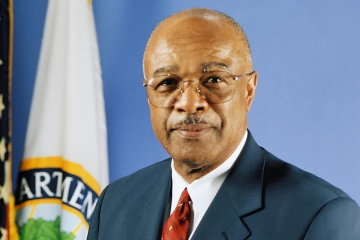
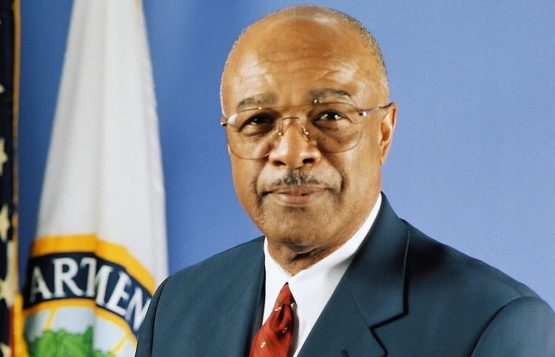
Rod Paige passed away this week. A former United States Secretary of Education, he was also a visionary, a leader, a passionate and compassionate educator, and so much more. We miss you, Rod. We will continue to miss you. We thank you for your service—to us and to the children and educators of America—and for your friendship. May you rest in peace.

Chester E. Finn, Jr. 12.10.2025
NationalFlypaper

Remembering Rod Paige, a great American

Chester E. Finn, Jr.
12.10.2025
Flypaper

The decline of human flourishing and what schools can do about it

Dale Chu
12.11.2025
Flypaper

Better schools start with better school board elections

David Griffith, Ph.D. | Jill Hoppe
12.11.2025
Flypaper

Do short-term noncredit programs boost earnings?

Preston Cooper
12.11.2025
Flypaper

Is the “college enrollment crisis” a myth? | Episode 998 of The Education Gadfly Show

12.10.2025
Podcast

The good, the bad, and the best research of 2025 | Episode 999 of The Education Gadfly Show

12.17.2025
Podcast
view
Sad student

The decline of human flourishing and what schools can do about it

Dale Chu 12.11.2025
Flypaper
view
Voting booths

Better schools start with better school board elections

David Griffith, Ph.D., Jill Hoppe 12.11.2025
Flypaper
view
Truck driver

Do short-term noncredit programs boost earnings?

Preston Cooper 12.11.2025
Flypaper
view
Matt Barnum headshot

Is the “college enrollment crisis” a myth? | Episode 998 of The Education Gadfly Show

Matt Barnum, Michael J. Petrilli, David Griffith, Ph.D., Brian R. Fitzpatrick, Ph.D. 12.10.2025
Podcast
view

The good, the bad, and the best research of 2025 | Episode 999 of The Education Gadfly Show

Michael J. Petrilli, David Griffith, Ph.D. 12.17.2025
Podcast
view
Rod Paige

Remembering Rod Paige, a great American

Chester E. Finn, Jr.
12.10.2025
Flypaper

I first glimpsed Rod Paige a few days after Bush 43 was inaugurated when Rod and the President both strode into the East Room—no giant gilded ballrooms back then—to announce their plans for what became No Child Left Behind. In my memory they were both wearing cowboy boots. (I’m almost certain Rod was.)

He of course was fresh from his previous post as Superintendent of Houston schools and already an education hero for me because of the support he provided Mike Feinberg and Dave Levin, starting back in 1994, in turning KIPP from a bold idea into the most celebrated early charter-school success. And then he helped other charter starters. And then more. All this in a vast city at a time when nearly all his peers around the country would rather vomit than say charter and rather sit on a porcupine than advance school choice in any way. Charters were new then, few existed; Texas allowed for them but only feisty, forward-looking entrepreneurs who cared about kids had the gumption to launch them—and Rod was probably the only Lone Star superintendent who actively encouraged them. He could see the promise for kids who needed it. But that wasn’t all. He and a remarkable team, backed by a great board and key community leaders, also launched a dozen important reforms for kids within the system, too.

Visionary. Leader. Passionate/compassionate educator. Bold. So much more. No wonder W turned to him to help transform the nation’s K–12 system. No wonder Rod said yes. No wonder NCLB came about swiftly—in the immediate aftermath of 9/11—and no wonder Rod fast-tracked it into implementation. And then presided over an amazing team at USDOE through W’s first term, a time when America’s schools made remarkable progress, especially for our neediest kids.

After which—I’m honored to recall—Rod agreed to Mike Petrilli’s and my plea that he join the Fordham board. Where he distinguished himself for 18 great years, invariably a source of wisdom and well-founded skepticism, as well as encouragement, humor, and true friendship. He always wanted to know if something we had in mind would help kids, especially the kids who need help. How would we know if it worked? Was there a better way to go about it? Had we thought about the practicalities, as well as the theory and the data? If we wanted to close a low-performing charter school in our role as authorizer, where would the children go? And so much more.

We were sad when age caused him to depart our board a few years ago, but we’ve stayed in touch ever since. We’ve been helping some gifted folks begin to work on a proper biographical tribute.

Because that’s the other thing about Rod. His career story already belongs to America. But his life story is just as amazing, from childhood in segregated Mississippi to the nation’s 7th EdSec—not to mention civil rights pioneer, super football coach, and ed-school dean. This isn’t the place to recount it in full. But recount and recall it we must. For it makes him more of an American hero than almost anybody appreciates.

We miss you, Rod, cowboy boots and all. We will continue to miss you. We thank you for your service—to us and to the children and educators of America—and for your friendship. May you rest in peace.

view
Sad student

The decline of human flourishing and what schools can do about it

Dale Chu
12.11.2025
Flypaper

Our society is failing its most important task: fostering human flourishing. And schools aren’t helping. Far too many students graduate unprepared to think critically, navigate community, or develop the resilience needed to face life’s challenges. To be clear, many of these capacities aren’t fully captured by grades or tests, and efforts to broaden how we think about success are often well intentioned. The problem is that in expanding the definition, we’ve too often let go of the core.

Making matters worse, the metrics we do rely on to assess education quality—grades, graduation rates, and state assessments—paint a misleadingly rosy picture. A growing number of states have quietly tinkered with cut scores to create the illusion of proficiency. Meanwhile, official statements from state education agencies resemble the “this is fine” meme, sunny proclamations in the middle of a five-alarm fire.

Many observers warn that these shortcomings will only become more consequential as AI and automation take on a growing share of human labor. In a future where traditional work may become less central, human flourishing will depend even more on our ability to create meaning, sustain social bonds, and govern ourselves well. Schools play a critical role here: Strong foundations in academics and character equip students to think clearly, communicate effectively, and manage complex social and civic situations. Academic decline is therefore both a consequence and a cause of societal fragility—a vicious circle we risk amplifying unless schools prepare students to flourish now and in the decades ahead.

That dynamic is no longer theoretical. This disconnect between reported success and actual preparedness burst into public view with last month’s University of California San Diego report showing that hundreds of incoming freshmen—many of them straight-A high schoolers who took trigonometry and even calculus—need remedial support in math skills that are typically  taught in elementary and middle school. The findings broke out of the ed policy bubble and into the mainstream, drawing coverage and commentary from, among others, Kelsey Piper, Rose Horowitch, and Megan McArdle, whose Washington Post column put it bluntly: The signs of educational decline are now impossible to ignore.

McArdle’s assessment captured the crux of the matter:

Instead of rectifying disparities in preparation and achievement, people decided it would be simpler to adjust the measurements. Parents opposed standardized testing, got their kids disability diagnoses that allowed them extra time on tests and lobbied teachers to change bad grades. Exhausted teachers responded with grade inflation, which also helped conceal that low-income and minority kids weren’t doing as well as their richer and White peers. Progressive educators watered down curriculums, gutted gifted and talented programs, and weakened admissions standards for honors classes and magnet schools. Colleges dropped standardized testing requirements, in part because that made it easier to diversify their student body. None of these things happened everywhere, but they happened in many places, and all of them made it harder to see—or rectify—pandemic-era learning loss.

On his Plain English podcast, Derek Thompson describes this moment not as a series of isolated incidents or mere academic decline but as a structural unraveling. Widespread weakness in math, logic, and basic skills does more than shrink individual prospects. It undermines human flourishing itself. A society less able to reason, deliberate, and solve problems together is more vulnerable to polarization, mistrust, and civic breakdown.

This matters for schools because human flourishing is not just about what skills students will need, but what kind of people and institutions they will depend on. And right now, we’re not doing well on either front. If, in the AI age, traditional employment is no longer the default, the need for civic strength—shared norms, personal responsibility, functioning schools, and a foundation of common decency—will only intensify. Put simply, a society already rattled by institutional decay may not handle the stresses of technological and social change well.

How, then, should schools navigate these crosscurrents? A few practical implications follow:

1. Elementary schools should rethink the use of screens and focus unapologetically on the basics.

Literacy and numeracy remain the foundation of everything that follows. In a moment when screens increasingly crowd out sustained attention, these core skills matter more, not less. The battle for successful students is largely won or lost in the early years, and no amount of technology can compensate for shaky fundamentals. If AI is going to do more of the cognitive heavy lifting later in life, students will still need a strong baseline of reading, writing, and mathematical reasoning to avoid becoming passive consumers of machine-generated answers.

2. High schools need major reform.

We talk about “K–12” as if it were a single system, but grades 9–12 operate under different pressures, incentives, and cultural expectations than elementary and middle schools. They are credentialing factories, social sorting mechanisms, and increasingly performance venues for AI-assisted content. High schools are long overdue for a redesign that emphasizes real mastery over performative achievement and pushes students toward genuine readiness for life after high school, whether that means work, vocational training, or higher education. A good place to start would be a zero-based budgeting approach for high school course requirements, as proposed by my colleague Mike Petrilli.

3. The link between high school and higher ed is ripe for retooling.

Selective college admissions is now an arms race in which students use AI to polish their application essays while colleges use AI to screen them. At some point, one must ask: What are we doing? The entire high-school-to-college pipeline is predicated on assumptions about work and prosperity that may not hold. If college becomes less relevant—or at least less economically determinative—high schools will need to rethink their purpose, and colleges will need to reconsider how they evaluate applicants in a world where higher education is just one of several options.

4. Civic formation will matter more in a post-work world.

If fewer people work in the traditional sense, schools will inevitably bear some responsibility for shaping citizens capable of navigating a world with more free time, more technological mediation, and greater uncertainty. This doesn’t mean schools should try to shoulder every formative task—that would let families, communities, and civic institutions off the hook—but they do have a distinctive role in teaching habits of thought, resilience, and responsible decision-making that are hard to cultivate elsewhere.

The best approach is to focus on what schools are uniquely equipped to do: help students cultivate gratitude for the contributions of others, foster optimism without naivete, and encourage resilience in the face of real challenges. It means teaching them to engage thoughtfully with community and country, without indoctrination, and equipping them to navigate a culture that often emphasizes doom and gloom in ways that actively undermine their chances to flourish.

—

Even if AI and robotics displace more of our everyday lives, the need for human networks and connections only grows. Elon Musk, in a recent interview, remarked that students could still go to college, but “for social reasons.” It sounds flippant, but the subtext is important: Relationships, community, and social capital will matter more in a world where traditional work is no longer inevitable. The real test for schools is whether they will produce young people who feel capable, connected, and ready to participate or whether they deepen the despair already sapping the country’s confidence.

view
Voting booths

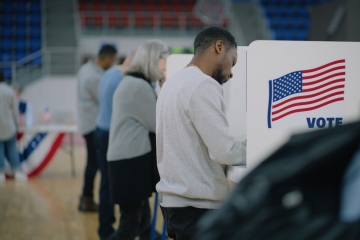
Better schools start with better school board elections

David Griffith, Ph.D. | Jill Hoppe
12.11.2025
Flypaper

Like the other elections that took place last month, the one that decided who would serve on the Albuquerque Public Schools Board was characterized by record turnout.

A decade ago, less than 7 percent of eligible voters participated in Albuquerque’s local school board elections. But things changed in 2019, after New Mexico moved its local elections from February to November. This year, initial counts suggest at least a third of eligible voters helped choose the individuals charged with overseeing—and perhaps improving—the city’s schools. That’s worth celebrating, even if we don’t love the outcome of this particular election.

In a 2021 Education Next survey, 39 percent of American adults said they didn’t know if their local school board members were elected (nearly all are), and another 5 percent said they were appointed (which isn’t typical). Yet, despite Americans’ confusion, local school boards decide how the hundreds of billions of dollars the U.S. devotes to K–12 education are spent, who becomes superintendent, and which reading, math, science, and social studies curricula local schools use.

Stakes like those should command the attention of parents and taxpayers. Yet, in practice, turnout for school board elections is often pitifully low. In Newark, New Jersey, where the public schools serve more than 40,000 students, only 2.8 percent of eligible voters cast a ballot in the 2024 school board election. Meanwhile, nearly 70 percent of Newark students are reading below grade level.

In a recent study conducted by Michael Hartney and David Houston and published by Fordham, Who’s on Board? School Boards and Political Representation in an Age of Conflict, we asked more than 5,000 school board members in more than 3,000 school districts across the country about their views on education issues such as school choice and curriculum.

The results confirm what many families feel: School boards are insulated from the communities they serve. For example, 25 percent of school board members are current or former public school teachers—a dynamic that can make hearings feel like internal staff meetings, albeit the kind that are periodically interrupted by angry parents.

Or consider the racial composition of boards. While the percentage of Americans who are white has declined by 10 percentage points since 2001, the percentage of White board members has risen ever-so-slightly. Meanwhile, the percentage who are Hispanic has barely budged, and the share who are Black has actually declined.

Strikingly, most board members admit that their elections aren’t competitive: Just one in five describe them as “vigorously contested.” Consequently, they also diverge from the public on major issues. For example, 75 percent of board members give their local schools an A or a B, compared to 51 percent of all U.S. adults. Meanwhile, just 29 percent of board members support charter schools, compared to 45 percent of the public.

This disconnect is not inevitable, but it is structural. Which means that fixing it requires more than a snappy campaign slogan or a good election cycle.

First and perhaps most importantly, the 36 states with “asynchronous” school board elections should follow New Mexico’s example and move them so they coincide with general elections, which have much higher turnout and are thus more representative.

Second, secretaries of state and local election offices should include school board elections in their official voter guides, so they are more visible to and accessible by voters who aren’t attending every local board meeting.

Finally, education reform groups and community organizations should actively recruit and support a broader, more representative pool of candidates who better reflect their increasingly diverse communities and their perspectives.

From budgets to bus routes, local school board elections have important consequences. Making them more democratic—by boosting turnout, helping voters who want to make informed decisions grasp the stakes, and ensuring that every community has a voice—is a messy but essential step towards public schools that work.

Editor’s note: This was first published by The 74.

view
Truck driver

Do short-term noncredit programs boost earnings?

Preston Cooper
12.11.2025
Flypaper

Students in short-term workforce education programs will soon get some help covering tuition costs. The recently-passed One Big Beautiful Bill Act expands Pell Grants to workforce programs as short as eight weeks or 150 clock hours in duration. Historically, federal funding for postsecondary education has skewed toward traditional degree programs. The new Workforce Pell Grants level the playing field, helping more students access high-quality workforce education and fill needed jobs.

Workforce Pell Grants also contain a great policy innovation: Funds may only go to programs that deliver strong economic outcomes. To qualify for grants, a program must ensure that its graduates’ earnings three years after completion exceed 150 percent of the federal poverty line ($23,475 in 2025) plus the price of tuition. Programs that leave students earning low wages cannot qualify.

A new report by Peter Riley Bahr and Rooney Columbus highlights the importance of the accountability system in Workforce Pell. Bahr and Columbus analyze nearly 130,000 students who enrolled in short-term, noncredit programs offered by community colleges in Texas. They observe students’ earnings before and after enrollment to discern whether the workforce education program produces a boost in wages.

1

Source: Bahr & Columbus (2025)

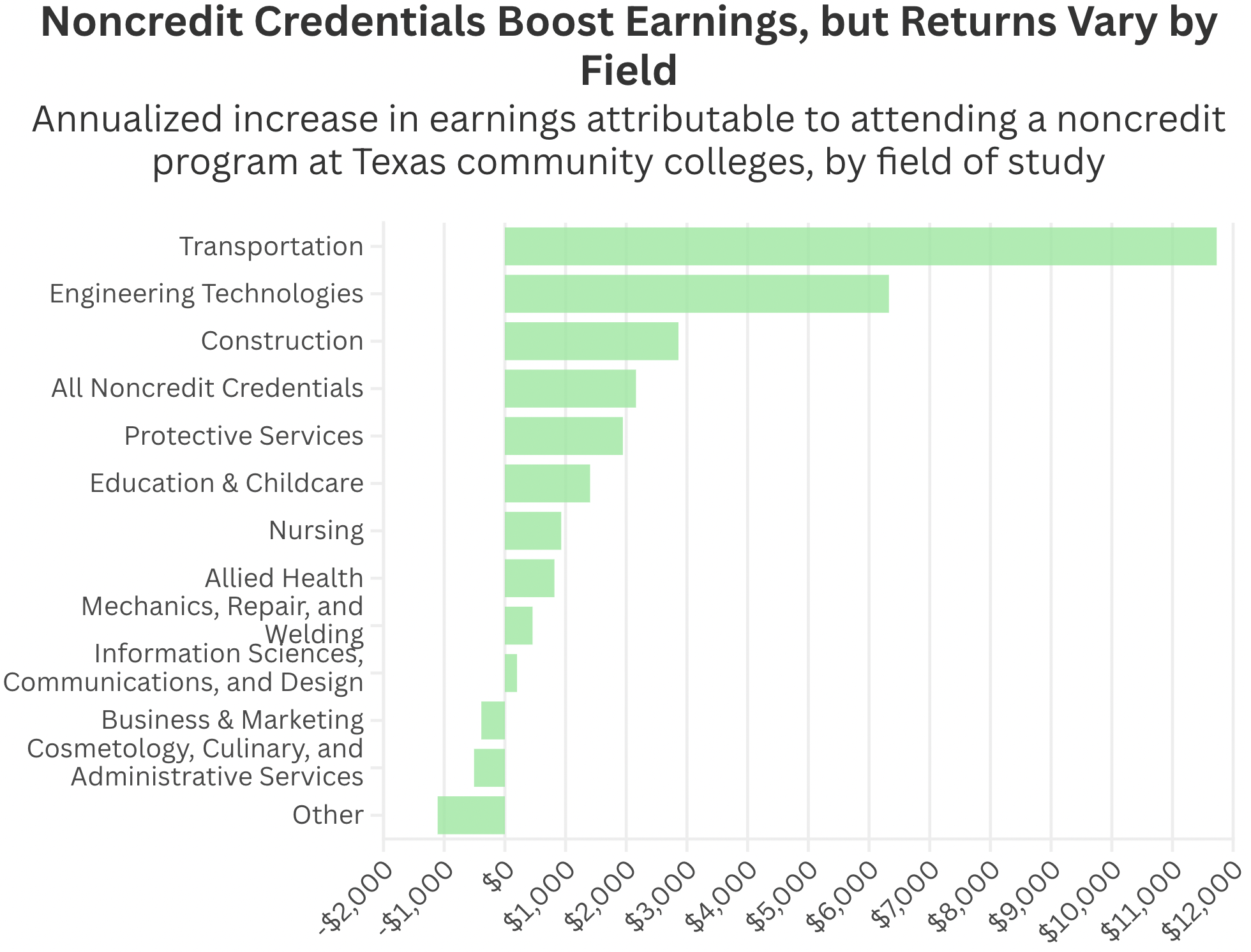
Overall, enrolling in a workforce program leads to a $2,160 annualized increase in earnings above trend, or about a 4 percent raise. But the results vary considerably depending on the type of workforce program. Just as the returns to a four-year college degree are contingent on your major, the returns to workforce education depend on your field of study.

Workforce programs in the transportation field (mostly commercial vehicle operation) led to an annualized earnings increase of nearly $12,000. Students in engineering technologies programs—which include occupational safety technology, petroleum technology, and manufacturing engineering technology—saw a salary increase of over $6,000.

But students in other fields fared worse. Changes in earnings for cosmetology students, business students, and communications and design students were statistically indistinguishable from zero. Even welding—which typically provides a decent return for longer-duration programs—seems to have less economic value for shorter-term courses. Other fields like education and protective services saw only small increases in earnings.

To be sure, not all the programs that Bahr and Columbus analyzed would be eligible for Workforce Pell Grants. Only one-fifth of the courses in the authors’ dataset exceed the 150-clock-hour minimum to qualify for funds (the average duration was around 90 clock hours). But those which would qualify for grants posted stronger outcomes. For students in courses lasting 150 to 300 clock hours, earnings rose by $4,800 per year, compared to $2,160 for the full sample.

The report also provides context on why workforce education programs are so appealing. The 90-hour average duration is ideal for workers who want to gain additional skills but can’t take extended time off to return to school. Community colleges also offer workforce programs year-round, rather than tying them to academic semesters, so workers can enroll when it suits them.

Bahr and Columbus’s findings highlight the opportunity of Workforce Pell Grants—and the importance of strong guardrails. Short-term workforce education can be a pathway to higher wages, but the particular field of study matters. That’s why the accountability framework attached to Workforce Pell Grants will be so critical to the success of the program: It will ensure that federal funding only flows to courses of the highest quality.

Editor’s note: This was first published by the American Enterprise Institute.

view
Matt Barnum headshot

Is the “college enrollment crisis” a myth? | Episode 998 of The Education Gadfly Show

12.10.2025
Podcast
 

This week, we’re joined by Matt Barnum, Chalkbeat’s Ideas editor, to unpack whether college enrollment is truly declining—or whether the national narrative has gotten ahead of the data. 

Then, on the Research Minute, Fordham’s new national research manager Brian Fitzpatrick highlights evidence from D.C. Public Schools showing that teacher monitoring improves instruction and student outcomes—especially for teachers under pressure to raise test scores. 

Recommended content: 

  • Is college enrollment really plummeting? — Matt Barnum, Chalkbeat Ideas
  • It’s Too Early to Write Off College Degrees —Callum Borchers, The Wall Street Journal
  • Does Monitoring Change Teacher Pedagogy and Student Outcomes? —Aaron Phipps, Journal of Labor Economics, The University of Chicago Press Journals (2025)

Feedback Welcome: Have ideas for improving our show? Send them to [email protected]

view

The good, the bad, and the best research of 2025 | Episode 999 of The Education Gadfly Show

12.17.2025
Podcast
 

This week, Mike Petrilli looks back at the highs and lows of education reform in 2025 as we wrap up our final episode of the year.

Then, on the Research Minute, David Griffith closes things out with a countdown of his top five studies of 2025—plus one bonus pick.

Recommended content:

  • Wonkathon 2025: What will make science of reading laws succeed? —Thomas B. Fordham Institute

  • 2025 Eddies —PIE Network

  • Was 2025 a good year for education reform? —Michael J. Petrilli, SCHOOLED

Have you subscribed to Schooled? Don’t miss out on the education reform community’s hot takes! Click the link below:

David’s Top Research Minutes of 2025

5. Gender Gaps in the Early Grades: Questioning the Narrative that Schools are Poorly Suited to Young Boys

  • Featured in Episode 988

4. How Test Optional Policies in College Admissions Disproportionately Harm High-Achieving Applicants from Disadvantaged Backgrounds

  • Featured in Episode 955

3. When Decentralization Works: Leadership, Local Needs, and Student Achievement

  • Featured in Episode 985

2. The Effects of Universal School Vouchers on Private School Tuition and Enrollment: A National Analysis

  • Featured in Episode 986

1. Who Wants to Be a Teacher in America?

  • Featured in Episode 992

Bonus: The Impact of Cell Phone Bans in Schools: Evidence From Florida

  • See also: Cutting the cord: Early evidence on cellphone policy implementation —Alicia Anderson, Thomas B. Fordham Institute

--

Feedback Welcome: Have ideas for improving our show? Send them to [email protected]

Fordham Logo

© 2026 The Thomas B. Fordham Institute
Privacy Policy
Usage Agreement

National

P.O. Box 110
Burke, VA 22009

202.223.5452

[email protected]

Ohio

P.O. Box 82291
Columbus, OH 43202

614.223.1580

[email protected]

Sponsorship

130 West Second Street, Suite 410
Dayton, Ohio 45402

937.227.3368

[email protected]