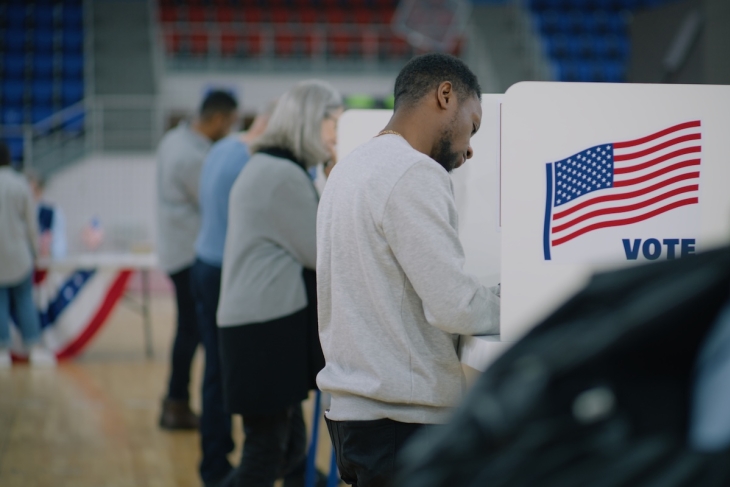
Like the other elections that took place last month, the one that decided who would serve on the Albuquerque Public Schools Board was characterized by record turnout.
A decade ago, less than 7 percent of eligible voters participated in Albuquerque’s local school board elections. But things changed in 2019, after New Mexico moved its local elections from February to November. This year, initial counts suggest at least a third of eligible voters helped choose the individuals charged with overseeing—and perhaps improving—the city’s schools. That’s worth celebrating, even if we don’t love the outcome of this particular election.
In a 2021 Education Next survey, 39 percent of American adults said they didn’t know if their local school board members were elected (nearly all are), and another 5 percent said they were appointed (which isn’t typical). Yet, despite Americans’ confusion, local school boards decide how the hundreds of billions of dollars the U.S. devotes to K–12 education are spent, who becomes superintendent, and which reading, math, science, and social studies curricula local schools use.
Stakes like those should command the attention of parents and taxpayers. Yet, in practice, turnout for school board elections is often pitifully low. In Newark, New Jersey, where the public schools serve more than 40,000 students, only 2.8 percent of eligible voters cast a ballot in the 2024 school board election. Meanwhile, nearly 70 percent of Newark students are reading below grade level.
In a recent study conducted by Michael Hartney and David Houston and published by Fordham, Who’s on Board? School Boards and Political Representation in an Age of Conflict, we asked more than 5,000 school board members in more than 3,000 school districts across the country about their views on education issues such as school choice and curriculum.
The results confirm what many families feel: School boards are insulated from the communities they serve. For example, 25 percent of school board members are current or former public school teachers—a dynamic that can make hearings feel like internal staff meetings, albeit the kind that are periodically interrupted by angry parents.
Or consider the racial composition of boards. While the percentage of Americans who are white has declined by 10 percentage points since 2001, the percentage of White board members has risen ever-so-slightly. Meanwhile, the percentage who are Hispanic has barely budged, and the share who are Black has actually declined.
Strikingly, most board members admit that their elections aren’t competitive: Just one in five describe them as “vigorously contested.” Consequently, they also diverge from the public on major issues. For example, 75 percent of board members give their local schools an A or a B, compared to 51 percent of all U.S. adults. Meanwhile, just 29 percent of board members support charter schools, compared to 45 percent of the public.
This disconnect is not inevitable, but it is structural. Which means that fixing it requires more than a snappy campaign slogan or a good election cycle.
First and perhaps most importantly, the 36 states with “asynchronous” school board elections should follow New Mexico’s example and move them so they coincide with general elections, which have much higher turnout and are thus more representative.
Second, secretaries of state and local election offices should include school board elections in their official voter guides, so they are more visible to and accessible by voters who aren’t attending every local board meeting.
Finally, education reform groups and community organizations should actively recruit and support a broader, more representative pool of candidates who better reflect their increasingly diverse communities and their perspectives.
From budgets to bus routes, local school board elections have important consequences. Making them more democratic—by boosting turnout, helping voters who want to make informed decisions grasp the stakes, and ensuring that every community has a voice—is a messy but essential step towards public schools that work.
Editor’s note: This was first published by The 74.