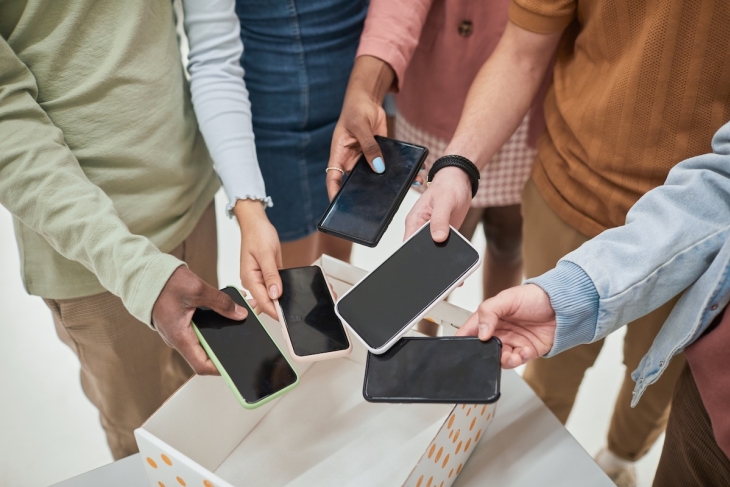
Most U.S. students currently or will soon attend a school with a cellphone policy. Phone bans provide cover for teachers and administrators lamenting the constant fight for kids’ limited attention in the classroom, and most teachers support enforceable policies that limit student use during instructional time. Opponents are often parents of school-age children with concerns both dramatic (what if I can’t reach my kid in an emergency?) and practical (is there soccer practice after school today?).
Given the paucity of empirical evidence to support them, school cellphone bans are effectively policymaking by vibe. The research literature is particular sparse in the U.S. context, and existing data are both mixed and complicated by the pandemic’s disruption. Hence the value of David Figlio and Umut Özek’s new working paper on a Florida district’s cellphone policy implementation. The researchers pull demographic, testing, discipline, and attendance data to compare pre- and post-cellphone ban results, using a quasi-experimental design to determine whether there is a causal connection between policy and outcomes. The findings, though not presently peer-reviewed, provide evidence that supports cellphone ban policies generally and bell-to-bell bans specifically.
In July 2023, Florida enacted HB 379, prohibiting student cellphone use during instructional time in K–12 schools.[1] Figlio and Özek draw on data from a large urban district that went further, requiring devices to be silenced and out of sight throughout the entire school day. Using student data from the district and Advan smartphone activity data to understand cellphone use at the building level, they classify schools by high or low cellphone use before the policy implementation in 2023. They use a difference-in-differences approach to compare test scores, disciplinary records, and attendance data pre- (2022–23) and post-policy shift in the high- and low-cellphone activity schools to see whether the ban had a causal effect on student outcomes during its first two years (2023–24 and 2024–25).
The ban successfully got kids off their phones—estimated building-level cellphone use by students dropped by about two-thirds within the first two months and remained low in the two years studied. Unsurprisingly, however, implementation presented notable challenges.
Disciplinary incident rates in the high-cellphone use schools went up in the first year of the ban relative to the low-use comparison schools, with an estimated 12 percent increase in overall suspensions and a 20 percent increase in in-school suspension rates compared to the low-use schools—both driven disproportionately by large increases among Black students. Disciplinary issues improved in the second year, but these improvements were driven by reductions in elementary school incidents; rates for middle and high schools were better than in year one but out-of-school suspensions remained elevated compared to pre-ban levels.
Academic outcomes improved under the ban. During the spring testing window at the end of the ban’s second year, scores in previously high-cellphone activity schools were up 1.1 percentiles overall relative to low-cellphone activity schools, with larger effects for boys (1.4 percentiles) and for middle and high school students who are more likely to have access to a phone (1.3 percentiles). Effects were not statistically significant for girls or elementary school students.
Those modest but promising gains should be viewed against the backdrop of other policy changes. The 2022–23 school year marked a major shift for state assessments, with SB 1048 eliminating the Florida Standards Assessment (FSA) in favor of new thrice-annual FAST assessments, which benchmark twice and then use the spring results for higher-stakes accountability purposes. The overhaul led Figlio and Özek to start their analysis with 2022–23 data rather than merging previous pandemic-era FSA results, but it’s possible that the small improvements stem from building-level differences in adjusting to the new tests. The study measures FAST academic outcomes only for grades 3–10 (English language arts) and grades 3–6 (math).
More importantly, unexcused absences dropped 5 to 10 percent under the new policy, making it difficult to disentangle the academic achievement effects of simply attending school from effects of the ban itself. Figlio and Özek suggest that up to half of the academic gains may be attributable to better attendance, especially among middle and high schoolers.
Why are more kids showing up for class under the new policy? This question falls outside the scope of this study but has real implications for both policy formation and for school leaders trying to build stakeholder buy-in during implementation.
I asked a few teachers, parents, and teens for their take on the attendance findings, and several suggested fear of missing out when friends are engaging in person at school. Others told me with confidence that the inability to quickly text home for a pick-up without trekking to the main office to call via landline under the glaring eyes of the office staff contributes to more kids spending their school day in the classroom. June 2025 data from the NCES School Pulse survey support this theory—more than half of respondents listed “parent apathy” as a reason why middle and high school students miss too much school.
School culture doesn’t exist in a vacuum, and changing behavior isn’t easy—especially when it requires shifting parent behavior alongside student habits. It’s worth remembering that many current high school students got their first devices during the pandemic, when cellphones became one of the few ways to stay socially connected during lockdowns and were a key academic tool for students without access to computers or to reliable internet. Parents are adjusting to new norms after years of constant contact with their teens; the bans provide some cover against student and parent pushback while school leaders help their communities adapt.
Figlio and Özek show that cellphone policies can drive modest academic achievement gains and significantly boost attendance, providing empirical evidence that supports the gut feelings of many policymakers and educators. Compared to policies that limit cellphone use only during instructional time, full bell-to-bell bans may create more opportunities for student engagement but also more opportunities for infractions. To guard against bias in disciplinary actions, school leaders should monitor enforcement approaches carefully and systematically code cellphone-related infractions. As more schools implement cellphone bans, robust data collection can inform attempts to develop appropriate digital device policies and healthy shared norms among students, families, and schools.
Source: Figlio, David N. and Umut Özek, “The impact of cellphone bans on student outcomes: Evidence from Florida.” NBER Working Paper No. 34388. National Bureau of Economic Research (October 2025).