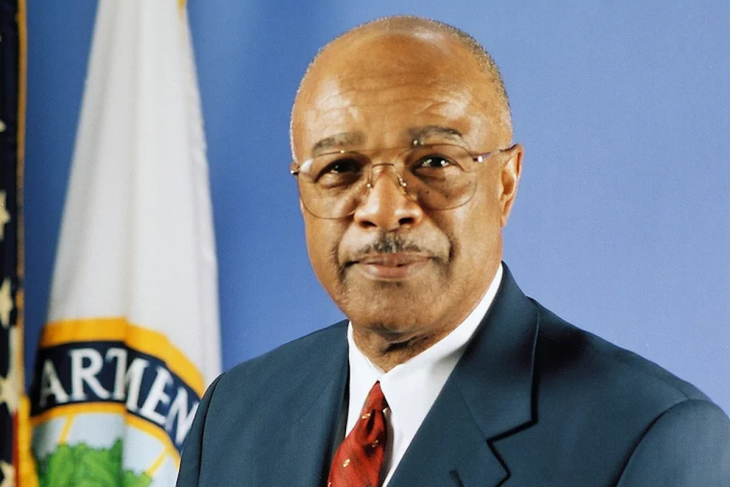
I first glimpsed Rod Paige a few days after Bush 43 was inaugurated when Rod and the President both strode into the East Room—no giant gilded ballrooms back then—to announce their plans for what became No Child Left Behind. In my memory they were both wearing cowboy boots. (I’m almost certain Rod was.)
He of course was fresh from his previous post as Superintendent of Houston schools and already an education hero for me because of the support he provided Mike Feinberg and Dave Levin, starting back in 1994, in turning KIPP from a bold idea into the most celebrated early charter-school success. And then he helped other charter starters. And then more. All this in a vast city at a time when nearly all his peers around the country would rather vomit than say charter and rather sit on a porcupine than advance school choice in any way. Charters were new then, few existed; Texas allowed for them but only feisty, forward-looking entrepreneurs who cared about kids had the gumption to launch them—and Rod was probably the only Lone Star superintendent who actively encouraged them. He could see the promise for kids who needed it. But that wasn’t all. He and a remarkable team, backed by a great board and key community leaders, also launched a dozen important reforms for kids within the system, too.
Visionary. Leader. Passionate/compassionate educator. Bold. So much more. No wonder W turned to him to help transform the nation’s K–12 system. No wonder Rod said yes. No wonder NCLB came about swiftly—in the immediate aftermath of 9/11—and no wonder Rod fast-tracked it into implementation. And then presided over an amazing team at USDOE through W’s first term, a time when America’s schools made remarkable progress, especially for our neediest kids.
After which—I’m honored to recall—Rod agreed to Mike Petrilli’s and my plea that he join the Fordham board. Where he distinguished himself for 18 great years, invariably a source of wisdom and well-founded skepticism, as well as encouragement, humor, and true friendship. He always wanted to know if something we had in mind would help kids, especially the kids who need help. How would we know if it worked? Was there a better way to go about it? Had we thought about the practicalities, as well as the theory and the data? If we wanted to close a low-performing charter school in our role as authorizer, where would the children go? And so much more.
We were sad when age caused him to depart our board a few years ago, but we’ve stayed in touch ever since. We’ve been helping some gifted folks begin to work on a proper biographical tribute.
Because that’s the other thing about Rod. His career story already belongs to America. But his life story is just as amazing, from childhood in segregated Mississippi to the nation’s 7th EdSec—not to mention civil rights pioneer, super football coach, and ed-school dean. This isn’t the place to recount it in full. But recount and recall it we must. For it makes him more of an American hero than almost anybody appreciates.
We miss you, Rod, cowboy boots and all. We will continue to miss you. We thank you for your service—to us and to the children and educators of America—and for your friendship. May you rest in peace.