
Students in short-term workforce education programs will soon get some help covering tuition costs. The recently-passed One Big Beautiful Bill Act expands Pell Grants to workforce programs as short as eight weeks or 150 clock hours in duration. Historically, federal funding for postsecondary education has skewed toward traditional degree programs. The new Workforce Pell Grants level the playing field, helping more students access high-quality workforce education and fill needed jobs.
Workforce Pell Grants also contain a great policy innovation: Funds may only go to programs that deliver strong economic outcomes. To qualify for grants, a program must ensure that its graduates’ earnings three years after completion exceed 150 percent of the federal poverty line ($23,475 in 2025) plus the price of tuition. Programs that leave students earning low wages cannot qualify.
A new report by Peter Riley Bahr and Rooney Columbus highlights the importance of the accountability system in Workforce Pell. Bahr and Columbus analyze nearly 130,000 students who enrolled in short-term, noncredit programs offered by community colleges in Texas. They observe students’ earnings before and after enrollment to discern whether the workforce education program produces a boost in wages.
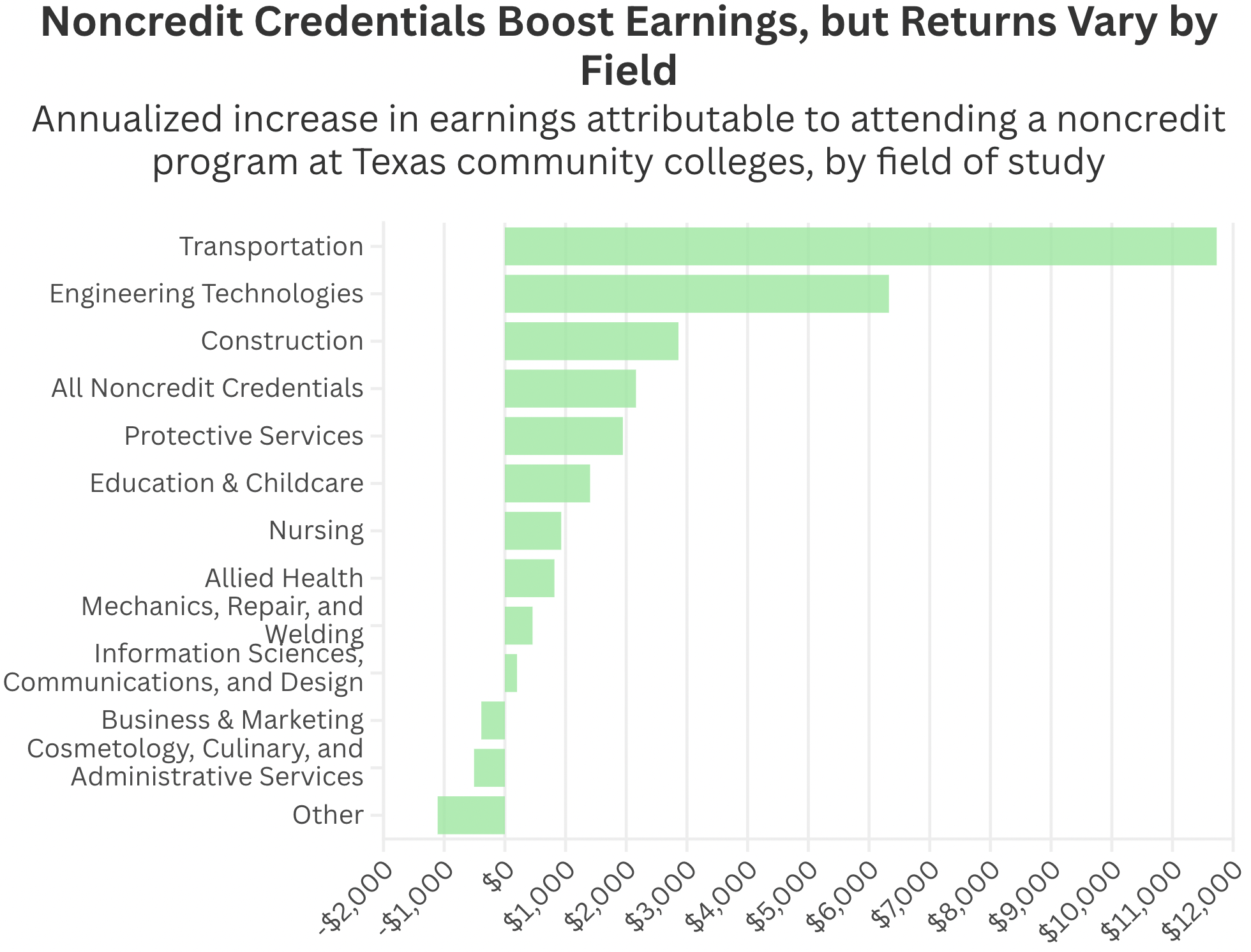
Source: Bahr & Columbus (2025)
Overall, enrolling in a workforce program leads to a $2,160 annualized increase in earnings above trend, or about a 4 percent raise. But the results vary considerably depending on the type of workforce program. Just as the returns to a four-year college degree are contingent on your major, the returns to workforce education depend on your field of study.
Workforce programs in the transportation field (mostly commercial vehicle operation) led to an annualized earnings increase of nearly $12,000. Students in engineering technologies programs—which include occupational safety technology, petroleum technology, and manufacturing engineering technology—saw a salary increase of over $6,000.
But students in other fields fared worse. Changes in earnings for cosmetology students, business students, and communications and design students were statistically indistinguishable from zero. Even welding—which typically provides a decent return for longer-duration programs—seems to have less economic value for shorter-term courses. Other fields like education and protective services saw only small increases in earnings.
To be sure, not all the programs that Bahr and Columbus analyzed would be eligible for Workforce Pell Grants. Only one-fifth of the courses in the authors’ dataset exceed the 150-clock-hour minimum to qualify for funds (the average duration was around 90 clock hours). But those which would qualify for grants posted stronger outcomes. For students in courses lasting 150 to 300 clock hours, earnings rose by $4,800 per year, compared to $2,160 for the full sample.
The report also provides context on why workforce education programs are so appealing. The 90-hour average duration is ideal for workers who want to gain additional skills but can’t take extended time off to return to school. Community colleges also offer workforce programs year-round, rather than tying them to academic semesters, so workers can enroll when it suits them.
Bahr and Columbus’s findings highlight the opportunity of Workforce Pell Grants—and the importance of strong guardrails. Short-term workforce education can be a pathway to higher wages, but the particular field of study matters. That’s why the accountability framework attached to Workforce Pell Grants will be so critical to the success of the program: It will ensure that federal funding only flows to courses of the highest quality.
Editor’s note: This was first published by the American Enterprise Institute.