Mobile Navigation

  • National
    • Policy
      • High Expectations
      • Quality Choices
      • Personalized Pathways
    • Research
    • Commentary
      • Gadfly Newsletter
      • Flypaper Blog
    • Events
    • Scholars Program
  • Ohio
    • Policy
      • Priorities
      • Media & Testimony
    • Research
    • Commentary
      • Ohio Education Gadfly Biweekly
      • Ohio Gadfly Daily
  • Charter Authorizing
    • Application
    • Sponsored Schools
    • Resources
  • About
    • Mission
    • Board
    • Staff
    • Career
Home
Home
Advancing Educational Excellence

Main Navigation

  • National
  • Ohio
  • Charter Authorizing
  • About

National Menu

  • Topics
    • Accountability & Testing
    • Advanced Education
    • Career & Technical Education
    • Charter Schools
    • Curriculum & Instruction
    • ESSA
    • Evidence-Based Learning
    • Facilities
    • Governance
    • Personalized Learning
    • Private School Choice
    • School Finance
    • Standards
    • Teachers & School Leaders
    • Think Again
  • Research
  • Commentary
    • Gadfly Newsletter
    • Flypaper Blog
    • Gadfly Podcast
  • Events
  • Scholars Program

The Education Gadfly Weekly

Sign Up to Receive Fordham Updates

We'll send you quality research, commentary, analysis, and news on the education issues you care about.
Thank you for signing up!
Please check your email to confirm the subscription.

The Education Gadfly Weekly: Most parents want schools to teach children social and emotional skills

Volume 21, Number 32
8.12.2021
8.12.2021

The Education Gadfly Weekly: Most parents want schools to teach children social and emotional skills

Volume 21, Number 32
view
High Expectations

The vast majority of parents want schools to teach children social and emotional skills

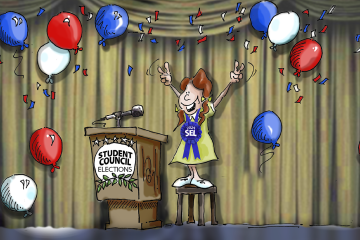
The biggest takeaway of our new report, "How to Sell SEL," is that most moms and dads want their children to acquire social and emotional skills and think that schools have a role in making that happen, even as they recognize the key role that they and other family members play. Read more.

Amber M. Northern, Ph.D., Michael J. Petrilli 8.12.2021
NationalFlypaper

The vast majority of parents want schools to teach children social and emotional skills

Amber M. Northern, Ph.D. | Michael J. Petrilli
8.12.2021
Flypaper

State civics and U.S. history standards are less politically biased than before. Let’s keep it that way.

Jeremy A. Stern, Ph.D.
8.12.2021
Flypaper

Can changing our eduspeak help with post-pandemic schooling?

Dale Chu
8.12.2021
Flypaper

A chilling effect: School board composition and charter schools

Amber M. Northern, Ph.D.
8.12.2021
Flypaper

Want great teachers and higher achievement? A study from Wisconsin suggests trying flexible pay.

Aaron Churchill
8.12.2021
Flypaper

The Education Gadfly Show #782: Whatever you do, don’t call it social and emotional learning

8.12.2021
Podcast

Cheers and Jeers: August 12, 2021

The Education Gadfly
8.12.2021
Flypaper

What we're reading this week: August 12, 2021

The Education Gadfly
8.12.2021
Flypaper
view

State civics and U.S. history standards are less politically biased than before. Let’s keep it that way.

Jeremy A. Stern, Ph.D. 8.12.2021
Flypaper
view

Can changing our eduspeak help with post-pandemic schooling?

Dale Chu 8.12.2021
Flypaper
view

A chilling effect: School board composition and charter schools

Amber M. Northern, Ph.D. 8.12.2021
Flypaper
view

Want great teachers and higher achievement? A study from Wisconsin suggests trying flexible pay.

Aaron Churchill 8.12.2021
Flypaper
view

The Education Gadfly Show #782: Whatever you do, don’t call it social and emotional learning

David Griffith, Ph.D., Adam Tyner, Ph.D., Amber M. Northern, Ph.D. 8.12.2021
Podcast
view

Cheers and Jeers: August 12, 2021

The Education Gadfly 8.12.2021
Flypaper
view

What we're reading this week: August 12, 2021

The Education Gadfly 8.12.2021
Flypaper
view

The vast majority of parents want schools to teach children social and emotional skills

Amber M. Northern, Ph.D. | Michael J. Petrilli
8.12.2021
Flypaper

America’s hardnosed focus on academic achievement in recent decades has not improved schools nearly enough. Part of the recent move to incorporate other educational goals, such as perseverance and self-discipline—often under the banner of “social and emotional learning” (SEL)—is a response to our schools and students still being off track two decades after passage of No Child Left Behind and almost four decades after A Nation at Risk. Some of the fervor around SEL also stems from longstanding beliefs about teaching the “whole child” and the obligation of schools to develop well-rounded individuals and good citizens. Indeed, much of SEL—such as the expectation that students learn to practice self-control, navigate social situations, and empathize with others—is as old as education itself.

The mental-health challenges imposed by the Covid-19 pandemic have also deepened the need to better support students’ social and emotional needs as they acquire cognitive skills and knowledge.

Yet some worry that a focus on SEL will take precious time and attention away from academics, which also took a hit from the pandemic. And the SEL terminology itself is nebulous, jargony, and off-putting to parents who want schools to focus on the three R’s or who worry that it might be code for liberal indoctrination.

If the “Common Core wars” taught us anything, it’s that mishandling communication about education reforms can derail good intentions.

We at Fordham wanted to gain greater clarity on what parents of K–12 school children think about SEL, how they understand it, whether they see it as more help or hindrance, and whether they have any concerns about its implementation. Understanding where parents agree or disagree and how their perspectives might split based on their racial, political, and religious backgrounds can help those on the ground to implement SEL in ways that reaffirm familial preferences, values, and priorities.

So in our new report, How to Sell SEL: Parents and the Politics of Social-Emotional Learning, we partnered with YouGov, a global public-opinion firm, to develop and field a nationally representative survey of 2,000 parents. Fordham’s associate director of research Adam Tyner willingly served not only as author of the report, but also data analyst and project manager.

The report is chockablock with notable insights and compelling data. We encourage you to read through them and see for yourself. For those in a hurry to get to the bottom line, however, here are our five key findings:

  1. There is broad support among parents for teaching SEL-related skills in schools, although the term “social and emotional learning” is relatively unpopular.

  2. Democratic parents favor schools allocating additional resources to SEL more than Republican parents do. They’re also more comfortable with the terminology.

  3. Across the political spectrum, parents regard families as the most important entities for cultivating SEL, yet there are partisan differences regarding how and where to emphasize SEL instruction.

  4. Republicans are somewhat more wary than Democrats that SEL might divert schools away from academics or conflict with their own values.

  5. Differences by parents’ race, class, and religion are rarely as pronounced as differences by political affiliation.

Based on those results, Tyner distills four policy implications, including recommending that SEL proponents focus on specifics rather than nebulous concepts. Faced with specifics such as schools teaching sensitivity to different cultures, parents get it and express approval, but abstract phrasing loses a lot of them. In addition, parents of all political stripes support indirect approaches to imparting the lessons of SEL, such as having teachers model common decency and common sense for their students.

The biggest takeaway? This is a good news story (and we’re desperately in need of those)! The vast majority of parents want their children to acquire social and emotional skills and think that schools have a role in making that happen, even as they recognize the key role that they and other family members play. Parents are also mindful of tensions if SEL gets pitted against academics—so let’s not do that! Because, while parents agree overall that there is often not enough time in the day to teach both academics and SEL, that does not deter them from wholeheartedly supporting that schools teach all the SEL-related skills included in our survey.

But here’s a cautionary flag: Republican parents especially hate the term “social and emotional learning.” The preferred term for parents of both parties? “Life skills.” Yep, that’s right. We’re well aware that verbiage may elicit eye rolls, but we’d be wise to pay attention.

So, to answer our report’s title, how do you sell SEL to parents? Discuss it concretely, honor the role of families in its development, and—whatever you do—do not call it social and emotional learning.

view

State civics and U.S. history standards are less politically biased than before. Let’s keep it that way.

Jeremy A. Stern, Ph.D.
8.12.2021
Flypaper

In 2020, as we began to look at state U.S. history standards for the first time since 2011, I was concerned about what we would find. Educational materials have long been prone to lean left (though there have been notorious examples of rightward bias in local curricula, textbooks, and more), and that was certainly the pattern we found in 2011: Too many standards pushed teachers and students to judge the past by the standards of the present without regard to context, and thus to condemn the past as an unalloyed story of oppression and evils. There was also, at the same time, a dramatic and worrying example of bias from the right. The justly notorious 2010 Texas standards went to the opposite extreme, actively downplaying and factually distorting injustices in the American past, including the centrality of slavery in causing the Civil War.

With our national divisions growing more obvious than ever over the last decade, I feared that context-free presentism would have grown more entrenched in many blue states, while additional red states would have followed Texas’s lead, pushing an ideological and inaccurate narrative of historical perfection.

Instead, to my considerable surprise, there was an all-around improvement. Obvious ahistorical presentism was less prominent than it had been in 2011. Indeed, several states now specifically warned against presentism. A number of states’ standards, including many of the strongest, directly urged students to understand both the formative power of America’s founding ideals and the nation’s long and still incomplete struggle to make those ideals a reality for all—precisely the balance that U.S. history education should always strive for. Meanwhile, my fear that Texas’s ideological manifesto would become a model for other states’ standards not only hadn’t been realized, but Texas itself had revised its contentious standards in 2018. A number of the more obviously ideological items were made significantly more balanced and factual.

But where are things heading next?

America’s culture wars only continue to escalate, and standards may not stay above the fray indefinitely. Pressure is coming from both sides. On the one hand, there is a continuing insistence that America must be seen solely as a tainted nation, with injustice as the essence of its being. On the other, there is an alarming and escalating denial of any negatives in our past (or present), ironically borrowing language from the left to attack any discussion of such realities as “divisive,” “hurtful,” and “racist.”

The most visible recent flashpoint from the left has arguably been the 1619 Project. These materials centered on inherently valid goals: promoting knowledge of slavery’s enormous importance in American history and combating its persistent legacy of racial inequality. But, as too often happens in American history education, it too easily slid into an oversimplified picture of America as built on little more than bigotry and lies. The Project correctly identified slavery as a central, inescapable, and foundational element of U.S. history—but it ran into trouble by effectively claiming that slavery is the only defining factor in our past, branding America’s founding ideals as little more than a set of deliberate lies concocted to protect slavery and white supremacy. (The project’s author, Nikole Hannah-Jones, has made some changes in response to criticism from prominent historians, including altering a particularly problematic passage to more accurately say that just “some” founders supported revolution to protect the slave system.)

Pressure from the right can too easily slide to the opposite extreme. Too many end up pushing a complete whitewash, while denouncing any other perspective as “unpatriotic.” That was certainly the case with President Trump’s 1776 Commission, which instead of trying to place slavery and racism in better historical context, largely sought to downplay them as incidental tangents to a narrative of national glorification.

To further confuse issues, many on the right have lately latched onto a once fairly obscure academic discipline as a catch-all label for a supposed conspiracy against patriotic pride: critical race theory.

In its actual academic form, critical race theory (or CRT) studies race as a social construct, the use of racial concepts in societal power dynamics, how racial attitudes become and remain embedded in culture and institutions, and how unequal racial power dynamics affect both the marginalized and the privileged. Like any academic discipline, CRT is defined and invoked differently by different practitioners, some more radical than others.

Even more to the point, until this recent politicized explosion, few beyond academia had even heard of CRT, let alone used it as a core element of public school curricula. The right has adopted the term as a convenient bugbear—presumably because it can easily be made to sound like “being critical of people for their race,” and because it suggests a single, organized “movement” that can be neatly targeted for purgation. Unfortunately, even thoughtful conservative educational analysts have been overly prone to adopt the misleading label in criticizing liberal priorities, and the media has been lazily credulous in adopting the term—feeding an unhelpful narrative of insidious infiltration by a sinister, anti-American dogma.

The dire picture invoked through the critical race theory label claims that students are being indoctrinated to see our national past as purely evil and discriminatory (a concern that has some degree of validity, as, for example, more measured and substantive criticisms of the 1619 Project show). Yet all too often, the “solutions” offered are no better than the ills they claim to counter. A string of new state laws banning critical race theory from schools have the alarming potential to discourage any meaningful discussion of past injustices, and perhaps even more, any acknowledgment that racism remains a force in American society today. Students must be taught that America’s ideals are far more than mere lies. But they should not be taught that our past is a story of uncomplicated triumphs, in which fundamental injustices and long (unfinished) struggles for change are brushed aside.

Too many on the left would proudly embrace the precisely opposite mantra. We see it in growing, contentious demands to remove all monuments to the founders (and even to Lincoln), who are to be seen only in light of their (unquestionable, important, and sometimes self-admitted) flaws, and thus not to be honored for their vital contributions to the nation.

The choice must not be between a left-wing absolutism, insisting that positive ideals in America’s past are mere lies concocted to justify oppression, and a right-wing absolutism, denying that discrimination was and is a fundamental part of our nation’s history. Such dichotomies are dangerously false, allowing each extreme to feed off and fuel the other. America, and its classrooms, need to understand both 1619 and 1776. E Pluribus Unum does not mean all Americans must be subsumed into a single feel-good narrative, or that teaching many strands of our national experience is “divisive” or “segregated.” And neither should diversity deny any sense of shared American heritage.

The best state standards have it right: we need to emphasize the power and uniqueness of America’s founding ideals, while also studying the many and ongoing struggles to make those ideals fully real. As the culture wars rage, we will see if those admirable successes by California, Alabama, Massachusetts, and other states can be protected and sustained.

Editor’s note: Dr. Jeremy Stern was lead reviewer for the Thomas B. Fordham Institute’s recent report, The State of State Standards for Civics and U.S. History in 2021.


view

Can changing our eduspeak help with post-pandemic schooling?

Dale Chu
8.12.2021
Flypaper

The radio show Marketplace recently ran a piece asking, “Can changing home appraisal language help close the wealth gap?” The story examined structural racism in the housing market, specifically the wealth gap that persists as a result of Black and Hispanic families having their homes undervalued because of their race. Apparently, Fannie Mae believes it can alleviate this long-standing problem by getting rid of racially-loaded language from home appraisals, purging terms like “crime-ridden” and “affordable neighborhood.” A similar effort has been underway in education as schools swing their doors open into a world of continued uncertainty, with forceful pushback against the term “learning loss.”

In both housing and schooling, the well-intentioned goal of this effort is to make the choice of language more objective and less racist. To wit, Fannie Mae says that “integrated community” should be avoided because it puts a subjective emphasis on demographics rather than focusing on the property. Those who are wary of “learning loss” posit that it stigmatizes an entire generation of children—especially those from poor, Black, and Hispanic communities. What’s more, housing and schooling are intrinsically linked, both in terms of property values and educational opportunity.

I have no problem with examining the assumptions behind the words we use. The intergenerational wealth gap is real. Deficit thinking in schools and the soft bigotry of low expectations are real. But in education, it too often seems like more time and energy are being spent in the spin room—think “unfinished learning,” “interrupted learning,” “learning lag,” “missed learning,” “learning recovery,” etc.—than on forcefully tackling the many grave problems we now face.

This disposition towards navel-gazing was the thrust of an incisive Twitter thread last week by Bellwether Education Partners’ Hailly T.N. Korman. She writes:

It isn’t a deficit mindset about kids or families to acknowledge that they are experiencing a problem. If your third grader can’t read, that’s a problem. If your algebra student doesn’t have automaticity with multiplication, that’s a problem. If your physics student doesn’t know algebra, that’s a problem. If your high-school graduate isn’t prepared for college or work, that’s a problem. Schools and districts and states and other professionals in the education sector should be figuring out how to fix this problem, not arguing about what to call it (or worse, pretending that it isn’t one).

To be fair, words are not nothing, but words alone won’t count for much with teachers and principals when it comes to getting students back on track this fall. The ship has already sailed on “learning loss,” but even if you could do away with it and other terms that might offend, the replacement terminology won’t help students read, write, add, or subtract any better. Besides which, what happened to the old adage about sticks and stones?

The phrase “achievement gap” has also become a lightning rod of late, with anti-racism activist Ibram X. Kendi arguing that we shouldn’t use it because (he believes) the tests that reveal these gaps are inherently racist. Kendi also seems to suggest that making mention of the “achievement gap” somehow pressures Black and Hispanic students to feel inferior. Not only does this view fly in the face of overwhelming evidence to the contrary, but the criticisms of “learning loss” and “achievement gap” reflect an ethos whose fixation on wordplay has been allowed to trump difficult conversations about who is and isn’t academically prepared.

For better or worse, this haggling over language is symptomatic of a larger problem where, as pundit Jonah Goldberg puts it, “we think words have eldritch energies that can transform reality if we really, really mean it.” On the one hand, there’s an allure to finding just the right word or phrase that threads the needle between dueling ideas. On the other hand, the focus on “learning loss” versus (take your pick) distracts from the knottier work of helping students pick up the pieces from the last eighteen months. What’s worse, euphemistically making information more complicated or difficult to understand doesn’t alter the reality of the underlying information.

Consider brightbeam’s Chris Stewart on this vernacular brouhaha:

I get the inclination to want to rephrase things because you have a political or sociological goal, but that’s not actually in keeping with reality. I’ve often joked that you could call it “dry cleaning” if you wanted. But the phenomenon beneath what you’re calling it is the same, and the most truthful way to term that is an achievement gap.

Or Goldberg again, this time on Fannie Mae:

Not everything is subtext, some things are just, you know, text. Some neighborhoods are, in fact, crime-ridden. Some are safe, some are not. Some have good schools, some don’t. The communities that are safe and have good schools are—regardless of race—more desirable than ones that are not.

You can do a lot with words, but words are not magic. If you think that home buyers—and mortgage lenders—won’t find other ways to get accurate information just because of some new mandate to make appraisals more difficult to parse, you’re not only foolish, you’re begging for punishment from the god of unintended consequences.

Sure, appraisers should reflect on their use of such terms, but the focus on words elides the actual work of getting rid of crime and making neighborhoods safe. Educators and policymakers should notice the similarities and recognize that, to Korman’s point, the obsession with “learning loss” belies the difficult task ahead of “fixing the problem” wrought by the pandemic. As it stands, too many people seem to act as if changing the way we speak about vexing issues is somehow a solution to those problems.

view

A chilling effect: School board composition and charter schools

Amber M. Northern, Ph.D.
8.12.2021
Flypaper

In states as diverse as West Virginia, Florida, and Iowa, decisions regarding the creation, expansion, and possible extinction of charter schools rest with the elected school boards of traditional districts. Such arrangements arise from an entrenched doctrine of local control, which many take to mean that only elected boards can run schools, despite much evidence to the contrary. These boards can also curb enrollment in charters, so as to prevent students from having educational choices beyond their zoned district schools. While it is difficult to examine empirically the impact of school board composition on charter schools, an interesting new working paper makes a novel effort to do so.

School board composition is endogenously determined via the electoral process—meaning, for instance, that factors like district teacher salaries or student performance may influence who runs for office and whom voters ultimately elect. By leveraging a well-established empirical phenomenon called the ballot order effect—which has repeatedly shown that the candidate listed at the top of the ballot gains an electoral advantage—two economists from Syracuse University and the University of Rochester sought to overcome these methodological hurdles. Taking advantage of California’s randomized ballot ordering process, they estimated the causal effects of an additional educator elected to the board (conditional on the share of educators in the candidate pool) on various outcomes, including total enrollment in charter schools within the district, the number of district-authorized charter schools, teacher salaries, student achievement, and high school graduation.

They constructed school board candidate rosters for California spanning nearly two decades, which include each candidate’s vote shares, their ballot position, electoral outcome, and occupational background—which they use to categorize them as educators or not. They merge those records with school district characteristics and other dependent variables, including teacher salaries and student outcomes. Their sample includes over 14,000 candidates in California school board races between 1998 and 2015. Descriptively, 16 percent of candidates were educators and the average share of educators on each school board was 18 percent.

There are four key findings. First, an educator randomly assigned to the top of the ballot increases the number of educators elected by 0.14 individuals—an effect that equates to a 26 percent increase—which obviously shifts the composition of the overall board. Second, an additional educator elected to the board reduces charter school enrollment beginning two years post-election, with the effect peaking at four years post-election; whereas the number of charters decreases starting one year after the focal election, and continues linearly through six post-treatment years. Each additional educator elected to the board causes a 3-percentage-point decline in the charter enrollment share and 1.3 fewer charter schools in the district four years after the election. Third, the top ballot assignment leads to increases in certified teacher salaries (about 2 percent on average), which rises over time and shows a simultaneous shift away from capital outlay costs. Presumably reductions in the latter help to fund bumps in pay. Fourth, there are no impacts on high school graduation rates, but small decreases in reading scores are observed in the first three years after the focal election, before rebounding towards zero.

Importantly, survey data show that educators are more likely to be union-endorsed. In many ways, then, these findings reinforce what other studies have found. That is, union representation predicts higher teacher salaries and potentially negative effects on student performance—while also translating to less support for charters. The analysts write, in matter-of-fact fashion, that they interpret their findings “as consistent with educator board members shifting bargaining in favor of teachers’ unions.” Yep, so does this writer.

SOURCE: Ying Shi and John D. Singleton, “School Boards and Education Production: Evidence from Randomized Ballot Order,” Annenberg Institute at Brown University (April 2021).

view

Want great teachers and higher achievement? A study from Wisconsin suggests trying flexible pay.

Aaron Churchill
8.12.2021
Flypaper

Many teachers are paid according to salary schedules that reward seniority and degrees earned, the result of state laws that require school districts to follow this rigid compensation scheme. Unfortunately, this method fails to acknowledge other factors that legitimately should influence teachers’ wages, including their classroom effectiveness, professional responsibilities, or demand for their labor.

But what if these constraints were loosened, so that school leaders could pay teachers in a more flexible way? A recent study by Yale University’s Barbara Biasi looks at what happened in Wisconsin after lawmakers passed reforms via Act 10 in 2011 that allowed districts to ditch the traditional salary schedule and adopt flexible pay policies. Roughly half of Wisconsin’s districts leveraged these new autonomies to negotiate salaries with each employee, much like many businesses do. The other half maintained a traditional seniority- and credentials-based salary schedule that applied to all teachers.

Her analysis reveals several eye-opening findings about the Wisconsin districts that switched to a flexible pay structure. These districts:

  1. Offered higher salaries to early career teachers. To give an example, Green Bay—a flexible pay district, post Act 10—paid teachers with less than five years of experience anywhere between $42,000 and $55,000 per year. In contrast, Madison, a district that stuck with a traditional salary schedule, set salaries for less experienced teachers within a narrower range of around $38,000 to $45,000. The higher salary ceiling in flexible pay districts allowed them to attract talented early career teachers (see next point).

  2. Attracted high-performing teachers, especially younger ones. Flexible pay districts drew teachers with significantly higher value-added scores, especially among those with less experience. The same was not true for traditional pay districts. They didn’t experience an influx of highly effective teachers. The analysis also indicates that teachers with lower value-added scores were more likely to exit flexible pay districts. Due to these entrances and exits, flexible pay districts saw an increase in the overall quality of their instructional staff.

  3. Rewarded instructional quality. In flexible pay districts, a one standard deviation increase in teachers’ value-added scores was associated with a 0.4 to 0.7 percent higher salary. No such correlation between wages and value-added existed among traditional pay districts. Even though Wisconsin districts didn’t receive value-added scores during this time period—those were calculated by the author—they were still able to identify quality teachers and modestly boost their pay.

  4. Increased performance among all teachers in the district. In addition to improvements linked to teacher mobility, the new compensation structure incentivized higher performance among all educators in the district. After the switch to flexible pay, the average value-added score of teachers in flexible pay districts rose more rapidly than in traditional pay districts. The prospect of higher wages under a system that rewards performance and effort, rather than longevity, could explain those results.

  5. Moved the needle on student achievement. Given all this, it’s not surprising to see students reaping the benefits. In Wisconsin’s flexible pay districts, student achievement on state exams rose by 0.06 and 0.05 standard deviations in reading and math, respectively—which, according to the author, is equivalent to about one-third of the effect of class size reductions. In traditional pay districts, however, achievement was flat. The bottom line, as Biasi puts it: “These tests indicate that changes in the composition and effort of teachers in flexible pay districts following the change in pay schemes led to a sizable increase in students’ test scores.”

Yes, the politics of reform will be difficult to navigate for lawmakers in many parts of the country. But the evidence, not to mention commonsense, points to giving schools more autonomy and flexibility in determining teacher pay. Some districts may stick with what they know—the single salary schedule—but as the Wisconsin example shows, others will use their newfound discretion to gain an edge in the labor market and drive higher student learning. Why stand in their way?

view

The Education Gadfly Show #782: Whatever you do, don’t call it social and emotional learning

8.12.2021
Podcast
 

On this week’s podcast, Adam Tyner and David Griffith discuss the Fordham report Adam just authored on parental attitudes toward and the politics of social and emotional learning. On the Research Minute, Amber Northern examines how school-based mentoring affects academic success and post-secondary attainment.

Amber's Research Minute

Matthew A. Kraft, Alexander Bolves, and Noelle M. Hurd, “School-based Mentoring Relationships and Human Capital Formation,” retrieved from Annenberg Institute at Brown University (July 2021).

If you listen on Apple Podcasts, please leave us a rating and review - we'd love to hear what you think! The Education Gadfly Show is available on all major podcast platforms.

view

Cheers and Jeers: August 12, 2021

The Education Gadfly
8.12.2021
Flypaper

Cheers

  • North Carolina’s Superintendent Catherine Truitt, agreeing with Fordham, wants to revise social studies standards to be “more specific and very clear” and give districts better guidance for teaching civics and history. —WRAL
  • In a time when Baltimore district schools are struggling to improve student outcomes, the newly-opened Mother Mary Lange Catholic School promises to serve more than 450 students. —Fox 45 Baltimore
  • Congress should support public charter schools with equal federal funding. The House bill that cut their budget is about “power, money, and the adults who run the system,” not families and students. —Jeb Bush
  • The Nation’s Report Card has resolved its heated discussion about equity in its reading frameworks and unanimously agreed on a rigorous and fair path forward. —The 74

Jeers

  • Oregon Governor Kate Brown signed a law that lowered the bar for high school students. They can now graduate without proving reading or math proficiency. —The Oregonian
  • Florida Governor Ron DeSantis threatens to withhold the salaries of school officials who enforce mask mandates. —USA Today
view

What we're reading this week: August 12, 2021

The Education Gadfly
8.12.2021
Flypaper
  • The data from North Carolina schools shows that in-person learning is more effective—and can be safe with masking and vaccination, regardless of community infection rates. —New York Times
  • The CDC recommends quarantines for unvaccinated students and school staff, with temporary masking recommendations for vaccinated students exposed to Covid-19. —K12 Dive
  • All Ohio school districts’ fall reopening plan have students in-person five days a week, but most also keep masks optional in schools, despite the recommendations of health experts and the CDC. —Dayton Daily News
  • “Researchers are developing artificial intelligence aimed at keeping students engaged and saving educators’ time.” —WSJ
  • More than 1 million children didn’t enroll in local schools because of the pandemic, many of them kindergarteners from low-income families. And for many, the choice stemmed from frustration with what schools were delivering during the closures. —New York Times
Fordham Logo

© 2026 The Thomas B. Fordham Institute
Privacy Policy
Usage Agreement

National

P.O. Box 110
Burke, VA 22009

202.223.5452

[email protected]

Ohio

P.O. Box 82291
Columbus, OH 43202

614.223.1580

[email protected]

Sponsorship

130 West Second Street, Suite 410
Dayton, Ohio 45402

937.227.3368

[email protected]