Mobile Navigation

  • National
    • Policy
      • High Expectations
      • Quality Choices
      • Personalized Pathways
    • Research
    • Commentary
      • Gadfly Newsletter
      • Flypaper Blog
    • Events
    • Scholars Program
  • Ohio
    • Policy
      • Priorities
      • Media & Testimony
    • Research
    • Commentary
      • Ohio Education Gadfly Biweekly
      • Ohio Gadfly Daily
  • Charter Authorizing
    • Application
    • Sponsored Schools
    • Resources
  • About
    • Mission
    • Board
    • Staff
    • Career
Home
Home
Advancing Educational Excellence

Main Navigation

  • National
  • Ohio
  • Charter Authorizing
  • About

National Menu

  • Topics
    • Accountability & Testing
    • Advanced Education
    • Career & Technical Education
    • Charter Schools
    • Curriculum & Instruction
    • ESSA
    • Evidence-Based Learning
    • Facilities
    • Governance
    • Personalized Learning
    • Private School Choice
    • School Finance
    • Standards
    • Teachers & School Leaders
    • Think Again
  • Research
  • Commentary
    • Gadfly Newsletter
    • Flypaper Blog
    • Gadfly Podcast
  • Events
  • Scholars Program

The Education Gadfly Weekly

Sign Up to Receive Fordham Updates

We'll send you quality research, commentary, analysis, and news on the education issues you care about.
Thank you for signing up!
Please check your email to confirm the subscription.

The Education Gadfly Weekly: How have middle-class students fared over the last quarter century?

Volume 19, Number 33
8.21.2019
8.21.2019

The Education Gadfly Weekly: How have middle-class students fared over the last quarter century?

Volume 19, Number 33
view
High Expectations

The kids who had been “left behind” are doing much better today than 25 years ago. But what about everyone else?

The past quarter-century has included dramatic progress of America’s lowest-performing students, many of whom are also low-income and children of color. But how’s the vast middle class doing? It’s a mixed bag: They still don’t read very well, but their math skills have improved a bit and they are graduating from college in higher and higher numbers.

Michael J. Petrilli 8.21.2019
NationalFlypaper

The kids who had been “left behind” are doing much better today than 25 years ago. But what about everyone else?

Michael J. Petrilli
8.21.2019
Flypaper

Democratic presidential candidates are wrong: Racist redlining caused school segregation, not charter schools

Derrell Bradford
8.21.2019
Flypaper

Can AP ease Gotham’s selective-high-school deadlock?

Chester E. Finn, Jr. | Andrew Scanlan
8.21.2019
Flypaper

Funding employer-led job training

Aaron Churchill
8.20.2019
Ohio Gadfly Daily

Training teachers and principals to support the needs of diverse students

Tran Le
8.21.2019
Flypaper

The Education Gadfly Show: The homecoming court edition

8.21.2019
Podcast
view

Democratic presidential candidates are wrong: Racist redlining caused school segregation, not charter schools

Derrell Bradford 8.21.2019
Flypaper
view

Can AP ease Gotham’s selective-high-school deadlock?

Chester E. Finn, Jr., Andrew Scanlan 8.21.2019
Flypaper
view
Job training grants

Funding employer-led job training

Aaron Churchill 8.20.2019
Ohio Gadfly Daily
view

Training teachers and principals to support the needs of diverse students

Tran Le 8.21.2019
Flypaper
view

The Education Gadfly Show: The homecoming court edition

Michael J. Petrilli, David Griffith, Ph.D., Amber M. Northern, Ph.D., Jeremy Tate 8.21.2019
Podcast
view

The kids who had been “left behind” are doing much better today than 25 years ago. But what about everyone else?

Michael J. Petrilli
8.21.2019
Flypaper

Editor’s note: This is the seventh in a series of posts (see here, here, here, here, here, and here) looking at whether the nation’s schools have improved over the past quarter-century or so. Special thanks to research intern Kara Long for her help with data analysis.

So far in this summer series, I’ve made this case:

1. Student outcomes rose significantly for the lowest-performing students and students of color from the late-1990s until the Great Recession—especially in reading and math, but in other academic subjects, too. There’s also been big recent improvement in the high school graduation rate for these groups.

2. Education reforms during this period, plus increased spending, deserve credit for some of these gains, though the rising socioeconomic tide of the booming 1990s was surely a major factor as well.

3. On the flip side, the fierce headwinds generated by the Great Recession—both in terms of child poverty and in decreased school spending—help to explain The Lost Decade of Educational Progress.

4. National economic trends—especially the child poverty rate, properly construed—might be the biggest driver of national education trends, but some states have beaten the socio-economic curve. They tend to be the ones, like Massachusetts, Florida, and Indiana that have embraced education reform.

These are significant claims. Yet so far I’ve focused on the dramatic, if stalled, progress of America’s lowest-performing students, many of whom (but not all, Vice President Biden!) are also low-income and children of color. But what about everyone else? While many of my friends in education reform are squarely focused on children who have been “left behind,” that leaves behind tens of millions of other kids. Plenty of policymakers and analysts—certainly including us at Fordham—place a special priority on the disadvantaged and those at risk of illiteracy or worse, but we also care about everybody else. So how’s the vast middle class doing?

I see three key trends worthy of comment.

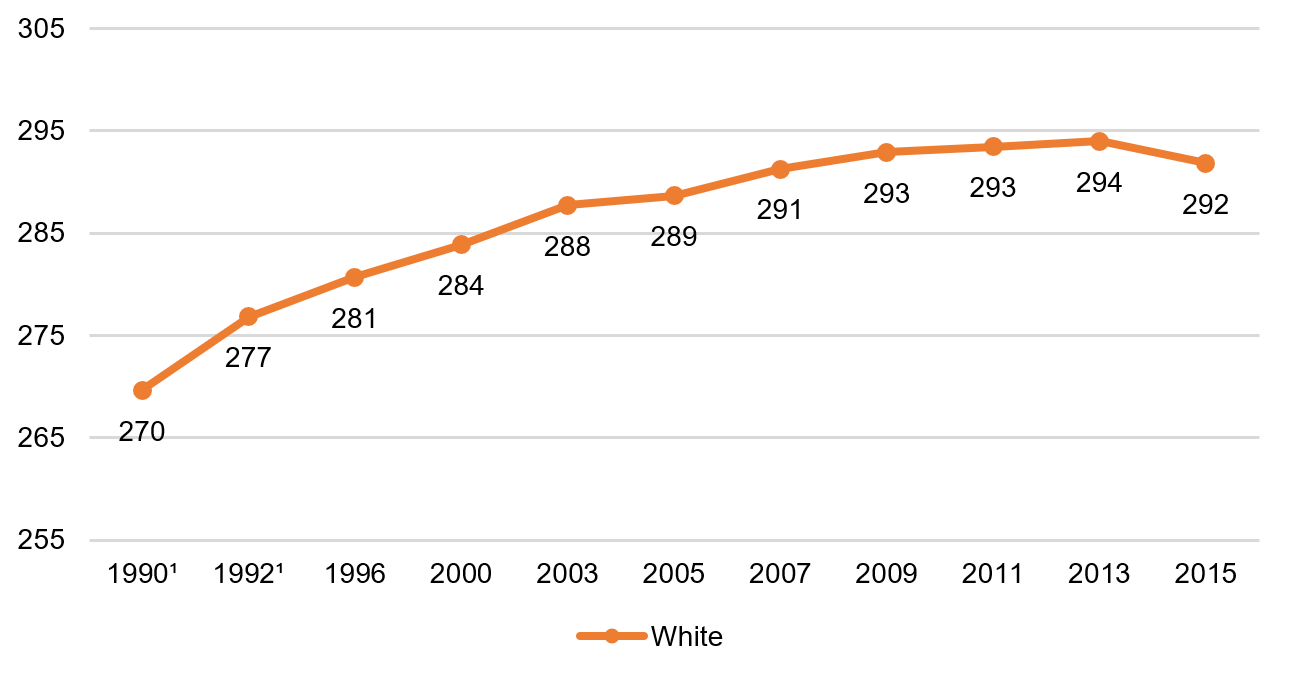
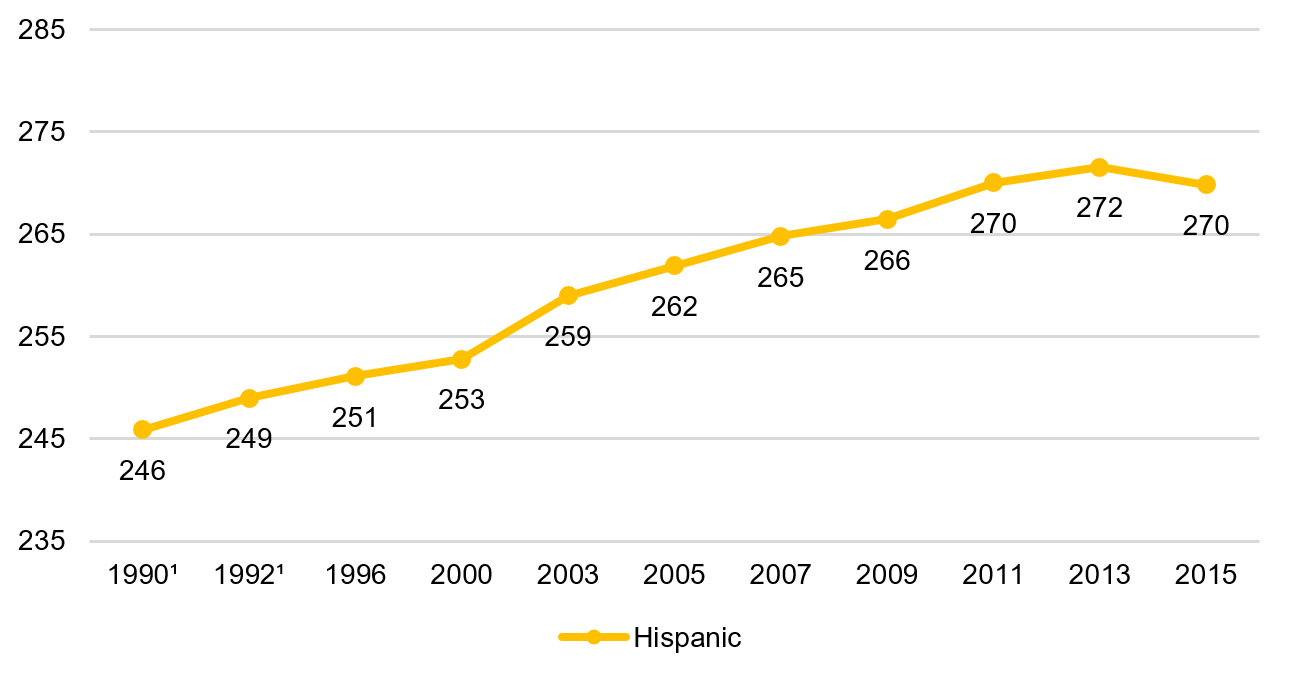
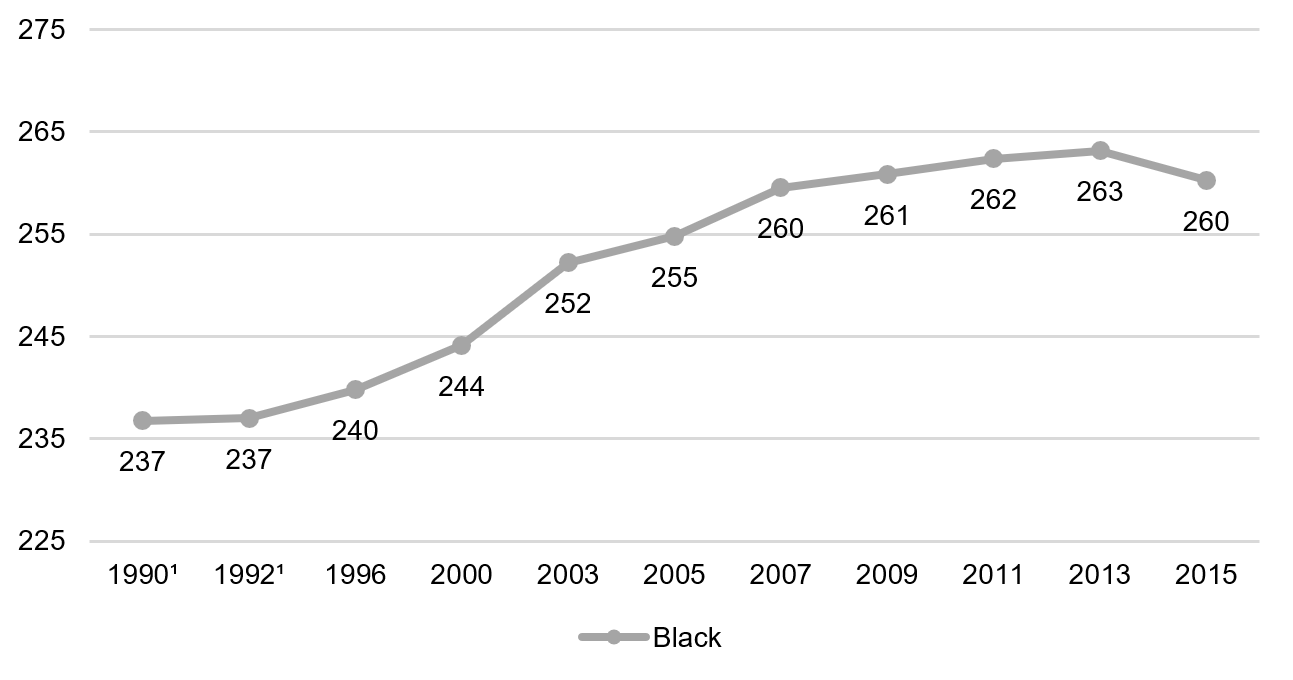
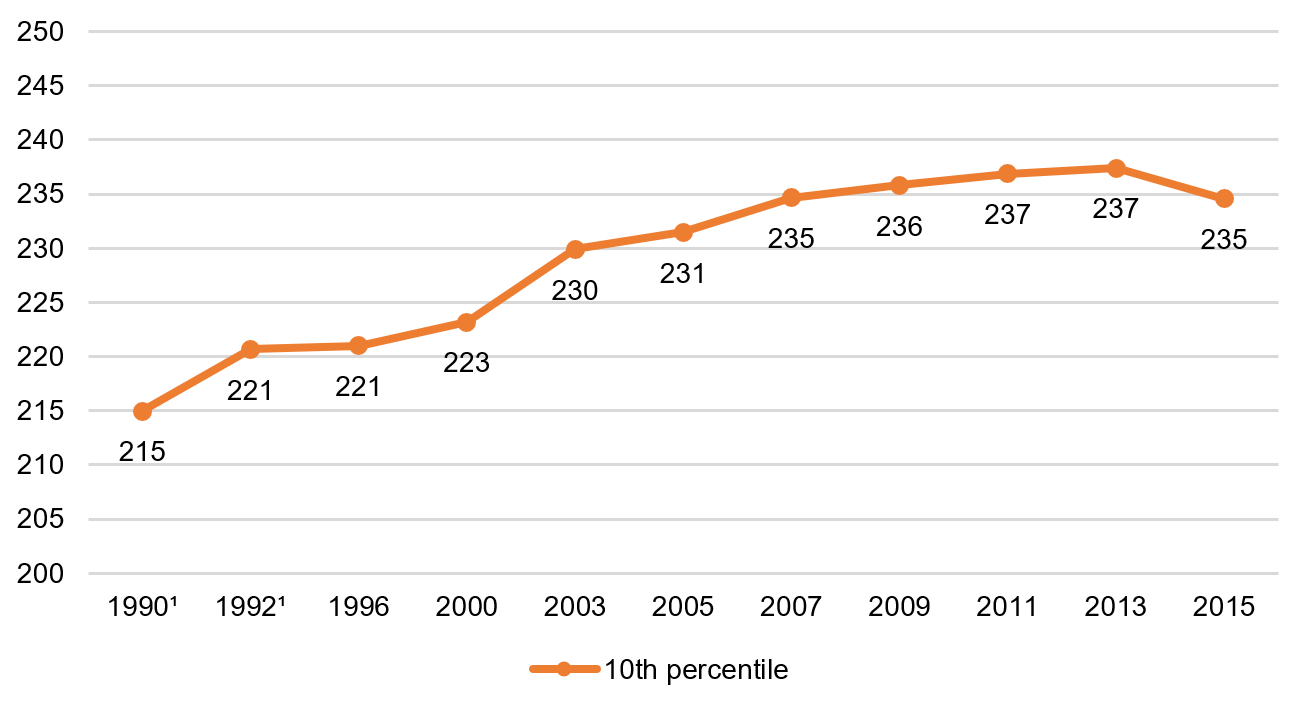
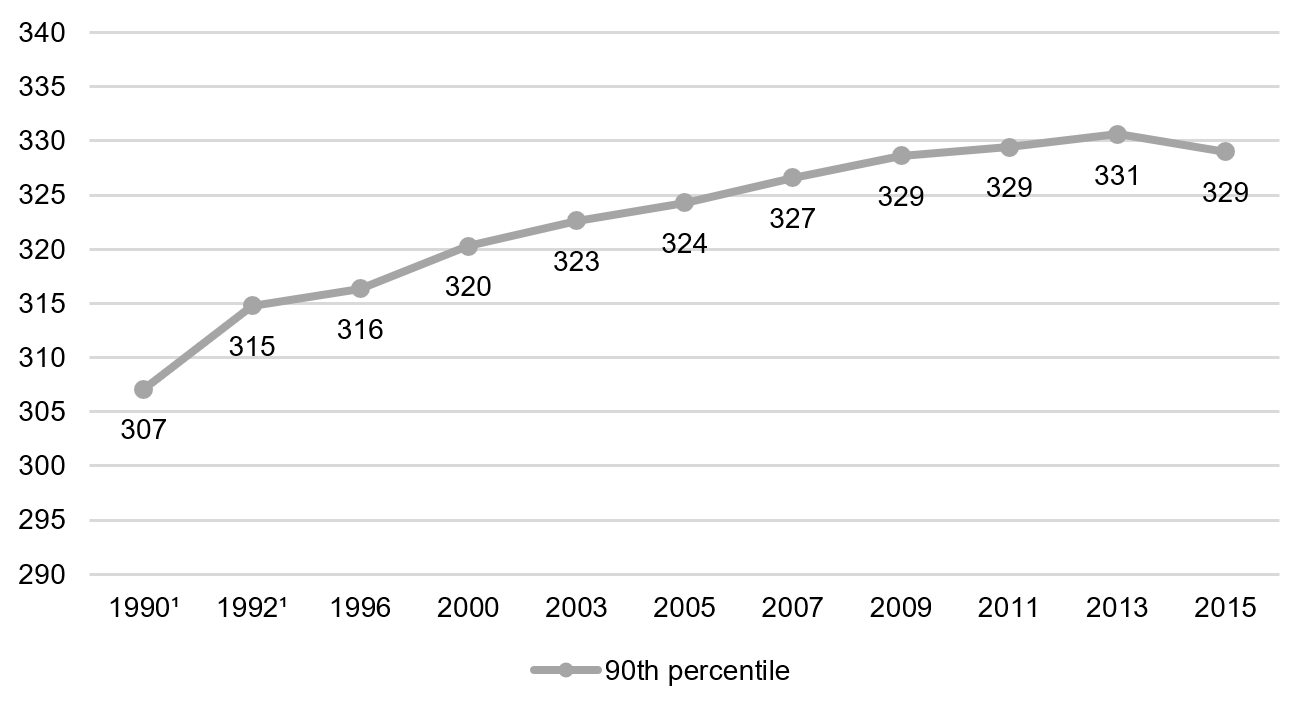
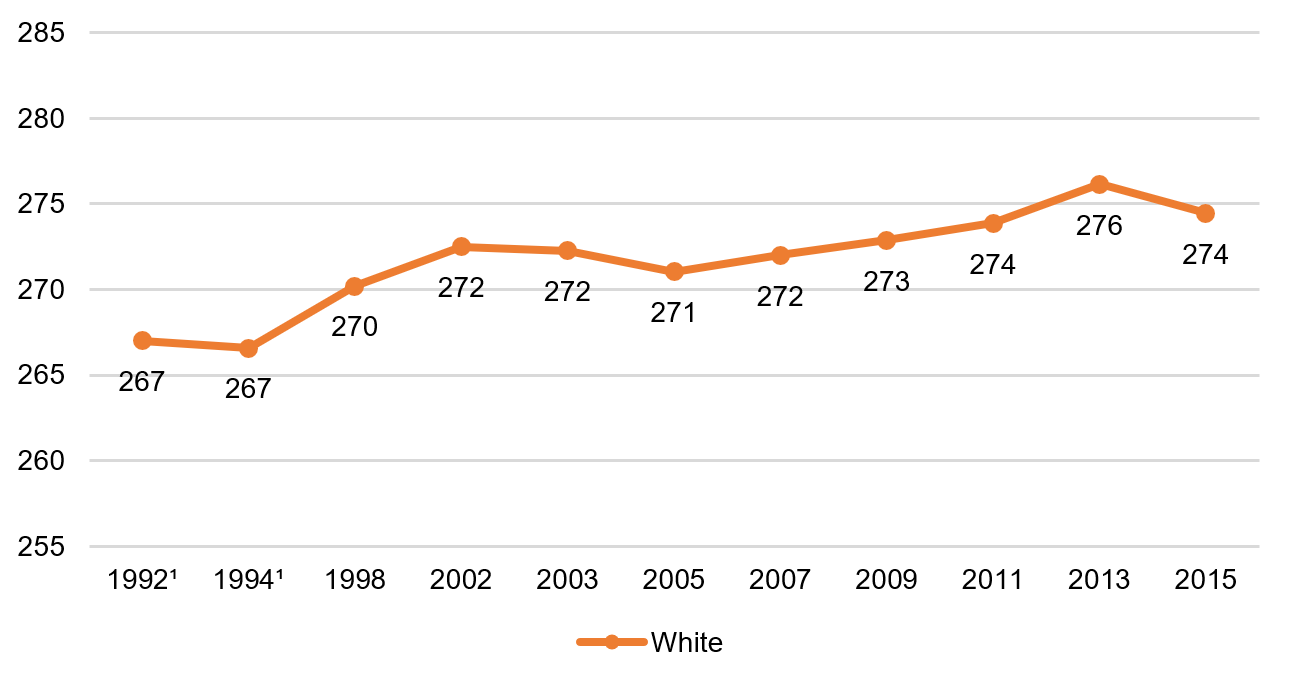
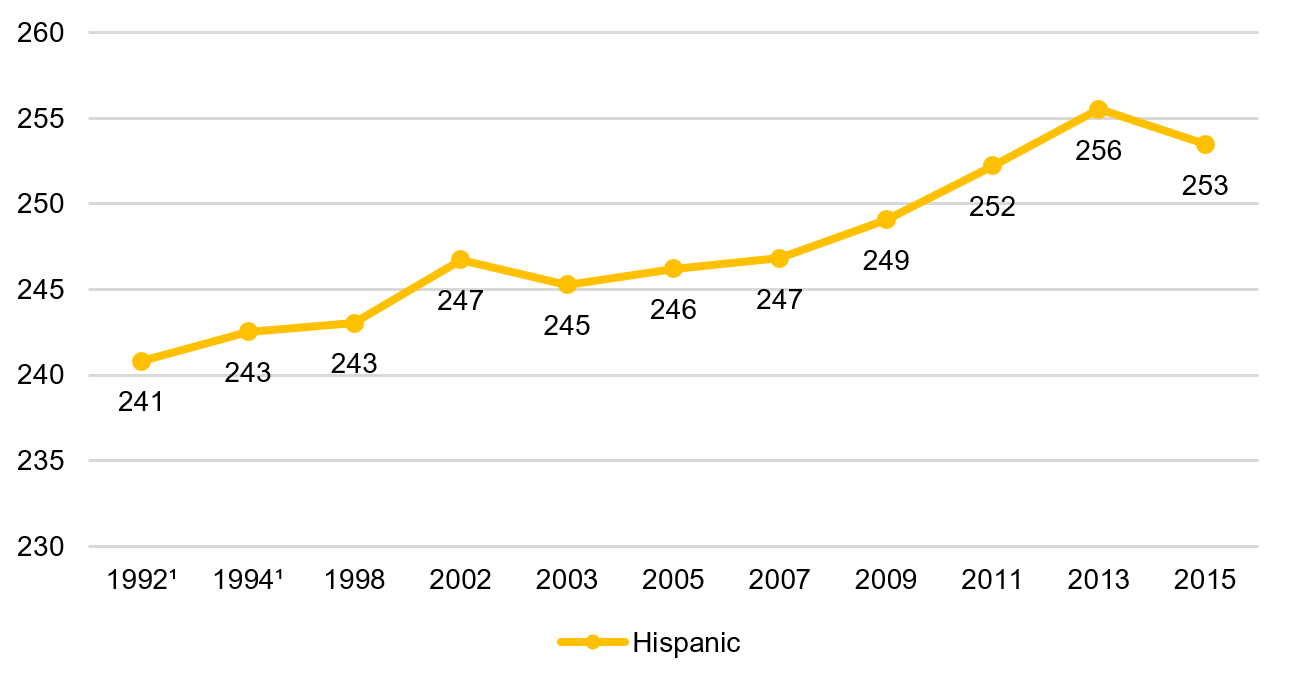
1. Progress in math in fourth and eighth grade has been widespread and long-lasting. Virtually all groups of students are doing much better now than before. Here are a few examples of what widespread progress looks like, reproduced from this 2017 post:

Eighth grade math, white students, 1990–2015

21

Eighth grade math, Hispanic students, 1990–2015

22

Eighth grade math, black students, 1990–2015

23

Eighth grade math, 10th percentile, 1990–2015

24

Eighth grade math, 90th percentile, 1990–2015

25

Note in particular the strong progress for students at the 90th percentile who, regrettably, include very few disadvantaged students.

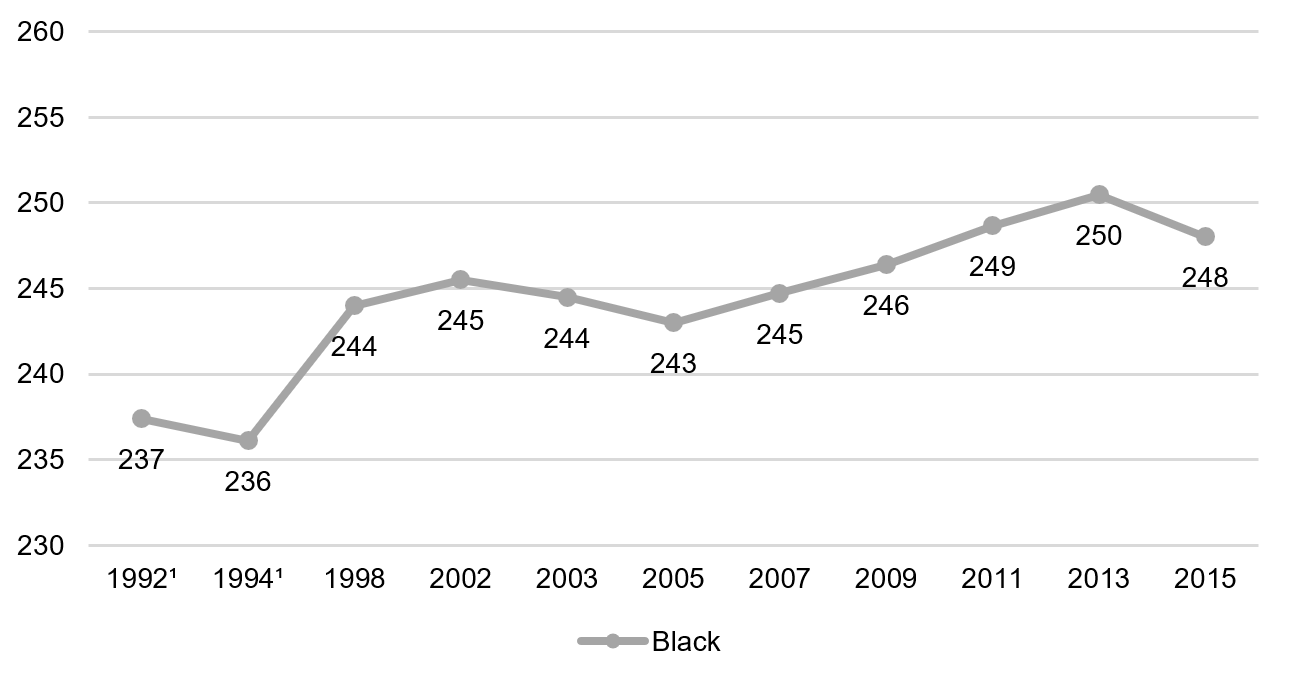
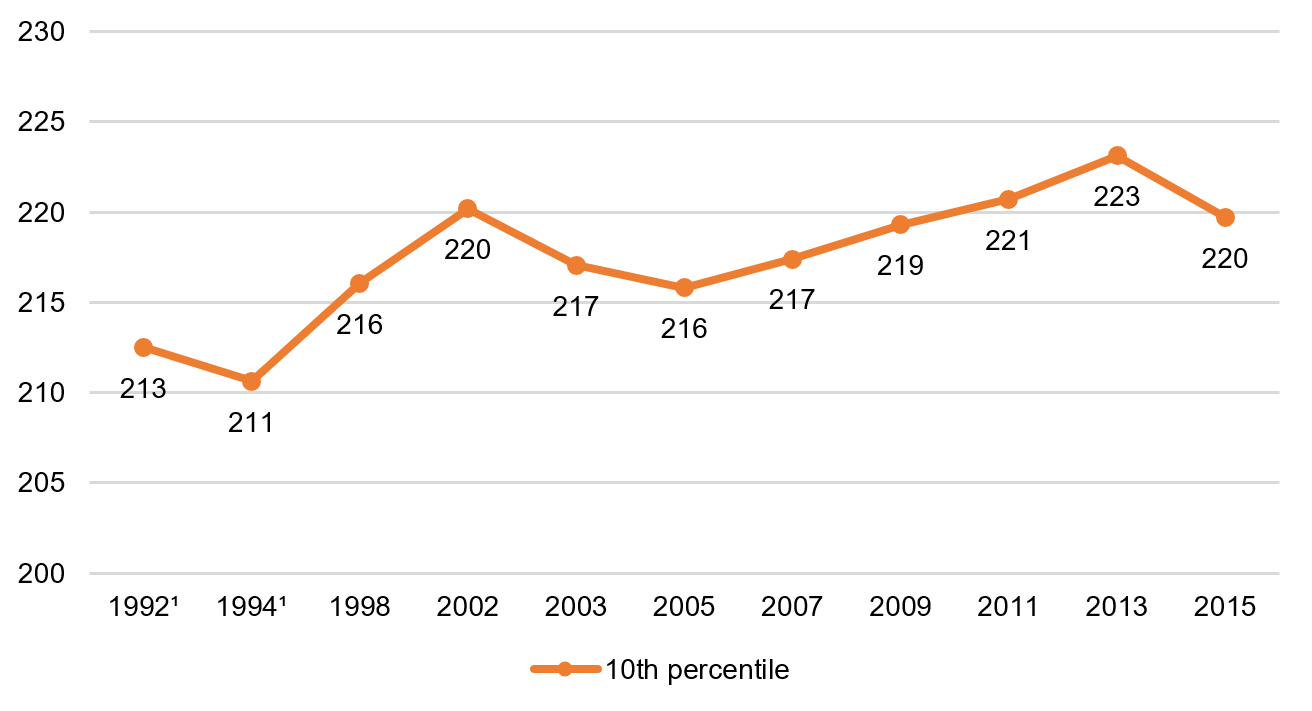
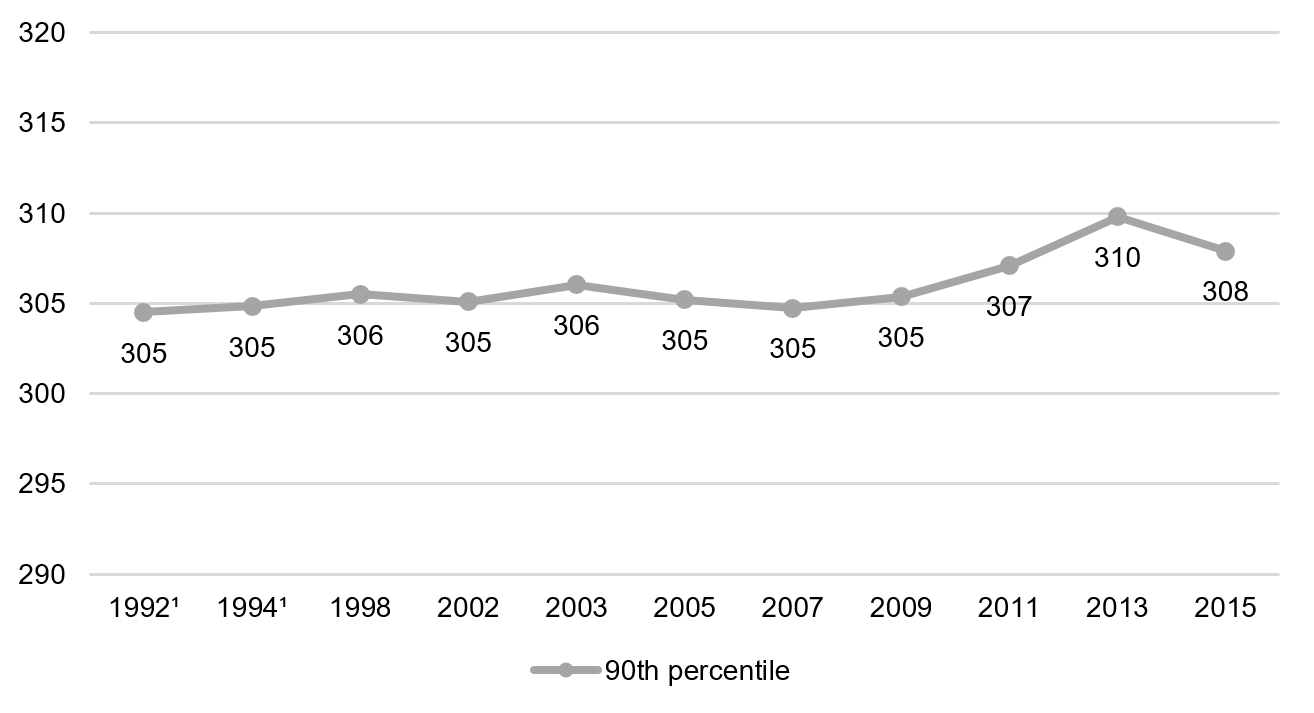
2. In reading, progress was generally limited to low-performing students and students of color. Going back to the 2017 post again, we can see in particular the relatively flat performance of students at the 90th percentile compared to the strong gains we see at the 10th.

Eighth grade reading, white students, 1992–2015

6

Eighth grade reading, Hispanic students, 1992–2015

7

Eighth grade reading, black students, 1992–2015

8

Eighth grade reading, 10th percentile, 1992–2015

9

Eighth grade reading, 90th percentile, 1992–2015

10

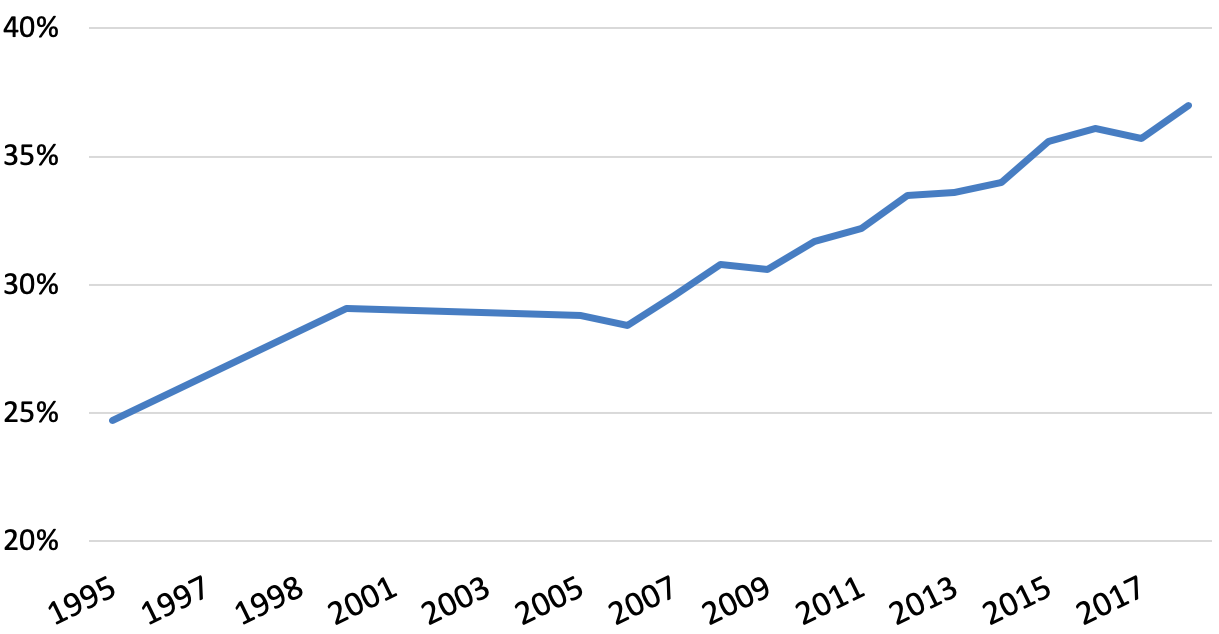
3. College completion rates are up significantly. As others have noted, there’s been limited progress on this count for disadvantaged students. But overall, the proportion of young Americans with at least a bachelor’s degree has grown significantly, going from 28 percent in 2007 to 37 percent just ten years later—an incredible increase of almost a third. For young white Americans, the college completion rate is now approaching fifty percent.

Percentage of 25–29-year-olds with a four-year degree or higher

s

What to make of these three trends? First, it sure seems like we got better at teaching math than we did at teaching reading. The reading gains, limited as they were to our lower-performing and lower-income students, may have been driven mostly by our significant progress in reducing child poverty rates. Perhaps a shift to a more scientifically-based approach to reading instruction in the early grades in the early 2000s helped as well. States that have put a steadfast focus on this type of instruction, like Florida, Mississippi, and Massachusetts, have seen better reading results than most everyone.

But whereas we’ve had a fairly coherent and stable approach to teaching math for several decades—thanks to leadership from the National Council of Teachers of Mathematics among others—our thinking and teaching on reading remains woefully inadequate—for poor kids and for everyone else. As Emily Hanford illustrated so effectively in her radio documentary, “balanced literacy” maintains its hegemony in the early grades, despite its weakness on systemic instruction in phonics, phonemic awareness, and other parts of evidence-based instruction. And as Natalie Wexler argues so well in her brand-new book, we continue to teach reading comprehension as a skill instead of embracing the critical role of knowledge-building in creating stronger readers. If progress is possible in math, it’s possible in reading, but we need to stop doing what isn’t working and launch a new strategy instead.

And what about the college completion boom? Do our schools deserve credit for that, or is there something else at play? That’s a big question that deserves its own post. But it may solve the riddle of why middle-class parents are perennially unwilling to sign up for education reform’s various hoped-for revolutions. When it comes to the most obvious marker of school success—the coveted college degree—things appear better than ever, at least for our own children.

So how are America’s middle-class kids doing? They still don’t read very well, though their math skills have improved a bit. And they are graduating from college in higher and higher numbers. In other words, achievement is mostly flat, while attainment is up. Whether that’s worthy of celebration or a sign that Lake Wobegon has infected our system of higher education, it’s a reality with which we reformers are going to have to grapple.

view

Democratic presidential candidates are wrong: Racist redlining caused school segregation, not charter schools

Derrell Bradford
8.21.2019
Flypaper

During a political campaign, the savviest candidates excel at two things. First, they offer a compelling message that differentiates them from their competitors. Second—which demands true skill and sophistry—they ascribe all their own failings to those very same competitors, forcing them to answer for political, policy and social issues for which they are not responsible. To restate: You blame the other guy for things you did and hope it sticks.

While the presidential contest among Democrats (the hoop-jumping is worthy of a summer community pool), and the battle between traditional public schools and public charter schools for which it has become a proxy, may lack much in the form of clear differentiation, it features the blame game that powers the second strategy aplenty. In the race to woo teachers unions and white progressives who love their neighborhood public schools, charters have become the bête noire of the education discussion, the thing where all the ills that ail our country intersect. Segregation, school finance woes, civil division, teacher turnover and pay—the Mandarin immersion charter school down the street and the one that is really excellent at closing achievement gaps for kids of color are clearly responsible for it all, right?

There’s just one problem: It’s not true. In fact, we need look no further than the nation’s traditional public schools to see who bears responsibility for the continued perpetuation of these issues.

Some candidates have excoriated charter schools for being engines of segregation even though the research does not bear this out. The blame for school segregation, however, lies not with charters but with neighborhood schools themselves and the pernicious history of redlining that segregated them in the first place. Consider that the Home Owners Loan Corporation, a creature of post-Depression New Deal national policy, delineated neighborhoods where residents could receive mortgages and neighborhoods where they could not, identifying the latter in red. It is no secret that the red neighborhoods were also filled with black people.

This policy and its racist leanings not only exacerbated neighborhood segregation, it was a foundational precursor to the neighborhood public school attendance zones of today and, notably, the platform for schools that are more segregated now than they were in the pre-Brown era.

To prove the case, it’s helpful to examine a place where the effects of charters (or private school choice, for that matter) don’t exist. Nebraska, for instance, has no charter schools. Despite their absence, the state features 25 of the country’s most segregated—both by race and by wealth—public school district borders. Yet attacks on this perpetually segregated system of public schools, the one we actually have, seem absent from candidate campaign literature. Why is that? Sen. Bernie Sanders, for instance, has made “charter school segregation” a pillar of his campaign platform. His home state, Vermont, is 94.2 percent white, according to the U.S. Census Bureau, and 1.4 percent African American, and has no charter schools. Can Sanders even credibly comment on this issue?

Some offer that charters undermine the nation’s public school finance mechanisms, but the same housing covenants that segregated the public schools are also at play here. As the professor Dorothy Brown divined, homes in majority-black areas appreciate less than those in majority-white areas. Not only does this mean the tax base of majority-black areas is lower—resulting in less ability to tax local property to raise wealth for local schools—it also has crippled the ability of black families to accrue household wealth compared to their white peers. Only Hawaii does not feature a property tax component for its public-school finance schemes. With every other state relying on valuations of property that have been systematically depressed by decades of race-motivated local and federal policies to fund schools, it’s difficult to argue that issues of equitable funding find their root in a charter school effort that is barely a quarter-century old. It’s also hard to rationalize the decision to fund schools this way unless one set of schools is necessarily meant to be funded better than another.

While lip service to this disparity by presidential candidates nods toward equalization, none of it attacks the underlying factors of neighborhood assignment that catalyze and exacerbate the conditions themselves.

Ironically, although the appetite to eliminate charters may be intensifying among progressive whites (as the schools remain very popular among African Americans and Hispanics), the desire to increase public school funding is mixed. While some red states such as Arizona have added billions to their budgets to increase public school revenue (and in Arizona, specifically, teacher pay) deep-blue Los Angeles rejected a tax hike to increase public school funding in the wake of one of the country’s most disruptive teacher strikes. If you’re not an ideologue, it’s easy to see that something else is at work here and that this is all more complicated than what happens when a family chooses a charter school.

But if the facts don’t support your position as a candidate, you might dispense with the pleasantries and go straight for demonization in a self-interested effort to improve your flailing candidacy and curry favor with the anti-charter lobby. Which is to say you might be status quo handmaiden Bill de Blasio, whose own political situation knows two sorts of extremes: that of anti-charterism and that of the deep disinterest of the Democratic primary electorate he currently courts.

New York City, where de Blasio is sometimes present to be mayor, features one of the nation’s best charter school sectors in a state with one of its best charter laws. Approximately 10 percent of the city’s students attend charter schools. Their collective population is overwhelmingly low-income and minority. Their results are among the country’s best.

There’s nothing like success happening in your presence—despite your opposition—to turn your resistance up to 11. Candidate de Blasio recently informed attendees at a campaign event that he “hates” charter schools. During his first term, as he struggled to gain the favor of the United Federation of Teachers (which did not support his candidacy), he at least pretended there were two universes of charter schools: those that played by the rules he liked and those that did not. The presidential race has, however, removed this fig leaf of difference and liberated him to attack the schools that 1 in 10 city students attend (chosen by untold numbers of voting adults who are their parents). This flip-flopping is not a surprise to New Yorkers, as the one thing most consistent about candidate de Blasio and his school policies is their inconstancy. He once valorized school integration before saying a family’s choice to buy a school and a house together mattered more. His schools chancellor, Richard Carranza, opposes “screened” schools and sees them as engines of segregation, yet he sent his own child to one in San Francisco.

And de Blasio opposes the admissions requirements at the city’s flagship selective high schools (Stuyvesant, Bronx Science and Brooklyn Tech, specifically), in theory because too few African-American and Hispanic students gain entrance to them. His opposition to the policies seems newly found, however, given that during his first term, his own son graduated from Brooklyn Tech. It’s also politically expedient to focus on these schools—which he does not control and whose admissions requirements must be amended in Albany—instead of the balance of the selective high schools which he does control and for which the admission requirements could be changed tomorrow. If you called candidate de Blasio’s positions on these issues of school choice wildly inconsistent, you’d be generous. If you called them deeply self-interested and elitist, you’d be spot on. If you called them detrimental to kids in New York and across the country, you’d simply be calling it as it should be seen.

There is other unfortunate moderating taking place among the candidates, though my own Sen. Cory Booker’s latest hand-wringing over the charter issue disappoints me most, given the success of Newark’s charter schools (and coincident improvement in the city’s traditional public schools), which serves as a close backdrop to his own political narrative. But the education race for the presidency does leave us with two fairly clear takeaways. The first is that the nation’s charter schools are not responsible for conditions the traditional public schools themselves have created and continue to perpetuate, and if candidates are serious about tackling those issues, it will require a degree of intellectual and historical honesty that much of the primary debate has lacked so far.

The second is that, instead of apologizing to the public school industrial lobby that is working to unwind choice for millions of American families, they should be apologizing to the rest of us for supporting a schooling agenda that de facto makes parents and students less free, provides fewer working opportunities to teachers, confounds the ability of cities and states to make new public schools to solve local issues, and big-boxes public education in a way no progressive would ever support.

They say one size doesn’t fit all … a bunch of distortions about charter schools won’t fit, either.

Editor’s note: This essay was originally published by The 74.

view

Can AP ease Gotham’s selective-high-school deadlock?

Chester E. Finn, Jr. | Andrew Scanlan
8.21.2019
Flypaper

Controversy surrounds New York City’s selective-admission high schools and Mayor Bill de Blasio’s plan to change the time-honored path by which students gain entry to them; the dispute largely concerns how to ration the limited supply of a valued commodity in the face of mounting demand. Yet there’s another way to give more children access to a rigorous, top-notch education: increase the supply and distribute it more broadly across the city. A major move to do that has been underway for six years in Gotham’s high schools, in the form of mayoral efforts—first by Michael Bloomberg, now by de Blasio—to expand the well-regarded Advanced Placement (AP) program’s offerings by bringing them into more schools to increase the number of enrollees.

New York’s efforts follow a sixty-year, nationwide evolution and expansion of AP offerings, originally designed for students in elite high schools to accelerate their college experience at prestigious institutions. Today, AP is a massive program—some 3 million young people now take its exams every May—that spans 38 separate subjects. The courses now also boost disadvantaged youngsters who never considered college or experienced college-level academics, much less the possibility of gaining credit upon entry or skipping introductory-level classes. Score “3” or higher on AP’s 1-to-5 exam scale and, in the overwhelming majority of American universities, such opportunities await. What’s more, the indication on your high school transcript that you succeeded in AP classes increases the odds of getting admitted in the first place.

Numerous New York high schools have long given AP courses. Selective Brooklyn Tech, for example, offered 111 sections of twenty-nine AP courses this past year. Nonselective Bayside High School offered as many courses. And yet many of the city’s 400-plus high schools still lack such options. As recently as the 2015–2016 academic year, more than 100 schools—mostly in poor neighborhoods—offered no AP courses. The evidence shows that expanding AP access is not just a way to mollify the equity hounds making a fuss over prestigious schools like Stuyvesant and Bronx Science—it’s also a proven way to boost college-readiness for young people and, done strategically, would also eventually tone up middle and primary schools.

It’s tough, though, to disseminate anything effectively through a system as labyrinthine as the New York City Department of Education (DoE); it’s even harder, sometimes impossible, to impose something like AP on a high school that never offered it and where the faculty is unprepared or unwilling to implement it. Nor is it easy to teach AP-level courses to students with widely varying levels of engagement and motivation. Despite those challenges, de Blasio—building on Bloomberg’s AP Expansion program in fifty-five high schools—has rolled out AP for All, with the goal of offering courses in every city high school.

Dating to 2016, the venture involves partnerships and outside help (a practice initiated by Bloomberg), not just from the New York-based College Board, which operates and oversees AP, but also from the Dallas-based National Math and Science Initiative (NMSI) and Seattle-based Equal Opportunity Schools (EOS). In recent years, all three nonprofits have pitched in to expand AP into more Gotham schools, to prepare more principals, ready more instructors, and encourage more poor teenagers and their families to pursue the venture.

More than a few high schools serving disadvantaged youngsters needed no mayoral nudge to make AP a key curricular building block. A notable example is the Urban Assembly School for Law and Justice (SLJ), which shares a building in downtown Brooklyn with two other small DoE secondary schools. Opened in 2004, SLJ resulted from Bloomberg’s and former chancellor Joel Klein’s heroic move to create more intimate, safe, and functional learning environments for high school students. SLJ is an open-enrollment school with 460 pupils, nearly all black or Hispanic. Two-thirds qualify for federally subsidized meals and three-quarters have parents who never finished college. It styles itself a “college preparatory high school . . . committed to high standards and personal attention for all students . . . in an empowering environment that fosters intellectual independence and civic engagement,” and seeks to do this by treating “law and justice” as “the lenses through which subject matter is viewed and academic skills are developed.”

Though most pupils are disadvantaged, the school itself enjoys several advantages. Many of its students, for example, come from relatively well-functioning families in which someone—an older sibling, aunt, or cousin—attended college and can talk encouragingly about it. Many are from immigrant families that view education as a path to upward mobility. There may not be much money at home, but academic achievement is not an alien notion.

SLJ also operates with relative independence, thanks to bureaucratic buffering supplied by the nonprofit, well-connected Urban Assembly. SLJ has benefited from a succession of standout leaders and a cadre of dedicated, top-notch teachers. An exceptional external network helps, with generous partners that raise private dollars to supplement its relatively generous municipal budget.

A part of the curriculum since 2008, Advanced Placement has become a crucial resource that SLJ deploys to envelop its students in rigorous academics. Students receive no extra points on their GPAs for taking such courses. Instead, they enroll as an educational challenge, earning college credits, saving time and money, developing skills, and enhancing transcripts for admission. Even when they fail to earn top scores on the exams, admissions officers will see their efforts.

While most pupils understand SLJ’s college-prep focus, many arrive with dismal preparation for rigorous academics. The remedial burden is thus weighty, the more so when the school aims to place students in college-level coursework shortly after their slipshod middle school experiences. In response, the SLJ team engages in multiple strategies to overcome that bleak past—some discreet, like intensive course planning by teachers, others more overt, like establishing ninth grade as a schoolwide “foundational year” to prepare students for the academic challenges ahead. AP students, meantime, participate in “AP Camp” each August to improve their skills.

Once the school year begins, SLJ’s “after school learning academy” houses an array of tutoring opportunities and review sessions. Students also have access to off-campus mentors, internships, field trips, and a host of summer opportunities. SLJ still faces daunting challenges, however. Many kids don’t practice good academic habits (like completing homework), often because they have family obligations, after-school jobs, or other distractions.

Despite these challenges, an impressive number of SLJ students still take AP classes, earning qualifying scores on the end-of-year exams. In May 2018, a third of the school’s tenth-, eleventh-, and twelfth-graders (including about half the graduating class) were enrolled in at least one AP course and tackled 178 exams, yielding fifty-eight qualifying scores. In microeconomics, more than half the exams taken earned qualifying scores, and 27 percent of the class of 2018—more than the national ratio—emerged with at least one such score on their transcripts. Such statistics reflect SLJ’s success—a school that takes all who apply, propelling an ever-growing portion of its pupils through the AP experience, and with encouraging results.

New York, like many cities, has striven to launch AP in high schools that have scant prior experience with the program, but implementation is ultimately up to individual principals and teachers in those schools. To achieve success, instructors must embrace the mission, gain the requisite training, apply themselves to unaccustomed and demanding work, persist for years, and simultaneously persuade innumerable colleagues and constituents—including children and parents—that things are truly different. Indeed, they must sell harder work, loftier expectations, and deferred gratification—not an easy pitch for either teachers or teenagers. High schools must change their academic climate, offering advanced courses beyond the present grasp of even their highest-achieving students.

Today, many of New York’s high schools offer more AP courses, particularly in tough STEM subjects, and more students have signed up—including those who never considered themselves college-bound. The courses involve high expectations that interfere with other necessary and cherished pursuits, from earning money to sports and family duties. This interference only multiplies if students also attend the extra tutoring and study-skills sessions that accompany the classes—after school, lunchtime, even on Saturdays—and that often prove necessary for course success.

Teachers must work harder, too—perhaps an unwelcome change for veteran instructors and a major undertaking for novices. Among their duties is submission of their course syllabi for College Board approval. They likely fret about their students’ performance on the AP exams. Indeed, they’re volunteering to take a sizable risk (or being persuaded to do so): standing in front of an AP classroom means exposing their performance to public scrutiny and comparison. Guidance counselors must also change, rethinking entrenched patterns of course sequences and students’ schedules, reimagining post high school options for their advisees, and—because these are likely children without much college experience in their families—taking pains to coax them into a college-going mentality while helping them navigate the rapids of admissions and financial aid.

The introduction of these courses means staff reassignments and budgetary strains as well, including additional lab equipment, new textbooks, custodial and security charges for the overtime and Saturday sessions, and extra pay and tuition costs for teachers to partake of professional development during summer. A school that persists with AP incurs a host of long-term obligations, costs, and priority shifts. It adds up to a profound and enduring change in school culture, which is perhaps the hardest education reform of all.

Mayor Bloomberg’s AP Expansion program commenced in 2013 and ultimately reached 77 high schools. Though audacious, the program has proven doable, so long as schools are carefully chosen, the DOE sticks with it, and NMSI can continue injecting the requisite talent and resources. The program has since yielded a solid increase in participation. In 2012, not a single student took an AP exam in thirteen of the first fifty-five high schools in the program. In the other forty, nearly 1,000 students sat for a total of 1,148 exams in the six subjects. By May 2016—the third and final year of the initiative—two and a half times as many pupils (2,396) in those fifty-five initial schools took nearly three times as many exams (3,249) in those subjects, and numbers continued to rise thereafter.

But encouraging as they are, some of the statistics remain difficult to digest. In 2017, for example, more than 3,000 AP exams taken in those schools did not yield qualifying scores, and more than 2,000 exam-takers did not obtain a single such score. Though many students earned a score of “2,” and many teachers saw progress during the year, the actual pass rate remained underwhelming, fluctuating around 18 percent during the life of the program. Gains, moreover, varied widely by school, with the top-performing third of the Expansion schools showing impressive growth but the bottom third indicating little or none. This isn’t surprising, as no large-scale reform across multiple schools shows equal success in all, particularly over just a few years. Even NMSI, understandably fond of touting its successes, has acknowledged that as many as a fifth of the first group of schools showed minimal gains during its engagement with them.

Nor is success cheap. We estimate that the total price tag for the AP Expansion initiative amounted to about $10 million between 2013 and 2016, or roughly $47,000 annually per participating school. Mindful that 924 additional qualifying scores were earned from 2013–14 through 2015–16, it appears that the city’s price tag per additional qualifying score approached $11,000.

De Blasio entered City Hall in January 2014 with different education priorities from his predecessor. While Bloomberg’s cadres focused on high-stakes accountability policies, an A–F school rating system, closing subpar schools, and devolving authority to successful principals—nearly all of which drew the unions’ ire—de Blasio viewed unions as allies and benefactors. He preferred to centralize decision making and sought to turn around weak schools, not close them.

He was keen to push appealing programs into more communities, scrapping any that appeared exclusive or elitist. The mayor, moreover, came under pressure to show results. He fended off Governor Andrew Cuomo’s multiple reform initiatives, finding himself dueling with the city’s well-connected and solidly performing charter school sector. At the same time, he had to persuade legislators to renew mayoral control of the school system, which was scheduled to expire in June 2015.

De Blasio secured a one-year extension to demonstrate greater success in the K–12 sphere. So, in September 2015, he announced a half-dozen sizable reforms of his own, including “AP for All.” His major address, titled “Equity and Excellence,” painted a grim picture—“a tale of two cities in our schools”—and declared that “each and every child, in each and every classroom, deserves a future that isn’t limited by their ZIP code.” Bloomberg’s AP Expansion still had a year to run but would soon be overtaken by a far grander plan to deliver more courses to many more high schools.

During the first year of AP for All (2016–17), NMSI worked with 63 high schools—four carried over from AP Expansion plus fifty-nine others, including thirty-five with no prior AP program—again focusing on a suite of preselected AP courses, mostly in STEM fields. Equal Opportunity Schools worked with another twenty-four high schools that year, and would add ten more the next year, focusing on identifying poor and minority pupils who could succeed in AP courses but had not previously participated.

This is a difficult endeavor in any city, especially within New York’s sprawling bureaucratic system, where structures, governance, and personnel practices always complicate matters. Numerous high schools, nonetheless, have shown gains with AP for All. In Flatbush, for instance, an AP for All school operates in historic Erasmus Hall, one of five thematic high schools in that vast structure. But their smaller size makes it hard for any one of them to support many AP classes and, because they’re located under the same roof, it makes obvious sense to team up. Yet there’s been much turnover among their principals; they report to several different regional superintendents on the DoE organization chart; two of the schools start with sixth grade; and one is a “screened,” semi-selective school, while the other four admit all students. Under those circumstances, sustained collaboration remains a challenge.

The schools’ leaders generally welcome AP for All, however, and are striving to widen pupil and teacher participation. One principal termed it a valuable step toward making that school more college-focused and less sports-centric, and even to attract more “nerds” from more neighborhoods. Still, the principal estimated that it can take six to eight years to “build a culture of high achievement” in a school, even when the leadership is stable and committed.

That small school on the Erasmus campus participates in other DoE initiatives and has additional outside partners, including the City University’s “College Now” dual-credit option. The principal is convinced that students benefit from having some college-level academic experience during high school, and returning alumni attest to how the experience helped them when they reached college—even if they never earned qualifying scores on the exams. Teachers we talked with had a similar view: “If I can get a kid to a ‘2’,” said one veteran instructor, it will have done some good. It shows that “something happened.”

Whether it’s AP or NMSI, good leadership or something else, this small school has also made gains. It cannot yet boast many qualifying scores, but it’s attracting more academically oriented students, and its graduation rate has risen “from the sixties to the eighties.” It’s an example, though, of how persevering with AP for All calls for a major attitude adjustment among veteran teachers accustomed to advanced classes that are open only to the strongest students. In a city with many such teachers in many high schools—and a powerful union that has often resisted top-down changes—attitudes may be the hardest thing to alter. That’s compounded by the challenge of equipping teachers with the pedagogical skills and content knowledge needed to “scaffold” instruction for classes of up to 30 kids who bring a range of preparation and, perhaps, ability—along with differing levels of outside support in their lives.

The city has committed considerable resources to this initiative, though the sums look small within its massive education budget. AP for All funding was slated to double from $12.5 million in 2017 to $25 million in 2018, then double again by 2020. That’s a big raise from the estimated $10 million spent on AP Expansion. The eventual return on that increased investment remains to be seen as the program grows. (It entered 2018–19 with 252 high schools on the list.) But the gains in AP participation and passing scores already visible are nothing to dismiss. In all, reported the DoE, 36 percent of the city’s 2018 graduates took at least one AP exam and 19 percent earned at least one qualifying score.

Yet in New York, as elsewhere, increased participation, particularly among disadvantaged youngsters, has meant lower passing rates. For example, 35 percent more Hispanic students took AP exams in 2018 than in 2016, but the proportion passing at least one exam dipped from 47 percent to 43 percent. Black students’ participation also grew—by 15 percent—but their rate of qualifying scores also slipped slightly, to 26 percent. By comparison, Asian and white students raised both their participation and passing rates. It’s wrong to focus solely on qualifying scores, though, when a big, complex undertaking like this is new, especially when schools, principals, and teachers are still adjusting to it, and when many kids who don’t reach that bar may yet gain from the AP experience.

Still, we’re struck by how different this effort is from the contentious issue of admission to the city’s selective high schools. AP for All, and its Bloomberg-era antecedent are, above all, efforts to expand the supply of rigorous education offerings at the high school level—mainly so that more poor and minority youngsters can access and gain from them. It’s had hiccups and encountered pushback, and its success rate isn’t near what it should be. But it’s better to grapple with those challenges while trying to bake a much larger pie than to fight endlessly over how to apportion slices of a small one that came out of the oven years ago.

Editor’s note: This essay was originally published by City Journal. It is drawn from the author's new book, Learning in the Fast Lane: The Past, Present, and Future of Advanced Placement, to be published on September 17 by Princeton University Press, and is reprinted by permission of Princeton University Press.


view
Job training grants

Funding employer-led job training

Aaron Churchill
8.20.2019
Ohio Gadfly Daily

Worker skills and employer needs are often misaligned. Young people, for instance, may leave high school or college with a sturdy grounding in math and English, but ill-equipped to manage a customer database, take a patient’s vital signs, or handle a piece of machinery. In a way, this is predictable: Schools, secondary and post-secondary alike, are typically geared towards imparting broad academic knowledge applicable to a wide range of professions, but not necessarily job-specific skills.

What can policymakers do to change this? In a recent paper, Oren Cass of the Manhattan Institute proposes that governments should more heavily subsidize on-the-job training, especially for young people (including those in high school and recent graduates) on non-four-year college pathways. To this end, he proposes a $10,000 per trainee grant program that would be paid to private employers. Cass reasons that businesses are the logical place to train workers, as they know the skills needed for their jobs. Yet, apart from subsidies, they are often reluctant to bear the training costs because they risk losing their investment when workers leave.

As envisioned by Cass, the program would allow employers to spend their grant funds flexibly. The training doesn’t necessarily have to occur “in house”; the organization may wish to spend its grant to enroll workers in community college courses, trade-union apprenticeships, or training programs done in concert with other employers. Among other policy details, he suggests that subsidized trainees be employed at least part-time and that limits be placed on the duration of the training period. The proposal suggests guardrails to ensure that highly educated “trainees” aren’t being subsidized (e.g., law associates). Last, high-school students would also be eligible to participate if they are employed at least part time and taking courses through their high school, career-technical center, or community college.    

All this sounds promising, but the age-old question of how to pay for it still looms. On this front, Cass bravely suggests that governments should reduce expenditures on higher education to free dollars for worker-training grants. (Colleges, however, would recover funds if employers select them as training providers.) As support, he cites the large skew in outlays dedicated to higher education—about $150 billion per year in federal and state spending—in comparison to the relatively small allocations for job training. Though apt to ruffle feathers in higher education, Cass concludes: “A rebalancing is in order. Shifting funding…may appear unappealing at first, but is best understood as a reallocation from one training provider to another.”

The Cass plan dovetails nicely with our own proposal that Ohio make greater investments in employer-led training. Should state legislators run with the idea, this paper is a must read as it adds more fodder for thinking about policy design and implementation.  

Source: Oren Cass, The Workforce-Training Grant: A new bridge from high school to career, Manhattan Institute (2019).

view

Training teachers and principals to support the needs of diverse students

Tran Le
8.21.2019
Flypaper

A new report by William Johnston and Christopher Young from the RAND Corporation examines the perspectives of teachers and principals about their pre-service training programs, with an emphasis on their preparation for work with non-white and low-income students.

The researchers primarily use data from the Measurement, Learning, and Improvement (MLI) Survey, a joint effort from the Bill & Melinda Gates Foundation and RAND. A nationally representative sample of principals and teachers, all of whom are members of the American Educator Panels (AEP), is periodically surveyed about their working conditions. In its spring 2018 administration, 3,229 principals and 15,258 teachers, or 25 percent and 53 percent of the AEP’s national totals, respectively, participated. For the purposes of this study, the survey findings were weighted to reflect the known national principal and teacher populations across individual-level (e.g., gender, professional experience) and school-level (e.g., school size, grade level, urbanicity, socioeconomic status) characteristics. In comparing educator responses from schools with different demographic profiles, the analyses were supplemented with 2015–16 school- and district-level data from the National Center for Education Statistics Common Core of Data.

Overall, both principals and teachers responded positively about their preparation experiences, overwhelmingly expressing that the individuals who provided training were effective, the feedback they received was helpful, that they left feeling prepared, and saw the connection between coursework and practice. However, only 60 percent of principals and 68 percent of teachers agreed with the statement, “my program prepared me to work with black, Latino, and/or low-income students.” Principals’ preparation to support the needs of minority and low-income students was among the lowest of the reported capabilities, with 35 percent feeling unprepared when they began their job. After disaggregating the data by race, Johnston and Young found stark differences between white and non-white educators’ perception of their preparation to support these groups of students. Sixty-two percent of white educators felt that their pre-service training prepared them for this work, compared to 76 percent of nonwhite educators. And this same discrepancy existed for white and nonwhite principals’ sense of preparedness when they began as school leaders. Interestingly, the researchers note that this gap disappears when white principals feel that their pre-service training prepared them in this area, which demonstrates the impact that effective and comprehensive training can have.

Johnston and Young also found a positive correlation between educators’ perceptions of the caliber of their pre-service training program and the duration of their field experiences. Whether in the form of full-time job placements, student teaching, or teacher shadowing, educators who had greater amounts of clinical experience were more likely to feel that their programs were effective. For example, when looking at the percentage of educators who agreed that their program prepared them to work with minority and low-income students, 54 percent of educators who had no field experience agreed, while 61 percent of those with one semester or less agreed, and 70 percent of those with more than one semester of field experience agreed. Although this number increased to 78 percent for educators with one year or more of field experience, there was a leveling off or decline for three of the other surveyed components of pre-service training—effective mentorship, helpful feedback, and feeling generally prepared—which suggests a minimal difference between more than one semester and one year or more of field experience in these respects.

While it’s heartening to see the present success and future potential of pre-service training programs, we must keep in mind that this study relies on educators’ self-reported sense of preparation, a limitation that the researchers do acknowledge. Educators’ feelings of preparedness do not reflect the actual quality of the programs they completed, nor do they translate to efficacy in the classroom. As such, the key finding that white educators reported lower levels of preparedness to support the needs of non-white and low-income students does not prove that they were in fact less prepared to do so than non-white educators.

Nevertheless, it’s apparent that pre-service training is one mechanism through which principals’ and teachers’ capacities are developed, if not in practice then at least in the teachers’ own perception. Having a field experience requirement makes it more likely that educators will feel ready to step into the classroom or school. And when it comes to serving black, Latino, and low-income students, pre-service training can level educators’ sense of preparation going into their work, no matter their individual race—a powerful thing since the first year of teaching or in administration is never easy for anyone. Whether it’s through policymaking entities or preparation program administrators, targeted efforts should be made to strengthen training on supporting the needs of a diverse student body. That’s one step for pre-service training programs towards enhancing quality and equity in our nation’s schools. 

SOURCE: William R. Johnston and Christopher J. Young, “Principal and Teacher Preparation to Support the Needs of Diverse Students: National Findings from the American Educator Panels,” RAND Corporation (2019).

view

The Education Gadfly Show: The homecoming court edition

8.21.2019
Podcast
 

On this week’s podcast, Jeremy Tate, CEO of the Classic Learning Test, joins Mike Petrilli and David Griffith to discuss what classical learning is and why it’s important. On the Research Minute, Amber Northern examines whether popular children have an outsized influence on their peers.

Amber’s Research Minute

Timothy Malacarne, “The Popular Kids Don’t Matter: Centrality and Influence on Adolescent Behavior,” Sociological Enquiry (July 2019).

Fordham Logo

© 2026 The Thomas B. Fordham Institute
Privacy Policy
Usage Agreement

National

P.O. Box 110
Burke, VA 22009

202.223.5452

[email protected]

Ohio

P.O. Box 82291
Columbus, OH 43202

614.223.1580

[email protected]

Sponsorship

130 West Second Street, Suite 410
Dayton, Ohio 45402

937.227.3368

[email protected]