Mobile Navigation

  • National
    • Policy
      • High Expectations
      • Quality Choices
      • Personalized Pathways
    • Research
    • Commentary
      • Gadfly Newsletter
      • Flypaper Blog
    • Events
    • Scholars Program
  • Ohio
    • Policy
      • Priorities
      • Media & Testimony
    • Research
    • Commentary
      • Ohio Education Gadfly Biweekly
      • Ohio Gadfly Daily
  • Charter Authorizing
    • Application
    • Sponsored Schools
    • Resources
  • About
    • Mission
    • Board
    • Staff
    • Career
Home
Home
Advancing Educational Excellence

Main Navigation

  • National
  • Ohio
  • Charter Authorizing
  • About

National Menu

  • Topics
    • Accountability & Testing
    • Advanced Education
    • Career & Technical Education
    • Charter Schools
    • Curriculum & Instruction
    • ESSA
    • Evidence-Based Learning
    • Facilities
    • Governance
    • Personalized Learning
    • Private School Choice
    • School Finance
    • Standards
    • Teachers & School Leaders
    • Think Again
  • Research
  • Commentary
    • Gadfly Newsletter
    • Flypaper Blog
    • Gadfly Podcast
  • Events
  • Scholars Program

The Education Gadfly Weekly

Sign Up to Receive Fordham Updates

We'll send you quality research, commentary, analysis, and news on the education issues you care about.
Thank you for signing up!
Please check your email to confirm the subscription.

The Education Gadfly Weekly: The common ground on race and education that’s hiding in plain sight

Volume 21, Number 21
5.27.2021
5.27.2021

The Education Gadfly Weekly: The common ground on race and education that’s hiding in plain sight

Volume 21, Number 21
view
High Expectations

The common ground on race and education that’s hiding in plain sight

In the latest skirmishes in education’s never-ending culture wars—the tussles over critical race theory, “anti-racist” education, and diversity, equity, and inclusion in the classroom—common ground is there to be found. Here, for example, are five promising and praiseworthy practices that most of us could get behind, regardless of our politics or our views on other issues, while doing a lot of good for millions of kids.

Michael J. Petrilli 5.27.2021
NationalFlypaper

The common ground on race and education that’s hiding in plain sight

Michael J. Petrilli
5.27.2021
Flypaper

To address mental health, think systemically about social, emotional, and academic learning

Justina Schlund
5.27.2021
Flypaper

As schools commence plans to address unfinished learning, here’s how to sequence implementation

5.25.2021
Flypaper

A new look at the question of the effectiveness of school turnarounds

Amber M. Northern, Ph.D.
5.27.2021
Flypaper

How remote instruction affected learning at the college level

Jeff Murray
5.27.2021
Flypaper

The Education Gadfly Show #771: Same old, same old: How districts are spending federal relief dollars (so far)

5.27.2021
Podcast

Cheers and Jeers: May 27, 2021

The Education Gadfly
5.27.2021
Flypaper

What we're reading this week: May 27, 2021

The Education Gadfly
5.27.2021
Flypaper
view

To address mental health, think systemically about social, emotional, and academic learning

Justina Schlund 5.27.2021
Flypaper
view

As schools commence plans to address unfinished learning, here’s how to sequence implementation

5.25.2021
Flypaper
view

A new look at the question of the effectiveness of school turnarounds

Amber M. Northern, Ph.D. 5.27.2021
Flypaper
view

How remote instruction affected learning at the college level

Jeff Murray 5.27.2021
Flypaper
view

The Education Gadfly Show #771: Same old, same old: How districts are spending federal relief dollars (so far)

Michael J. Petrilli, David Griffith, Ph.D., Amber M. Northern, Ph.D., Chad Aldeman 5.27.2021
Podcast
view

Cheers and Jeers: May 27, 2021

The Education Gadfly 5.27.2021
Flypaper
view

What we're reading this week: May 27, 2021

The Education Gadfly 5.27.2021
Flypaper
view

The common ground on race and education that’s hiding in plain sight

Michael J. Petrilli
5.27.2021
Flypaper

I’m sure I’m not the only one who is depressed and dispirited by the latest skirmishes in education’s never-ending culture wars—the tussles about critical race theory, “anti-racist” education, and diversity, equity, and inclusion in the classroom. I’ve got friends and colleagues on both sides of these battles, who hold positions that are both heartfelt and hardening. I am not naïve enough to believe that they are likely to declare a truce anytime soon. Nor do I have any particular wisdom about the perfect way to address these sensitive issues.

Still, I believe that common ground is there to be found, if not between the hard-liners on either side, then at least among parents and educators out there in the real world of kids and classrooms. I also believe that a great many Americans yearn to occupy such ground. After a crippling pandemic and way too much partisan warfare, so many of us long to get back to working together to help all students make progress. Here are five promising and praiseworthy practices that I believe most of us could get behind, regardless of our politics or our views on other issues, while doing a lot of good for millions of kids.

1. The adoption and implementation of “culturally-affirming” instructional materials. The label is new, but the idea is not: Kids should be able to see themselves and their cultures in the books that they read. Mostly that’s about making sure the canon is inclusive and diverse, with authors and characters that represent America’s diversity. The good news is that several of the best English language arts programs already do this quite well, especially EL Education, which is purposefully inclusive of Black, White, Hispanic, Asian-American, and Native American themes, authors, and characters, and gets all greens from EdReports. But we should keep getting better at this so that all children feel like they’re valued as part of the great American story. High-quality professional learning is going to be an essential accompaniment to the materials.

2. The effort to diversify the education profession. This is simply common sense, especially because of the large demographic gulf between our student population and our educator corps. Everyone benefits from teacher diversity. It’s a shame that ed schools have made such little progress making it happen. It’s particularly important for students of color, especially Black students, given the growing research evidence demonstrating the positive impact on such children in having the opportunity to take classes from teachers of the same race. As we at the Thomas B. Fordham Institute found in a recent study by scholar Seth Gershenson, this may be one reason that urban charter schools outperform their district counterparts. They are simply better at recruiting a diverse staff, and matching their pupils to same-race teachers, and that is showing up in higher achievement.

3. Helping teachers maintain high expectations for all students, regardless of race, ethnicity, or socioeconomic background. This is right in line with education reform dogma going back a generation, encapsulated by President George W. Bush’s call to end the “soft bigotry of low expectations.” Simply put, it’s racist to expect less from Black children and other children of color. (That’s a message that some “antiracism” advocates need to hear, too.) It’s also un-American. This is one of the primary motivations for statewide academic standards and uniform assessments. A high-quality curriculum can be extremely helpful here, too, as it articulates what high expectations look like in daily practice. We must also pay attention to grading practices and to the subtle messages that educators send to their students.

4. Teaching students to empathize with and understand others, especially those whose lives are more difficult than their own. This, too, is scarcely new. It’s part of “social and emotional learning,” or what others call “character education,” and has been part of great schooling since ancient times. But there’s a case to be made that, given America’s growing diversity and inequalities, it’s more important than ever for children to appreciate that some kids have it much harder than they do. And in particular, that many Black Americans face particular challenges because of racism that their fellow Americans need to better acknowledge and understand. We also need to help students learn to listen to each other, and engage with views from across the ideological spectrum—essential objectives for high-quality civics programs.

5. Presenting the history of slavery, Jim Crow, and other painful chapters in an honest, unflinching way. Everyone should want all American children to know the evils of those institutions, given how at odds they were with the principles of our founding as well as our current aspirations. This isn’t reinventing the past on the basis of today’s values. It’s correcting efforts to sugarcoat the horrors of those chapters in American history. Of course, instructional materials and methods should be age-appropriate. But nowhere in the United States should these topics be avoided. Nor should we fail to teach the significant progress that we’ve made on these and other fronts. Instead, we should aim for an approach to teaching history that is both critical and patriotic.

—

This list covers quite a lot of territory. It is congruent with the education reform movement of the past several decades, and I don’t see it as ideological, even as I recognize that some aspects will appeal more to progressives and some more to conservatives. Some should even appeal to the advocates on either side of this issue! Importantly, it avoids both mandates and bans on how schools should address these topics. In a big, diverse country, we should allow schools to figure out the best path forward, especially schools that parents themselves have chosen.

At the same time, let’s not let our solutions to old problems cause new ones. Most importantly, nobody should be demonized because of their race, and schools should never seek to indoctrinate their students. About that, the conservative critics are right.

Still, for education leaders that want to advance a positive agenda without alienating parents, teachers, and students, these five actions—embracing culturally affirming instructional materials; diversifying the teaching profession; maintaining high expectations for all students; teaching students empathy; and presenting American history in a manner that is both critical and patriotic—present a path forward. They sure beat fighting each other into oblivion.

view

To address mental health, think systemically about social, emotional, and academic learning

Justina Schlund
5.27.2021
Flypaper

Editor’s note: This was the third-place submission, out of twenty-five, in Fordham’s 2021 Wonkathon, in which we asked participants to answer the question, “How can schools best address students’ mental-health needs coming out of the Covid-19 pandemic without shortchanging academic instruction?”

When district leaders in Washoe County School District, Nevada, worried this year about supporting mental health and academics, they knew which experts to turn to. It was the same group of experts whose ideas in past years helped them decrease dropout rates, improve classroom instruction, and develop statewide standards—students.

This February, they brought together more than 200 students in a virtual conference to analyze data, discuss the challenges, and develop solutions for supporting students’ mental health. Working alongside district leaders, they’re planning how to build on the districts’ long-term implementation of social and emotional learning (SEL), including integrating academics and SEL in an existing tutoring program, supporting teachers in providing a space for students to discuss difficult topics, and developing strategies to connect students and families in the summer.

Coming out of the pandemic, there will be plenty of talk about how best to address students’ mental health needs without shortchanging academic instruction. But rather than gather school system leaders in a room to debate competing priorities, look toward systemic, long-term solutions informed by those who are most impacted by educational decisions.

If we truly want to support students’ mental wellness and academic growth, then we need to work with students, educators, families, and community partners to create a systems-wide approach to social, emotional, and academic learning.

To envision a systems-wide approach, think bigger than a one-off program that teaches coping skills, and ask how SEL will show up throughout all students’ educational experiences as a foundation for their learning and development. Draw connections between standalone teacher trainings on trauma-informed practices to broader structures and policies that allow educators to feel supported, connected, and empowered. And when you look to hire much-needed mental health professionals, ensure that they’ll be surrounded with school systems that prioritize SEL throughout students’ education. Without a systemic approach, any attempt to address mental health will inevitably run the risk of shortchanging other priorities or becoming unsustainable.

So how do you promote SEL and academics systemically? Education leaders will need to: 1) create the infrastructure to align often competing priorities, 2) strengthen adult competencies and capacity, 3) create environments and experiences that fully support all students’ learning and development, and 4) use data and assessment systems to more holistically measure students’ outcomes and experiences.

Here’s how to get started:

Build the relationships, partnerships, and infrastructure needed to align social, emotional, and academic priorities. With so many concerns and priorities that will shape the coming years, education leaders will need to create cohesion and coordination across their many stakeholders. This will require deeper partnerships with students and families in order to develop responsive plans that truly address the social, emotional, and academic needs of all students. To build this foundation:

  • Create structures to better connect with families and students who have been traditionally left out of school decision-making and those who have not been well-served by existing efforts. For example, work with community partners who have existing relationships or create cross-role teams with well-connected staff, family, or student volunteers to double-down on personalized outreach efforts.

  • Set up two-way communication channels that keep all staff, students, families, and community partners informed and engaged around SEL and academic priorities.

  • Examine where SEL, mental health, and academic efforts have been impactful and where more support is needed. Determine whether strategies equitably support all students, whether school and community resources are efficiently leveraged, and which programs or practices you should continue, modify, or stop.

  • Build a broad coalition—with representation from educators, mental health professionals, community partners, families, and students—to develop a systems-wide plan for supporting students SEL and academics.

Design opportunities where educators can connect, heal, and build their capacity to support students. There will be plenty of talk this summer and fall about the types of professional learning that educators will need to support students’ mental health, make up for academic “learning loss,” and implement new programs. On the heels of one of the most difficult years educators have ever faced, these efforts need to also account for educator’s own social, emotional, and mental health needs. To strengthen adult SEL competencies and capacity:

  • Establish dedicated space and time for staff to come together to build relationships, practice self-care, and engage in adult SEL practices.

  • Ensure access to mental health support for educators as needed. Check in regularly with staff, and establish a process to identify and provide support for adults at higher risk for significant stress or trauma.

  • Create opportunities for innovation and educator leadership. Build consistent time into the schedule for staff to collaborate and share successes and challenges with each other. Explore new ways to team teachers to play to their strengths to deliver instruction and student support.

  • Work with educators to design embedded professional learning to build educators’ capacity to support students’ social, emotional, and academic growth. Define professional learning priorities aligned to academic and SEL goals, and identify metrics that track observable, measurable progress in staff’s professional development. Provide educators with coaching and feedback on their SEL practices, including enhanced opportunities for peer coaching and learning.

Create safe, supportive, and equitable learning environments that promote all students’ social, emotional, and academic learning. Brain science tells us that students learn best in emotionally safe and stimulating environments, through trusting relationships, and when they have opportunities to make connections between social, emotional, and academic learning. A large body of research has also demonstrated that high-quality SEL opportunities contribute to students’ academic growth, mental health, and long-term success. To create environments and experiences that promote SEL to support students’ mental health and academics:

  • Build structures that cultivate supportive adult-student and peer relationships. For example, examine and revise daily schedules and adult assignments to maximize relationship-building, such as “looping,” student advisory groups, and pairing adults with students to ensure every student has at least one adult at school who checks in with them daily.

  • Weave in opportunities for students to develop, practice, and reflect upon social and emotional competencies throughout the day—through explicit instruction of social and emotional skills, SEL integrated into academic instruction, and community-building opportunities. Evidence-based SEL programs help ensure high-quality opportunities for all students.

  • Identify and implement a comprehensive system of support for students with additional needs. Determine what resources exist to meet mental health needs and where additional staffing or community partnerships are needed. Establish a process to identify and provide students with additional support when needed, and work in partnership with families and students to monitor interventions.

  • Create opportunities for students to express their voice and work together on solutions to issues they care about. This offers students meaningful ways of practicing their social and emotional skills, and supports educators in designing more effective SEL and academic plans informed by students’ perspectives.

Expand data practices to more holistically measure student growth and well-being. A commitment to ongoing continuous improvement will help ensure that existing and new strategies translate into intended academic, social, and emotional outcomes. This will mean collecting and reflecting on data that provide a fuller picture of students’ strengths and needs, beyond single measures of academic test scores. Students, educators, and families will be essential to rethinking assessment systems that better support social, emotional, and academic learning. To rethink assessment systems and promote continuous improvement:

  • Review and update existing assessment policies and data infrastructures to more holistically measure students’ social, emotional, and academic development, and address inequities in opportunities and experiences across classrooms and schools. For example, consider data on school and classroom climate, social and emotional competence, and student and family experiences.

  • Ensure structures and resources that support schools in the regular collection of data on student outcomes, student and family experiences, and school climate. Establish data systems that support analysis of data disaggregated by key subgroups (e.g., race, income, gender) to allow issues of equity to be addressed.

  • Establish systems for sharing and involving educators, students, families, and communities in data reflection and planning for continuous improvement of SEL and academic efforts.

Rather than position mental health and academics in competition, leverage SEL to create a throughline that supports all educational priorities. By working with students, educators, families, and communities to systemically implement SEL, we can create the foundation for all students to thrive socially, emotionally, and academically.


view

As schools commence plans to address unfinished learning, here’s how to sequence implementation

5.25.2021
Flypaper

Helping students recover from the effects of the Covid-19 pandemic and the other crises of the past year is likely the greatest challenge that most of today’s educators will ever face. It will take extensive time, skill, and collaboration between leaders, teachers, staff, and families. And it will look different from community to community—and even from school to school.

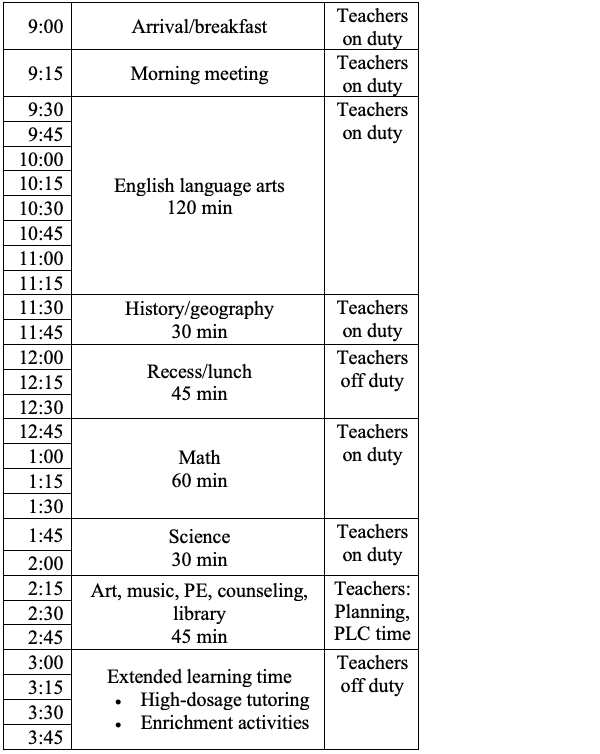
One key question is how instructional leaders might sequence the implementation of various pieces of a recovery plan, such as the one recommended in The Acceleration Imperative, and how to bring them into a coherent whole. See below for thoughts about that, and a model student schedule that indicates what all of this might look like in practice.

Recommendations

  • Put the basics in place before adding new elements, especially high-dosage tutoring. Adopting and helping teachers implement a high-quality curriculum is job number one. Many elementary students, especially those in high-poverty schools, will need extra help to recover from the loss of instructional time related to the pandemic. Done right, high-dosage tutoring shows great promise in helping such students return to grade level. But doing it right means integrating tutoring with regular classroom and small-group instruction and using the same high-quality instructional materials in all cases. Successful high-poverty schools that already had evidence-based instructional strategies and high-quality instructional materials in place before the pandemic might be ready to start integrating tutoring into their programs. But other schools have to walk before they can run.

  • Build a positive and supportive school climate. Many students will return to school with significant mental-health needs because of the significant trauma associated with the pandemic, the economic downturn, and America’s reckoning with racial injustice. This will lead some of them to want to act out or shut down at school. But by building strong relationships, ensuring school policies and practices reflect and engage diverse families, and setting high, common, school-wide expectations for behavior and academic achievement, schools can help students feel safe and optimistic and keep them focused on learning.

  • Don’t bite off more than you can chew. The only recommendations that will help students thrive are ones that are implemented thoughtfully, with fidelity, and with attention to detail. Aim for quality over quantity, and save some steps for later.

  • Make teachers’ jobs doable. Consider asking teachers to team up via “departmentalization,” for example with one teaching English language arts and another teaching math to both of their classrooms. That may be especially helpful at schools that are implementing new high-quality curricula, given that each teacher would have fewer subjects to master. Alternatively, schools with several years of experience with high-quality instructional materials might consider “looping,” where teachers stay with their current students and follow them into the next grade in the fall to maintain strong relationships. All schools, districts, and networks should also consider focusing on “priority” instructional content, as identified by Student Achievement Partners.

  • Embrace external support. Most schools should get help from professional learning organizations with expertise in the high-quality curricula their district or network has chosen. Such curricula come with embedded assessments that produce actionable data. External support organizations can help schools and teachers make good decisions around mid-course corrections.

Sample student schedule

A school’s precise schedule will depend on the time requirements for its chosen curriculum, along with various constraints, such as collective bargaining agreements and transportation logistics. Those specifics aside, here’s one example of a schedule that makes room for all of the elements discussed in The Acceleration Imperative plan.

cao

Reading List

Betts, F. (1992). How Systems Thinking Applies to Education. Educational Leadership, 50(3), 38-41.

Bryk, A., Gomez, L., Grunow, A., LeMahieu, P. (2105). Learning to Improve: How America’s Schools Can Get Better at Getting Better. Cambridge, MA: Harvard Education Press.

Bryk, A., Sebring, P., Allensworth, E., Luppescu, S., and Easton, J. (2010). Organizing Schools for Improvement: Lessons from Chicago. Chicago and London: The University of Chicago Press.

Deming, W.E. (2018). The New Economics for Industry, Government, Education (3rd. Ed.). Cambridge, MA: MIT Press.

Fleming, K. (2021). I-Flex: A New Teaching Modality for Post-Pandemic Recovery. Core Education.

Leonard, J. (1996). The New Philosophy for K-12 Education: A Deming Framework for Transforming America’s Schools. Milwaukee, WI: ASQ Quality Press.

Meadows, D. (2008) Thinking in Systems: A Primer. White River Junction, VT: Chelsea Green Publishing Company.

Scholtes, P. (1998). The Leader’s Handbook: Making Things Happen, Getting Things Done. New York, NY: McGraw-Hill.

view

A new look at the question of the effectiveness of school turnarounds

Amber M. Northern, Ph.D.
5.27.2021
Flypaper

Turnaround efforts for low performing schools have been the subject of research interest since their advent in the No Child Left Behind era. A recent working paper from a trio of researchers joins other studies focusing on the more recent ESSA era of turnarounds. Specifically, the researchers examine the impact of test-based accountability on young children, those in the untested K–2 grades, rather than the later grades where so much empirical interest has been concentrated.

This novel addition to the literature targets North Carolina’s Transformation Initiative (NCT), which focused on seventy-five of the state’s lowest-performing schools as determined by state test scores. Roughly half of those (thirty-eight) were elementary schools and the students in grades K–2 in those schools—tested via formative measures described below—comprised the treatment group (the rest of the low-performing schools were not included in the study). The total student sample—including in the 137-school control group—was nearly 50,000 K–2 students.

Turnaround services were provided to schools from 2015 through 2017 and included needs assessment, school improvement planning, and leadership and instructional coaching from local and state education agencies. Researchers used a regression discontinuity design, estimating the effect of being just below the cut off score for assignment to NCT, and verified there was no evidence that the state manipulated those cut offs. Analysts estimated the effects on four academic outcomes: early literacy, using the DIBELS early literacy assessment; reading comprehension, using the mCLASS TRC reading comprehension assessment; chronic absenteeism, indicating whether the student is absent for 10 percent or more of enrolled school days; and grade retention, noting whether students are retained in the same grade for a second year. They also examined descriptively whether NCT was associated with teacher grade-level reassignment.

In the first year of the intervention, the NCT produced negative effects on early literacy and reading, but researchers saw a rebound, resulting in positive effects in the second year of around 0.08 to 0.09 of a standard deviation on both of the assessments. Also in the first year, NCT schools had higher chronic student absenteeism (around 3 percentage points higher than control schools) and higher grade retention (about 4 percentage points higher). Grade retention effects were concentrated in kindergarten and first grade, and the effects of chronic absenteeism were strongest in kindergarten. But they found no effects on either of these outcomes in the second year.

While youngsters in grades K–2 do not take state tests, their teachers receive effectiveness scores that are calculated using their students’ TRC reading comprehension results. Thus researchers are able to identify any classroom assignment changes by teacher quality level. They find that low-effectiveness teachers in tested grades across the full sample—up to and including eighth grade teachers, so as to “examine teacher pathways into and out of” those lower grades—are 1.7 times more likely to be reassigned to untested early grades in 2016. However, reassignments did not occur in NCT schools any more often than in comparison schools. Moreover, there were no highly effective teachers of tested grades in treatment schools who moved to untested early grades—meaning treatment schools were retaining all of their highly effective teachers in the tested grades.

What does all this mean? Although the turnaround initiative had unintended negative consequences for young learners in the first year, they didn’t last long. And ineffective teachers are just as likely to be reassigned in schools impacted by turnarounds than in those that aren’t. We’re all aware of the importance of high-quality early childhood education given its impact on long-term outcomes, but we need not be overly worried that children in the early grades will suffer negative blowback from accountability-induced turnarounds. That’s good news for kiddos and their parents alike.

 SOURCE: Gary T. Henry, Shelby M. McNeill, and Erica Harbatkin, “Accountability-Driven School Reform: Are There Unintended Effects on Younger Children in Untested Grades?,” retrieved from Annenberg Institute at Brown University (February 2021).

view

How remote instruction affected learning at the college level

Jeff Murray
5.27.2021
Flypaper

Stories of successful remote teaching and learning experiences during the pandemic are heartening. But more and better data around those successes are required. Evidence suggests that districts will likely continue some level of Covid-era remote learning for the near future, and that old-school virtual charters have drawn in many new families who discovered their need for them in 2020. Anecdotes of successful pandemic pivots are not enough. A new report published in the Journal of Microbiology & Biology Education is a good start at building the vital knowledge base of how best to conduct virtual learning. The data come from the perspective of higher education but many of the lessons are transferrable to K–12.

The three co-authors of the report are all professors at New York University, teaching undergraduate seminar-style biology courses, each enrolling about twenty-five students. All three had to adapt their traditional courses to fully-remote models, taught from their homes to students in their homes located around the world. The instructors’ desire to maintain quality and rigor in their courses while pivoting to remote teaching drove them to reassess their learning objectives—derived from the K–12 Next Generation Science Standards—determining that some could only be communicated and achieved through synchronous, real-time instruction, while others could be successfully met via asynchronous, self-paced coursework. They also needed to revamp their course materials to make them fully accessible to students in the remote mode. Finally, a number of new technology platforms were required to ensure full participation and collaboration among students and with their instructors.

The adaptations required were endless. For example, an experiential learning project—in which students identify twenty unique plant species in their local environment to observe the effects of biodiversification—included changes to cover lack of Wi-Fi in the field, varying access to personal technology, extreme differences in students’ local environments around the world, and even differing levels of pandemic lockdown protocol ongoing in various countries. A number of off-the-shelf remote learning tools were employed to help maintain student progress in the asynchronous effort and to facilitate the group work required. Final presentations were recorded and viewed via Zoom, and while live feedback did not occur, each student was required to view and comment on all the presentations in writing via a Google form.

In a second example, the professors initially thought one of several existing, open-source virtual labs could be used to replace their typical Mendelian genetics project. However, these were found to cover only non-human genetics and did not feature face-to-face phenotyping, both of which had been found to be important for successful student engagement and information retention in the course previously. Pivoting, a synchronous Zoom session which largely approximated the typical classroom version was substituted. This included phenotyping in pairs, individual data analysis, and a full group session to discuss findings. A handful of students unable to attend synchronously completed their work individually on their own time and were able to view a recording of the group discussion.

What does all this amount to? On the upside: Certain learning targets, such as understanding biodiversity and adaptation to various environments, were enhanced by the geographic spread of students. The need for different versions of course materials led the professors to reinvent those materials in positive ways which will help improve access to them in the future. And the pandemic itself, including rapidly-evolving data and misinformation, provided a strong “hook” for group projects on real-world biology concepts.

On the downside: Working with unfamiliar software and modules sometimes put the focus on troubleshooting rather than learning for both teachers and students, varying student access to Wi-Fi and sufficiently powerful devices led to an occasionally unequal experience of the class, and extreme time-zone variations rendered full class synchronization impossible. Luckily, such time zone issues rarely bedevil remote learning in the K–12 space. And it is to be hoped that between philanthropic, state, and federal efforts spurred by the pandemic, internet and enabled-device access will be a quickly-shrinking problem for our schools moving forward.

But the biggest roadblock to the highest quality remote learning identified here and elsewhere is a lack of live personal feedback. Kudos to the NYU professors for their clever adaptations and creative thinking to create virtual conversations—and a hearty welcome back for the old school online message board—but live Q. and A. among students and teachers was largely absent for a variety of reasons. This is the life blood of lecture and seminar classes, a non-negotiable element that must be faithfully replicated if fully-remote learning is to have a permanent and effective place in formal education.

It is unfortunate that the professors did not compare student outcomes between their traditional seminar and the Covid-adapted version. It was likely a deliberate omission with no explanation provided. Such data are, ultimately, what are required to make certain that remote learning efforts properly replicate traditional classroom rigor. However, the details provided here are a useful step forward.

SOURCE: Erin S. Morrison, Eugenia Naro-Maciel, and Kevin M. Bonney, “Innovation in a Time of Crisis: Adapting Active Learning Approaches for Remote Biology Courses,” Journal of Microbiology & Biology Education (May 2021).

view

The Education Gadfly Show #771: Same old, same old: How districts are spending federal relief dollars (so far)

5.27.2021
Podcast
 

On this week’s podcast, Chad Aldeman, policy director of the Edunomics Lab at Georgetown University, joins Mike Petrilli and David Griffith to discuss the latest trends in school district spending of federal relief funds. On the Research Minute, Amber Northern examines how learning acceleration can recover learning loss.

Amber's Research Minute

TNTP and Zearn, "Accelerate, Don’t Remediate: New Evidence from Elementary Math Classrooms," (May 23, 2021).

If you listen on Apple Podcasts, please leave us a rating and review - we'd love to hear what you think! The Education Gadfly Show is available on all major podcast platforms.

view

Cheers and Jeers: May 27, 2021

The Education Gadfly
5.27.2021
Flypaper

Cheers

  • “The year of school choice.”—Jeb Bush
  • State and education leaders need to treat curriculum like “essential educational infrastructure.” —Alex Spurrier
  • School choice advocates rejoice over the increased public and legislative support the pandemic, and lengthy school closures, brought for more educational options. —Governing
  • “Resisting ‘anti-racist’ education is neither racist nor unreasonable.”—Rick Hess
  • Last month, our podcast covered how the Oklahoma charter association’s legal strategy secured funding on more equal terms with district schools. Governor Kevin Stitt says he’ll sign a bill to increase charter funding and codify the legal settlement. —Tulsa World

Jeers

  • NAEP science scores reveal troubling declines in student performance in the last decade. —EdWeek
  • Districts across the country failed students with disabilities during the pandemic, and experts worry about the long-term consequences. —Washington Post
  • “Analysis: States and districts may not be ready to spend $122b in rescue plan funds, but the unions are. Get ready for more school hiring.” —The 74
  • The Biden administration is letting states and districts off the hook from federal testing requirements this year, making no effort to hold them accountable. —AP News
view

What we're reading this week: May 27, 2021

The Education Gadfly
5.27.2021
Flypaper
  • Schools are struggling to entice students to return to classrooms and build trust with parents from low-income families. —WSJ
  • “D.C.-area school systems recruit exhausted teachers for summer instruction — with varying success.” —Washington Post
  • An animated interactive feature in the New York Times shows how the science behind how opening windows and other ventilation protocols are key to safe school reopenings. —New York Times
Fordham Logo

© 2026 The Thomas B. Fordham Institute
Privacy Policy
Usage Agreement

National

P.O. Box 110
Burke, VA 22009

202.223.5452

[email protected]

Ohio

P.O. Box 82291
Columbus, OH 43202

614.223.1580

[email protected]

Sponsorship

130 West Second Street, Suite 410
Dayton, Ohio 45402

937.227.3368

[email protected]