Mobile Navigation

  • National
    • Policy
      • High Expectations
      • Quality Choices
      • Personalized Pathways
    • Research
    • Commentary
      • Gadfly Newsletter
      • Gadfly Podcast
      • Flypaper Blog
      • Events
    • Covid-19
    • Scholars Program
  • Ohio
    • Policy
      • Priorities
      • Media & Testimony
    • Research
    • Commentary
      • Ohio Education Gadfly Biweekly
      • Ohio Gadfly Daily
  • Charter Authorizing
    • Application
    • Sponsored Schools
    • Resources
    • Our Work in Dayton
  • About
    • Mission
    • Board
    • Staff
    • Career
Home
Home
Advancing Educational Excellence

Main Navigation

  • National
  • Ohio
  • Charter Authorizing
  • About

National Menu

  • Topics
    • Accountability & Testing
    • Career & Technical Education
    • Charter Schools
    • Curriculum & Instruction
    • ESSA
    • Evidence-Based Learning
    • Facilities
    • Governance
    • High Achievers
    • Personalized Learning
    • Private School Choice
    • School Finance
    • Standards
    • Teachers & School Leaders
  • Research
  • Commentary
    • Gadfly Newsletter
    • Flypaper Blog
    • Gadfly Podcast
    • Events
  • COVID-19
  • Scholars Program

The Education Gadfly Weekly

Sign Up to Receive Fordham Updates

We'll send you quality research, commentary, analysis, and news on the education issues you care about.
Thank you for signing up!
Please check your email to confirm the subscription.

The Education Gadfly Weekly: About those 12th grade NAEP scores: The cake was (mostly) baked years ago

Volume 20, Number 41
10.29.2020
10.29.2020

The Education Gadfly Weekly: About those 12th grade NAEP scores: The cake was (mostly) baked years ago

Volume 20, Number 41
view
High Expectations

About those 12th grade NAEP scores: The cake was (mostly) baked years ago

As we previously saw at the 4th grade and 8th grade levels, the just-released 2019 12 grade NAEP results were mostly flat or down. But we already knew from the 2015 results that this cohort of students entered high school performing below their older peers.

Michael J. Petrilli 10.29.2020
NationalFlypaper

About those 12th grade NAEP scores: The cake was (mostly) baked years ago

Michael J. Petrilli
10.29.2020
Flypaper

Three gubernatorial contests with important ed implications

Dale Chu
10.29.2020
Flypaper

Gifted education done right benefits Black and Hispanic children. It’s not inherently racist.

Brandon L. Wright
10.29.2020
Flypaper

Educating patriots

Robert Pondiscio
10.29.2020
Flypaper

Teacher improvement during the first ten years

David Griffith
10.29.2020
Flypaper

The Education Gadfly Show: Coping with the costs of declining enrollments

10.29.2020
Podcast

What we're reading this week: October 29

The Education Gadfly
10.28.2020
Flypaper
view

Three gubernatorial contests with important ed implications

Dale Chu 10.29.2020
Flypaper
view

Gifted education done right benefits Black and Hispanic children. It’s not inherently racist.

Brandon L. Wright 10.29.2020
Flypaper
view

Educating patriots

Robert Pondiscio 10.29.2020
Flypaper
view

Teacher improvement during the first ten years

David Griffith 10.29.2020
Flypaper
view

The Education Gadfly Show: Coping with the costs of declining enrollments

Michael J. Petrilli, David Griffith, Amber M. Northern, Ph.D., Karen Hawley Miles 10.29.2020
Podcast
view

What we're reading this week: October 29

The Education Gadfly 10.28.2020
Flypaper
view

About those 12th grade NAEP scores: The cake was (mostly) baked years ago

Michael J. Petrilli
10.29.2020
Flypaper

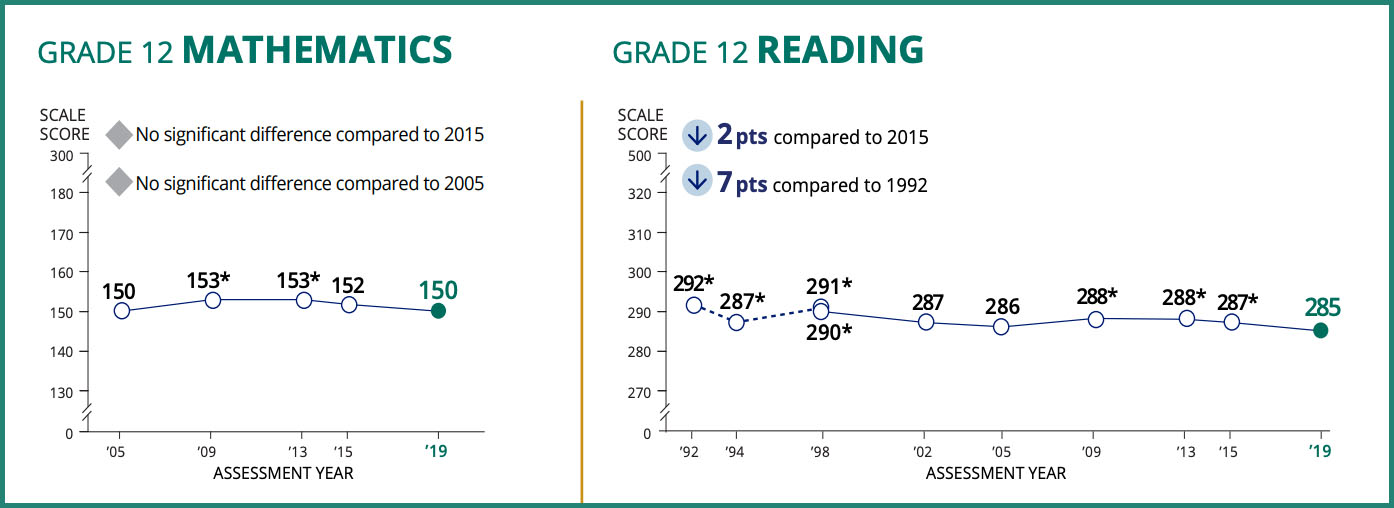
When it comes to America’s achievement trends, the bad news keeps coming. As we previously saw at the fourth grade and eighth grade levels, the just-released 2019 twelfth grade results in math and reading were mostly flat or down across the board, as well, with particularly sharp declines for our lowest-performing students in reading.

Figure 1. NAEP mathematics and reading scores for grade 12, 1992–2019

f1

Source: The 74. 

There’s no sugarcoating it. This does not bode well for this generation’s economic prospects, or the future of our country. But we shouldn’t be surprised. As I wrote on Monday, we already knew from the 2015 results that this cohort of students entered high school performing below their older peers, after suffering a major slow-down in progress between the fourth and eighth grades.

In fact, much of the declines that we see in twelfth grade when we compare the graduating class of 2019 to the class of 2015 were already apparent at the eighth grade level, especially in math.

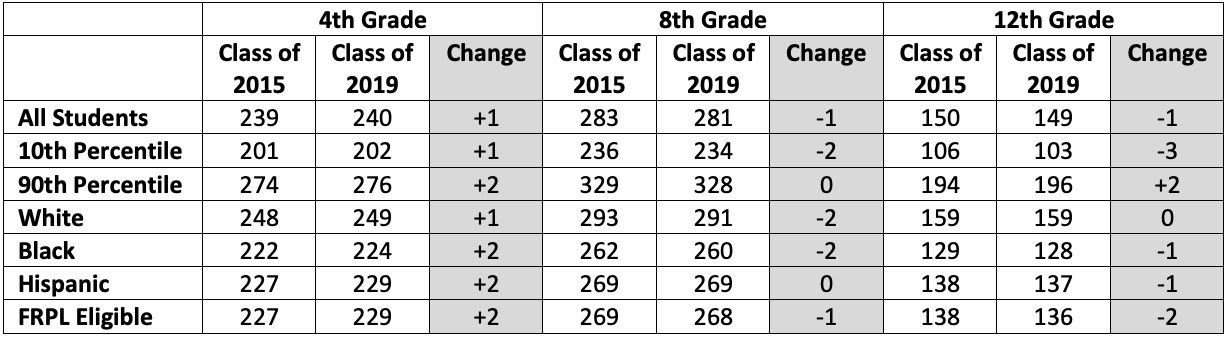
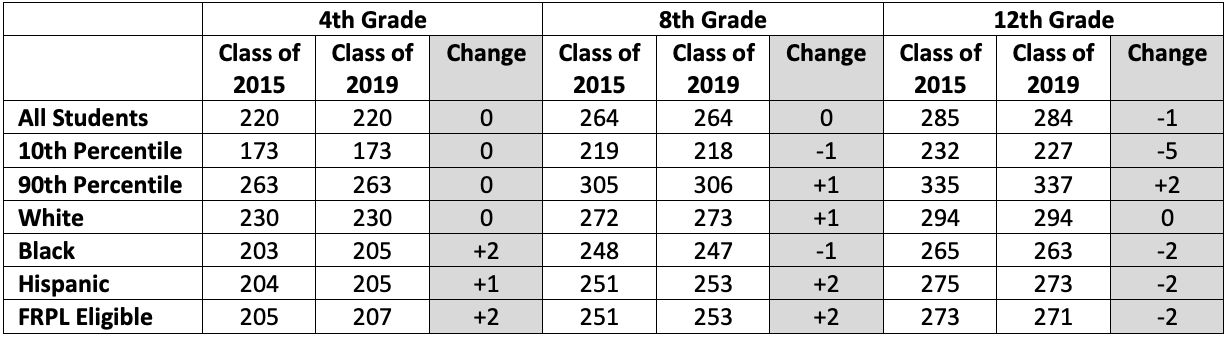
Consider table 1 below. On average, the class of 2019 scored 1 point higher in fourth grade math than did the class of 2015. But by eighth grade, it scored 1 point lower, and remained 1 point lower by twelfth grade. This middle-school slide was most dramatic for Black students, who went from +2 in fourth grade to -2 in eighth, and then back to -1 by twelfth. Hispanic students, meanwhile, also lost ground from the fourth to the eighth grade—going from +2 to 0—and kept sliding to -1 in twelfth grade. Similar patterns were seen for students eligible for free or reduced-price lunch (FRPL) and the lowest performing students (those at the tenth percentile).

Table 1. NAEP mathematics scale scores, public school sample

t1

In reading, trends for Black students were similar as those for math, with a slide starting between the fourth and eighth grades and continuing into twelfth, as seen in table 2. But for Hispanic and FRPL-eligible students, and those at the 10th percentile, most of the declines in reading happened between the eighth and the twelfth grades. The backward movement was particularly large for the lowest-performing students, going from flat results in fourth grade to -1 in eighth grade to -5 in twelfth. This might reflect the impact of falling dropout rates—an issue we’ll turn to below.

Table 2. NAEP reading scale scores, public school sample

t2

Digging into these details is important for making an accurate diagnosis of what’s causing these disheartening trends. In short, high schools shouldn’t get all the blame, as many of the declines started before the eighth grade.

And this analysis should give us more confidence in the hypothesis that a major culprit here was the sharp decline in school spending between 2010 and 2013, which the class of 2019 experienced between their third and seventh grades.

I should pause to say that by fingering spending, I’m not letting school systems off the hook. Had they made smart cuts to their budgets, employing strategies like those spelled out in a 2010 book co-produced with Rick Hess, and updated in a recently-released sequel, they could have survived the lean times without hurting students and student achievement.

Let’s also acknowledge that, as NCES official Peggy Carr told reporters, some of what we’re seeing in the twelfth grade scores is almost surely related to the big decrease in the high school dropout rate. “There is a strong correlation between improvements in graduation rate, students who we are now able to test, and a decline in scores,” Carr said. “And that’s a good thing. Students who would normally not be in the assessment are now in the assessment.”

In other words, it used to be that the country’s most disadvantaged, lowest-performing students would have been long gone before they had a chance to sit for the twelfth grade NAEP. But now that states and districts have driven the graduation rate ever higher—through means both suspect and praiseworthy—many more of those kids are making it all the way across the graduation stage. That’s a good outcome. No one wins when kids drop out. They might also be dragging down the national averages, but that’s cold comfort.

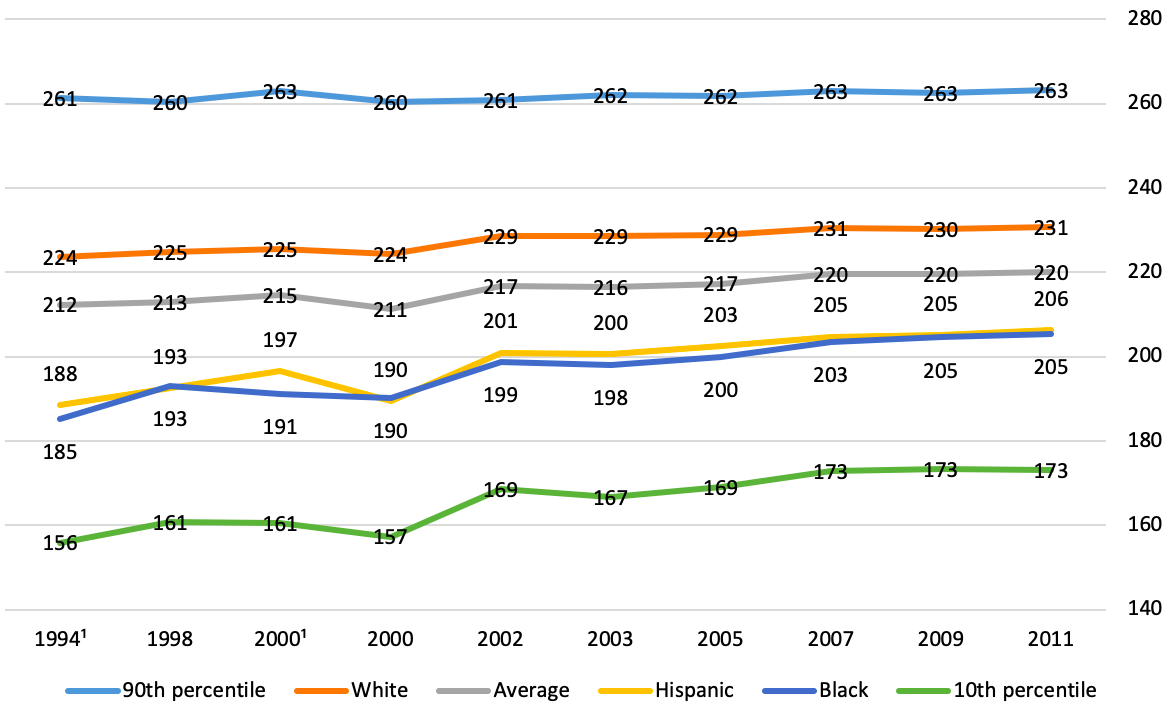
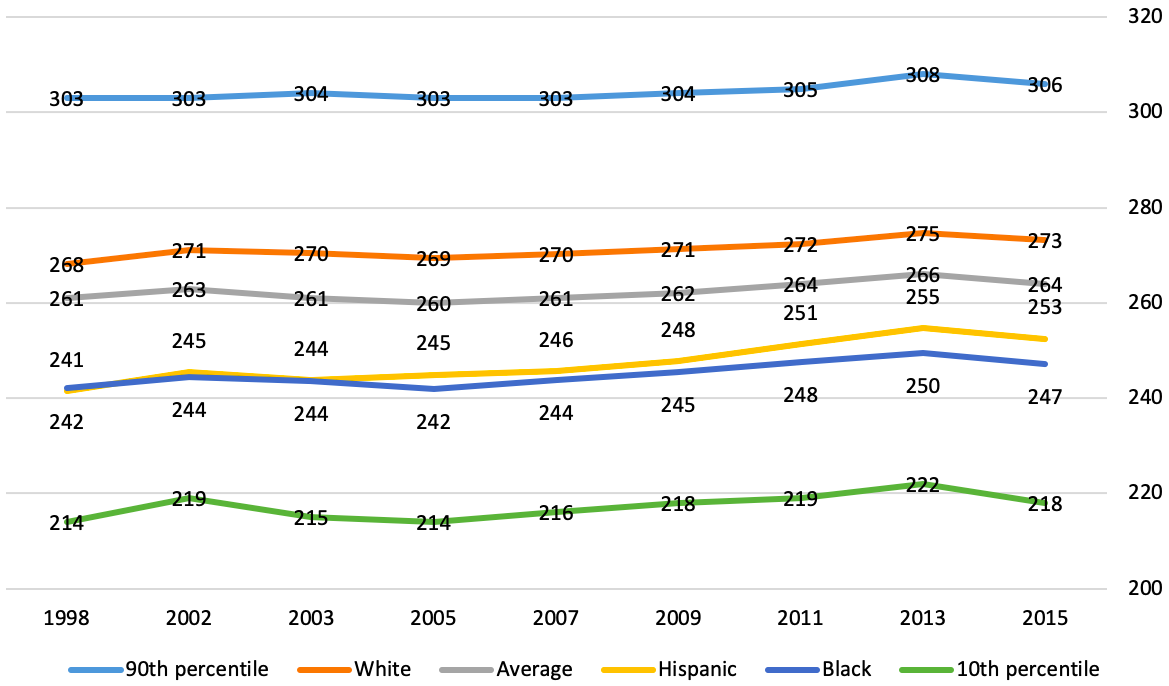
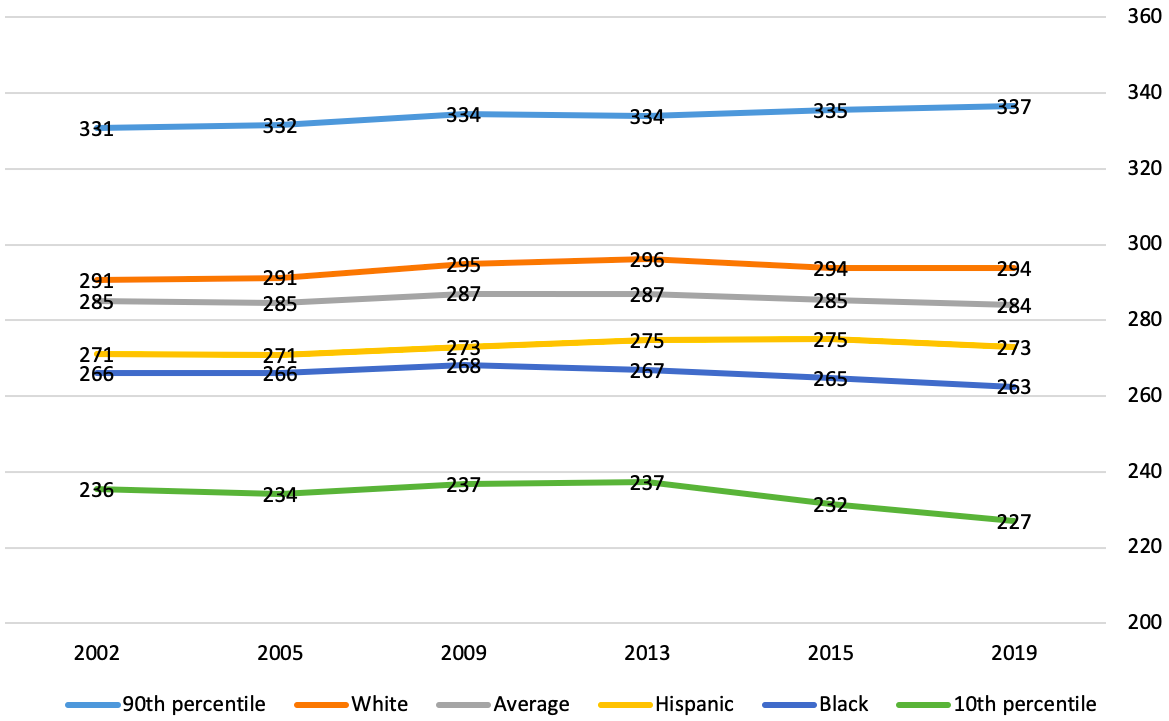
Consider the charts below. At both the fourth and eighth grade levels, reading scores are flat to slightly up if we look at scores for the graduating classes of 2002 through 2019, including for the lowest-performing students (those at the tenth percentile). But at the twelfth grade level, lately the bottom has fallen out for those lowest performers. That means one of two things: Either our high schools have suddenly gotten terrible at teaching reading to students struggling with basic literacy, or a lot more poor readers are staying in high school and taking the NAEP.

Figure 2. Average scale scores for grade 4 reading, public school sample, high school classes of 2002–19

f2

Figure 3. Average scale scores for grade 8 reading, public school sample, high school classes of 2002–19

f3

Figure 4. Average scale scores for grade 12 reading, public school sample, high school classes of 2002–19

f4

Again, none of this is meant to let schools off the hook. Even before this awful pandemic, given trends at the fourth and eighth grade levels, our high schools already faced the challenge of coping with students coming into ninth grade performing at lower levels academically. By next fall, that problem is only going to grow worse—dramatically so. They had better figure out quickly how to meet the challenge and help students make up as much ground as possible before they take their diplomas into the world.

view

Three gubernatorial contests with important ed implications

Dale Chu
10.29.2020
Flypaper

As the clock winds down on the 2020 presidential campaign, what seems certain is that the path forward on education reform will not be through whoever wins the White House. Indeed, what’s easily overlooked in the fog of national politics is the education leadership changes in store at the state level, where eleven gubernatorial seats are up for grabs. With new leadership comes the potential for fresh momentum and political will at a moment of extraordinary difficulty for schools.

To wit, the issue of reopening schools amid the pandemic looms large in all of these state-level contests. The major concern of parents and educators alike leading up to next week’s denouement is when and how to safely bring back students for in-person instruction. With new cases trending upwards yet again, everyone finds themselves weighing the risk of reopening against the risk of remaining closed, but three large states—one red, one purple, and one blue—are worth watching closely because of the unique education-related dynamics at play.

The first noteworthy contest is Indiana’s. I’ve spilled plenty of ink covering the ups and downs of education politics in my former home, where I was involved in that state’s halcyon days of school reform under the direction of Governor Mitch Daniels and State Superintendent Tony Bennett. The education chapters that followed under now Vice President Mike Pence and current Governor Eric Holcomb have been far more complicated, without the benefit of being productive, because of ongoing disagreements and disputes between the governor and the separately elected state superintendent.

Holcomb is expected to win a second term handily and thanks to a statutory change long in the making will be able to appoint a schools chief aligned to his vision for change. The question is whether he’ll select a respected administrator or a hard-charging reformer. Based on which way the winds are blowing, I would suspect the former, but even that would be an improvement in light of the turmoil over the last eight years—and an opportunity to see if the Hoosier state can recapture some of the magic that once made it an education reform darling.

North Carolina is the second contest to keep an eye on. The scorched-earth politics in the ninth largest state is a microcosm of the forces roiling our national discourse, but there’s no better place than North Carolina when it comes to trying to figure out which policies can and cannot work. It’s also where the legacy of the nation’s first “education governor,” Governor Jim Hunt, continues to cast a long shadow against which all Tar Heel governors are measured.

Polling has current Democratic Governor Roy Cooper on a path for reelection for his well-received handling of the coronavirus rather than education, where he has found himself at loggerheads with a GOP legislature that has driven major education reforms over the last decade. The tone for their contentious relationship was set soon after Cooper narrowly won election four years ago when Republicans used a special session to strip him of many of his executive powers prior to taking office. Since then, important policy questions like teacher compensation have been highly contentious.

North Carolina will have a new elected state superintendent come January because the incumbent filed to run for another office and lost. In a debate between the two candidates earlier this month, Democrat Jen Mangrum and Republican Catherine Truitt were refreshingly civil in praising one another despite clear areas of disagreement. The goodwill should be short lived. No matter what the outcome, North Carolinians can expect the resumption of the inescapably partisan approach that has come to characterize the state’s education politics.

Finally, the contest in Washington is meaningful because the state has been a hotbed of discomfiting education activity since its initial mark as ground zero in the pandemic. Governor Jay Inslee, who ran a short-lived bid for president, is expected to sail through to a third term as the state’s chief executive. Moreover, in deep blue Washington during a presidential year, few voters will split tickets, which means State Superintendent Chris Reykdal should also coast to another term in that office in spite of a sex education mandate marring the campaign.

Unsurprisingly, both men are faithful adherents to the teachers’ union playbook. If Biden prevails, both men could also be in line for plum cabinet posts. Inslee would be a prime candidate for Interior Secretary, and for Reykdal’s part, he could be angling to take the reins from Betsy DeVos in light of a remarkable “open letter” he penned last month to Biden and Harris. In his screed, the state superintendent outlined ten “critical steps” including a gratuitous swipe at ESSA’s annual testing requirement and a broadside against school vouchers. Suffice it to say, the country could be in for some real dyspepsia if the Evergreen State’s brand of ed policy spreads significantly beyond its borders.

Win, lose, or draw, these three contests portend significant education repercussions within their respective states. In Indiana, it’s a real chance to right the ship. North Carolina is in a telling battle of attrition with no end in sight. And Washington could be an unnerving harbinger of federal policy in the years ahead. All of which is to say, K–12 education may never register prominently in a presidential race, but the issue is alive and well as a local matter, and there’s good reason to believe that the fiercest battles yet to be fought in America’s struggle over school reform will have roots in this particular triumvirate.

view

Gifted education done right benefits Black and Hispanic children. It’s not inherently racist.

Brandon L. Wright
10.29.2020
Flypaper

As our country grapples with racial injustice, there are persistent calls to diversify elite institutions at all levels, from corporate and foundation boards to law schools and medical schools to undergraduate programs. All good. And in line with the adage that college begins in kindergarten, many of these efforts eventually look at schools to better prepare more Black, Hispanic, and low-income children to excel academically and earn a shot at entering selective universities. To do that, we need to make sure that the most promising among them get enrichment and acceleration. That means gifted education.

Yet tragically, instead of following that logic and expanding gifted services for Black, Brown, and other historically disadvantaged students, some insist that the anti-racist thing to do is eliminate them. This has led to misguided questions like “Is it even possible to make a concept that has racist origins more equitable?” in an essay published by the Hechinger Report, and moves that seek to replace gifted ed with toothless initiatives like “schoolwide enrichment.” This is exactly the wrong approach.

To be sure, gifted education has a diversity problem, due in part to how school systems have historically designed these programs and other enrichment efforts. A Fordham study in 2018 called Is There A Gifted Gap? found that White students constitute 47.9 percent of the student population but 55.2 percent of those enrolled in gifted programs, while the comparable figures for Black students are 15.0 and 10.0 percent, and for Hispanic students, 27.6 and 20.8 percent. Those latter student groups are also 49 and 23 percent less likely, respectively, to participate in Advanced Placement than their peers. And when Black and Brown students attend a school that offers International Baccalaureate courses, they are 62 percent and 51 percent less likely, respectively, to take part.

But the problem isn’t the idea of gifted education itself—which, far from being inherently racist, is simply the practice of grouping higher-achieving and higher-potential students together so that they can benefit from deeper and faster curricula that wouldn’t work well in regular classrooms, especially classrooms with lots of students struggling to reach grade level.

The real problem has three components. First, our country, communities, and schools have long done a poor job of maximizing the potential of students in low-income neighborhoods that are predominantly Black and Hispanic—regardless of their ability. Not only do they suffer from poverty, they have less access to healthcare, healthy food, safe streets, early childhood education, and much more. And then when they do attend school, it’s too often in crumbling buildings that lack adequate supplies, where they sit in crowded and unruly classrooms with less experienced teachers who are more likely to transfer or quit. The list of disadvantages goes on. But the takeaway is simple: We make it far too difficult for these children to succeed.

Second, too many districts serving poor students and students of color have taken previous and misguided charges of racism to heart and eliminated their own gifted education programs, opting instead for the lure of “heterogeneous classrooms.” This jargon is based on the egalitarian but mistaken notion that letting some kids go faster than others, even go at their own speed, is inherently suspect. But here’s the thing: Proponents of this fallacious view have long been more effective at shaming urban districts in deep-blue cities to eliminate gifted education than they have been with their affluent and suburban counterparts. So rich kids with lots of academic potential still get access to enrichment and acceleration—in their fancy suburban public schools, expensive private schools, or at home—whereas poor and minority kids in the city do not.

Third, even when school systems do offer gifted programs, they are often too small and limited to serve all students who might benefit from them, especially Black, Hispanic, and low-income children. Often such programs are concentrated in neighborhoods full of demanding upper-middle class parents. In many places, moreover, admissions are based on standardized test scores, for which administrators set objective cutoffs—ironically, in the name of equity. These tests are rarely universal, meaning families have to ask even to take them, or must rely on teachers to nominate their children as candidates. This ends up favoring affluent and advantaged children, who tend to score higher on standardized tests because of those advantages—not because they’re more able or have more potential. Higher-income students are also more likely to have engaged, pushy parents, who are more likely to know about the tests, make sure their kids take them, do everything they can to motivate educators to pick their children when that’s required, and sometimes engage private tutors to give their kids an academic boost.

These problems—systemic, and in some cases systematically racist, to be sure—have nothing to do with the basic idea of gifted education. The idea remains sound and stands to benefit the Black, Brown, and low-income children who need it most. We just have to expand access, while ensuring that these programs continue to challenge all of their students and maximize their potential.

To achieve this, districts should adopt systems that better develop the natural ability of all high achievers, and then more equitably identify them for gifted services. First, they should “frontload,” meaning they ought to raise schools’ academic rigor in early grades so that disadvantaged pupils are ready for more advanced offerings later. Then they should universally test all students beginning in third grade for gifted program eligibility, when the excellence gap has hopefully narrowed because of the frontloading in pre-K and K–2. The top 5 percent or so of test takers in each school, not the top 5 percent in the district, should be identified for gifted ed. Joining them should be another 5 percent of pupils nominated by teachers on the basis of uncommon potential or simply a gleam in the eye.

This would diversify the population qualifying for these services and not just favor kids who are White, Asian, or upper-middle-class, as the system does today. And in giving high-ability and high-potential Black and Hispanic students so many more years of increased academic rigor and enrichment, it would better prepare them to gain acceptance to, and excel at, selective high schools and colleges, where they’d earn degrees that make them competitive for respected and lucrative careers. In other words, it achieves the ends of diversifying opportunities for Black, Brown, and low-income children, but does so by building up their achievement, instead of tearing down the unique and valuable services provided by high-quality gifted programs.

As calls increase to eliminate gifted programs in the name of equity, policymakers and school leaders must resist them—and recognize that bowing to that misguided pressure will do more harm, not less, to their Black and Brown students. Instead, they should double down on gifted education, diversifying and strengthening it so as to maximize its benefits for the disadvantaged boys and girls that need it most.


view

Educating patriots

Robert Pondiscio
10.29.2020
Flypaper

Decades before “equity” became a buzzword in education, E. D. Hirsch, Jr. had his finger on what the word actually means: equal access for all children to the knowledge and verbal proficiency that makes full participation in American life possible. In a series of books and journal articles stretching back decades, Hirsch has argued that we will not have a just and prosperous society until our schools ensure that every child has access to the knowledge that the children of well-off families take for granted.

Hirsch’s scholarship rests on the hypothesis, validated by volumes of evidence from cognitive science, that language comprehension—particularly the ability to read with understanding—is not a discrete, transferable “skill,” like riding a bike, that can be learned, practiced, and mastered. Rather, it rests on a common base of knowledge, literary and cultural allusions, and idioms common to a nation’s “speech community.”

This mental furniture allows its members to participate fully and fluently in civic and economic life, but it’s unequally distributed among knowledge haves and have-nots. Decisions by teachers or by schools about what children should know are thus matters of unusual gravity. It might be decided that teaching Greek mythology is passé, even Eurocentric, and that schools should adopt a more “culturally relevant” curriculum to honor diversity and engage children. But a future college admissions officer or employer might hold it against a young person if they don’t recognize, for example, a reference to “opening Pandora’s box.”

Like a fish that doesn’t know it’s in water, highly literate people are swimming in “background knowledge” of history, science, literature, and art. Sophisticated written and spoken language is a kind of shorthand. Writers and speakers rely on assumptions about what their readers and listeners know to fill in gaps, supply context, and resolve ambiguities in speech and texts. Thus, Hirsch argues, fairness demands that schools teach a rigorous core curriculum in elementary school (and ideally middle school) that closes knowledge gaps. To do otherwise is to subvert the school’s role as an engine of upward mobility.

Hirsch’s egalitarian vision is as empirically verifiable as it is out of step with current education fashions. Not surprisingly, his work has been mischaracterized as “banking” and canon-making, or even as an effort to impose “whiteness” on nonwhite students. In fact, it’s an effort to catalogue the taken-for-granted knowledge of the broad American speech community so that it can be taught. This fundamental disconnect led University of Virginia professor of psychology Daniel Willingham to describe Hirsch’s landmark 1987 book Cultural Literacy, which spent six months on the New York Times best-seller list, as “the most misunderstood education book of the last fifty years.”

The years since the firestorm over Cultural Literacy have been kinder to Hirsch. The content-rich elementary education he champions has not overthrown the progressive, “child-centered” pedagogies he has criticized, but the education world that once reviled him as a reactionary trying to impose an archaic canon on children has increasingly accepted that he was right: There is no escaping the connection between broad general knowledge and broad general literacy. Hirsch launched the Core Knowledge Foundation over thirty years ago to promote his ideas and produce a curriculum built on his insights. Today, many publishers promote and sell a “content-rich” English language arts curriculum.

Hirsch has refined his message and mustered fresh evidence in each of his subsequent books, but now, at ninety-two, in what he says is his farewell book, his project has taken on fresh urgency. The aim of How to Educate a Citizen is not merely to save American education from demonstrably false ideas about teaching and learning, but to save America itself. This sounds grandiose, but it follows from Hirsch’s core thesis. Education and nationhood are functionally the same idea. “Intellectual error has become a threat to the well-being of the nation,” Hirsch warns. “A truly massive tragedy is building.”

Our earliest thinkers about education “thought the school would be the institution that would transform future citizens into loyal Americans,” Hirsch writes. More than two centuries ago, Benjamin Rush, signer of the Declaration of Independence, wrote an essay advocating a common elementary school curriculum. “The paramount aim of the schools, he wrote, was to create ‘republican machines.’ By that he meant active, loyal, purposeful citizens of the republic.” The mechanism that builds strong readers and drives genuine educational equity is the same one that builds strong bonds of affection and loyalty among citizens. “The elementary school is decisive for forming both our knowledge base and our gut allegiance,” Hirsch writes.

We are far more accustomed to thinking of schools as a means to promote the private ends of college or career. Hirsch reminds us that “nation-creating” was the explicit aim of American public education at its founding, “reinforced in primers and spelling books on a scale never before seen in human history.” New York in particular, with its diversity of immigrants and religions, was “especially alert to the need to build up a shared public sphere where all these different groups could meet as equals on common ground,” he writes. “How prescient the founders were in being worried about factions and lack of public spirit and even disloyalty to the republic,” he laments. “We have, to our distress, acquired some of the evils they feared.”

How to Educate a Citizen arrives at a moment when the dominant ideas in education are once again working against his unifying vision for common schools. On the right, advocates often put a higher priority on school choice; on the left, a strident social justice orthodoxy insists that all institutions, especially public schools, must be “anti-racist” and “decolonize” their curriculum. Recall how Colin Kaepernick last year pressured Nike to discontinue a sneaker adorned with the 1776 flag, which he claimed was an offensive symbol from the era of slavery. A nation that cannot agree whether its flag is a symbol of pride or racial hatred is not ready to agree on what its children should be taught.

Hirsch is fond of invoking the words of Thomas Jefferson, chiseled over a doorway on the campus of the University of Virginia, where he taught for decades. “For here we are not afraid to follow truth wherever it may lead, nor to tolerate any error so long as reason is left free to combat it.” Guided by those words over his long, admirable, and prolific career, E. D. Hirsch, Jr. has worked patiently to correct the errors of the false prophets of progressive pedagogy and to restore the public purpose of American education and its founding ideals. It is up to the rest of us now to follow his lead.

SOURCE: E.D. Hirsch, Jr., How to Educate a Citizen: The Power of Shared Knowledge to Unify a Nation (Harper, 2020).

Editor’s note: This was first published by City Journal.

view

Teacher improvement during the first ten years

David Griffith
10.29.2020
Flypaper

A recent study from Brown University’s Matthew A. Kraft and John P. Papay and Harvard’s Olivia L. Chi uses nine years of administrative data from Charlotte-Mecklenburg Schools in North Carolina to examine teacher improvement through the lens of principal evaluations.

Although teachers were evaluated on eight domains (e.g., Management of Instructional Time, Management of Student Behavior), it’s not clear that these domains actually capture different dimensions of teacher quality. Nor is there any evidence that teachers improve more quickly in some domains than others. So for simplicity’s sake, the bulk of the paper relies on a single measure of teacher quality, which is based on teachers’ ratings across all eight domains.

Overall, the authors find that “new teachers make large and rapid improvements in their instructional practices throughout their first ten years on the job,” rather than plateauing after three to five years, as some early research suggested. For example, between the first and tenth years on the job, the average teacher moves from the 31st to the 62nd percentile of subjective (i.e., principal-assessed) performance (though it’s worth noting that most teachers still get favorable evaluations).

Yet the rate and duration of teachers’ improvement also varies significantly across and within settings. For example, middle school teachers seem to stop improving after three years on the job, while both elementary and high school teachers continue to improve. And somewhat more encouragingly, there is a significant negative correlation between teachers’ initial performance and their rate of improvement (meaning weaker teachers improve more quickly and should perhaps be given a few years to improve rather than hastily dismissed).

Notably, although the authors find “little evidence of differences in the improvement profiles among teachers in tested vs. non-tested grades,” principals do rate teachers in high-stakes classrooms slightly higher than their peers in low-stakes classrooms—a difference the authors attribute in part to the fact that receiving a lower performance rating modestly increases a teacher’s odds of being reassigned to a non-tested grade, though there’s no evidence that high-performing teachers in low-stakes classrooms are reassigned to high-stakes classrooms.

According to the authors, the findings generally “underscore the potential of human capital investments in the teacher labor force, and the perils of relying on a revolving door of inexperienced teachers to staff schools.” And yet, some high-performing charter schools seem to have just such a door (though not necessarily because they want one). So one way or another, there must be a bit more to the story.

SOURCE: Matthew A. Kraft, John P. Papay, and Olivia L. Chi, “Teacher Skill Development: Evidence from Performance Ratings by Principals” (Annenberg Institute at Brown University, 2019).

view

The Education Gadfly Show: Coping with the costs of declining enrollments

10.29.2020
Podcast

On this week’s podcast, Karen Hawley Miles, CEO and president of Education Resource Strategies, joins Mike Petrilli and David Griffith to discuss her chapter in Getting the Most Bang for the Education Buck on how school districts can cope with budgetary consequences of declining enrollments—a growing problem because of Covid-19. On the Research Minute, Amber Northern examines the academic effects of reclassifying English language learners as English proficient.

Amber's Research Minute

Masayuki Onda & Edward Seyler, “English learners reclassification and academic achievement: Evidence from Minnesota,” Economics of Education Review (2020).

The Education Gadfly Show is available on Google Podcasts, Libsyn, Spotify, iHeartRadio, Apple Podcasts, TuneIn, The Podcast App, PodBean, Podbay, Chartable, Castbox, and myTuner Radio.

view

What we're reading this week: October 29

The Education Gadfly
10.28.2020
Flypaper
  • School districts in Texas are reporting troubling percentages of students failing remote courses, causing educators and parents to push for a return to in-person instruction. —Texas Tribune
  • Despite boasting “a new building, a top-notch air-filtration system” and families eager to return, Washington, D.C.’s Latin American Montessori Bilingual charter school backtracked on reopening in November because of teachers’ concerns. —Washington Post
  • There are troubling racial disparities in enrollment in career and technical high school courses among Black and Latino students. —Hechinger Report
  • How have districts fared in serving special education students since the pandemic began? Parents share their thoughts. —Chalkbeat Chicago
  • The Biden campaign won’t commit to issuing state testing waivers this school year—an encouraging sign for those committed to monitoring student learning during the pandemic. —Education Week
  • Fairfax County School Board proposes a plan to improve access to Thomas Jefferson High School, a selective-admission high school, for talented students of color. —Washington Post
  • “Betsy DeVos is the most-sued secretary in the forty-one-year history of the U.S. Department of Education.” —The 74 Million
  • Kindergarten teachers worry that virtual learning is failing their students, especially those from disadvantaged backgrounds. Perhaps these children could use an extra year to catch up. —Hechinger Report

Sign Up to Receive Fordham Updates

We'll send you quality research, commentary, analysis, and news on the education issues you care about.
Thank you for signing up!
Please check your email to confirm the subscription.
Fordham Logo

© 2020 The Thomas B. Fordham Institute
Privacy Policy
Usage Agreement

National

1016 16th St NW, 8th Floor 
Washington, DC 20036

202.223.5452

[email protected]

  • <
Ohio

P.O. Box 82291
Columbus, OH 43202

614.223.1580

[email protected]

Sponsorship

130 West Second Street, Suite 410
Dayton, Ohio 45402

937.227.3368

[email protected]