
Earlier this month, Dana Goldstein of the New York Times wrote one of the most important education articles in years. In it, she argues that both political parties have abandoned the ed-reform agenda.
For decades, both Republicans and Democrats strove to be seen as champions of student achievement. Politicians believed pushing for stronger reading and math skills wasn’t just a responsibility, it was potentially a winning electoral strategy.
At the moment, though, it seems as though neither party, nor even a single major political figure, is vying to claim that mantle.
One could quibble around the edges of her argument (as Dan Buck did in these pages). As I’ve written before, there’s a good case to be made that OG ed reform is still alive and well in many red states. And at least a couple of policy areas have momentum and support from across the political spectrum, most notably the “science of reading” for little kids and Career and Technical Education for older ones.
But Goldstein is right that such islands of activity don’t add up to a serious agenda. They aren’t nearly enough to boost student achievement or close achievement gaps, especially given America’s long educational decline, which started more than a decade ago, before going off a pandemic-induced cliff.
So allow me to offer a robust education-reform agenda, one that would actually bring marked improvements to our public schools. Consider this a complement to ongoing efforts to expand high-quality parental choice via charter schools, private school scholarships, and other means. No doubt, “my agenda” will remain hypothetical unless and until politicians and other leaders embrace and run with it.
I will group the reforms by three prongs, organized around problems they are trying to address:
- Changes to educational practice that are eminently doable if we can overcome the tyranny of bad ideas;
- Reforms, especially related to spending and personnel, that must grapple with power politics, especially the politics of jobs, school boards, and teachers unions; and
- The hard but essential work of executing effectively.
Prong 1: Improving educational practice
The first prong of reforms should arguably be the easiest, because all that’s standing in our way is a bunch of bad ideas. We could call these changes “doing what works,” or “following the evidence,” or even just “following common sense.”
The most prominent example today is the science of reading. This one has struck a chord because the dumb way of trying (and failing) to teach kids to read was so obviously idiotic to anybody who had not spent their life inside an ed-school bubble. As in: Of course we must teach kids how to sound out the letters that make up words in the code we call the English language. Of course children are not going to learn how to read by osmosis, like we learn to speak.
And yet that basic notion—that we need to teach kids how to read via direct and explicit instruction in decoding letters and words—was denied in many U.S. classrooms for decades.
Now policy makers and education leaders are trying to replace bad ideas with reading pedagogies that align with evidence and common sense. Hooray!
The good news is that there’s much more where that came from. We could look next at math, where some still resist the obvious notion that little kids need to learn their math facts to the level of automaticity, meaning knowing how to add, subtract, multiply, and divide quickly and effortlessly. Conceptual understanding is important, too, but it’s not sufficient, and not much of it will happen without the basics.
Or we could embrace the importance of teaching elementary-age kids about the world they are inheriting, via exciting and engaging instruction in history, science, literature, and the arts. Which is not only their birthright and essential to informed citizenship, but also is the only proven way to build vocabulary and reading comprehension.
Or we could seize upon the commonsensical notion of grouping students by where they’re at in the learning progression, rather than with kids who merely share the same birth years. Because not all six- or seven- or eight-year-olds are at exactly the same level in reading or math, we should group kids with others at the same readiness level, at least for part of the school day. (That is surely the case for small-group tutoring.)
Indeed, as Emily Hanford’s Sold a Story explained recently, Success for All schools have been grouping their pupils like this for decades, even with some kids spending part of their day in different grade levels, and it’s worked. Yet there are some out there who think that any kind of grouping amounts to “tracking” and is therefore racist, classist, and inequitable. Balderdash!
Fruitful terrain can also be plowed in grading and discipline practices. “Reforms” that have swept through our schools in recent years have led to lowered expectations for students “because equity.” We banned the use of zeros for kids who failed to turn in assignments or bombed their tests, even if they put in zero effort. We replaced traditional disciplinary practices, such as handing out detention during lunch or after school or on Saturday morning, and instead put kids in Kafkaesque “restorative circles”—or just looked the other way. We let phones and other devices invade the classroom.
Recalibrating our grading and disciplinary standards—while helping students meet them—would be a huge shot in the arm to our teachers, our schools, and our efforts to improve achievement.
Want more? Look at the hash we’ve made of middle schools and high schools because we reject the notion that not all teenagers need to tread the same pathway to college or career. We say we’re moving past the “college for all” era, yet we haven’t scrubbed the many course requirements still on the books, which leave little room for students to do real career training (like internships or apprenticeships). We pretend that making kids take three years of math and four years of English amounts to a call for rigor, and we keep adding new course requirements (coding! Financial literacy!) while never taking any away.
Let’s sum it up and reframe this as a positive agenda.
- For our elementary schools, let’s make sure that districts adopt high-quality instructional materials, including English language arts programs that do an excellent job following the science of reading, and that also provide a content-rich curriculum in history, geography, science, literature, and the arts. And in math, let’s make sure that instructional materials are as focused on computational skills, especially in the early grades, as on conceptual understanding.
- From grades K through 12, let’s embrace the use of targeted, flexible groups, whether for early reading instruction or for math groups or, once kids get to middle and high school, for advanced versus on-grade-level instruction. By all means, let’s make sure that we are constantly looking for kids who might be late bloomers, and are now ready for more challenging assignments. And let’s make sure that the way we make decisions around those groups and course assignments is based on evidence and not bias. That means, for example, automatically enrolling students in advanced math courses if they demonstrate their readiness on the state test.
- And let’s return to the tried-and-true methods of grading and discipline that, like Chesterton’s fence, were adopted for good reason. Mainly because they make it clear to students that we have high expectations for them, and that they will be held accountable for their behavior and effort.
Prong 2: Reforming spending and personnel practices
Overcoming the tyranny of bad ideas is hard, especially in a system that is as fragmented as ours, with its 14,000 school districts and over 100,000 schools. That’s a lot of people to persuade! But it’s infinitely easier than trying to enact reforms that will impact the livelihoods of the adults who work in those schools.
And here is where we come to our second prong and the fundamental challenge of public education—and most public services: how to bring sound decision-making and accountability into a world where the politicians have every incentive to follow the will of the people who work for them rather than the people they are supposed to serve.
In other words, how do we deal with the all-powerful teachers unions, their capture of elected school boards, and the plain fact that the public education system is, among many other things, a gigantic jobs program?
If we want excellent public schools, we need to find a way to attract talented people and keep them, while quickly determining when we’ve made a mistake and be able to let those people go.
And we need to stop our practice of prioritizing teacher and staff quantity over quality.
A serious education reform agenda—one targeted at improving achievement and closing gaps—would focus on significantly raising teacher salaries, especially for new teachers, and especially for those willing to serve in our neediest schools. That’s because of basic labor economics. If we want great people, we need to pay for them. And if we want people to be willing to work in challenging circumstances, we need to pay them more. A lot more.
And how wonderful it would be if the only barrier to this agenda was money. Let’s just spend more money on our schools, and they will pay teachers more! Make that funding more progressive so that high-poverty schools get extra, and they will pay their teachers extra!
Except that it hasn’t worked. As Chad Alderman wrote recently, after adjusting for inflation, spending has gone up, up, up while teacher salaries have been flat, flat, flat.
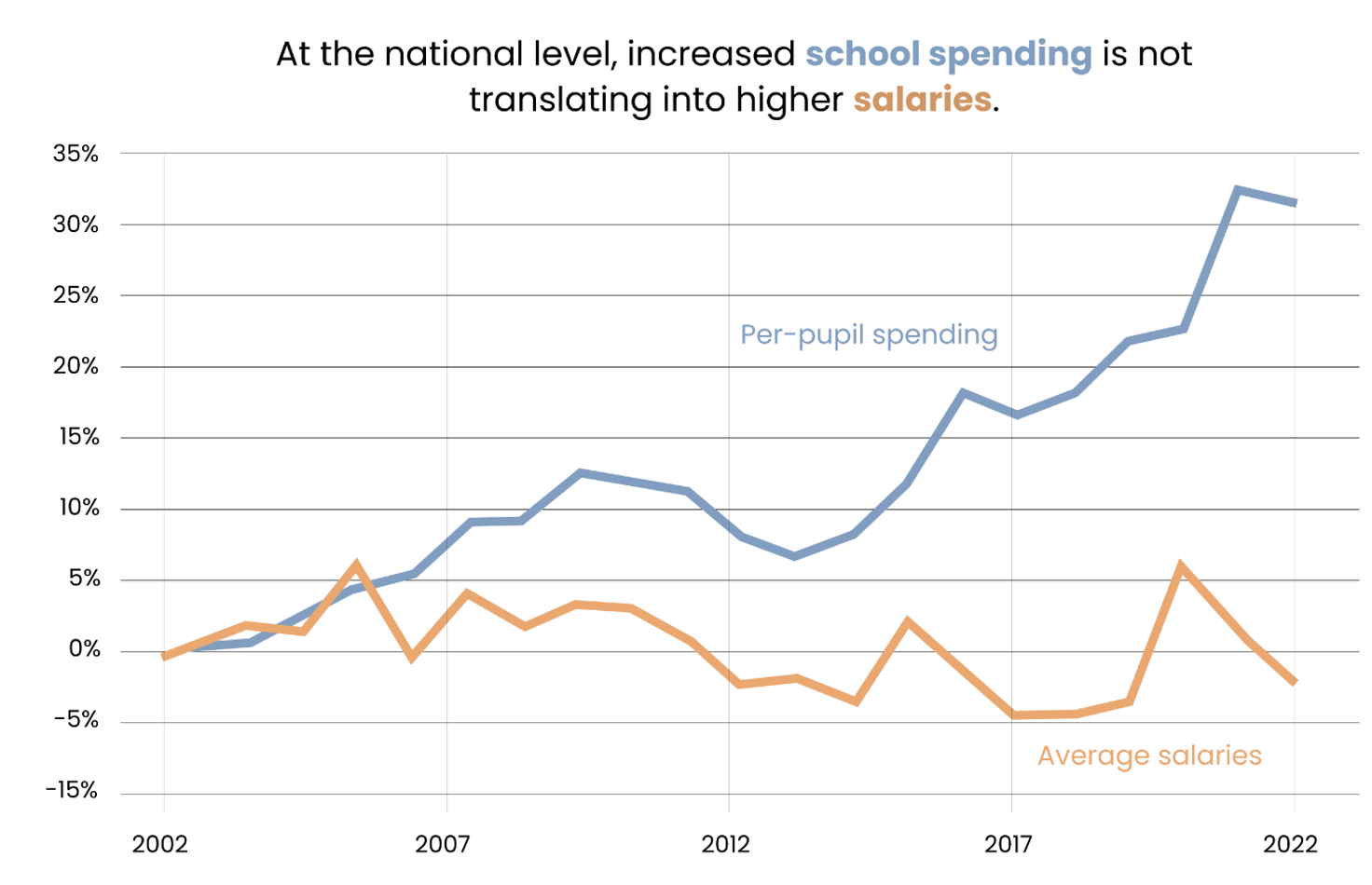
And that is because, at every turn, and in practically every school district, when the time comes to choose between raising teacher salaries or hiring more teachers and other staff, we hire more teachers and other staff.
For a long time, this was in the cause of shrinking class sizes, which are now truly tiny in many places.
More recently, we have invented new categories of staff that we think we need in our schools. Reading coaches, math coaches, and now a whole slew of mental health counselors. Not to mention an ever-growing number of administrators and central-office personnel—on top of the classroom aides, school secretaries, bus drivers, lunch ladies, and the rest of the army of education staff we’ve had forever.
It’s not hard to understand why we have prioritized expanding the payroll—at least, if you’re willing to be cynical. Consider the teachers unions. As a friend reminded me recently, their fees are based on a per-head basis, so when schools add staff, they get more money. But when the unions successfully bargain for additional pay, that doesn’t put any more dollars in their coffers.
School boards members, meanwhile, like to hire people. The more the merrier. State and local politicians like that also. Because creating jobs is popular!
And so we’ve stumbled into a model whereby we offer mediocre pay to teachers and then try to help them be more effective by surrounding them with lots of other bodies.
If we wanted to do what’s best for kids and for raising student achievement, we would flip this model on its head. We would invest our resources in higher pay, and dramatically higher pay for teachers in high poverty schools. We would slim down the other staff, both in schools and central offices. We would let class sizes rise modestly. And we would use the tenure approval process seriously, weeding out the bad hires before they get lifelong protection.
“Raising teacher salaries” sounds like it should be a popular plank. But it’s the necessary trade-offs that make this so hard politically.
And other items in this prong might be even tougher—like expediently closing underenrolled and underperforming schools, which is political suicide but absolutely necessary given our country’s demographics.
Like I said: Hard. But necessary.
Prong 3: Execution
I debated whether to mention this, given that I honestly don’t have any great ideas on how to tackle it. But for any reform that is likely to help kids and boost student achievement, the key is not just passing a law or a school board resolution, but implementation and execution. That means getting the details right day in and day out at the classroom level.
Schools aren’t that different from other service-sector industries in this respect. I imagine that running assisted living centers or hospitals or even restaurant chains is challenging, too—making sure that customers have a positive experience, that great employees are hired and have the support and tools that they need, that mediocrity and bad management are addressed quickly.
In our world, many reforms struggle with the “last mile.” Many of us worry about that right now with the science of reading, and whether we are providing the best materials and training for teachers. We should also worry about it when it comes to math, or grouping, or grading, or discipline.
Mike Goldstein has thought about these problems longer and harder than anyone else I know, including wondering about some sort of management training system that we could put in place so that school districts have a cadre of professionals who are great at implementation, regardless of the initiative. That sounds about right to me.
Conclusion
Things might not be as dire as Dana Goldstein’s article implied. But it’s certainly true that most states and districts are lacking a reform agenda strong enough to overcome the inertia and forces that are dragging down student achievement. Policymakers and practitioners: take the agenda above and make it yours!