
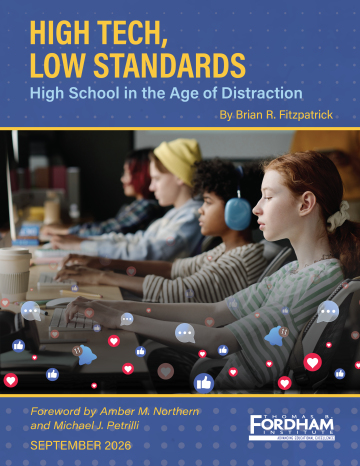
High Tech, Low Standards: High School in the Age of Distraction
A new national survey finds that school-issued devices, AI misuse, and grade inflation are undermining learning and leaving many students feeling unprepared for the future.
High Tech, Low Standards: High School in the Age of Distraction
A new national survey finds that school-issued devices, AI misuse, and grade inflation are undermining learning and leaving many students feeling unprepared for the future.
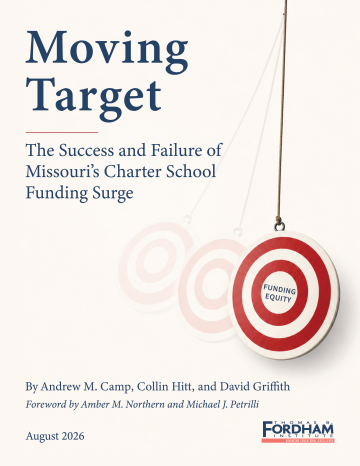
Moving Target: The Success and Failure of Missouri’s Charter School Funding Surge
In 2022, the state of Missouri made a concerted effort to eliminate its charter school funding gap. But how much progress has it actually made? And what have charters done with the additional funds?
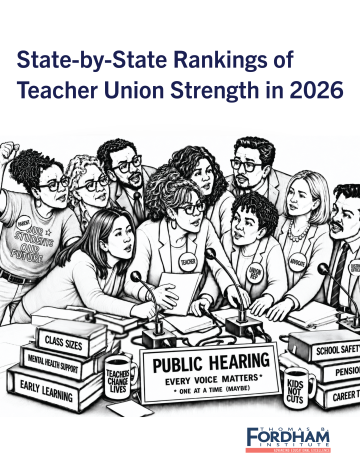
State-by-State Rankings of Teacher Union Strength in 2026
These profiles accompany Fordham’s report, A Crowded Table: Teacher Union Strength in 2026, which updates Fordham’s 2012 rankings of state teacher union strength.
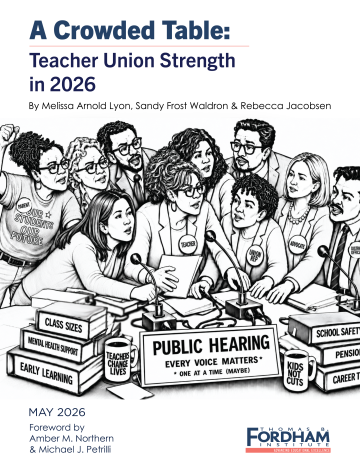
A Crowded Table: Teacher Union Strength in 2026
Researchers use the latest publicly available data and a fresh survey of K–12 stakeholders in all 50 states to provide a comprehensive update to Fordham’s 2012 rankings of state teacher union strength.
From the Teacher’s Desk: A Science of Reading Progress Report
Reading instruction is shifting toward the science of reading, and teachers are making progress. But gaps in training, materials, and implementation remain—especially in high-poverty schools.
College or Career Readiness? Postsecondary and Labor Market Outcomes for Ohio High School Students Earning Industry-Recognized Credentials
Rapidly growing numbers of Ohio students attain industry recognized credentials during high school, reflecting recent policy incentives that encourage their attainment. Our latest report examines the college and workforce outcomes of Ohio students who earn such credentials.
Wonkathon 2025 Anthology: What comes next for the science of reading?
For eleven years now, we at the Thomas B. Fordham Institute have hosted an annual Wonkathon on our Flypaper blog. Designed to generate substantive conversation around key issues in education reform, we invite policy “wonks” to submit responses to a question.
Thomas B. Fordham Institute 2025 Annual Report
Fordham's 2025 Annual Report looks back on a year of research, commentary, Ohio policy work, and charter school authorizing, with a focus on rebooting the American Dream for the next generation.
The Leaky Pipeline: Assessing the college outcomes of Ohio’s high-achieving low-income students
Our latest report sheds light on the academic trajectory of high-achieving, low-income (HALO) students in Ohio. They have demonstrated their potential to reach college and use it as a springboard to the American dream. Yet due to the widespread neglect of their talents, our education system allows too many of them to fall through the cracks.
Who’s on Board? School Boards and Political Representation in an Age of Conflict
School boards have become ground zero for America’s education culture wars, with fiery debates over race, gender, curriculum, and pandemic policies making national headlines. But beyond the noise, how well do these elected bodies actually represent their communities?
“Equitable” Grading Through the Eyes of Teachers
Policies like "no zeros," eliminating late penalties, and allowing unlimited retakes aim to make grading fairer for disadvantaged students. Critics argue the changes inflate grades, erode accountability, and harm learning—and many teachers agree.
Think Again: Do the returns to teacher experience fizzle out?
For many years, the conventional wisdom in education reform circles was that teachers stopped improving after a few years on the job. This brief challenges that notion.