Grading policies have long been debated in American schools, but only recently have “equitable” reforms taken center stage.
Policies like "no zeros," eliminating late penalties, and allowing unlimited retakes aim to make grading fairer for disadvantaged students. But critics argue that these changes inflate grades, erode accountability, and ultimately harm student learning—and many teachers agree.
In the first nationally representative survey to examine this issue, America’s K–12 teachers finally got a chance to weigh in. The verdict: Most teachers report feeling pressured to give higher grades, and say these policies reduce academic engagement, even in schools without formal mandates.
Download the full report or read below.
Foreword
By Michael J. Petrilli
In recent years, traditional grading practices have been criticized for failing to correct longstanding social inequities. Proposed “reforms”—which supposedly promote “equity”—include awarding half-credit for assignments that are never completed, allowing students to retake tests and quizzes without penalty, and giving no credit for homework or classroom participation.
Anecdotal evidence suggests that many teachers have adopted some of these practices, as have a non-trivial minority of departments, schools, and districts where so-called “no zeros” policies are effectively mandatory. Yet, to our knowledge, there has been almost no research on the prevalence or efficacy of “grading for equity.” So we asked Fordham analysts David Griffith and Adam Tyner to craft a few questions about this topic for RAND’s nationally representative teacher panel.
Per Figure ES-1, the results suggest that teachers are skeptical of the five “equitable” practices that are the focus of the resulting report, at least one of which (those same results suggest) has now been adopted by no less than half of America’s public schools and nearly three-quarters of the country’s “majority minority” middle schools.
Figure ES-1: Teachers are skeptical of most "equitable" grading practices.

Note: n = 958. To calculate net ratings for No Zeros, No Late Penalties, and Unlimited Retakes, we subtracted the percentage of teachers who said each practice was "harmful" or "very harmful" to academic engagement from the percentage who said it was "helpful" or very helpful." To calculate net ratings for No Participation and No Homework, we subtracted the percentage of teachers who said incorporating participation and homework into grades was "helpful" or "very helpful" from the percentage who said it was “harmful“ or “very harmful."
Turns out, teachers don’t like it when the powers that be take a sledgehammer to their few sources of leverage over student motivation and effort. Nor do they like giving students grades they don’t deserve.
So how did we get here?
Although debates over grading aren’t new, there are two sides to the most recent chapter of this story—one well-meaning, the other indefensible.
The sorta-kinda-understandable take, advanced by consultant Joe Feldman among others, is that traditional grading practices don’t focus enough on student learning, and that “standards-based grading” would more accurately reflect whether students have mastered the knowledge and skills articulated in state standards (and encourage them to keep at it until they do). Therefore, we shouldn’t include homework or class participation in students’ grades (as these reflect effort and diligence, not achievement), and we should allow re-takes and re-dos of tests and assignments until students demonstrate mastery.
That’s all well and good except that—as Tyner and colleague Meredith Coffey argued last year in their policy brief, Think Again: Does “equitable” grading benefit students?—in practice, these policies “tend to reduce expectations and accountability for students, hamstring teachers’ ability to manage their classrooms and motivate students, and confuse parents and other stakeholders who do not understand what grades have come to signify.”
The wholly indefensible arguments that lurk beneath the recent push for “equitable” grading, meanwhile, represent little more than a return to the “soft bigotry of low expectations.” Stemming from the writings of scholars such as Ibram X. Kendi and Tema Okun, this pseudo-intellectual approach seeks to close whatever racial gaps it encounters by shooting the messenger. For example, by Kendi’s reasoning, any racial disparity—such as the fact that the average Black student’s GPA is nearly half a point lower than the average White student’s—is a sign of racism. Therefore, something must be wrong with the grades.
Or consider Okun’s offensive assertion that “punctuality” is a feature of “white supremacy”—a claim that still shows up in teacher professional development nationwide—and that regards as racist any grading of students on factors such as attendance or participation. It’s hard to know what to say to this claim except that, if we truly believe in all our students’ potential, it is obviously wrong, as are policies that give Black students tacit permission to skip class.
Given the influence that such ideas achieved during the “Great Awokening,” it’s not surprising that evidence-free arguments for “equitable” grading have gained some purchase. But despite the fact that Peak Woke seems to be behind us, the data suggest that many places are still dealing with “reformed” grading practices that teachers simply don’t support.
So, rather than continue to pay unwitting homage to ideas that most Americans reject, we should listen to teachers and go back to tried and true methods that reflect high expectations for all students.
After all, it’s not unrealistic or racist to expect students to come to class and do the work. Nor is it unreasonable or cruel to assign grades that accurately reflect their lack of effort or mastery when the alternative is allowing them to exert minimal effort and consequently fall further behind.
Otherwise, how often should we expect the one in four U.S. students who are chronically absent to come to class if there is no reward for participation or penalty for late work? How hard should we expect the typical middle schooler to try if they can get a C by completing less than half of their assignments? Does anyone really believe that inflated GPAs will help high school students who haven’t really learned anything land high-paying jobs after they graduate?
In short, if our goal is to prepare them to succeed in the real world, don’t we owe the millions of American students whose futures depend on a solid K–12 experience at least a few zeros?
Introduction
Grades are central to the work of schools. For students, they are an important source of motivation and feedback. For teachers, they are an essential form of communication and leverage. For parents and other caregivers, they are a vital starting point for understanding how their kids are doing in school.
For decades, accountability hawks have complained about the decline of grading standards. Among other things, grade inflation has made a student’s grade point average (GPA) an increasingly unreliable indicator of academic success. For example, a 2023 report from ACT showed that recent cohorts of American high schoolers had the highest GPAs on record even as they earned the lowest ACT scores in decades.[1]
Although lowering the bar for receiving a good grade may seem like a victimless crime, research shows that grading standards influence student behavior, as well as learning. For example, a seminal study of college students by economist Philip Babcock showed that when students expected a C grade in their classes, they studied about 50 percent more than students who expected an A.[2] Such behavioral changes help explain why subsequent studies of elementary students in Florida[3] and high school math students in North Carolina[4] have found that students tend to learn less when assigned to teachers with lower grading standards. Simply put, they do not work as hard.
Meanwhile, advocates of grading reform hold more diverse beliefs about grades as motivators and focus more on the potential for bias. As evidence, they cite studies showing biases based on student race[5] and other characteristics that are irrelevant to academic performance, such as physical attractiveness[6] and weight.[7] In light of such evidence, grading reformers such as Joe Feldman,[8] Ken O’Connor,[9] Thomas Guskey,[10] and Cornelius Minor[11] have suggested numerous changes to teachers’ grading practices—for example, grading written assignments anonymously or eliminating extra credit—that are meant to level the playing field.
Still, some ideas that are associated with the push for “equitable” grading are less obviously connected to eliminating bias. For example, some advocates argue that districts should change their grading scales (e.g., by moving from 0–100 to 0–4), ban grades for homework, or abolish late penalties. Moreover, many also advocate "minimum grading", which stipulates that teachers must award students partial credit (e.g., a grade of 50 on a 100-point scale) even when they make no attempt to complete an assignment, on the grounds that zeros damage students’ academic prospects so grievously that they may stop trying.[12]
Unlike practices that target teacher bias, these latter reforms are in direct conflict with the values of traditional grading. For example, so-called “no zeros” policies are by definition a way of lowering academic expectations and inflating grades.[13] So it should come as no surprise that such changes have often generated controversy where they have been adopted. For example, after Fairfax County Public Schools in Virginia implemented “equitable” grading reforms, district teachers circulated a document criticizing the changes and pointing out the potential for unintended consequences.[14] In places such as Portland (OR),[15] San Leandro (CA),[16] and Schenectady (NY),[17] changes to grading policies have prompted heated public debates. And in a few places, such as Atlanta (GA)[18] and Las Vegas (NV),[19] reports suggest that administrators have reversed course on at least some policies.
Yet, as a recent Wall Street Journal article noted, none of these stories tells us “exactly how many schools use the equitable-grading approach.”[20] Nor has any prior investigation yielded systematic or remotely comprehensive data on teachers’ views on “equitable” grading.
Accordingly, this report uses data from a nationally representative survey of 967 K–12 teachers to address three questions:
1. How prevalent are “equitable” grading policies?
2. What do teachers think of “equitable” grading practices?
3. Are teachers supported when they try to uphold high grading standards?
To answer these questions, we surveyed a nationally representative panel of K–12 teachers from RAND's American Teacher Panel.[21] Specifically, we asked them about five ostensibly “equitable” grading policies:
- No Zeros—Mandates that teachers assign a minimum grade of 50 percent (or something similar) for missed assignments or failed tests.
- No Late Penalties—Gives students the right to turn assignments in late without penalty.
- Unlimited Retakes—Gives students the right to retake tests/quizzes without penalty.
- No Homework—Prohibits teachers from including homework assignments in a student’s final grade.
- No Participation—Prohibits teachers from basing any part of a student’s grade on class participation.
Of course, some students may do their homework and/or actively participate in class without the incentive provided by summative course grades. The point of our proposed nicknames is that they can get away with not doing so.
In any case, we also asked teachers about their views of the practices these policies seek to codify, since there is an important distinction between school or district policy and individuals' practice.
Similarly, we asked teachers about their views of the practices these policies seek to codify, since there is an important distinction between school or district policy and individuals’ practice.
Finally, in addition to answering multiple-choice questions, survey respondents were given an opportunity to share their thoughts on “equitable” grading via an open-ended question.
Illustrative quotations from these responses are included at various points in the report, alongside a  symbol.
Overall, the results suggest that most teachers are skeptical of attempts to mandate practices that effectively lower the bar that students must clear. For a full description of the survey methods, see the Technical Appendix.
How prevalent are “equitable” grading policies?
Finding 1: About half of teachers say their school or district has adopted at least one “equitable” grading policy.
Overall, about half of K–12 teachers in the United States say their school or district has adopted at least one “equitable” grading policy, with middle school teachers and those in majority-minority settings reporting somewhat higher rates of adoption than those in other settings (Figure 1).
Figure 1: About half of teachers say their school or district has adopted at least one “equitable” grading policy.

Note: “More affluent” refers to teachers in schools where half or less of students are eligible for free or reduced-price lunches. “Less affluent” refers to teachers in schools where over half of students are eligible for free or reduced-price lunches. “Majority-minority” refers to teachers in schools where over half of students are Asian American, Black, Hispanic, Pacific Islander, or of mixed race/ethnicity.
Moreover, about 36 percent of teachers say their school or district has adopted more than one “equitable” grading policy, though only 2 percent say their school or district has adopted all five of the policies that were part of the survey (Figure 2).
Figure 2: More than a third of teachers say their school or district has adopted more than one “equitable” grading policy.

Note: n = 958. "n+" indicates that the teachers reported that their schools or districts have adopted n or more of the five grading policies we asked about—namely, No Zeros, No Late Penalties, Unlimited Retakes, No Homework, and No Participation. For example "1+" indicates that their schools or districts have adopted one or more of the policies.

“We have read and adopted many of the polices outlined in Feldman's Grading for Equity.”
Nationally, about one in eight K–12 teachers say their school or district has adopted a policy that prohibits teachers from including homework or class participation in student grades. And at least a quarter say that their school or district has adopted each of the three most common “equitable” grading policies: Unlimited Retakes, No Late Penalties, and No Zeros (Figure 3).
Figure 3: At least a quarter of teachers say their school or district has adopted each of the three most common “equitable” grading policies—Unlimited Retakes, No Late Penalties, and No Zeros.

Note: n = 958
Upon closer inspection, those top three policy changes are particularly common at the middle school level, where about two-fifths of teachers report that their school or district has adopted each of them (Figure 4). Moreover, No Zeros policies are particularly common in schools where most pupils are students of color. For example, about 55 percent of teachers in majority-minority middle schools say their school or district has some variant of No Zeros, suggesting a propensity among policymakers to lower standards for non-white students.
Figure 4: No Zeros, No Late Penalties, and Unlimited Retakes policies are particularly common at the middle school level.

Note: n = 937
What do teachers think of “equitable” grading practices?
Finding 2: Most teachers say “equitable” grading practices are harmful to academic engagement.
Overall, teachers’ responses suggest that “equitable” grading practices are harmful to academic engagement. However, some practices are more likely to be viewed as harmful than others. For example, 81 percent of teachers say “giving partial credit for assignments that are never turned in” (the No Zeros policy) is “harmful” to engagement, with 51 percent saying it is “very harmful” and just 8 percent saying it is “helpful” or “very helpful” (Figure 5).
Figure 5: The overwhelming majority of teachers say “giving partial credit for assignments that are never turned in” is harmful to academic engagement.

Note: n = 957 Results are from a five-point Likert scale, where the options were “very helpful,” “helpful,” “neither helpful nor harmful,” “harmful,” and “very harmful.” In this figure, “very helpful” and “helpful” have been combined, and “very harmful” and “harmful” have been combined.
Consistent with that result, more than 50 teachers used the open response portion of the survey to express their personal opposition to some version of No Zeros, making it the most mentioned—and most widely ridiculed—grading policy.
“We have the 50% rule, which I think is ridiculous.”
“Being given a 50 percent for doing nothing seems to enable laziness.”
“Everybody gets at least a 50 percent is insulting to the students who work.”
“We have gone to the ‘Do nothing, get a 50’ grade policy. Students have figured out that, if they work hard for a quarter (usually the first) they can ‘coast’ the rest of the year and get a D.”
“Forcing teachers to give students half-credit on assignments that have not been completed and/or turned in is a disservice to students.”
“Most teachers can’t stand the gifty fifty.”[22]
Importantly, there is no evidence that teachers’ views on this policy are driven by their experience level, their race/ethnicity, or the race/ethnicity of their students. For example, 54 percent of non-white teachers, 51 percent of teachers in majority-minority schools, and 51 percent of teachers with ten or more years of experience say that the No Zeros policy is “very harmful” (Figure 6).
Figure 6: Overwhelming majorities of teachers of color, teachers in majority-minority schools, and veteran teachers say that “giving partial credit for assignments that are never turned in" is harmful to academic engagement.

Note: Results are based on a five-point Likert scale, where the options were “very helpful,” “helpful,” “neither helpful nor harmful,” “harmful,” and “very harmful.” In this figure, “very helpful” and “helpful” have been combined. “Majority minority” refers to teachers in schools where most students are Asian American, Black, Hispanic, Pacific Islander, or of mixed race/ethnicity.
“I am an educator with 33 years in the classroom, and I see a terrible trend… Students are starting to feel entitled to points for nothing.”
“Equity grading is not leveling the playing field… It is simply lowering standards so that school districts look like they are meeting kids where they are, when in fact they are hiding their failures behind ‘equitable’ policies.”
In addition to No Zeros, many teachers expressed opposition to other “equitable” grading policies or practices. For example, Figure 7 shows that more than half of teachers (56 percent) say “allowing students to turn in late work with no penalty” (No Late Penalties) is harmful to student engagement, although teachers are evenly divided when it comes to “allowing students to retake tests with no penalty” (Unlimited Retakes).
Figure 7: Most teachers say the No Late Penalties policy is harmful to engagement.
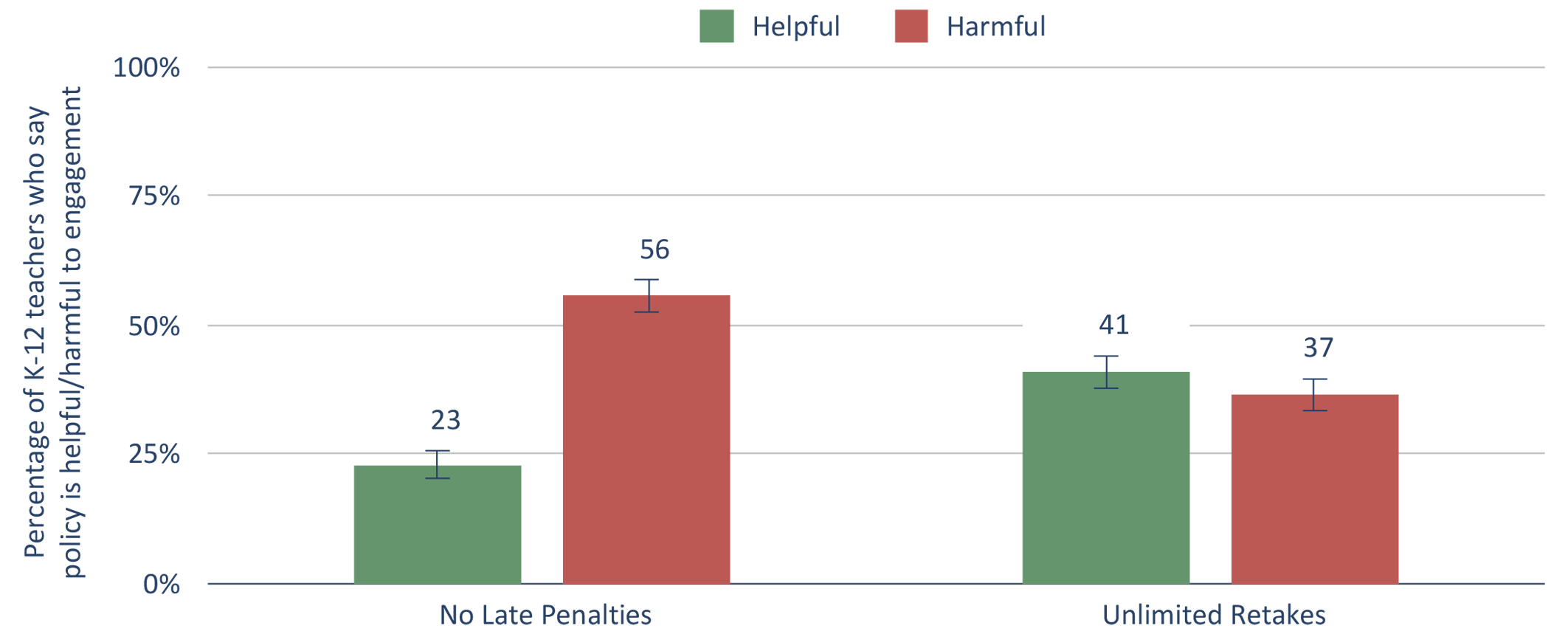
Note: n = 957. Results are from a five-point Likert scale, where the options were “very helpful,” “helpful,” “neither helpful nor harmful,” “harmful,” and “very harmful.” In this figure, “very helpful” and “helpful” have been combined, and “very harmful” and “harmful” have been combined.
Consistent with those results, many teachers used the open response portion of the survey to criticize policies that prevent them from imposing late penalties or require them to offer retakes.
“Students are allowed to turn in work at any point in the school year with zero penalty, which removes the incentive for students to ever turn work in on time, and then it becomes difficult to pass back graded work because of cheating.”
“I like the idea of students being able to edit/improve their work based on feedback from the teacher. However, if they do not have deadlines or policies in place to encourage them to try their best the first time, teachers will have to grade almost every assignment more than once.”
“Teachers are required to give multiple chances to turn in or redo work, so the county can improve graduation rates.”
“I hate being required to allow all students to re-take tests even if they did not prepare or do any of the work before the test.”
“It's not fair for students who pass the first time to allow students who failed to retest and get a higher grade.”
“Allowing retakes without penalty encourages a growth mindset, but it also promotes avoidance and procrastination.”
Finally, nearly 60 percent of teachers say “basing part of a student’s grade on participation” is helpful to engagement, while just 13 percent say it is harmful (Figure 8). Similarly, 44 percent of teachers say “basing part of a student’s grade on homework” is helpful, while just 25 percent say it is harmful.
Figure 8: Most teachers say basing part of a student’s grade on participation or homework is helpful to academic engagement.

Note: n = 957. Results are from a five-point Likert scale, where the options were “very helpful,” “helpful,” “neither helpful nor harmful,” “harmful,” and “very harmful.” In this figure, “very helpful” and “helpful” have been combined, and “very harmful” and “harmful” have been combined.
Are teachers supported when they try to uphold high grading standards?
Finding 3: Although most teachers want high standards for students, many feel pressured to inflate their grades.
When given the choice between “reforming grading to be fairer to students with disadvantages” and grading policies that set “high expectations for everyone,” an overwhelming majority of teachers (71 percent) chose the latter (Figure 9). Moreover, many of teachers’ open responses suggest that in practice, there is a trade-off between high expectations and fairness, although the two aren’t necessarily in conflict.
Figure 9: Most teachers say grading policies should set high expectations for everyone.

Note: n = 955
“I believe in consistent, high standards and then making exceptions for students who need it. I do not believe in lowering the bar for all students.”
“Our district's grading policy is too lenient. It encourages disengagement and lowers academic standards for every single student.”
“Our school will start the year demanding we be consistent and set clear expectations. But at the end of the grading period, when they see so many students with failing grades, we are supposed to do a 180 and be mindful and ease up.”
“Students will always sink to lower expectations. Every time. It's pathetic what has become of education in this country.”
In search of standards-based grading
-
Click to Expand "In search of standards-based grading"
-
Grading reforms, including equitable grading, are often linked to the decades-long push for standards-based or mastery grading, which holds that teachers’ evaluations of students should focus on their mastery of specific learning objectives rather than how many assignments they have completed—with resulting grades often taking the form of qualitative assessments (e.g., “approaching expectations” or “advanced”), as opposed to letter grades.
Regardless of the scale, whether a grade should represent only a student’s final understanding of a subject or should also incorporate factors such as effort, collaboration and participation, and adherence to class rules and deadlines is controversial, and a full dissection of these rival grading philosophies is beyond the scope of this report. However, one thing we can say is that many teachers say grades should be based on objective standards, as opposed to effort (Figure 10).
Figure 10: Most teachers say grades should be based on objective standards, as opposed to effort.

Note: n = 956
Of teachers’ 490 open responses to the survey, many dealt with the nuances of these grading philosophies, and at least 100 mentioned some form of standards-based grading. Overall, teachers’ responses suggest that they are divided when it comes to this approach, with many expressing support for the underlying principles and others warning that implementing standards-based grading is subjective or confusing in practice.
“Our district uses a standards-based grading policy at the elementary grades… I think this is the most fair and accurate way to grade students. However, many teachers and parents do not seem to understand the system and have maintained a letter grade mindset.”
“My school uses standards-based report cards, which are unfair to the teachers and low-achieving students. We are forced to give kids who show little to no effort high marks because they are intelligent but give low marks to students who work hard or make great gains but still can't meet grade level academic standards.”
“Grading policy changes have, of course, contributed to the dumbing down of our system, but it is also probably the way out. Standard-based grading removes the subjectivity.”
“Standards based grading is too subjective.”
“We do standards-based grading, and it is great.”
“We switched to a mandatory Standards Based Grading system. It's a mess.”
In general, teachers’ responses suggest frustration with the decline in grading standards—which shouldn’t be surprising, given the substance of recent “reforms.” By definition, any policy that gives students half credit for assignments that aren’t completed inflates students’ grades, as do other policies that prevent teachers from deducting points or otherwise penalizing students who don’t meet the expectations that are associated with a course.
“Grade inflation is pervasive. It's almost impossible to fail. A’s are passed out like Halloween candy. Whether a student learned anything is nearly irrelevant.”
“Today, students honestly feel like they sat in the class so they need to get an A.”
“Grade inflation is terrible at my school. Almost every student is given an A or a B, whether they deserve it or not.”
“Grading standards have fallen to the detriment of students. It's nearly impossible to get a low grade now.”
Still, upon closer examination, it’s clear from teachers’ responses that “equitable” grading policies aren’t the only reason for grade inflation. For example, while about half of teachers say their school or district has adopted at least one “equitable” grading policy, many more—84 percent—say their supervisors would “be concerned if they [were to] give too many low grades,” while just 16 percent say that high grades would attract such concern (Figure 11).
Figure 11: Most teachers say their supervisors would be concerned if they gave too many low grades.
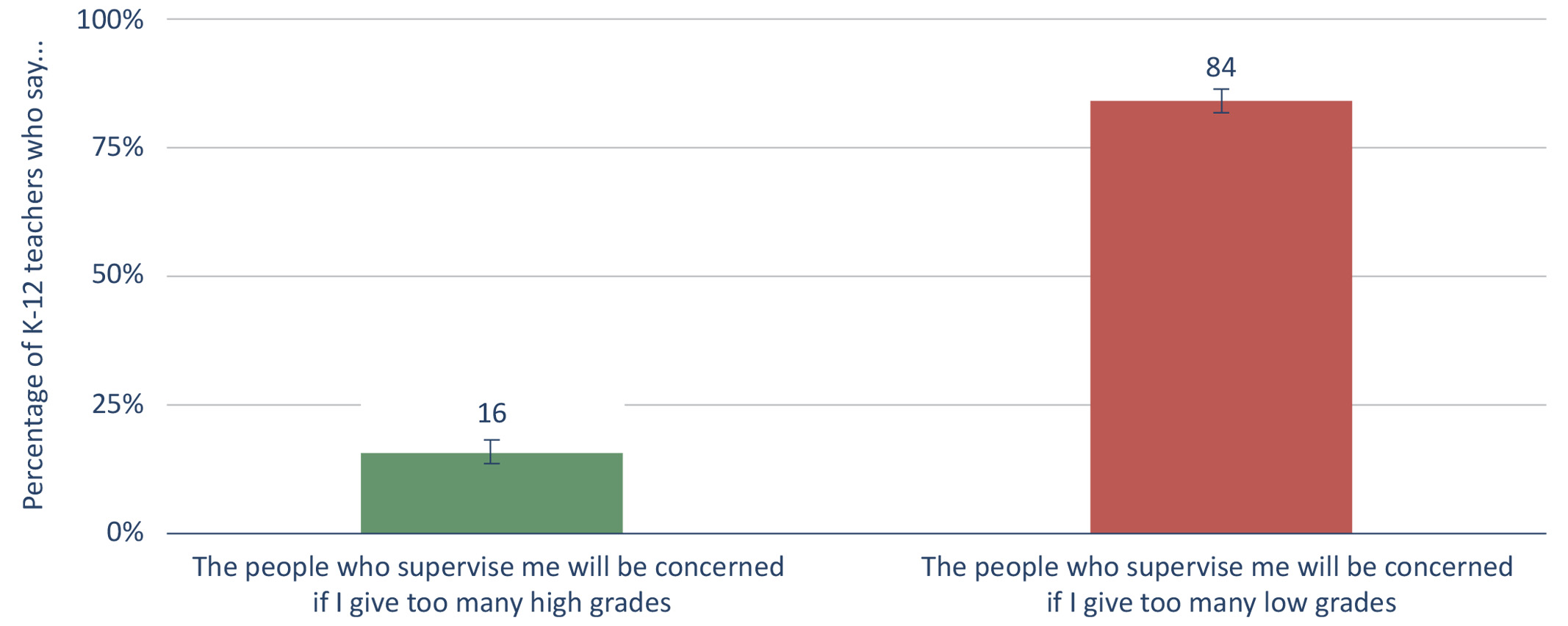
Note: n = 955
Consistent with that result, many of teachers’ open-ended responses suggest that they feel pressure to inflate students’ grades, even in the absence of explicitly inflationary policies.
“Sometimes it feels like the only ‘acceptable’ grades are A-, A, and A+.”
“There are not necessarily mandates, but we are encouraged not to fail students.”
“There is an administrator who often pushes for 50 percent as the lowest grade. ... Student apathy post-pandemic is really high, and many of us worry that implementing this sort of policy is giving students permission to only do a few assignments a year to bump their grade into passing territory.”
“Counselors can override teachers' grades if a parent calls because they are concerned that their child's grades aren't fairly representing the student's efforts.”
“Admin wants to allow AI, even though this is plagiarism.”
“Sometimes they pass a student even if they failed.”
“Teachers are pressured to pass all students.”
Finally—and perhaps surprisingly, given the results presented thus far—most teachers (58 percent) say it’s more important to have “clear, schoolwide policies so students’ grades are fair,” though a sizable minority (42 percent) say they “should be able to use their professional judgment” (Figure 12). Given the tenor of teachers’ other responses, it’s important to note that this result doesn’t tell us what kinds of policies teachers think schools should adopt.
Figure 12: Most teachers say it’s important to have clear, schoolwide grading policies.

Note: n = 955
“It's pretty much the wild, wild west. Everyone is allowed to do what works for their classroom.”
“Our school district wisely gives teachers the authority to assess their students.”
“The grading policies are inconsistent within the district, school, department, and content. Some use a 4-point rubric, some use total points, and some use standards-based grading systems. The inconsistency is difficult for students to understand how they can improve their grades.”
“I think schools should trust teachers to do what is best for their subject and students.”
“It is contentious. No two teachers have the same beliefs it seems.”
Recommendations
1. End “No Zeros” and other policies that lower expectations for students.
While it can be appropriate for individual teachers to cut students some slack when they are experiencing personal challenges, it’s inadvisable to adopt a universal policy that automatically gives students credit for work they haven’t completed or proactively awards them a minimum grade. (Changing the grading scale to make it more lenient, which is often the explicit justification for switching to 0–4 from 0–100, is another means to indistinguishable ends.)[23]
Similarly, while some individual teachers allow students to retake tests or turn assignments in late without penalty, given the number of educators who question these practices, it’s imprudent to mandate them.
Finally, while some teachers choose not to award points for homework or participation, given the share who say incorporating these factors into grades is helpful, it’s inappropriate to prohibit such incorporation.
Even if these policies were grounded in solid empirical research—which they are not—the obvious differences between grades, subjects, and classrooms would argue against the adoption of reflexively universal policies that limit educators’ options and have the practical effect of inflating students’ grades.
As numerous studies have demonstrated, students benefit from high expectations,[24] which is another way of saying that codifying low expectations is damaging.
“If a teacher's autonomy to grade how they see fit goes away, I will leave the profession.”
“I don’t think we should reward kids that don’t want to do any work. Real life doesn’t work that way.”
“Mandatory grading policies from non-classroom teachers are usually nonsense.”
2. Refocus the push for fairness in grading on practices that mitigate racial and socioeconomic bias.
Despite the questionable nature of some reforms, fairness in grading is a worthy goal. But of course, there is more than one defensible definition of fairness. (For example, many teachers think giving zeros for incomplete assignments is perfectly fair.) And perhaps more to the point, ensuring that grades meet a particular definition of fairness isn’t the only goal of public education.[25]
That’s why grading reforms should represent changes that (1) are consistent with most observers’ conception of fairness and (2) don’t undermine other important educational goals, such as holding up high expectations for academic performance.
Some “equitable” grading reforms obviously fit this bill. For example, given the evidence that teachers can exhibit various biases when grading their students’ assignments, there is a strong case for requiring teachers to grade written assignments anonymously and encouraging the use of grading rubrics. Prohibiting teachers from awarding extra credit for bringing school supplies to class—a perennial complaint of grading reformers—is also common sense.
“There's always a tension between professional judgement and consistency. I think forcing rubric grading or standards-based grading has caused more problems than it's solved.”
“Maintaining teacher autonomy in assessment and evaluation is crucial. Standardized grading policies are a waste of time and just create issues.”
“There has to be accountability. At this particular moment there is not.”
3. Incentivize administrators to uphold high grading standards instead of faulting teachers who do so.
As teachers’ responses suggest, much of the pressure to inflate students’ grades comes from administrators, for whom “equitable” grading is often little more than another excuse to avoid the paperwork and parental pushback that are associated with handing out D’s or F’s or requiring students to repeat a course.
“If a student is failing…often, it is the teacher who is held accountable for the grade and has to explain themselves rather than the student.”
“The teachers are the ones in trouble if the student is failing, and the teachers are the ones who put in the effort to rectify the grades.”
Reports of administrators refusing to follow mandatory grade retention policies in early grades and promoting dubious computer-based “credit recovery” courses in high schools[26] are likewise symptomatic of the fact that, with few tested subjects in middle and high school, there is little transparency when it comes to student learning. And of course, that problem is deeper than whatever problems misguided grading reforms are creating, which means that solving it requires more than simply discrediting those practices or rolling back the associated mandates.
“There are many seniors that have failed a class that somehow graduate on-time.”
“Everyone must pass.”
If districts and states truly want to provide their students a rigorous public education, they must deemphasize graduation and course-passing rates and emphasize external measures of academic success, such as end-of-course exams.
Only then will our public schools deserve the sorts of grades they are awarding to students.
Technical Appendix
This report is based on questions from a nationally representative survey of public school teachers that was conducted by the RAND corporation in the fall of 2024. (Note that, although RAND was responsible for collecting the survey data, Fordham is responsible for the interpretation of those data and the resulting report.) As part of that survey, questions about “equitable grading” and other topics were emailed to 2,000 K–12 teachers from RAND’s American Teacher Panel (ATP), a nationally representative panel of 25,000 public K–12 teachers recruited through probability-based methods from commercially available lists.
Per Table 1, initial invitation emails were sent to teachers on October 17, 2024.
Table 1: Email invitation and reminder schedule.
| Contact | Date of contact | Number of Emails sent |
|---|---|---|
| Initial invitation | October 17th, 2024 | 2,000 |
| 1st reminder | October 23rd, 2024 | 1,489 |
| 2nd reminder | October 25th, 2024 | 1,326 |
| 3rd reminder | October 30th, 2024 | 1,201 |
| 4th reminder | November 4th, 2024 | 1,149 |
| 5th reminder | November 7th, 2024 | 1,100 |
| Final reminder | November 13th, 2024 | 1,054 |
The field period closed on November 25, 2024, at which time there were 974 completed surveys and fifty-four partially completed surveys. After excluding a handful of ineligible teachers and surveys that did not include substantive responses, a total of 967 cases received a weight. Thus, the final completion rate for the survey was 49 percent.
To provide a sample similar to the population of K–12 public school teachers in the United States, responses were weighted to account for differences in sampling and response. More specifically, the final analysis weights are the product of three interim weights:
- Calibrated weight of the sampling frame—A calibration weight that assigns a weight for each ATP member based on teacher and school characteristics so that the sum of the weights along the calibration factors closely match the characteristics of the national population of public school teachers based on National Center for Education Statistics (NCES) estimates.
- Sample selection weight—The inverse of the probability of selection into the survey sample using the ATP as the frame.
- Survey response weight—The inverse of the modeled probability of a teacher completing the survey.
The products of these weights were subsequently recalibrated and trimmed if necessary. Table 2 summarizes the estimates for standard teacher and school ATP variables, which were the variables used for calibration.
Table 2: Unweighted, Weighted, and Population Estimates for Calibration Variables
| Variable | Unweighted [CI] | Weighted [CI] | Population |
|---|---|---|---|
| School Level | |||
| Elementary | 48.0 [44.8, 51.1] | 44.8 [41.6, 48.1] | 44.7 |
| Middle | 19.0 [16.5, 21.5] | 20.6 [17.8, 23.3] | 20.7 |
| High | 33.0 [30, 36] | 34.6 [31.4, 37.8] | 34.6 |
| School Size | |||
| Small | 27.5 [24.7, 30.3] | 27.8 [24.8, 30.7] | 27.9 |
| Large | 72.5 [69.7, 75.3] | 72.2 [69.3, 75.2] | 72.1 |
| School Locale | |||
| Suburban | 42.7 [39.6, 45.8] | 38.9 [35.7, 42.0] | 38.7 |
| Town/Rural | 31.1 [28.2, 34.1] | 32.9 [29.8, 36.1] | 32.9 |
| Urban | 26.2 [23.4, 28.9] | 28.2 [25.1, 31.2] | 28.4 |
| School Percent Minority | |||
| 0%–50% | 49.1 [46.0, 52.3] | 48.0 [44.7, 51.3] | 47.9 |
| 50%–100% | 50.9 [47.7, 54.0] | 52.0 [48.7, 55.3] | 52.1 |
| School Neighborhood Poverty | |||
| IPR 0 to 200 | 17.3 [14.9, 19.7] | 17.9 [15.3, 20.5] | 17.8 |
| IPR 201 to 400 | 52.4 [49.3, 55.6] | 52.8 [49.5, 56.0] | 52.8 |
| IPR 401 to 999 | 30.3 [27.4, 33.2] | 29.3 [26.4, 32.3] | 29.4 |
| Teacher Gender | |||
| Female | 74.5 [71.7, 77.2] | 75.1 [72.3, 77.9] | 75.2 |
| Male | 25.5 [22.8, 28.3] | 24.9 [22.1, 27.7] | 24.8 |
| Teacher Race | |||
| Black | 5.4 [4.0, 6.8] | 6.3 [4.6, 8.1] | 6.5 |
| Hispanic | 9.2 [7.4, 11.0] | 9.0 [7.2, 10.9] | 9.0 |
| Other | 3.3 [2.2, 4.4] | 3.0 [1.9, 4.1] | 3.0 |
| White | 82.1 [79.7, 84.5] | 81.6 [79.0, 84.2] | 81.5 |
| Teacher Experience | |||
| Less than 10 years | 25.0 [22.3, 27.8] | 35.7 [32.3, 39.1] | 35.9 |
| 10+ years | 75.0 [72.2, 77.7] | 64.3 [60.9, 67.7] | 64.1 |
Endnotes
[1] Sanchez, Edgar I. Evidence of Grade Inflation Since 2010 in High School English, Mathematics, Social Studies, and Science Courses. ACT Research Report R2300. Iowa City, IA: ACT, August 2023. https://www.act.org/content/dam/act/secured/documents/Evidence-of-Grade-Inflation-in-English-Math-Social-Studies-and-Science.pdf.
[2] Babcock, Philip. “Real Costs of Nominal Grade Inflation? New Evidence from Student Course Evaluations.” Economic Inquiry 48, no. 4 (October 2010): 983–996. https://doi.org/10.1111/j.1465-7295.2009.00245.x.
[3] Figlio, David N., and Maurice E. Lucas. “The Gentleman’s A: New Evidence on the Effects of Grade Inflation.” Education Next 4, no. 2 (Spring 2004). https://www.educationnext.org/the-gentlemans-a.
[4] Gershenson, Seth. Great Expectations: The Impact of Rigorous Grading Practices on Student Achievement. Washington, DC: Thomas B. Fordham Institute, February 4, 2020. https://fordhaminstitute.org/national/research/great-expectations-impact-rigorous-grading-practices-student-achievement.
[5] Quinn, David M. “How to Reduce Racial Bias in Grading: New Research Supports a Simple, Low-Cost Teaching Tool.” Education Next 21, no. 1 (Winter 2021): 72–78. https://www.educationnext.org/how-to-reduce-racial-bias-in-grading-research.
[6] Malouff, John M., and Einar B. Thorsteinsson. “Bias in Grading: A Meta-Analysis of Experimental Research Findings.” Australian Journal of Education 60, no. 3 (November 2016): 245–256. https://doi.org/10.1177/0004944116664618.
[7] Dian, Mona, and Moris Triventi. “The Weight of School Grades: Evidence of Biased Teachers’ Evaluations against Overweight Students in Germany.” PLOS ONE 16, no. 2 (February 8, 2021): e0245972. https://doi.org/10.1371/journal.pone.0245972.
[8] Feldman, Joe. Grading for Equity: What It Is, Why It Matters, and How It Can Transform Schools and Classrooms. 2nd ed. Thousand Oaks, CA: Corwin, 2023.
[9] O’Connor, Ken. A Repair Kit for Grading: 15 Fixes for Broken Grades. Portland, OR: Assessment Training Institute, 2007.
[10] Guskey, Thomas R. On Your Mark: Challenging the Conventions of Grading and Reporting. Solution Tree Press, 2014.
[11] McKibben, Sarah. “Turn & Talk / ‘Antiracist’ Grading Starts with You.” Educational Leadership 78, no. 1 (September 2020). https://www.ascd.org/el/articles/turn-and-talk-antiracist-grading-starts-with-you.
[12] Greene, Peter. “No-Zero Grading and the Mystery of Assessment.” Curmudgucation (blog), July 26, 2023. https://curmudgucation.
[13] Coffey, Meredith, and Adam Tyner. Think Again: Does “Equitable” Grading Benefit Students? Washington D.C.: Thomas B. Fordham Institute (February 2024). https://fordhaminstitute.org/national/research/think-again-does-equitable-grading-benefit-students.
[14] Hess, Frederick M., and Eric Wolf Welch. “Should Schools Adopt ‘Equitable Grading’ Practices? A Teacher Voices His Concerns.” Thomas B. Fordham Institute, March 21, 2024. https://fordhaminstitute.org/national/commentary/should-schools-adopt-equitable-grading-practices-teacher-voices-his-concerns.
[15] Schemmel, Alec. “Portland School District Workshops ‘Equitable Grading’ Practices That Outlaw Zeros for Cheating, Missing Work.” Washington Free Beacon, March 11, 2024. https://freebeacon.com/campus/portland-school-district-workshops-equitable-grading-practices-that-outlaw-zeros-for-cheating-missing-work.
[16] Najarro, Ileana. “A Guide to Equitable Grading in Schools (Downloadable).” Education Week, April 16, 2025. https://www.edweek.org/leadership/a-guide-to-equitable-grading-in-schools-downloadable/2025/04.
[17] Nelson, Paul. “Schenectady Schools Adopts New ‘Equity’ Grading.” Times Union, October 26, 2023. https://www.timesunion.com/news/article/schenectady-schools-adopts-new-equity-grading-18415330.php.
[18] So, Taylor. “Better Late Than Never? APS Enforces New Late Policy.” The Warrior Wire, October 31, 2023. https://www.thewarriorwire.org/12781/news/better-late-than-never-aps-enforces-new-late-policy.
[19] Clark County School District. “CCSD Updates Guidelines to Reflect Teacher Feedback.” CCSD Newsroom, August 4, 2023. https://newsroom.ccsd.net/ccsd-updates-guidelines-to-reflect-teacher-feedback.
[20] Barnum, Matt. “As ‘Grading for Equity’ Movement Grows, More Teachers Are Pushing Back.” The Wall Street Journal, May 11, 2025. https://www.wsj.com/us-news/education/grading-for-equity-schools-teaching-b301df23.
[21] For more information about the methodology, survey sample, and instrument, see Technical Appendix. The survey instrument can be viewed within the PDF version of this report.
[22] Many more teachers expressed negative opinions of minimum grading. Here are additional examples: “Giving anything other than a zero for no effort is ridiculous.” “Giving credit to kids who don’t turn in work ruins it for all kids. No one has to work if this is case.” “My school does a minimum 50 for the first grading period. This gives students the wrong impression, and then they barely have to work.” “It is frustrating to give a student a 50 when they’ve turned in nothing.” “Minimum of 60 grade for Marking Period 1, even for students who miss every day of class.” “If you do nothing, why should I give you a 50%? Students are now doing below-average work or no work at all and are walking out with a C or B. … They’ve learned that they only have to participate half the time in order to pass.” “Not a fan of missing assignments being a 50 when some students work really hard for that 50. Students should earn a zero if they don’t turn anything in.” “Fifty percent floors are being actively abused by students.”
[23] Advocates of switching from a 0–100 scale to a 0–4 scale often argue that the change makes obtaining a passing grade easier, holding student performance constant. For example, see Curtis Taylor, Ruth Smith, Yekaterina Milvidskaia, Mari Jones, Daisy Sharrock, “Eliminating the 0-100 Scale,” High Tech High Graduate School of Education (blog). April 11, 2024. https://hthgse.edu/eliminating-the-0-100-scale
[24] Babcock, “Real Costs of Nominal Grade Inflation?” Economic Inquiry 48, no. 4 (2010); Figlio and Lucas, “The Gentleman’s A,” Education Next 4, no. 2 (2004); Gershenson, Great Expectations (Fordham Institute, 2020).
[25] Consistent with Finding 2, researcher Sarah Morris found that teachers expressed similar concerns about student motivation in the context of equitable grading reforms. In survey responses and interviews, after professional development sessions, several participants reported tension between implementing reforms such as minimizing zeros and maintaining student accountability. For example, one teacher wrote, “I am still struggling with 50% for no work.” Another reflected, “If we eliminated grades and did not change anything else, many of my students would not be motivated to do anything.” These responses suggest that even when educators are open to incorporating equity principles into their grading practices, they remain concerned about whether such practices inadvertently reduce academic engagement. Morris, Sarah Ruth. The Effects of Grading Equity Practices on Students: Do Student Perceptions of and Teachers’ Exposure to Grading Equity Practices Matter? Ph.D. dissertation, University of Arkansas, 2024.
[26] One of the teachers in the survey told us: “Students are given the option to fix their quarterly grade with credit recovery, which many students take advantage of. ... They refuse to work all quarter and then do minimal work in credit recovery to pass.”
About this Study
This report was made possible by our sister organization, the Thomas B. Fordham Foundation, and by the contributions of numerous individuals. These include members of the RAND education team and grading expert Sarah Morris, whose feedback on a draft was particularly welcome. Here at the Fordham Institute, we thank Amber Northern for her assistance with the survey instrument, Chester E. Finn, Jr., Michael J. Petrilli, and Meredith Coffey for providing feedback on drafts, Robert Chung for helping with quality checks, Stephanie Distler for managing report production and cover design, and Victoria McDougald for overseeing media dissemination.