Mobile Navigation

  • National
    • Policy
      • High Expectations
      • Quality Choices
      • Personalized Pathways
    • Research
    • Commentary
      • Gadfly Newsletter
      • Flypaper Blog
    • Events
    • Scholars Program
  • Ohio
    • Policy
      • Priorities
      • Media & Testimony
    • Research
    • Commentary
      • Ohio Education Gadfly Biweekly
      • Ohio Gadfly Daily
  • Charter Authorizing
    • Application
    • Sponsored Schools
    • Resources
  • About
    • Mission
    • Board
    • Staff
    • Career
Home
Home
Advancing Educational Excellence

Main Navigation

  • National
  • Ohio
  • Charter Authorizing
  • About

Ohio Menu

  • Topics
    • Accountability & Testing
    • Advanced Education
    • Career & Technical Education
    • Charter Schools
    • Curriculum & Instruction
    • ESSA
    • Evidence-Based Learning
    • Governance
    • Personalized Learning
    • Private School Choice
    • School Finance
    • Standards
    • Teachers & School Leaders
  • Research
  • Policy
  • Commentary
    • Ohio Gadfly Newsletter
    • Ohio Gadfly Blog
    • Events

The Education Gadfly Weekly

Sign Up to Receive Fordham Updates

We'll send you quality research, commentary, analysis, and news on the education issues you care about.
Thank you for signing up!
Please check your email to confirm the subscription.

Ohio Gadfly—Cautious optimism for Ohio’s Statewide Innovative Waiver Pathway

Volume 20, Number 13
6.23.2026
6.23.2026

Ohio Gadfly—Cautious optimism for Ohio’s Statewide Innovative Waiver Pathway

Volume 20, Number 13
view
Innovative waiver pathway blog image
School Funding

Cautious optimism for Ohio’s Statewide Innovative Waiver Pathway

For the last decade, Ohio’s dual credit program, College Credit Plus (CCP), has been giving academically eligible students in grades 7–12 the opportunity to earn postsecondary credit by taking college courses for free.

Jessica Poiner 6.23.2026
OhioOhio Gadfly Daily

Cautious optimism for Ohio’s Statewide Innovative Waiver Pathway

Jessica Poiner
6.23.2026
Ohio Gadfly Daily

Ohio lawmakers just passed a sweeping math reform bill. Here’s what’s in it.

Jessica Poiner
6.22.2026
Ohio Gadfly Daily

Fact check: Traditional public schools aren’t open to everyone

Jessica Poiner
6.11.2026
Ohio Gadfly Daily

Measuring equity-efficiency tradeoffs in elementary education settings

Jeff Murray
6.23.2026
Ohio Gadfly Daily

Instructionally-aligned tutoring and student literacy outcomes

Jeff Murray
6.18.2026
Flypaper
view
SB 19 summary blog image

Ohio lawmakers just passed a sweeping math reform bill. Here’s what’s in it.

Jessica Poiner 6.22.2026
Ohio Gadfly Daily
view
Public schools open to all blog image

Fact check: Traditional public schools aren’t open to everyone

Jessica Poiner 6.11.2026
Ohio Gadfly Daily
view
Efficiency-equity tradeoffs in schools SR image

Measuring equity-efficiency tradeoffs in elementary education settings

Jeff Murray 6.23.2026
Ohio Gadfly Daily
view
Tutoring

Instructionally-aligned tutoring and student literacy outcomes

Jeff Murray 6.18.2026
Flypaper
view
Innovative waiver pathway blog image

Cautious optimism for Ohio’s Statewide Innovative Waiver Pathway

Jessica Poiner
6.23.2026
Ohio Gadfly Daily

For the last decade, Ohio’s dual credit program, College Credit Plus (CCP), has been giving academically eligible students in grades 7–12 the opportunity to earn postsecondary credit by taking college courses for free.

According to the most recent annual report, more than 94,000 students participated in CCP during the 2024–25 school year. But the report also shows sizable enrollment gaps between White and minority students, as well as economically disadvantaged pupils and their more affluent peers. There have been some improvements, especially among low-income students. But for the most part, traditionally underserved kids are missing out on the program’s benefits.

In an effort to address this issue, state lawmakers established the Statewide Innovative Waiver Pathway in the 2023 state budget. This program allows institutions of higher education and industry partners to apply to the Ohio Department of Higher Education (ODHE) to create a CCP pathway with a waiver for student eligibility requirements, thereby making pathways available to students who don’t meet traditional college readiness standards. Upon completion, students earn an industry-recognized credential, certificate, or degree that’s aligned with an in-demand job field. Any public or nonpublic secondary school, as well as any public or nonpublic higher education institution, can use an approved waiver pathway.

Ohio’s first approved pathway focuses on the in-demand job fields of engineering technology and advanced manufacturing. It was granted to Columbus State Community College, Sinclair College, and Lorain County Community College (LCCC) for a timeframe of three academic years: 2025–26, 2026–27, and 2027–28. The associated waiver eliminates requirements for students to achieve a cumulative unweighted GPA of 3.0 or pass placement tests before they can take entry-level CCP courses. It applies only to students who are pursuing technician degrees or certificates in certain areas of engineering (electro-mechanical, electronic, mechanical, and manufacturing), manufacturing equipment, or semiconductor fundamentals. ODHE’s website identifies pathways toward five approved certificates, six approved associate degrees, and one approved baccalaureate degree.

It makes sense for the state’s inaugural waiver pathway to focus on these career fields. Ohio is home to the nation’s third-largest manufacturing workforce and a $117 billion industry. According to ODHE Chancellor Mike Duffey, the state’s fastest-growing jobs include engineering technician roles connected to advanced manufacturing. And a quick look at Ohio’s top jobs list indicates that several of the waiver-approved associate degrees lead to salaries that are pretty close to the statewide median of $71,000. An associate degree for electro-mechanical and mechatronics technologists and technicians, for instance, has a median salary of $67,000. A similar degree for mechanical engineering technologists and technicians has a median salary of $68,000.

It also makes sense for the inaugural pathways to be housed at Columbus State, Sinclair, and LCCC. They are among the largest schools currently providing these credentials. They have plenty of experience working with high schoolers, as they each enrolled more than 4,000 CCP students last year. (Columbus State and Sinclair both enrolled more than 10,000.) They also collectively cover a broad geographic swath of the state: LCCC is in northeast Ohio, Columbus State calls central Ohio home, and Sinclair can be found in the southwest. The participation of LCCC is particularly noteworthy, as it’s located in a more rural part of the state. If this initiative is successful, it could be a blueprint for how to ensure that more of Ohio’s rural students get better access to training for in-demand careers.

Clearly, there’s a lot of potential here. But it’s important to remember that the key feature of a Statewide Innovative Waiver Pathway is the waiver itself, which exempts students from GPA and testing requirements designed to signal their readiness for college-level coursework. Proponents of the program are quick to argue in favor of such exemptions. Lieutenant Governor Jim Tressel, for example, has said that expanding CCP this way will “give more of our home-grown talent an affordable pathway to high-demand careers.” David Harrison, President of Columbus State, noted that waiver pathways will “open the door for students from all backgrounds to great jobs and high-growth careers.”

Expanding access to affordable pathways that lead to in-demand careers is a worthy pursuit. But objective measures of college readiness exist for a reason. When students aren’t academically prepared for college-level rigor, they’re more likely to struggle in their courses. These struggles can increase the likelihood that students don’t earn a credential or degree.

The good news is that this particular policy was designed with two important guardrails that can help ensure students don’t fall through the cracks.

First, the higher education institutions offering CCP courses as part of a waiver must build wraparound student support services into their pathways. Guidance from the state notes that these services should be “tailored to the needs of students who do not meet traditional college readiness standards and/or are underrepresented in higher education.” Institutions must provide evidence of a plan to provide these services as a condition of approval. Whether or not they actually follow through on offering these services—and the quality of what they provide—is up in the air. But the expectation is there, and ODHE has a responsibility to hold institutions accountable for meeting it.

Speaking of ODHE, the second guardrail requires the department to annually collect data to evaluate the success of waiver pathways and track the progress of students who utilize them. It’s unclear how transparent the state will be with these data or how willing department officials will be to act on it by expanding (or eliminating) pathways based on outcomes. Given that the program is still in its first year of implementation, the lack of clarity is understandable. But going forward, being transparent about this data is absolutely crucial.

If waiver pathways prove to be an effective way to help students who don’t meet traditional college-ready benchmarks get to and through a postsecondary program that sets them up for a well-paying job in an in-demand career, the public should know that. Advocates should know what to champion. State lawmakers should know where to direct state investment. Families and students should be aware of their opportunities.

But if, in a few years’ time, innovative waiver pathways have failed to live up to their potential, Ohioans need to know that, too. State officials can’t, in good conscience, maintain established pathways if they have proof that most participants are failing to complete them and earn a credential. Industry partners shouldn’t recruit traditionally underserved students into career fields that are on the downswing or lead to dead-end jobs that don’t pay a good wage. And higher education institutions shouldn’t open their doors to high-need students in this context unless they’re committed to providing the support and services that these students need.

The Statewide Innovative Waiver Pathway is exactly the kind of policy that Ohio should be testing out as it strives to do better by its students. Thus far, it looks like it could be a big win for everyone involved. But only time will tell.

view
SB 19 summary blog image

Ohio lawmakers just passed a sweeping math reform bill. Here’s what’s in it.

Jessica Poiner
6.22.2026
Ohio Gadfly Daily

More than a year after it was first introduced, Senate Bill 19 has finally crossed the finish line. The legislation’s path to the governor’s desk has been a winding one, marked by plenty of additions and subtractions, but the final bill is one that lawmakers should be proud of. Let’s take a closer look at what it should accomplish once it becomes law. 

1. Help for struggling students.

When students take Ohio’s state exams, their results fall into one of five performance levels: limited, basic, proficient, accomplished, and advanced. The top three levels (proficient, accomplished, and advanced) are considered passing scores that are at or above grade level. The lowest (limited) is a clear sign that students are falling behind.

The bad news is that significant numbers of Ohio students scored limited during the 2024–25 school year. In elementary and middle school math, the percentage ranges from 23 percent in fourth grade to an abysmal 39 percent in eighth. English language arts is slightly better, but still worrisome, and ranges from just under 17 percent in fifth grade to more than 27 percent in eighth. To catch up to their peers—and be prepared for adulthood—these students will need intensive intervention from their schools.

The good news is that Senate Bill 19 will ensure they get it. The bill requires districts to provide evidence-based academic intervention services, free of cost, to every student who scores limited on a state test in math, ELA, or both. Students are also eligible if they earn a score equivalent to limited on a diagnostic assessment. Approved intervention services include high-dosage tutoring, additional instruction time, an extended school calendar, and learning support programs. Districts and schools can provide these services directly, through a contracted vendor, or via a combination of both, though they must ensure that intervention doesn’t supplant existing academic instruction. Students must receive services until they score proficient on a state test or diagnostic exam.

To bolster the likelihood that intervention expectations won’t become box-checking exercises, the bill includes two important provisions.

First, districts are required to notify parents or guardians that their student will be receiving intervention and provide a description of which services the student will receive and who will provide them. Schools must also “periodically update” families and provide resources for how they can help their students. These requirements should empower parents to keep a close eye on student progress. They’ll also provide additional information that can help balance inflated grades.

Second, beginning with the 2027–28 school year, the Department of Education and Workforce (DEW)[1] will randomly identify 5 percent of schools (that includes traditional district buildings, charters, and STEM schools) and review the academic intervention services they’re providing to students. As part of this review, the department will assess whether qualifying students are receiving the academic intervention they’re entitled to under law, as well as the types, methods, and quality of services. The resulting report must be posted by each school on its website, and will also be included in student opportunity profiles on state report cards. Collectively, these oversight provisions will hold schools accountable for actually providing high-quality intervention and offer additional transparency to parents and the public.

2. Help for high-achievers.

Struggling students aren’t the only ones who need extra support to reach their potential. High-achievers often do, as well. In Ohio, students who score accomplished or advanced are surpassing grade-level standards. They’re considered by the state to be on track for college, and their achievement is a clear indicator that they’re ready for more challenging work.

One of the simplest ways to support high-achievers is to give them the opportunity to take Algebra I in eighth grade rather than waiting for high school. Testing data indicate that high-ability students who take Algebra I in eighth grade almost universally perform well on the state’s end-of-course exam. Unfortunately, in Ohio, more than half of these students (55 percent) weren’t enrolled in algebra during eighth grade and thus didn’t take the end-of-course exam in 2024. Those who are most likely to be left out—even though they’ve met the same academic readiness benchmarks—are students of color and those from low-income backgrounds.

Senate Bill 19 levels the playing field by requiring districts to enroll any sixth grader who achieves advanced on their state math exam into a seventh-grade course that combines seventh and eighth grade math standards. If students earn at least proficient on their end-of-year test, they must then be enrolled in Algebra I in eighth grade. Students who score accomplished in sixth grade must also be enrolled in the combined course and placed in algebra, but only if they also have an average grade of A or B in a math course or earn a DEW-designated score on a math diagnostic. Parents will be permitted to opt out their children. The bill also requires districts to provide students in grades 3–5 who score advanced or accomplished[2] with advanced learning opportunities in math. Together, these provisions will ensure that opportunities are available to all high achievers, not just some.

3. Renewing the focus on math achievement.

During the 2024–25 school year, just 55 percent of Ohio students scored proficient or above on the state’s math exams. That means almost half of Ohio kids are moving from grade to grade without mastering the math content and skills they’ll need in adulthood. Senate Bill 19 aims to boost math achievement by focusing on curriculum, teachers, and district- and school-level accountability.

First, curriculum. The legislation charges DEW with reviewing core math curricula and establishing a list of high-quality core curriculum and instructional materials that are aligned with state standards and best practices. DEW must also establish a list of evidence-based math intervention programs. Unlike the state’s science of reading efforts, public schools will not be required to use curricula from the state’s list (more on the one exception below). But going forward, DEW will identify the reading and math curriculum that each building uses—and whether it’s been designated by DEW as high quality—on state report cards. 

Second, teachers. For prospective teachers, the bill requires the State Board of Education to assess whether they are proficient in math. Teacher candidates who apply for a license in the pre-K–8 grade band but fail to demonstrate proficiency on the math portion of the exam can still earn a teaching license, but schools will be prohibited from assigning them to teach math until they earn a proficient score. For current teachers, DEW will develop a professional development course that focuses on foundational knowledge in math, as well as a pilot series of professional development programs on evidence-based math instruction.

Third, district- and school-level accountability. Beginning with the 2026–27 school year, any district or school where 51 percent or fewer of students score proficient on the state’s third grade math test will be required to submit to DEW a math achievement improvement plan. (Public schools are already required to submit similar plans for reading.) These plans must contain an analysis of student performance data, measurable student performance goals, strategies to meet specific student needs, staffing and professional development plans, and instructional strategies for improving student performance. Schools with a plan must also use curriculum from the list established by DEW starting in the 2027–28 school year. Although implementation will matter immensely—merely having a plan isn’t enough to raise student achievement—requiring district and school leaders to create a plan is an important step.

***

Lawmakers in both the House and Senate deserve kudos for getting SB 19 across the finish line. It was a long and winding road, but the finalized bill is promising. If implemented faithfully, the provisions it contains could significantly boost math achievement in Ohio.


[1] DEW can contract with an organization that has documented expertise in supporting school improvement and academic interventions to help with conducting reviews.

[2] Just like with sixth graders, younger students who score accomplished must either earn an A or B in their course or earn a designated score on a diagnostic to qualify.

view
Public schools open to all blog image

Fact check: Traditional public schools aren’t open to everyone

Jessica Poiner
6.11.2026
Ohio Gadfly Daily

In 2022, a coalition of traditional public school districts filed a lawsuit that aimed to eliminate the EdChoice Scholarship, Ohio’s largest private school choice program. As part of their argument, the plaintiffs claimed that, while a traditional public school “accepts all comers,” scholarship-accepting private schools don’t. Taxpayer dollars, they said, should only go to schools that are required to take all students who want to enroll. 

It would be a compelling argument if true. But, as I pointed out in this 2022 piece, it’s not.

Nearly four years later, a lot has changed. An initial ruling in the EdChoice lawsuit sided with the plaintiffs. The case is now before an appeals court. Despite the pending lawsuit, the 2023 state budget established near universal eligibility for the program. And the number of families participating continues to climb.

One thing that hasn’t changed is the establishment’s claim that unlike private schools, everyone has equal access to public schools. It’s just as hypocritical now as it was then. But in our current economic climate, where it’s even harder for many families to afford homes in communities with excellent public schools, that hypocrisy has become even more appalling. In an effort to cut through this freshly-claimed falsehood, let’s revisit my initial rebuttal with some updated data.

***

In many places in Ohio, traditional public schools aren’t open to everyone. Most of those places are suburbs, which are only open to students who live within their district boundaries. These boundaries are rooted in real estate redlining that’s had a lasting effect on American society. They don’t require an application for entry like private schools, but they do require proof of residency. And instead of tuition, they require payment in the form of a hefty mortgage and property taxes, or sky-high rent, a price tag that’s often far out of reach for low- and middle-income families.

Consider how this works in the Columbus metro area. Columbus City Schools (CCS), the largest district in the state and one of the named plaintiff districts in the EdChoice lawsuit, served over 46,000 students during the 2024–25 school year. On the most recent state report card, it posted an overall rating of two out of five stars. That’s the same overall rating it earned during the 2023–24 and 2022–23 school years. Ratings on individual measures have also been flat: Achievement, Progress, and Gap Closing have remained at two stars for three straight years, while Graduation and Early Literacy have stayed consistent at one star.

One- and two-star ratings are clear indicators that a district and its schools aren’t meeting state expectations. But a closer look at individual ratings shows just how bad things actually are. Even in an era of lackluster graduation standards and grade inflation on school report cards, the 2025 state report card shows that just 83 percent of CCS students graduated “on-time” (in four years). Nearly 65 percent of the class of 2024 took the SAT, but only 6 percent earned remediation-free scores on the reading, writing, and math sections. [1]Twenty percent of students took at least one Advanced Placement course, but less than 5 percent earned a score of three or better on their exams. And while nearly 97 percent of third graders were promoted to fourth grade, only 36 percent proved they could read proficiently on the state ELA exam. Just 16 percent of K–3 students who were off track in reading progressed to being on track by the end of the school year.

Now, imagine you’re a parent living in Columbus. You want to make sure your child has the best education possible, and the data above—likely combined with your own experience—have convinced you that CCS isn’t the best option. You still want your child to attend a public school, though, so you start looking around. Ohio’s school district map shows that there are over a dozen districts that share borders with CCS, and because you have reliable transportation, they’re all viable options. A close look at 2024–25 report cards reveals that seven of the identified districts had overall ratings of three stars or higher and no one- or two-star ratings on the primary measures of Achievement, Progress, Graduation, or Early Literacy. Those districts are Bexley, Dublin, Gahanna-Jefferson, Grandview Heights, Hilliard, Upper Arlington, and Worthington.

You decide to focus on these seven districts. Your first move is to look into open enrollment because, even though your assigned district is academically low-performing, you like your neighborhood and you’d rather not move. Unfortunately, open enrollment isn’t an option. None of these seven districts allow students who live outside their borders to enroll in their schools.

If you want to enroll your child at one of these higher-performing districts, you’ll have to move. But that’s easier said than done. In fact, purchasing a home in the districts that surround Columbus is financially out of reach for many city residents. The table below lists the median household income in 2024 dollars and the typical home value in each district as of this writing. Every single one has a significantly higher median income than Columbus. The smallest difference—between Columbus and Gahanna-Jefferson—is nearly $43,000. The same is true for typical home values. The closest difference, also between Columbus and Gahanna-Jefferson, is over $131,000. In districts like Bexley, Dublin, Grandview Heights, and Upper Arlington, the typical home now costs more than a half-million dollars. For all but the wealthiest Ohioans, it’s become a pipe dream to buy a path into excellent public schools.
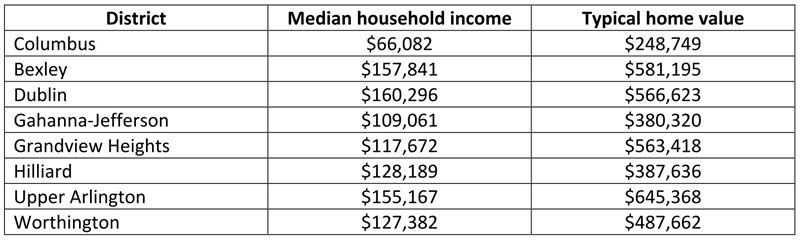
Public schools open to all blog figure 1

It’s important to keep in mind that this table shows median incomes. There are thousands of Columbus households that make far less than $66,000 a year. The same is true for typical home values. Wealthier enclaves within Columbus—neighborhoods like Clintonville and Victorian Village—are driving up the average home value for the rest of the city. And don’t forget, thousands of Columbus residents are renters, not homeowners. That means they don’t have any home equity to help with a down payment on a new house. To make matters worse, many signs point to homes in central Ohio getting even more expensive over the next few years.

It’s possible that these families could rent, rather than buy, their way into these communities. After all, renting is now cheaper than buying a home in every major U.S. city. But as the table below shows, average rents at the time of this writing are also higher in the suburbs. And remember, the same factors driving up real estate prices are also driving up rent. Luxury apartments downtown boost the city’s median rent and make it seem a lot closer to suburban averages than it actually is.
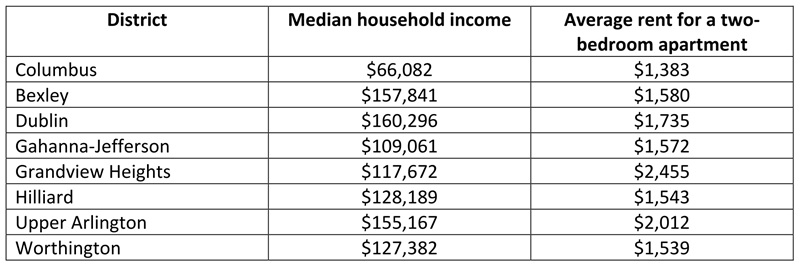
Public schools open to all blog figure 2

As a last resort, you look for family and friends who are living in the districts you prefer but can’t afford. Your loved ones are residents, and they pay taxes, so maybe your children can list those addresses as their proof of residency. But a quick Google search reveals that’s a really bad idea. Apparently several of the districts on your list hire private investigators to tail parents and make sure they’re actually residents. In other parts of the state, parents have been sent to jail for enrolling their students in districts where they don’t reside. Much as you want your kids to have a better education, doing jail time is a steep price to pay.

The upshot? You’re stuck. The public schools that claim they’re open to all aren’t actually open because you don’t make enough money to live there. You can’t send your children to temporarily live with family or friends because districts have teams of lawyers and private investigators to hunt you down. And although Ohio has a statewide open enrollment policy that approximately 80 percent of districts participate in, the affluent, high-performing districts that surround cities like Columbus are almost exclusively closed.

What makes the establishment’s “we’re open to all” argument particularly galling is that they already know all of this. They know not all districts are open. They know that only certain kids are fortunate enough to attend the high-performing districts that they hold up as exemplars of public education. They just don’t care. Not about families, anyway. All they care about is protecting their interests—adult interests—and maintaining their monopoly. Public schools, they say, are a public good. And when something is a public good, it should be protected at all costs.

For readers who are unfamiliar, public good is an economic term that refers to services that are available to all members of society and are often paid for via tax dollars. To qualify as a public good, a service must meet two criteria. First, it must be non-excludable—the availability of the service can’t be limited to only certain people, like those who can afford to pay. Second, it must be non-rivalrous. That means when one person uses the service, it can’t prevent someone else from doing so.

EdChoice opponents are quick to point out that private schools fail to meet these criteria, as they can exclude certain students and have limited seats available. But as the central Ohio data outlined above clearly demonstrate, public schools often fail to meet these criteria, too. Yes, there are school buildings where kids are provided with an education. But is it the same education? Does everyone in the public have access to this public good, or do those who are richer get a better version? Are we really going to tell the parents of a Columbus third grader who can’t read, or a sixth grader struggling with basic math, that their child is receiving the same education as the kids in higher-performing districts that, just like private schools, exclude thousands of families?

That’s where school choice comes in. Rather than asking families to trust that districts with decades of poor performance are suddenly going to take improvement efforts seriously, charter schools and private school vouchers give families a lifeline to another option. But instead of asking why families might be so desperate for other options, districts like Columbus are pouring millions of dollars—money that could definitely be used elsewhere—into destroying all competition.

You see, it’s not enough for districts to close their borders and be hypocrites. They also want to prevent kids from attending any and every school that’s not under their control. That’s why they’re so outraged by data demonstrating that urban charter schools outperform local districts. That’s why they’ve filed a lawsuit to eliminate the EdChoice program. And that’s why, when parents dared to express concern over a lawsuit that could upend their lives and their kids’ futures, the callous response from the plaintiff districts was that families “do not have sufficient knowledge about either the Ohio Constitution or the EdChoice Voucher Program to be of any use to the Court in deciding this case.”

The bottom line is this: If you’re rich enough to buy or rent a home in a high-performing district, your kid gets to go to an excellent school. The world is your oyster. If, however, you can’t afford to pay your way into one of these districts, then most—if not all—high-performing public schools are closed to you. You can either resign yourself to the assigned district that, for myriad reasons, doesn’t work for your child, or you can take advantage of school choice programs. But beware—if you put your child’s interests above those of the adults running your district, the establishment will brand you as a traitor. Because after all, your kids are really their kids.


[1] Results on the ACT were similarly abysmal: 9 percent of students took the ACT and less than 2 percent earned a remediation-free score on the English, math, and reading sections.

view
Efficiency-equity tradeoffs in schools SR image

Measuring equity-efficiency tradeoffs in elementary education settings

Jeff Murray
6.23.2026
Ohio Gadfly Daily

School leaders regularly make decisions on how to deploy their finite resources—staff, money, time—in ways they believe will best serve their students. While distribution is likely intended to be both efficient (providing the maximum benefit possible) and egalitarian (not benefiting one group of students over another), reality dictates that tradeoffs between these two goals must regularly be made, per the “leaky bucket” theory propounded by Arthur Okun in 1975.[1] Can such tradeoffs be measured? A new study from the American Educational Research Journal gives it a try.

Researchers Paul Yoo of Stanford and Paul Hanselman of the University of California, Irvine, use data on elementary school students from one unnamed western state—specifically, 375,000 unique students who entered fourth and fifth grades between 2005–06 and 2013–14 at 700 unique public schools. This represents almost 95 percent of the state’s fourth and fifth graders during those school years. According to the researchers, per-pupil spending was within 10 percent of the national average, and funding policy was less progressive than the median state in providing compensatory support for high-poverty districts. Average third-grade achievement in math and reading ranked below the national median on a nationally normed metric, and the achievement gaps between lower- and higher-income students were wider than the median state. Student data include demographic characteristics (gender, race/ethnicity, special education status, gifted status, and economic disadvantage status), attendance, and academic outcomes for each year in reading and math. They standardize test scores within each year, grade, and subject to have a mean of 0 and a standard deviation of 1.

Yoo and Hanselman create value-added models of student achievement to generate annual estimates of schools’ (a) overall effectiveness in promoting learning and (b) differential effectiveness in promoting more learning for low-income students relative to higher-income peers.

What they find is that the schools in their study are, overall, minimally effective at promoting learning compared to the average expected value-add of schools in the state, with sample schools adding approximately 1 month of learning in math and reading for students in grades four and five, as compared to 2 to 3 months for the average school serving those grades. They also find that the most effective schools achieve that result by adding more learning to their higher-income students than to their lower-income students. The difference is small but significant, with higher-income students coming closer to the average (2–3 months of learning), while lower-income students fall just short of a month of learning. This doesn’t mean that the schools are ineffective for low-income students, just that there is a difference between high- and low-income kids, which they say is proof of a tradeoff made between equity and efficiency in provision of education.

Or, more accurately, a set of tradeoffs. The researchers tested a number of variables that impacted the outcomes of students, including prior academic achievement levels, racial/ethnic diversity in schools, and concentrations of low- and high-income students, among others. Most of them had small and modestly-significant impacts on student learning. Some were positive and some were negative, but no obvious patterns were discernable among schools. They conclude that “many important aspects of tradeoffs are rooted in organizational practices” from building to building, but do not have enough evidence at the school level to speculate about mechanisms. Even in districts where financial allocations are made centrally, school- and even classroom-level use of funds will have a differential impact on students.

Yoo and Hanselman are convinced from their findings that their resource buckets are leaking (per Arthur Okun) in these schools, but cannot generalize beyond them—or, likely, even beyond the specific grade levels they study. However, they seem equally convinced that the mechanisms are knowable and would be useful to know, especially for school leaders charged with allocating resources. They suggest several avenues of deeper research that could get closer to isolating specific allocation decisions, and their effects on students, including case studies comparing similar schools with differing outcomes.

SOURCE: Paul Y. Yoo and Paul Hanselman, “Efficiency-Equity Tradeoffs in Schools: Evidence from Elementary School Learning,” American Educational Research Journal (May 2026).


[1] The researchers offer this example of such a tradeoff: “Consider a school administrator deciding how to allocate limited staff. Assigning all staff as classroom teachers would minimize average class sizes, potentially providing the richest learning environments overall, but this allocation would preclude targeted, compensatory use of resources, such as for tutoring, that could support more equitable outcomes.”

view
Tutoring

Instructionally-aligned tutoring and student literacy outcomes

Jeff Murray
6.18.2026
Flypaper

While we are now several years removed from the pandemic, work continues to remediate its inadequate substitutes for in-person teaching and learning. Tutoring emerged as a favored response from schools. But the type, amount, and quality matter if academic outcomes are going to rebound. A recent study focuses on a specific aspect of tutoring quality to determine its value to students: the instructional and curricular alignment between tutoring and the classroom.

Researchers Cara Jackson and Ayman Shakeel, from the Center for Outcomes Based Contracting and Abt Global, respectively, conducted a randomized control trial in a single school district in Tennessee during the 2024–25 school year at the request of district leaders. In a new Chalkbeat article, those leaders explain that their schools had been providing literacy tutoring to hundreds of students for years in hopes of boosting academic achievement, but their data showed that “students were not exiting intervention” and were instead becoming “intervention lifers”—running in place just to keep from falling further behind. Believing that the culprit was instructional misalignment between tutoring and the regular school classroom,[1] the district spent the last of its pandemic relief funding to purchase as many instructionally-aligned tutoring materials as they could afford, tried them out on as many kids as they could accommodate, and hired Jackson and Shakeel to evaluate the results.

The trial was a small one: 296 total students in grades K through 3, all of whom scored below the 40th percentile on the aimswebPlus literacy diagnostic administered at the start of the 2024–25 school year. Of these students, 179 were randomly assigned to the instructionally-aligned treatment group (the most that could be accommodated) and 117 to the business-as-usual control group. Tutoring took place either in the classroom or in a separate room of their school building, with tutoring group size regularly varied for both treatment and control students. Some control group students used a computer for their tutoring from time to time, but no treatment group students ever did. As was typical in the district, control group tutoring could be led by paraprofessionals or teachers. Treatment group tutors were exclusively teachers, in order to maximize alignment between tutoring and classroom instruction. Sessions for both groups were intended to occur daily, but teacher and student absences throughout the year lessened the true dosages. Session lengths were not prescribed and varied daily, averaging around 41 minutes per session for both groups.

Jackson and Shakeel find that treatment group students scored an average of 0.12 standard deviations higher than students in the control group on end-of-year aimswebPlus testing, which is statistically significant. They also find a positive impact for instructionally-aligned tutoring of 0.17 standard deviations on the state’s standardized ELA exam, though that effect falls below statistical significance. Treatment effects are strongest for boys and for the lowest-performing students at the start of the year. More interestingly, students do better when tutoring sessions are conducted by adults who did not hold a master’s degree, be they licensed teachers or paraprofessionals. The researchers surmise that these younger, less-experienced tutors stuck more closely to the curricular expectations of the tutoring materials than their older, more-experienced peers. Additionally, tutoring group size appeared to matter—all else being equal—with the highest impacts seen in tutoring groups comprising four students; no more, no less. No explanation is proffered for this curious finding.

In the end, the researchers urge a cautious interpretation of their findings (instructionally-aligned tutoring might be a way to boost students out of “intervention lifer” status) and more investigation. They would love to have more specific data on absenteeism, more details about which adults were conducting which tutoring sessions, and of course, more students in both groups. The district in question, they write, was immediately “working to expand the instructionally aligned tutoring,” although their Covid funding has long run out and the resulting expansion is going to be far more ad hoc than their initial effort as studied here. None of which bodes well for district students, regardless of how long the remediation effort continues.

SOURCE: Cara Jackson and Ayman Shakeel, “Creating Coherence: Does Instructional Alignment Affect the Impact of Tutoring?” Annenberg Institute at Brown University (November 2025).


[1] In this report, “alignment” is defined as curriculum, instruction, and assessment—including tutoring—acting as “a unified system for common learning goals.” In the district, alignment was actualized by purchasing tutoring materials from the same company from which they sourced their English language arts curricula.

Fordham Logo

© 2026 The Thomas B. Fordham Institute
Privacy Policy
Usage Agreement

National

P.O. Box 110
Burke, VA 22009

202.223.5452

[email protected]

Ohio

P.O. Box 82291
Columbus, OH 43202

614.223.1580

[email protected]

Sponsorship

130 West Second Street, Suite 410
Dayton, Ohio 45402

937.227.3368

[email protected]