Ohio’s dual credit program, College Credit Plus (CCP), provides academically eligible students in grades 7–12 the opportunity to earn postsecondary credit by taking college courses for free. Launched during the 2015–16 school year after a significant overhaul of the state’s former dual-credit program, CCP permits students to take courses at their high school with an approved secondary teacher or college instructor, on a university campus, or online.
According to the Ohio Department of Higher Education (ODHE), the purpose of CCP is threefold: 1) to enhance students’ career readiness and postsecondary success, 2) to offer a wide variety of college credit options to college-ready students, and 3) to provide those options at no or limited cost. A performance audit conducted by the Ohio Auditor of State in 2022 found that overall participation, student impacts, and tuition savings from the program were positive, indicators that CCP was meeting its goals to boost student readiness and help families save money. Ohio’s goal of providing college credit options to all college-ready students, however, was still a work in progress, as the audit found that traditionally underserved students were missing out on the program’s benefits.
Given that it’s been a decade since CCP was launched, now seems like a good time to re-examine Ohio’s progress. ODHE recently released an updated annual report that includes CCP data from 2015–16 through 2024–25. For those interested in dual credit, the report is worth a read in its entirety. But for the sake of this analysis, we’ll examine the data through the lens of CCP’s three primary aims.
1. Boosting student readiness and postsecondary success
When it comes to student outcomes, the annual report primarily focuses on grades. During the 2024–25 school year, a total of 93 percent of students earned a passing grade in their CCP course or courses. Just under 3 percent earned a failing grade, while nearly 2 percent were identified as withdrawals.[1]
On the surface, this seems like great news. Tens of thousands of Ohio high schoolers are taking college courses, passing them, and earning credit. But a closer look at the annual report reveals that the vast majority of courses during the 2024–25 school were taken either online or at a high school with an approved secondary teacher. It’s possible that online courses and high school teachers are delivering rigorous, college-level instruction. But with widespread grade inflation, it’s hard to be sure. Advanced Placement (AP) and International Baccalaureate (IB) courses, which also offer the opportunity to earn college credit, avoid the grade inflation problem by awarding college credit only to those who earn a minimum passing score on a standardized exam. CCP courses, meanwhile, award college credit solely based on grades.
Another way to measure student outcomes is through attainment. The annual report notes that CCP is increasingly used as a pathway to earning a degree before graduation. In fact, in 2025, students earned a record 861 certificates and 958 associate degrees while still in high school.
Again, this seems like great news. But ODHE’s annual report doesn’t identify the subject or industry in which students earned their certificates or associate degrees. And as we’ve seen with industry-recognized credentials (IRCs) linked to high school graduation, those details matter. The number of Ohio students earning IRCs has skyrocketed, and more students are graduating as a result, but there are large discrepancies between graduation and academic proficiency rates, and the credentials students are earning haven’t (yet) been linked to data on wages, job outlook, or employer demand. In other words, there’s very little evidence that students are better off—academically, financially, and in terms of employability—after earning an IRC. Without detailed data about the certificates and associate degrees being earned under CCP, it’s similarly difficult to determine whether students are better off.
A third way to examine student outcomes is college-going rates. Using data obtained from the National Student Clearinghouse, the report identifies the number of CCP-participating high school graduates who went on to enroll in postsecondary education. Table 1 identifies the numbers for the last five years.
Table 1. Matriculation to postsecondary education after high school graduation
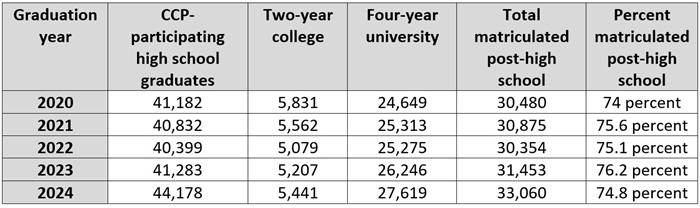
Based on these data, the majority of CCP participants enroll in a postsecondary institution after high school graduation. That’s good news. But it’s unclear how many go on to actually earn a degree, the ultimate indicator of postsecondary success. It makes sense that attainment rates would be missing for most of the years identified in Table 1, as many of these students could still be working toward a degree. But the report offers matriculation data as far back as 2016 and doesn’t provide accompanying attainment rates. That leaves us with an incomplete picture. ODHE should rectify this by including attainment data in its report.
2. Providing opportunities for all students
Since the inception of CCP, participation among low-income students has “hovered steadily” around 20 percent. During the 2024–25 academic year, however, that rate increased to 34 percent. It’s unclear how much of this sudden jump can be attributed to changing academic eligibility requirements, which could hurt, rather than help, students in the long-run. It’s also possible that the data have been impacted by the expansion of the Community Eligibility Provision. On its face, though, higher participation among low-income students is good news.
Unfortunately, the news isn’t as positive for minority students. The report fails to provide specific numbers, and state-level data available via report cards aren’t disaggregated by race, making it difficult to determine exact percentages. Based on what the report does include, though, there appears to be a sizable enrollment gap between White and minority students. Going forward, ODHE should offer more detailed data to ensure an accurate picture of enrollment gaps.
3. Helping students and families save money
ODHE’s report provides the rates of standard college tuition saved by participating students. These numbers have been calculated by multiplying the number of credits attempted at each institution type with the standard tuition rates that colleges report for the corresponding academic year. Table 2 identifies the numbers for the three most recent school years with available data. For the 2023–24 year, the total rate of tuition savings was more than $214 million. According to ODHE, families have saved over $1.5 billion in the last ten years.
Table 2. Tuition savings through CCP

These statewide numbers are impressive. But they could be glossing over the reality of negligible savings for individual families. Students who pass multiple CCP courses could be saving thousands of dollars in tuition because those accumulated credits help them graduate early. But according to the report, the majority of kids don’t participate in CCP until their junior or senior year, and most only enroll in one or two courses. Those one or two courses likely aren’t enough to shave a semester off a four-year degree. That means many students could still end up with four years’ worth of student loan debt regardless of the money they “saved” by earning college credit in high school.
***
What’s the verdict?
College Credit Plus has come a long way in the last decade. Tens of thousands of students are taking advantage of the opportunity to earn college credit while in high school. Most who participate in CCP go on to pass their courses and enroll in college after graduation. And based on standard tuition rates, the credits they earn in high school are saving them money.
But there are also signs that CCP isn’t yet living up to its full potential. Grade inflation, changing academic eligibility requirements, and a lack of detailed data on attainment collectively paint an incomplete picture of student outcomes. Sizable enrollment gaps (which could be explained by Ohio’s sizable achievement gaps) remain between low-income and minority students and their affluent and White peers. And despite “cumulative savings” exceeding $1.5 billion, it’s impossible to tell if individual students actually end up with less student loan debt courtesy of CCP.
Overall, state leaders should be encouraged by the data provided in this latest report. Tens of thousands of kids have access to opportunities they didn’t have before, and that’s nothing to sneeze at. But it should also serve as a reminder that there’s much work to be done—and no time to waste.
[1] The remaining outcomes each fell under 1.5 percent.