
For nearly a year, Ohio lawmakers have been working on Senate Bill 19, legislation aimed at improving student achievement. Recently, the House Education Committee released an amended bill. There are considerable differences between the newest and initial versions. But there is one difference, in particular, that directly contradicts the bill’s original purpose.
Under the original legislation, public schools would be required to enroll any child in grades 3–7 who scores at the two highest levels on their state math exam (“accomplished” or “advanced”) in an advanced math course the following year. These designations weren’t just plucked out of thin air. Students who score accomplished or advanced are considered to be on track for college. Their achievement is a clear indicator that they’re ready for more challenging work. And yet, the revised version of the bill only requires opportunities to be provided to students who score advanced. Those who score accomplished can still be enrolled in advanced courses, but—in a new and misguided twist—only if both the school principal and the student’s classroom teacher, in consultation with a parent or guardian, agree that the student would “benefit” from the opportunity.
Implying that students with a documented history of high achievement might not “benefit” from advanced coursework is absurd. Testing data indicate that high-ability students who take Algebra I in eighth grade almost universally perform well on the state’s end-of-course exam. And yet, more than half of them (55 percent) weren’t enrolled in algebra during eighth grade and thus didn’t take the end-of-course exam in 2024. That’s nearly 13,000 students who missed out on advanced math opportunities despite proving their readiness. For reference, during the 2024–25 school year, just under 10 percent of seventh graders scored advanced on the state’s math exam. Meanwhile, 18 percent scored accomplished. Collectively, these students have demonstrated their readiness. But under the revised bill, only a third of them would have guaranteed access to advanced coursework.
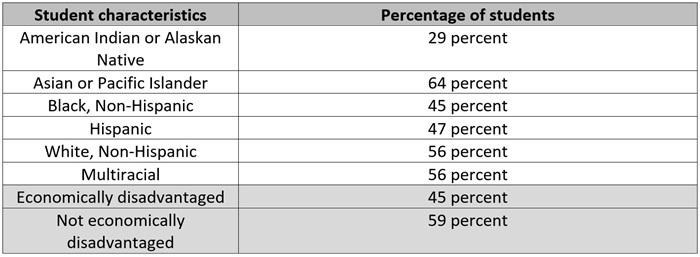
What makes this subtle change particularly pernicious, though, is who it’s most likely to harm. Ohio testing data outlined in Chart 1 demonstrates that high-achieving low-income and minority students are more likely than their peers to miss out on advanced math. Less than 50 percent of Black, Hispanic, and American Indian/Alaskan native students who scored in the top two levels took algebra in eighth grade, while 56 percent of their White peers did so. A similar gap exists based on income: Just 45 percent of economically disadvantaged students who scored accomplished or advanced were enrolled in Algebra I in eighth grade, compared to 59 percent of their more affluent peers.
Chart 1. Percentage of seventh graders who scored accomplished or advanced on Ohio’s 7th grade math exam and took the Algebra I exam the following year
One of the reasons why these gaps exist is that some schools, like those in economically disadvantaged urban areas, offer fewer opportunities for students to take advanced math. But that’s not the only reason. According to a nationally representative survey of teachers and principals published by the RAND Corporation in 2023, even when low-income and minority students attend schools that offer advanced math courses, they can still miss out if teachers and administrators fail to recognize their potential. Nearly one-quarter of principals said teacher nominations were included as part of the selection process for taking Algebra I before high school. And that’s a problem, says RAND, given that “previous research demonstrates that [using] subjective measures—especially teacher nominations—during the enrollment process is a known contributor to persistent disparities in representation in advanced math courses.”
The upshot? This change to SB 19 could prevent low-income and minority students from accessing math opportunities that their achievement track record proves they’re ready for. Constructing a bureaucratic roadblock for students who score accomplished will benefit districts, as it limits the number of students they’re required to advance. But it won’t help kids—especially those from underserved backgrounds.
If current practice is any indication, most of these students will be placed on lower-level tracks that can hinder admission into selective universities. Delaying algebra until ninth grade denies high-achieving, low-income students the opportunity to take calculus or high-level statistics as juniors and seniors. Not only that, it likely forecloses advanced physics, chemistry, or computer science courses that require strong mathematical skills as a prerequisite. Ultimately, these students will have less competitive college applications than their more advantaged peers—all because state lawmakers were unwilling to guarantee advancement opportunities.
Offering advanced coursework for high-achievers will challenge the status quo in many schools. But Ohio families deserve to know that schools are being held accountable for ensuring that all students are being prepared for success. Senate Bill 19, in its original form, would help accomplish that. Recent adjustments that water down its original intent should be rejected.