State report cards set the baseline for math improvement in Ohio
In June, lawmakers passed long-awaited and comprehensive math legislation in the form of Senate Bill 19.


Education systems often fail to challenge our very brightest students. The unfortunate result is that too many high achievers lose their edge and fall short of their potential.
New report card data show signs of hope, but there’s still a long way to go before the science of reading can be declared a success, especially in Ohio’s urban school districts. It’s time to double down on rigorous implementation.
In the wake of the September release of school report cards, education groups were in a celebratory mood.
In 2023, we at Fordham released a publication titled Will Ohio’s Covid Generation Get Back on Track?
Consistent, rigorous implementation of the science of reading should produce literacy achievement gains. State report cards for the 2025–26 school year, which were released last week, reveal both good news and bad news on this front for Ohio.
Today, the Ohio Department of Education and Workforce released school report cards for the 2025–26 school year. Data include state math and reading exam results as well as high school graduation and chronic absenteeism rates.
Newly-enacted Senate Bill 276 has the potential to make state tests a lot more useful to families and schools going forward. Here’s how.
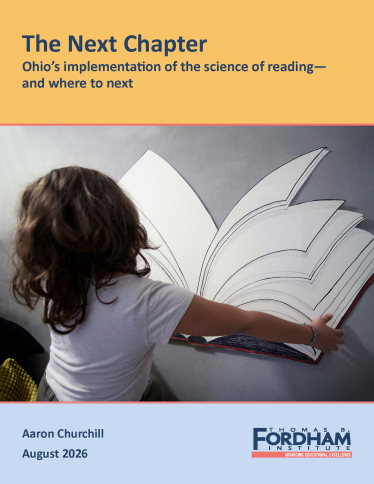
Our latest report documents the significant work Ohio has undertaken to implement science of reading reforms, while also recommending ways that policymakers can further strengthen implementation.
Historically, students who enroll in community colleges unprepared for college-level work have been required to take prerequisite courses to boost their math and English skills before they’re permitted to enroll in credit bearing courses. This unexpected burden of additional time and money often leads large numbers of students to drop out prior to earning a degree.
We dig into new research from Ohio that shows positive academic impacts of mandatory third grade retention policies. But skittish lawmakers killed them anyway.
In April, the Ohio Department of Education and Workforce released an amended ESSA plan for public comment that proposes stronger
Known as the “Nation’s Report Card,” the National Assessment of Educational Progress (NAEP) has long provided the clearest yardstick by which states can compare their students’ math and reading performance to other states.
Thousands of Ohio students are M.I.A. from school and losing the opportunity to reach their potential. Nearly 385,000 students—about one in every four—were “chronically absent” in 2024–25, meaning they missed more than 10 percent of the school year. Of these students, 125,000 were absent more than 20 percent of the year, or about two months’ worth of school.
Positive press coverage of the Columbus Promise program elides problematic data regarding participation, cost, and achievement. Unless and until these issues are rectified, the program exists only to serve adult interests rather than those of students.
The intent of Senate Bill 19 is to improve math education for all Ohio students. But a recent amendment would limit which students get access to advanced math courses. This is unconscionable and must be changed before the bill is passed.
NOTE: Today, the Ohio Senate’s Education Committee heard testimony on Substitute S
NOTE: Today, the Ohio Senate’s Education Committee heard testimony on Senate Bill
The Ohio House Education committee recently added an amendment to Senate Bill 19 that threatens to upend state testing.
Ohio overhauled school report cards five years ago. It was a necessary step and an improvement overall; but they have ushered in an era of grade inflation and swept academic deficiencies under the rug. They must be fixed.
Researchers have long been interested in quantifying how inputs like school quality and years of education translate into personal earnings over time and individual contributions to the larger economy. The common consensus is that more school leads to more human capital, as demonstrated by higher wages for those with more formal education than their peers.
This is the fourth and last piece in a series that examines elements of Ohio’s school report card that could use refinement (previous articles covered chronic absenteeism
Ohio’s current report card measure of students’ post-secondary readiness is an improvement over the previous iteration, but its focus on low-quality industry credentialing must be changed to ensure that workforce preparation efforts are accurately reported.
Most parents assume that if their children are earning A’s and B’s, they must be meeting grade-level standards. After all, A is the highest grade possible. Getting a B is the next best thing. If students weren’t meeting the school’s expectations—if they were academically behind and at risk of falling further—they wouldn’t bring home such good grades.
Ohio’s school report cards have long provided transparency and accountability for student learning. But they’re not perfect. We explain how one vital report card component—early literacy—could be improved to provide clearer information to parents, educators, and the general public.
It’s been nearly three years since policymakers established Ohio’s science of reading initiative.
Student participation in Ohio’s College Credit Plus program has skyrocketed in recent years. But the data indicate that unchecked numbers of high schoolers earning college credit may not be entirely good news.
Our latest report examines the predictive value of Ohio’s state tests and finds that scores provide vital data predicting the post-secondary education outcomes of students.
With Thanksgiving in the rearview mirror and Christmas on the horizon, Ohioans are now fully immersed in the holiday season. Between shoveling snow and checking the kids’ Christmas lists, most folks aren’t thinking about their plans for the new year.
Today, the Ohio Senate Education Committee heard testimony on Senate Bill 19 which aims to establish academic intervention services at public schools and to implement mathematics improvement and intervention plans.