Mobile Navigation

  • National
    • Policy
      • High Expectations
      • Quality Choices
      • Personalized Pathways
    • Research
    • Commentary
      • Gadfly Newsletter
      • Flypaper Blog
    • Events
    • Scholars Program
  • Ohio
    • Policy
      • Priorities
      • Media & Testimony
    • Research
    • Commentary
      • Ohio Education Gadfly Biweekly
      • Ohio Gadfly Daily
  • Charter Authorizing
    • Application
    • Sponsored Schools
    • Resources
  • About
    • Mission
    • Board
    • Staff
    • Career
Home
Home
Advancing Educational Excellence

Main Navigation

  • National
  • Ohio
  • Charter Authorizing
  • About

The Education Gadfly
8.3.2025
Fordham Gadfly image
Listen to this article
Loading the Elevenlabs Text to Speech AudioNative Player...

Cheers

  • Mississippi, Texas, and Florida show how high per-pupil spending doesn’t correlate with student achievement. —Chad Aldeman, The 74
  • Albuquerque’s Valley High School partners with local trade unions to give students a head start toward careers in skilled trades. —The 74
  • The Presidential Fitness Test returns to public schools. —EdSource 

Jeers

  • An education professor claims there’s no reading crisis, despite alarming downward trends that predated the pandemic. —Paul Thomas, The Washington Post
  • Eric Adams caved to union pressure in NYC, retreating from previous charter school support and instead aligning with entrenched interests opposed to school choice. —Reason Magazine
Jeff Murray
8.1.2025
Ohio charter news logo
Listen to this article
Loading the Elevenlabs Text to Speech AudioNative Player...

Stories featured in Ohio Charter News Weekly may require a paid subscription to read in full.

The end of a long and bumpy road in Dayton

Dayton City Schools officials announced this week that they would not provide busing for high school students for the upcoming school year—which begins in less than three weeks—except those with special needs and other accommodations. This is a chaotic situation for families and can be added to the long list of transportation failures in the city over the last ten years or more that have impacted district, charter, private, and STEM school students alike. As usual, blame for the failure is laid at the feel of school-choice-using families, with elected school board member Jocelyn Rhynard writing in an op-ed yesterday that Dayton would be able to efficiently and effectively transport students if they were not required to bus those other kids. “DPS should not be mandated to transport students that do not attend Dayton Public Schools,” she writes, and calls for the state to permanently end this decades old requirement.

A somewhat better view

Kudos to Trotwood Preparatory and Fitness Academy for opening its doors to a summer tutoring program run by a local nonprofit education support organization and open to kids from Dayton, Trotwood, Middletown, Springfield, and beyond. It looks great: positive, focused, and productive. Hope everyone has a fun and educational camp session to get ready for the new school year!

What the money will buy

Charter schools in Manatee County, Florida, will soon begin receiving a share of county sales tax revenue for the first time, and after a long legal battle to affirm their right to the money. The first-year funds are just a trickle—$4.5 million distributed across 17 schools and allocated based on enrollment—of what will come when the full percentage is phased in by fall of 2028 (!). The leader of Lakewood Ranch Preparatory Academy is ready to start digging just as soon as the funding arrives. She’s going to build outdoor classrooms. “We want to expand the opportunities for our kids to experience nature in a different way and we want to expand some of our health and wellness opportunities outside.” This is great, with much more awesomeness to come!

California dreaming – pt. 1

In the San Francisco Standard this week, an op-ed written by the co-founder of and a summer intern with the Briones Society questions why city leaders consistently treat charter schools like an enemy to their work. The society is focused on boosting and adding to all that is great about San Francisco, and the authors insist that charter schools are part of that greatness. They lay out data in favor and bust persistent myths against charter schools, concluding that “openness to charter schools — and a determination to hold them accountable — will allow San Francisco to benefit from the creativity and determination of education entrepreneurs, just as our economy benefits from innovation provided by tech entrepreneurs.” Nice.

California dreaming – pt. 2

California state senator Steven Choi does much the same in his recent op-ed for the Orange County Register. In it, he explains his opposition to Assembly Bill 84 (it “imposes unnecessary new layers of bureaucracy on charter school operators without any evidence that it enhances student outcomes”) and his support for Senate Bill 414 (which “outlines reasonable oversight that will reduce opportunities for bad actors to take advantage of the flexibility that so many students rely on” without “punishing” current high performers). He says that “charter schools have been a beacon of opportunity for families” across the Golden State, with many of them “low-income, immigrants, and others needing flexible educational options.” He opines that California’s education system is stronger because of charters and state laws must support high-performing schools and preserve alternative educational models that work.

*****

Did you know you can have every edition of the Ohio Charter News Weekly sent directly to your Inbox? Subscribe by clicking here.

Policy Priority:
School Choice
Topics:
Charter Schools
Jeff Murray
8.1.2025
Gadfly Bites logo
Listen to this article
Loading the Elevenlabs Text to Speech AudioNative Player...

News stories featured in Gadfly Bites may require a paid subscription to read in full. Just sayin’.

  1. This is a really long story, but definitely worth your time for various reasons. It is an analysis of math and ELA test score performance comparing voucher-using students at private schools with students at various districts in and around Dayton. (Grades 3 through 8 only.) Kudos to the Dayton Daily News, which once again shows the value of having a dedicated and thorough education reporter (and team) on staff. Comments and cogent analysis from Fordham’s data guru Aaron Churchill are way down in the mix, along with Stéphane Lavertu, our Senior Research Fellow. You should read it all, but I’ll just point out two important things. First is to compare the responses to low test score performance from district and private school leaders as quoted here. Who responds to the data by saying that they are working to improve (with detailed examples), and who makes excuses for why the data do not tell “the whole story”? Even the leader of the lowest-performing private school explains in detail why the Montessori education method she uses does not lend itself to standardized test results, a fact that literally everyone has known for 100 years. Second is that, upon reading every word of this, the headline could easily be rewritten as follows: “Do private schools offer Ohio students a better education? Yeah, pretty much.” Just sayin’. (Dayton Daily News, 7/30/25) And if you want to dig into the numbers yourself, here’s a handy search box, courtesy of the awesome Josh Sweigart and Eileen McClory. (Dayton Daily News, 7/30/25)

  2. Whew! Dayton City Schools officials have at last read the writing on the wall and given up their “fanatical work” over the last couple weeks to try and conjure up a transportation plan for high school students for the coming school year that doesn't fall afoul of new state laws. As I have noted repeatedly throughout this mess: It is not required for them to provide anything to high schoolers (except those with special needs); every scheme that they have tried for at least the last ten years has been an utter disaster; their first post-budget effort a couple weeks ago was predicated on forcing their own students to give up their intradistrict building choice; and it seems highly likely that whatever plans individuals, families, or groups of families come up with on their own will be simpler, safer, and more efficient than anything these “pros” could ever figure out. (Dayton Daily News, 7/31/25) As usual though, the elected school board goes down denigrating private and charter school students swinging. Elected board member Jocelyn Rhynard has an op-ed in the DDN where she once again blames the requirement for districts to transport school-choice-using students (interestingly focusing on private schools only and not mentioning charters at all) for Dayton City Schools’ inability to get their transportation show on the road properly. “DPS should not be mandated to transport students that do not attend Dayton Public Schools,” she says, and calls on “true partners” of the district to permanently end this requirement. To which your humble clips compiler says, as he always does in this situation, “Be careful what you wish for, your honor.” (Dayton Daily News, 7/31/25)

Did you know you can have every edition of Gadfly Bites sent directly to your Inbox? Subscribe by clicking here.

Policy Priority:
School Funding
Topics:
Governance
Eric Tucker Edward Metz
8.1.2025
Happy student in school
Getty Images/Unaihuiziphotography
Listen to this article
Loading the Elevenlabs Text to Speech AudioNative Player...

What if a federal program reached four fifths of K–12 students nationwide for just 70 cents each, yielded a 9-to-1 return, seed-funded over 100 entrepreneurial education technology startups, and introduced AI and other novel solutions in classrooms? Skeptics might rightly raise an eyebrow. Yet, remarkably, the Small Business Innovation Research (SBIR) program is exactly this kind of success story.

Today, we at The Study Group released “From Seed Funding to Scale,” the first-ever program impact analysis of the U.S. Department of Education and Institute of Education Sciences’ SBIR (ED/IES SBIR). Rooted in Reagan-era R & D sensibilities, eleven agencies collectively invest $4 billion annually through America’s Seed Fund. ED/IES competitively awards phased grants—$250k for Phase I, $1M for Phase II—to education innovators. Crucially, companies must meet rigorous milestones to receive continued funding, ensuring taxpayer dollars fuel results, not wishful thinking.

As policymakers consider how best to rebuild and reimagine IES, SBIR’s targeted, research-driven investments offer a valuable blueprint for leveraging entrepreneurial creativity to achieve substantial impact.

For context, ED/IES’s SBIR program provides critical early-stage capital to small businesses, taking on initial R & D risks to drive innovation and commercialization. Competitive Phase I and II awards allow innovators to pilot new products designed for eventual wide-scale adoption. This proven early-stage investment model is a predecessor to and complements the proposed National Center for Advanced Development in Education (NCADE)—an education-focused, DARPA-inspired center for scaling breakthroughs—creating aligned, complementary paths for innovation.

The program’s results speak for themselves. Our analysis confirmed that between 2012 and 2022, ED/IES SBIR supported research-based educational products that have now reached 130 million students and educators at a price-tag of just $0.70 per user. More impressive still, these modest grants catalyzed over $800 million in subsequent product sales, private investment, and acquisition value—a remarkable 9-to-1 return on the initial $91.1M investment. While self-reported, these findings clearly indicate substantial social and economic benefits.

Take, for instance, Learning Ovations, a firm that created a platform to commercialize an evidence-based literacy assessment that individualized instruction reached national scale after acquisition by publishing giant Scholastic. Another startup, Analytic Measures (now Caimber), developed Moby.Read—an AI-powered reading assessment tool so efficient and accurate that Google acquired it to bolster their own platforms. And codeSpark, which teaches computer science through playful stories that children create, was acquired by Homer Learning and now reaches 40 percent of all schools in the country. These acquisitions aren’t outliers. Eighteen percent of SBIR-funded firms were acquired, confirming clear market validation.

More examples include Core Curriculum by MidSchoolMath, which immerses students in tasks such as managing ancient economies and is used in thirty-eight states. The chemistry learning game Happy Atoms, developed by Schell Games, successfully transitioned from classrooms to mainstream retail shelves at Target. Presence created a platform which enabled the delivery of more than 7 million virtual teletherapy sessions to children. And KASI Learning by Alchemie, an accessible science program for all learners—specifically students who are blind or visually impaired—is distributed through publisher Wiley. SBIR companies nearly doubled their workforce, creating hundreds of private-sector jobs.

Moreover, SBIR doesn't impose rigid mandates or create bureaucracies. Instead, entrepreneurs partner with education researchers, and schools choose what works in their context.

Perhaps SBIR’s most strategic victory lies in its investments in artificial intelligence. Well before AI captured national attention, SBIR-funded companies were already developing widely adopted AI-driven educational tools. At a time when global competitors are pouring billions into educational AI with heavy-handed, top-down directives, SBIR strategically positioned schools early with homegrown AI. This nimble, entrepreneurial approach has the potential to ensure that the United States doesn’t have to match global competitors with mandates. We can out-innovate them instead.

This isn’t just good policy. It’s smart economics. SBIR demonstrates that targeted R & D investments can yield exponential returns. For fiscal conservatives, SBIR exemplifies discipline and accountability—delivering real results.

More generally, it’s a proven approach for education R & D that Congress and state policymakers should expand. In an era of tight budgets and fierce global AI competition, America cannot afford to leave wins like these on the table. By recommitting to this Reagan-era vision—small, strategic government investments catalyzing private-sector innovation—we can elevate student achievement, create jobs, and help ensure America leads in educational technology and innovation.

Policy Priority:
High Expectations
Topics:
Evidence-Based Learning
Governance
Chester E. Finn, Jr.
7.31.2025
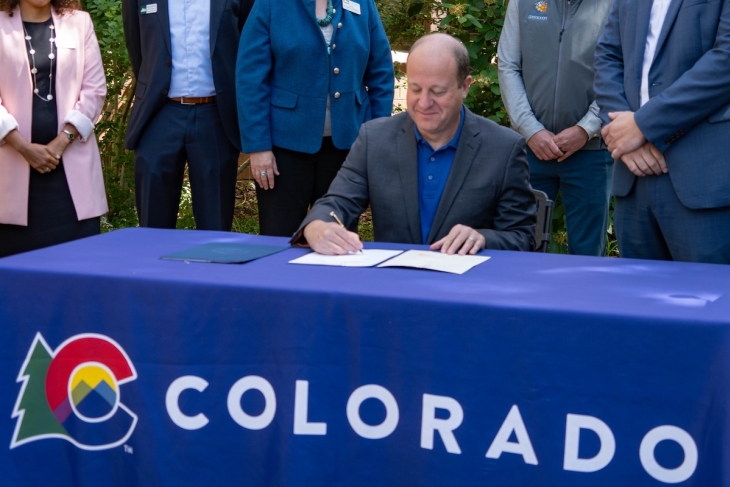
Colorado Governor Jared Polis
Colorado Governor Jared Polis. Image Credit: City of Fort Collins, CO/Flickr.
Listen to this article
Loading the Elevenlabs Text to Speech AudioNative Player...

The wide-ranging new report that Colorado Governor Jared Polis extracted from the National Governors Association (NGA) during his recently ended term as chairman kindled a lot of memories.

Once upon a time, back in what Gen Z views as prehistory—I’m talking about the 1980’s and ‘90’s, when I was middle-aged—state governors were the most potent drivers of K–12 education reform in America and the NGA was a major force for change.

It started in the ‘80s with an enormous amount of education reform, almost entirely at the state level, typically catalyzed by governors though sometimes by legislators and occasionally by business leaders. States periodically collaborated, both under NGA auspices and in smaller compacts such as the Southern Regional Education Board (SREB) and Education Commission of the States (ECS).

Their agendas varied but typically included higher standards, improved reporting, better teachers, stronger graduation rates, wider access to college, and early stirrings of accountability for schools and sometimes for students in the form of minimum-competency graduation tests. Many of these governor-reformers were southern—North Carolina’s Jim Hunt, Florida’s Bob Graham, Mississippi’s Bill Winter, Tennessee’s Lamar Alexander, South Carolina’s Dick Riley, Arkansas’s Bill Clinton, etc.—but not all. Their northern counterparts included Minnesota’s Al Quie, Wisconsin’s Tommy Thompson, Colorado’s Roy Romer and New Jersey’s Tom Kean.

It was quite a line-up—and stayed that way well into the ‘90’s.

Their occasional joint efforts could be powerful, as in the SREB’s piloting of state-level NAEP reporting and the multiyear “Time for Results” project that Alexander launched when he chaired the NGA. But sometimes they competed. I recall Alexander and Graham—Republican and Democrat—amiably racing to see whose state could first enact a merit pay program for teachers.

The apogee of their collective influence on the country as a whole was surely the “Charlottesville Summit” of 1989, where forty-nine governors, together with President George H.W. Bush—“I want to be the education president”—agreed, for the first time in history, on an ambitious set of national education goals to be achieved by century’s end.

Bush reiterated those six lofty goals in his State of the Union Address in January 1990 and a month later, at its annual winter meeting, the NGA adopted them along with specific objectives that clarified and amplified them.

Four years later, prompted by President Bill Clinton, who had been a force for ed-reform both as governor and within the NGA (which he chaired in 1986–87, immediately following Alexander), Congress passed the “Goals 2000: Educate America Act” and the “Improving America’s Schools Act,” precursor and foundation-builder for No Child Left Behind (NCLB) in 2001. These set the course for federal education policy for two decades, until ESSA rolled it partway back in 2015.

The governors’ insistence on better achievement data also played a major role in the statutory retooling of NAEP in 1988, in the state-specific reports of student performance that followed, and in the establishment of NAEP’s “achievement levels” that today comprise the closest thing we have to national education standards.[1]

Gubernatorial ed-reform energy continued through the ‘90’s, as the National Education Goals Panel followed up on Charlottesville and associated federal laws, and as school choice made its debut, with the pioneering Milwaukee voucher program authorized in 1989 and the pathbreaking Minnesota charter-school law enacted two years later.

Many more “education governors” surfaced, too, such as Michigan’s John Engler, Ohio’s George Voinovich, Massachusetts’s Bill Weld, and Texas’s George W. Bush, who famously brought his experience and zeal from Austin to Washington when he moved into the Oval Office in January 2001. 

Why do I recount all this prehistory? Partly because I was there, partly because it really made a difference, but also to contrast it—in two ways—with the present-day situation.

The first contrast, unsurprisingly, involves partisanship. Back in prehistoric times, lots of states were purple and most of the reforming within them entailed a degree of cooperation across party lines—which is also why many of those reforms proved fairly durable. So, too, the multistate collaborations, not just within the SREB and NGA—where the hand-off from Alexander to Clinton, for instance, was seamless and “Time for Results” forged onward—but also the ad hoc reform panels and commissions that kept up the momentum. That was true of the “Goals Panel,” of the National Council on Education Standards and Testing (co-chaired by Colorado’s Romer and South Carolina’s Carroll Campbell), and of the National Assessment Governing Board, which has always had one governor from each party among its members—and often supplying much of its oomph.

The second contrast has to do with that oomph. When ed-reform was hot, governors generated much of the heat—and the NGA was a force to be reckoned with, not only influencing federal policy but also as a forum for reform ideas, for staff support, for enlisting expertise, and for lively debates, comparisons, and competitions.[2]

Fast forward to 2025

Not so today. As choice-focused reforms burgeon in red states, there’s backsliding almost everywhere when it comes to standards, assessment, and accountability, and bipartisanship is rare indeed. With a small number of exceptions—Youngkin in Virginia, Polis in Colorado, and Huckabee in Arkansas come to mind—governors have turned to other issues, sometimes including the cultural conflicts that today dominate education discourse, and few seem to resist the omnipresent (union-driven) pushback against testing and accountability. 

As for the NGA, from time to time it returns to education, most recently the worthy initiative spearheaded by Colorado’s Polis, who chaired the group from July 2024 until two weeks ago. He launched a multi-faceted project called “Let’s Get Ready: Educating All Americans for Success,” and within his one-year term, pressed NGA to create and issue a pretty good blueprint for education reform across a number of fronts. (More on this below.)

But his predecessor, Utah’s Spencer Cox had a different priority—a good one, to be sure, encouraging Americans to “disagree better,” get out of their silos, foster good citizenship, and transcend some of the bitter partisanship. And his successor, Oklahoma’s Kevin Stitt, wants to “reignite the American Dream.”

Yes, there’s still an education piece within Stitt’s plan. Yes, NGA has an ongoing gubernatorial “Task Force on Education, Workforce and Community Investment.” And yes, the NGA staff still contains an able “program director for K–12 education,” with a strong team, within its multi-purpose Center for Best Practices. Far be it from me to suggest that they ignore the topic. Yet only episodically is K–12 education reform high on their agenda and there’s scant continuity from year to year—a fatal flaw for a realm that only ever changes when the pressure for change is sustained over many years, election cycles, and party switches.

It has to be added that NGA’s latest K–12 offering—Polis’s legacy—is comprehensive but lacks edge. The Let’s Get Ready report contains good stuff, particularly the parts that focus on career preparation, and its “roadmap for governors” is sound, as far as it goes. But the report—and roadmap—range over such vast territory as to have no real focus. I find myself nodding in agreement with—for instance—its recommendations for statewide data systems and focusing on outcomes. Yet when you look closely, it wants so many different outcomes that no leader of any jurisdiction, much less a governor, has the bandwidth or clout to work on all of them. It’s common knowledge that an elected official with a four- or even eight-year term must select a few key targets—provided they want to get something done—and shoot all their arrows at those targets, not get diverted onto a hundred other worthy efforts even if all carry the “education” label.

Combine the vastness of the Polis legacy menu and the unlikelihood that Governor Stitt or his successors will push the NGA to double down on that menu—every new leader (in this case with a one-year term) is tempted to declare their own glittering priority—and I find it unrealistic to count on NGA to juice the ed-reform effort that so urgently needs a lot of juice.

Some individual governors will stick with—or rediscover—that an educated population is key to just about everything else they want their states to achieve. At a time when national leadership for this activity has been so lacking—not just Trump and team, also Biden and his, plus a vacuum among business leaders—I applaud the governors that work at it. But there aren’t nearly enough of them and nowadays they mostly work in isolation.

All things considered, prehistory has seldom looked better.


[1] That saga began immediately after the release of A Nation at Risk in 1983, when many education-minded governors sought better data than was then available on how their states were doing in producing educated children. The NAEP “study group” that Lamar Alexander chaired urged that this well-respected national testing program be revamped in a number of ways, including the release of state-level data, and the National Assessment Governing Board, which I chaired for two years at its outset, realized that Charlottesville’s third goal—that every child become “proficient” in core subjects—would be meaningless until some authoritative body determined what constitutes proficiency and how to gauge its attainment. I go into this history in some depth in Assessing the Nation’s Report Card.

[2] It’s tedious to slog through their conference transcripts, but if you have the sitzfleisch, see here.

Policy Priority:
High Expectations
Topics:
Governance
Michael J. Petrilli
7.31.2025
Teenager working in a grocery store
Getty Images/jacoblund
Listen to this article
Loading the Elevenlabs Text to Speech AudioNative Player...

Much of the education world is obsessed these days (and rightly so) with preparing students for the world of work. That is certainly the case within the subculture of career and technical education, but a growing number of policymakers and advocates are expressing an interest in making sure that all students, even those heading straight to college after high school, develop the real-world “durable skills” that their future employers will demand.

The impulse is great. But as with so many other skills that we hope our young people will develop, we quickly assume that what’s needed is some new school-based program or course or curriculum. What if, instead, the way to teach work skills is to encourage teenagers to, you know, work?

There’s a growing interest in work-based learning, such as apprenticeships and internships during high schoolers’ junior and senior years. But there’s also a recognition that placing lots of students in such opportunities is nigh impossible, given transportation and liability challenges, not to mention that a lot of workplaces don’t know what to do with sixteen- and seventeen-year-olds.

But other workplaces absolutely do. In particularly, the kinds of businesses that have long hired teenagers for after-school, weekend, and summer work. Helping students access jobs at fast-food restaurants, swimming pools, smoothie shops, summer camps, and other entry-level employers would be a much more productive effort for education systems than helping them develop workplace skills while sitting in classrooms. That’s akin to trying to build soccer skills by having kids watch Premier League games rather than just letting them play.

Thankfully, some schools are ahead of this curve. So reports Education Week’s Elizabeth Heubeck, who found several high schools that are helping kids land jobs by hosting summer job fairs and/or partnering with non-profit employment agencies.

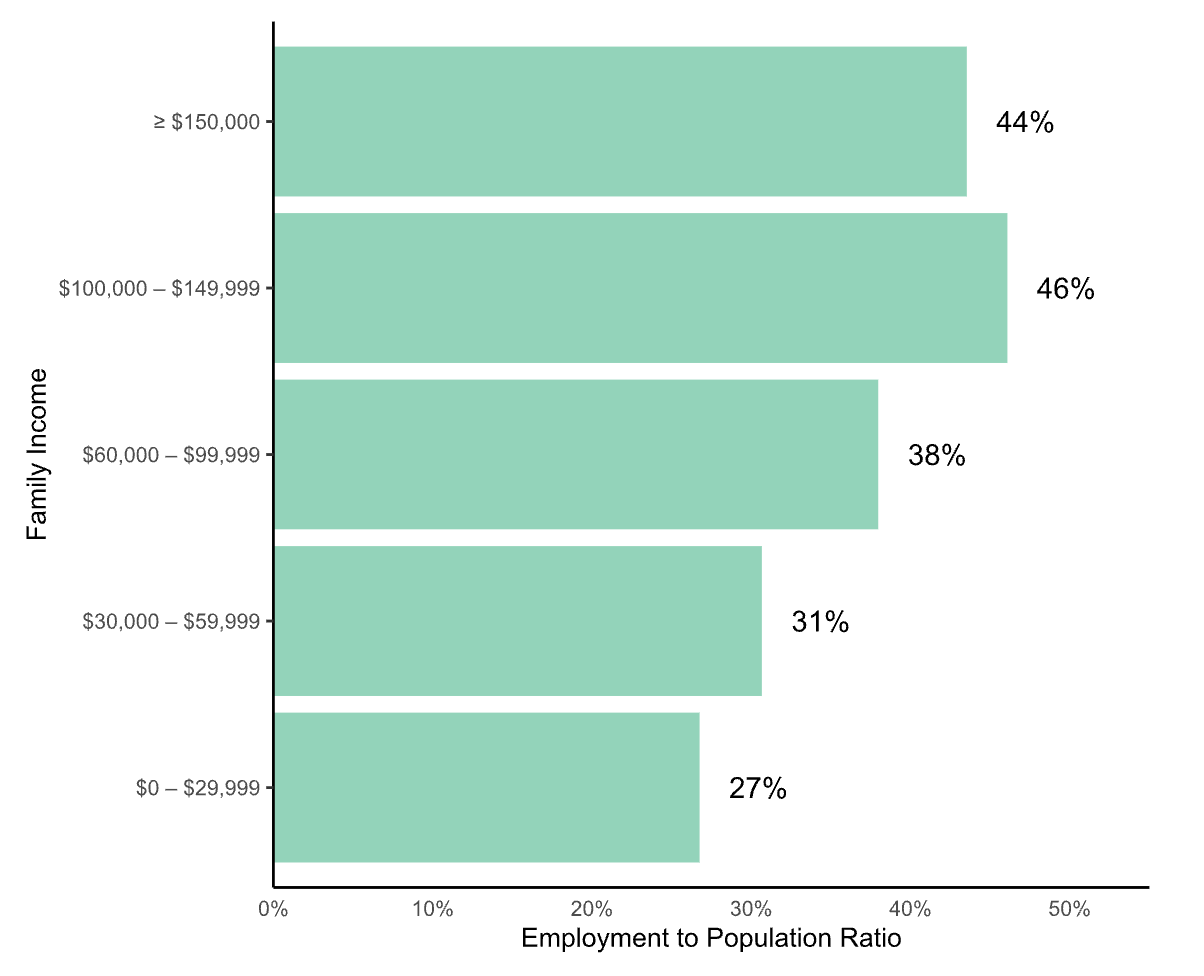
But we need a lot more of that. Especially since, counterintuitively, America’s most affluent kids are more likely to work during the summer. (See figure 1.) A 2024 Labor Department study found that:

The likelihood of a young person being employed during the summer months is strongly associated with their family’s income. A young person from a family with a higher income is more likely to be employed during the summer months than a young person from a family earning less. For example, nearly half (46 percent) of youth from families earning between $100,000 and $149,999 per year were employed, whereas about only a quarter of young people (27 percent) from families earning less than $30,000 had summer employment.

Figure 1. Percent of youth employed by family income, June to August 2023

1

Source: U.S. Department of Labor and its analysis of CPS Basic Monthly Samples (June–August 2023) accessed via IPUMS.

Kids growing up in high poverty neighborhoods without many nearby workplaces, plus fierce competition for the limited jobs available, have a much tougher time finding work. That’s why some cities have created summer jobs programs to overcome these challenges—programs that show real educational benefits for participants.

But schools and municipalities could do so much more. One possibility is to let teenagers work during part of the school day—say, every morning or afternoon—“for credit.” Even a so-called “low-skill” job builds a track record, confidence, and some valuable skills. Combine that with mentorship and academic courses and we might have junior- and senior-year experiences that are much more engaging, relevant, and fruitful than the ones that many kids sleep walk-through now.

In the meantime, educators in schools nationwide, and especially CTE programs, should ask themselves a simple question: Could we be doing more to help our students find summer work?

Policy Priority:
High Expectations
Topics:
Career & Technical Education
Curriculum & Instruction
Governance
Teachers & School Leaders
Meredith Coffey, Ph.D.
7.31.2025
Broken pencil
Getty Images/BrianAJackson
Listen to this article
Loading the Elevenlabs Text to Speech AudioNative Player...

Since ChatGPT exploded onto the scene in November 2022, educators have grappled with how and whether to engage AI for student writing. States, districts, and universities have scrambled to develop AI policies. Anecdotally, I’ve heard from teachers who ban it completely—their students must now write all major assignments by hand, in class—and others who believe that any limits are futile, and therefore they place none at all. Most, of course, fall somewhere in between.

These are tough questions, and doubly so because students haven’t been writing enough since well before the advent of ChatGPT. In a 2022 survey, only 4 percent of English language arts (ELA) teachers reported that their students in grades 3–12 met the expert recommendation of sixty daily writing minutes. Only 31 percent reported their students reaching even half that goal. The findings are consistent with a 2016 survey that found that third and fourth graders spent an average of twenty-five minutes a day writing, as well as national data from 2011, which revealed that only 25 percent of middle schoolers and 31 percent of high schoolers wrote for thirty minutes or more daily.

Trends in assessments and expectations seem to bear out a deemphasis on students’ writing. High school end-of-course exams have reduced writing requirements. As of 2022, for example, Virginia students can substitute the simplistic, low-bar ACT WorkKeys Business Writing test for the state’s longstanding Standards of Learning writing exam. The SAT recently dropped its essay portion (and, long ago, the separate writing test that the essay portion had replaced). Most alarmingly, it’s apparently now acceptable for an English professor to declare that AI can do the work of “learning to write” for students.

We can cite everything from No Child Left Behind to the advent of ChatGPT as a reason for insufficient writing time. But regardless of the catalyst, what’s important is that students at all levels keep writing. Here’s why.

First, learning to write helps students learn to read. And goodness knows students need help with reading. Handwriting letters and words can boost very young readers’ understanding of letter-sound relationships and advance their automaticity in reading words. Later, writing helps with understanding sentence and text structure. If you put sentences or paragraphs together yourself, that builds your understanding of how others are constructing their own sentences and texts. Eventually, the same goes for more sophisticated choices in reading and writing, like style and genre.

Writing also boosts students’ content knowledge and cognitive development. Especially when writing by hand, students are more likely to retain the information they’re writing about—and that’s true across subjects. What’s more, a recent study shows that it’s specifically important for students to write without AI. Not only were students who used AI to craft their essays unable to remember much of what they had written, but also, compared to peers who didn’t use AI, their brain scans revealed less neural activity when it came to creativity, integrating information, and self-monitoring. That aligns with yet more research demonstrating that writing improves analysis and inference skills. We already know that relying on Google Maps is rotting our spatial memories. Relying on AI for writing may well inhibit the development of children’s and adolescents’ brains.

What’s more, a lack of classroom attention to writing tends may create extra harm to the most vulnerable students. Struggling writers—especially those with learning disabilities—need more time for writing practice, and students with initially weaker skills show more gains from writing interventions than their more skilled peers. Explicit instruction around writing strategies benefits all students, but particularly students with disabilities and English learners.

So what can educators and policymakers do?

First, keep students writing, from short tasks (e.g., sentence mechanics practice and concise summaries) to long-form writing (e.g., persuasive essays and personal narratives). They should be writing not only in ELA, but also in social studies, science, art, and music, to improve their writing skills while enhancing their knowledge and reasoning in those subject areas. Writing practice need not come at the expense of content instruction. Writing summaries of or responses to new content, for example, can accomplish both simultaneously. Especially in our age of AI, this may mean more in-class writing and more pen and paper. So be it!

No less crucial, however, is the need to improve teacher training on how to teach writing. There’s ample evidence that teacher preparation programs spend little time on writing pedagogy, and as a result, many educators don’t feel confident in their abilities to teach writing, with teachers in low-income schools feeling even less prepared in this realm than their peers in high-income settings.

I’m not arguing that anyone can or should keep AI out of schools. Not only is it now a fact of life, but it can also offer great tools for differentiating instruction, expediting lesson planning, and even polishing writing. In fact, the same study that found that using AI to write an essay was bad for brain activity also found that using AI after writing an essay actually increased brain activity. We have a lot left to learn, especially with such rapid technological advancement. But what we do know is that we can’t afford to give up on teaching students to write. And that means that we don’t surrender writing instruction to our AI overlords.

Policy Priority:
High Expectations
Topics:
Curriculum & Instruction
Teachers & School Leaders
Jeff Murray
7.31.2025
Parent walking with child to school
Getty Images/Roberto Jimenez
Listen to this article
Loading the Elevenlabs Text to Speech AudioNative Player...

For more than twenty-five years, Florida has been ground zero for school choice expansion. Among the many options for families are charter schools, private schools, tax-credit programs, microschools, ESAs, vouchers for students with special needs, homeschooling, and more. This diverse landscape makes the Sunshine State a perfect laboratory for analyzing what works—and what doesn’t—in the realm of school choice. A new report looks at a thorny issue specific to vouchers: why tens of thousands of Florida families who applied for and received private school scholarships ended up not using them.

In 2023, Governor Ron DeSantis removed the previous income-based eligibility limits on the Florida Tax Credit Scholarship and the Family Empowerment Scholarship for Educational Options, making both private-school tuition-support programs available to every K–12 student in the state. Caps on the number of available scholarships were also eliminated. This resulted in a surge of applications, awardees, and users—to the tune of a 70 percent increase in usage in two years. That usage would have been even higher, but 41,000 families that applied for and were awarded scholarships for their children from these two programs did not ultimately use them. Step Up for Students, a Scholarship Funding Organization approved by the Florida Department of Education to administer the various scholarship programs available to residents, wanted to know why. Researchers Ron Matus and Dava Cherry emailed over 32,000 of these families in January and February of 2025. Using reminders and a drawing for ten $100 gift cards as incentives, they eventually received 2,739 completed surveys.

Approximately 40 percent of survey respondents’ children were Hispanic, approximately 31 percent were White, and 23.5 percent were Black. Thus, survey respondents were more likely to be Black and Hispanic, and less likely to be White, than families who received and actually used their scholarships. Survey respondents were also less likely to be in the highest income tier and more likely not to have reported their incomes than the families who used the scholarships. However, 40 percent of respondents who did report incomes were below 185 percent of the Federal Poverty Guidelines. Interestingly, a majority of survey respondents (50.3 percent) reported a bachelor’s degree or above as their highest level of educational attainment, followed by some college but no degree (14.5) and associate-level degrees (14.3). Less than 3 percent of respondents indicated they had an education level below high school graduation. Survey respondents with multiple children indicated using a variety of school types, with zoned or assigned public schools the single largest category (36.9 percent), followed by private schools (25.2) and charter schools (13.3). Fifty-five percent of respondents said they were somewhat satisfied or very satisfied with their child’s school at the time they applied for the scholarship, while 30.2 percent were somewhat dissatisfied or very dissatisfied.

Despite the fact that they ultimately didn’t use their awards, the vast majority of respondents indicated a strong desire for those scholarships, and Black and Hispanic parents were likelier to say the scholarship was very important to them (94.3 percent) than White parents (77.6). Higher income parents, with a similar spread, were more likely to say the scholarship was very important to them than their lower-income counterparts. Specifically, a desire for more individual attention and smaller class sizes was the most-commonly-cited reason for applying for the private school scholarships, with Black parents and low-income parents being the most motivated by this factor.

So why didn’t these relatively well educated and motivated families use the scholarships they applied for? Just over a third of respondents (34.7 percent) said there were no available seats at the private school they wanted, and 19.7 percent said the scholarship amount—both programs provide an average of $8,000 per year—wasn’t enough to cover tuition at their desired school. Another 19.6 percent were specifically concerned about affording additional fees beyond tuition. Just under 10 percent cited lack of transportation to and from school, and 5.8 percent said the school they were interested in was too far away to be practical for them every day, with or without transportation provided.

A third of parents (36.5 percent) who didn’t use their scholarships ended up switching school types anyway (such as moving from a traditional district school to a charter). Destinations included brick-and-mortar charters, virtual schools, and open-enrollment district schools. And those who moved were twice as likely to express satisfaction (20.4 percent) with their new school than to express dissatisfaction (10.5), regardless of destination. Two-thirds of respondents said they’d apply for the scholarships again, including 63 percent of those who switched school types and 55.5 percent of those who were satisfied after doing so.

Overall, two things seem to be going on. First, universal eligibility with no caps incited a sort of widespread “speculation” among families looking for a different choice, and many applied without a concrete plan as to how their scholarships could or would be used. Since Florida does not require scholarships to be used once awarded, families were free to choose other options that they determined were a better fit without any sort of penalty.

Second, the longstanding barriers to voucher usage that have been commonly associated with choice programs in various states—lack of open seats, finding reliable transportation, and affording out-of-pocket expenses—are still present in Florida, and universal eligibility does not alleviate them. The only element that has changed in Florida is that folks who would normally be deterred from applying by these roadblocks are emboldened by open eligibility and no enrollment caps to try their luck anyway. Eligibility for future years is not impacted by failing to use an award, but families do have to apply again in future years, which 66.7 percent of survey respondents indicated they would do. Thus, while many families were able to capitalize on the new, unlimited eligibility model, that model was still not robust enough for tens of thousands of other families still dissuaded by the same old troubles voucher families have faced since their inception.

SOURCE: Ron Matus and Dava Cherry, “Going with Plan B: Why thousands of Florida parents didn’t use their school choice scholarships,” Step Up for Students (July 2025).

Policy Priority:
Quality Choices
Topics:
Evidence-Based Learning
Private School Choice
Jeff Murray
7.30.2025
Gadfly Bites logo
Listen to this article
Loading the Elevenlabs Text to Speech AudioNative Player...

News stories featured in Gadfly Bites may require a paid subscription to read in full. Just sayin’.

  1. Following on from Monday’s theme, here’s a few more items from the “what the heck are the adults that run schools thinking?!” file. There’s no details given on how much the switch to individually-packaged fruits and veggies in new Earth-friendly wrappings will cost the schools who have to buy them because all other options have been discontinued, but all I could think of when reading about the school lunch purveyor patting themselves on the back about making the no-doubt costly switch was: I’m pretty sure cucumbers and kiwis and jicama already come in their own biodegradable packaging; no extra charge. (Columbus Dispatch, 7/29/25)

  2. Despite the facts that the district is under state fiscal oversight, is operating with an interim superintendent and a “fill in” treasurer, and that only three board members were in attendance to vote, cash-strapped Trimble Local Schools took the first step toward putting a 1 percent earned income tax levy on the November ballot during a meeting last week. (WOUB-FM, Athens, 7/28/25) In this coverage of the same meeting, the only two “witnesses” quoted directly—both in favor of the income tax vs. a property tax—are the wife of an elected board member (who voted for the income tax, unsurprisingly) and a consultant who is working with the district to try and eliminate its giant deficit (who of course couldn’t officially vote for the income tax but sounds like he would have if he could have, also unsurprisingly). We do hear that one unnamed and unquoted citizen spoke up to suggest that district administrators should be held responsible for the errors that allowed the massive debt to occur, and that the interim supe responded to insist that it’s more important to look forward than to look back. “We’ll let the [fiscal emergency] commission handle what has happened in the past,” he said, out loud and on the record. “But we as a community have to focus on where we’re at now and how we’re going to move forward.” Charming. (Athens Independent, 7/24/25)

  3. Big Walnut Local Schools announced this week it would eliminate all student instructional and extracurricular fees beginning this fall, saying that it wants to provide “fiscal relief” to hard-pressed district families. It’s not every fee, superintendent Ryan McLane stresses with some sadness, but many of the most common ones, including band, choir, athletics, and other extracurricular activities. He credits his treasurer’s “careful planning” and good district stewardship for being able to provide this relief. However, McLane also says (out loud and on the record) that “Academics are our top priority, but for our kids, it’s not the driving motivation that gets them excited about coming in the doors every day.” It’s Chess Club, isn’t it, boss? (NBC4 News, Columbus, 7/29/25)

  4. By way of contrast, here’s a nice look at a new all-boys private school that will open in Akron on August 21. Dreams Academy will serve boys in grades K-2 and will (of course) accept students using EdChoice Scholarships. The school is run by longtime Akron residents active in the community and will have a strong religious foundation along with academic rigor intended to help boost the skills and confidence of young Black boys who, school leaders say, are too often left to fall through the cracks in other schools. “Our boys are failing and dying at a rapid rate, and our children, even in kindergarten, are being diagnosed with anxiety,” said founding principal Monique Swain. “And so my desire and my goal for these boys is to find ways to speak to their hearts and to keep encouraging them that they are leaders and that they are wonderfully made. I want them to find ways as early as kindergarten to help them find their purpose.” Phew. This sounds pretty good to me, and maybe this clip belongs in a different, and better, file than the others. (Cleveland.com, 7/29/25)

Did you know you can have every edition of Gadfly Bites sent directly to your Inbox? Subscribe by clicking here.

Policy Priority:
School Funding
Topics:
Governance
Jessica Poiner
7.29.2025
Checking in on early literacy blog image
Getty Images/Robert Daly
Listen to this article
Loading the Elevenlabs Text to Speech AudioNative Player...

It’s been two years since Ohio policymakers, led by Governor DeWine, enacted sweeping early literacy reforms aligned to the science of reading, an evidence-based instructional approach that research has proven is an effective way to teach children how to read. Key elements of the statewide initiative include high-quality curriculum, teacher professional development, and stricter standards for teacher preparation programs, as well as roughly $170 million in state funds.

How are things going? We don’t yet have test score data (that will come this fall), but a report given by Department of Education and Workforce (DEW) officials at a recent public meeting provides reasons for optimism. Let’s take a closer look at progress on the three key elements.

1. High-quality instructional materials

Ohio’s reading initiative requires public schools (both district and charter) to adopt and use high-quality instructional materials (HQIM) that are approved by the state based on their alignment to the science of reading. This was a smart move by lawmakers, as research demonstrates that HQIM can improve student learning and achievement. But it’s also the heaviest implementation lift. According to a statewide survey, just one-third of Ohio districts were using core ELA curricula that met the state’s newly established standards during the 2022–23 school year.

Reading programs can be expensive, which is why lawmakers set aside $64 million to help districts purchase new materials. DEW wisely allocated most of those funds to schools needing to make the most significant changes. Districts that reported using non-aligned curricula received an average of $121 per PK–5 student, while those that reported partial alignment received $101. As of June 15, more than three-quarters of Ohio districts and schools—732 in total, or 82 percent—report using state-approved HQIM. Unfortunately, 10 percent (eighty-seven districts and schools) admit to being just partially aligned, and another 8 percent (seventy-three districts and schools) are not aligned. Those districts will need to make changes prior to the start of the new school year to be in compliance with state law.

2. Professional development for educators

When it comes to improving student achievement, studies show that teachers matter more than any other element of schooling. It was a no-brainer, then, for lawmakers to invest in professional development for teachers working in Ohio public schools. They followed a two-pronged approach.

First, they required all current educators (that includes teachers and administrators) to complete a professional development course in the science of reading by June 30, 2025. DEW partnered with Keys to Literacy, an NCTQ recommended professional development provider, to provide the course, and offered multiple options based on an educator’s role, grade band, and previously completed training. Stipends were available for those who completed the course. As of July 1, more than 144,000 completion certificates had been issued.

Second, lawmakers sought to provide additional support to struggling schools via state-funded literacy coaches. A 2024 report noted that a total of thirty-three coaches provided over 5,600 coaching sessions, nearly half of which were one-on-one individualized support for teachers, in fifty-four schools. By 2025, eighty-four reading coaches were providing support to educators in 125 schools. More than 33,000 coaching sessions were conducted, with almost 60 percent (nearly 20,000) identified as one-on-one individualized support. During the recent public meeting, DEW noted that the number of sessions and time spent on coaching activities were “positively associated with increases in student achievement scores over time.”

But that’s not all. Recognizing the importance of ongoing professional development, lawmakers used the recently passed House Bill 96 to build on these efforts. Not only did they maintain funding for literacy coaches to the tune of $12 million a year, DEW will also be required to maintain its introductory science of reading course and develop a new competency-based course that licensed educators must complete every five years. Together, these efforts should ensure that Ohio teachers and administrators continue to receive the training and support they need to boost students’ literacy skills.

3. Audits of teacher preparation programs

If Ohio wants to boost literacy outcomes, it’s important to ensure that the next generation of educators has been properly trained before they enter the classroom. Unfortunately, a 2023 report analyzing the course materials of twenty-six Ohio undergraduate and graduate preparation programs[1] found uneven training efforts in elementary reading. Seven programs earned “A” ratings while another six received an “F.” The state’s largest preparation programs (including Ohio State and Ohio University) received mixed reviews.

To address this issue, lawmakers enacted provisions that require the state to exercise more significant oversight over teacher preparation programs. More specifically, the Ohio Department of Higher Education (ODHE) was charged with auditing programs to ensure that teacher candidates are well-trained in the science of reading. ODHE has already published its metrics and contracted with The Meadows Center to conduct the initial round of audits, which began this spring. This fall, the department will release final reports for each of the roughly fifty programs that were assessed along with an overall statewide analysis. Programs found to be out of alignment with the state’s science of reading expectations will have one year to address identified issues. If they fail to do so, the chancellor will revoke their approval. Going forward, programs will be reviewed every four years. 

***

Ohio’s bold early literacy reforms have the potential to vastly improve reading achievement, which could have a profound impact on short- and long-term outcomes for kids. To realize that potential, though, rigorous implementation is crucial. There’s still a long way to go before we can celebrate a job well done. But the implementation progress that’s been made in the three areas outlined above should hearten families and advocates.


[1] Together, these programs prepared 1,700 elementary teacher candidates during the study period, representing over 75 percent of total program completers at the time.

Policy Priority:
Standards & Accountability
Topics:
Curriculum & Instruction

Pagination

  • First page « First
  • Previous page ‹ Previous
  • Page 93
  • Page 94
  • Page 95
  • Page 96
  • Current page 97
  • Page 98
  • Page 99
  • Page 100
  • Page 101
  • Next page Next ›
  • Last page Last »
Fordham Logo

© 2026 The Thomas B. Fordham Institute
Privacy Policy
Usage Agreement

National

P.O. Box 110
Burke, VA 22009

202.223.5452

[email protected]

Ohio

P.O. Box 82291
Columbus, OH 43202

614.223.1580

[email protected]

Sponsorship

130 West Second Street, Suite 410
Dayton, Ohio 45402

937.227.3368

[email protected]