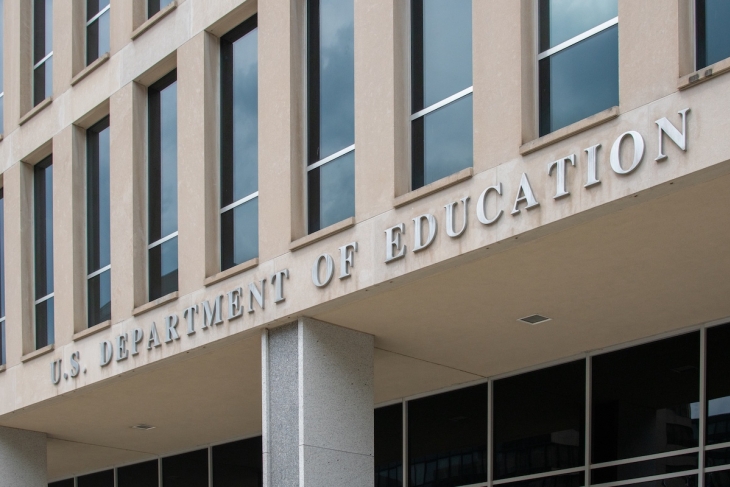
My colleague and friend, Amber Northern, Fordham’s longtime research chief, joined the U.S. Department of Education this week as a “senior advisor to the Secretary with a focus on reforming the Institute of Education Sciences (IES).” She’s on leave from Fordham for six months while serving in this capacity—and we already miss her.
Reforming IES—just designing a reformed IES—is an immense challenge but also a great opportunity to renew and revitalize what I contend is the single most important part of the Department and single most fundamental and essential part of the federal role in education.[1]
First, a bit of history. IES’s antecedents go back to the 1860’s when Congress created what was (briefly) called a “Department of Education” and charged it with
collecting such statistics and facts as shall show the condition and progress of education in the several States and Territories, and of diffusing such information respecting the organization and management of schools and school systems and methods of teaching as shall aid the people of the United States in the establishment and maintenance of efficient school systems, and otherwise promote the cause of education throughout the country.
“Statistics and facts”! “Condition and progress”! “Diffusing such information”! “Establishment and maintenance of efficient school systems”! A grand, ambitious mandate that I construe as the charter of the National Center for Education Statistics (NCES), which is—or should be—the beating heart of IES and of the federal role itself, and which Bill Bennett and I did our best to revitalize when we had something to say about it back in the late 1980’s.
But controversy surrounded this work from the very start, often due to concerns about the size, scope, and intrusiveness of the federal government’s involvement in an activity that the Tenth Amendment left to the states. (As is well known, education is nowhere mentioned in the U.S. Constitution, though Jefferson wanted it to be.) Congressional nervousness about the risk of federal control led—within a year—to the new “department” being downgraded to a “bureau of education” and placed within the Interior Department, there to be headed by a “commissioner,” which remained the title of the top federal education official until the modern department was born in the waning years of the Carter Administration.[2]
By the time I joined the Department in 1985, multiple reorganizations had produced the “Office of Educational Research and Improvement” (OERI), in which NCES was one of five units, with the other four responsible for research, “improvement of practice,” dissemination, and the government’s various programs of assistance to public libraries. But innumerable reviews—including a major one by the National Academy of Sciences—found weaknesses in this structure and in due course it was reborn by Congress in 2002 as the Institute of Education Sciences (IES). Despite multiple efforts by both the Senate and House to reauthorize and revise the Education Sciences Reform Act (ESRA), no bill has made it through all the hurdles, meaning that “current law” for IES is now twenty-three years old.
The IES era
Over that period, much progress was made in strengthening the Department’s work in education research and evaluation, less in statistics and assessment. IES’s first director, Russ Whitehurst, almost singlehandedly pushed a level of rigor and objectivity into what had often been (and in non-government realms often still is) shoddy and impressionistic “studies.” IES also ramped up fellowships and such to train more ed-scholars in rigorous methodologies. But the improvements didn’t stop there; many products are timelier and dissemination methods are more modern. If the “What Works Clearinghouse” has been a bit of a disappointment, most of the “Practice Guides” it has produced are terrific. The National Assessment of Educational Progress has also widened its aperture (if not as much as I would like) and improved some procedures, including getting out timely data on reading and math scores at the state and national levels, per a separate mandate enacted as part of No Child Left Behind.
Yet weaknesses also surfaced and persisted, criticisms were leveled from many directions, and calls for reforming and redirecting IES multiplied, including a number of thoughtful critiques and proposals from former director Mark Schneider, who has been candid that the needed changes surpassed what he was able to do in six years.
But that was then, back when the government as we knew it was still trying, much of the time, to follow its long-term practice of periodically revisiting and updating its programs, agencies and activities. Back then, it made sense to reflect and recommend an IES overhaul, presumably joined with the overdue reauthorization of ESRA and perhaps including the much-touted idea of an “education DARPA.”
That now feels like a century ago. The Trump team’s desire to abolish the Department and shrink the federal role in just about everything (except maybe defense) led to DOGE’s assault on ED and particularly on IES, starting soon after Inauguration Day. It was, in fact, among DOGE’s first targets—and their aim was awful.
IES accounts for barely one percent of ED’s discretionary budget, meaning that DOGE’s marksmen missed far larger and juicier prey. For reasons not clear to anyone, they went first for the statistics operation, including much of the infrastructure of NAEP—both people and contracts—as well as sundry R&D grants and contracts, many of which were in the midst of their work or even nearing the end. By the time DOGE finished with IES, nearly 90 percent of the staff was gone and innumerable contracts were abrogated, paused, or perhaps left for recompetition.
The slashers subsequently reached much deeper into the Education Department, reducing the staff to about half of the previous 4100 employees at this smallest of Cabinet agencies when Trump was sworn in.[3] Little of this seemed to square with Secretary Linda McMahon’s commitment during her confirmation hearing to faithfully expend whatever monies were appropriated by Congress.
Even Schneider, a sage and veteran advocate for major changes in IES, was alarmed by the threats these cuts pose to the most basic activities of IES, while also viewing the destruction as opening the way to a far more thorough reconstruction than he had the scope to undertake when he was in charge.
IES reborn?
Developing a design for that reconstruction is now Amber’s assignment. Announcing her new role, the Department bluntly depicted its view of the problem she is supposed to tackle:
IES has failed to provide a clear and compelling research agenda that puts students at the center. Its research contracts often prioritized politically charged topics and entrenched interests over classroom best practices and tools, even while American students experienced historic levels of learning loss following the COVID-19 pandemic.
Nobody thinks she can do this alone—and the ED press statement goes on to say that she’ll tackle this challenge in league with those who remain at IES as well as “external experts and stakeholders.”
Ideas abound, from turning the entire thing over to a sort of state consortium to farming out sundry IES functions to other federal agencies—research to NSF, data to Census, etc.—to various versions of ESRA overhauls that never quite made it through the legislative process. Schneider also continues to suggest specific changes, ranging from overdue upgrades in technology (including AI) to a wholesale overhaul of the Department’s procurement operation, which now makes it nearly impossible to alter the many contracts with outside organizations that actually conduct most of IES’s work. (A particular bugaboo is a quasi-oligopoly of contractors calling themselves the NAEP Alliance that hikes the cost of NAEP, freezes antiquated practices into each successive round of contracts, and fends off potential competition.)
Plenty more challenges loom. Pending a congressional overhaul of ESRA, current law prescribes much of IES’s structure, how top staff are appointed, the existence of a presidentially-chosen policy board (that has seldom met), and many functions and activities. (One hopes that a comprehensive new plan includes a legislative strategy.)
Lobbyists and hungry interest groups also abound, associations and contractors—many of them large and well-connected—that want any plan for IES to ensure that their priorities are retained and their federal funds continue to flow. Good-government groups press to ensure the independence and integrity of the statistics unit. Visionaries—such as the Alliance for Learning Innovation—have far-reaching ideas about breakthroughs in education research. The American Educational Research Association (AERA) watches everything related to IES with hawk eyes, determined to secure the interests of its thousands of members. And on and on.
The opportunity is surely at hand to reconceptualize and revitalize this core function of the federal government in education—but whatever Amber and company develop will face huge difficulty getting from “report on shelf” to actual implementation. How solid is Secretary McMahon’s backing—and that of an administration that wants to get rid of the entire department? What about OMB budget slashers now taking over from DOGE? Is Congress capable of bringing an ESRA reauthorization across the finish line—is it capable of bringing anything across the finish line? And what would that look like after the lobbyists work their will? This isn’t the sort of thing that gets accomplished through single-party “reconciliation” methods. It actually requires a semblance of agreement across the usual dividing lines at a time when that happens less and less—and it’s hard to see education research as a top priority on Capitol Hill in the next couple of years.
In the near term, will Dr. Northern have the staff support and high-level cooperation that she’ll need both within the diminished remains of IES and in the upper reaches of ED? Any worthwhile overhaul of IES will reverberate across the entire department.
Big picture, is it truly possible to have constructive growth, much less rebirth, in an era of destruction? (As I write, OMB has proposed a $12 billion reduction in the ED budget—and an IES budget just one-third of the current appropriation.) And can it happen without the exceedingly rare combination of high-level commitment, external support and legitimacy, and congressional engagement?
I wish Amber well. It’s a mighty tall order, but she's determined. That's good because the stakes are huge, too.
[1] Properly protecting civil rights is an important newer function.
[2] Education—which had its name changed from “Bureau” to “Office” in 1929—lingered in the Interior Department until 1939, when FDR moved it to the new Federal Security Agency, where it remained until Eisenhower created the Department of Health, Education, and Welfare in 1953.
[3] Lawsuits are in the works regarding many of these cuts—as well as the White House quest to “dismantle” the Department itself, so the final outcome is far from clear.