Mobile Navigation

  • National
    • Policy
      • High Expectations
      • Quality Choices
      • Personalized Pathways
    • Research
    • Commentary
      • Gadfly Newsletter
      • Flypaper Blog
    • Events
    • Scholars Program
  • Ohio
    • Policy
      • Priorities
      • Media & Testimony
    • Research
    • Commentary
      • Ohio Education Gadfly Biweekly
      • Ohio Gadfly Daily
  • Charter Authorizing
    • Application
    • Sponsored Schools
    • Resources
  • About
    • Mission
    • Board
    • Staff
    • Career
Home
Home
Advancing Educational Excellence

Main Navigation

  • National
  • Ohio
  • Charter Authorizing
  • About

Jeff Murray
7.23.2025
Gadfly Bites logo
Listen to this article
Loading the Elevenlabs Text to Speech AudioNative Player...

News stories featured in Gadfly Bites may require a paid subscription to read in full. Just sayin’.

  1. Only one story to talk about today. But as often happens around here, it’s important enough to look at in a bit of depth. A press conference was held earlier this week in regard to the future of the EdChoice Scholarship Program. Speakers included Ohio House Speaker Matt Huffman, state Rep. Jamie Callender, and Ohio Attorney General Dave Yost. There was even a parent there who depends on EdChoice to help access her children’s education, ready to discuss her own very important perspective on the issue. The point of the presser was to reassure all the EdChoice moms and dads across the state that the program will continue uninterrupted for the upcoming school year, despite the recent, well-publicized ruling by Franklin County Judge Jaiza Page (Columbus School for Girls, Class of 2002 – Go Unicorns!). In case you didn’t know, school starts as early as August 11 in some areas of the state—less than three weeks from now—which explains why making such a statement clearly, emphatically, and on the record was so important. So shame on the Statehouse News Bureau (and far too many other media outlets like them) for focusing instead on the very-much-not-news point that the state is imminently going to appeal Judge Unicorn’s ruling (um…surprise?) to the exclusion of everything else that was said, and which was actually important news. (Statehouse News Bureau, 7/21/25)

  2. Kudos, however, to Spectrum News for covering it the only proper way, including the primary quote of note—“EdChoice is the law of the land for the coming school year”—from AG Yost. (Spectrum News, 7/22/25)

  3. Dayton Daily News gets mixed reviews from me for their coverage: Foregrounding Yost and the smooth continued operation of EdChoice for the rapidly-impending school year, but also seeking out, getting comment from, and then giving way too much ground to the voucher grouchers and their tedious legal hot air. Which should probably be saved for the appeals court where they’re going to need it. (Dayton Daily News, 7/22/25)

  4. Ditto for ABC 6 News here in Columbus, who sticks with the appeal headline and framing per Central Office, but is also the only outlet I’ve seen so far to actually quote Ms. Williams about how important the EdChoice program has been to her children’s education. Thank heavens for that at least. (ABC 6 News, Columbus, 7/22/25)

Did you know you can have every edition of Gadfly Bites sent directly to your Inbox? Subscribe by clicking here.

Policy Priority:
School Choice
Topics:
Private School Choice
Jessica Poiner
7.22.2025
Teacher merit pay Dallas DC blog image
Getty Images/Ridofranz
Listen to this article
Loading the Elevenlabs Text to Speech AudioNative Player...

In June, The Washington Post published an op-ed arguing that if schools evaluated and paid teachers based on student outcomes they would achieve better results. As proof of what’s possible, the authors—scholars Eric Hanushek and Margaret Raymond of the Hoover Institution—cited teacher pay initiatives in two cities: Washington, D.C., and Dallas.

For Ohioans, these reform efforts are likely unknown. But there’s a lot to learn from their experiences that could help inform a successful merit-pay strategy in the Buckeye State.

First, some background. Officials at the District of Columbia Public Schools (DCPS) began linking teacher performance to pay and retention during the 2009–10 school year. Under this system, known as IMPACT, teachers who were rated “ineffective” were dismissed and those rated “minimally effective” were given one year to improve. Higher-performing teachers were eligible for a bonus of up to $25,000 each year they earned a rating of “highly effective.” According to an analysis[1] published in Education Next, DCPS dismissed the majority of very low-performing teachers during the early years of IMPACT, while other low performers were 50 percent more likely to voluntarily leave. Those who stayed got better, likely responding to the large financial incentive. “Improved teaching was common,” the analysis finds, and “student achievement increased as a result.”

A few years later, the Dallas Independent School District (ISD) replaced traditional salary schedules with a pay system tied to evaluations. Teachers’ compensation was based on their evaluation score averaged over two years, though salaries were only adjusted downward if teachers scored at a lower level for three consecutive years. Performance-based salaries during the first year ranged from $45,000 to $90,000. A separate Education Next analysis, co-authored by Hanushek, found that in the four years (2015–2019) after Dallas ISD adopted its new performance-based system, student performance on standardized tests improved while scores in similar Texas schools stayed flat. Like D.C., teacher turnover during implementation was concentrated among lower-rated teachers.

For Ohio policymakers, who are considering if and how to implement teacher merit pay in the Buckeye State, three lessons stand out.

1. Implementing effective performance pay initiatives requires radical change, which in turn requires political courage.

In their op-ed, Hanushek and Raymond observe that, despite positive outcomes for students in both districts, “performance-related reforms have not caught on in the rest of the nation’s schools.” That’s disappointing but not surprising, given the considerable controversy, pushback, and political fallout that comes with such sweeping reforms.

Washington, D.C., and Dallas are instructive examples. In the nation’s capital, the chancellor who oversaw the launch of IMPACT, Michelle Rhee, caused plenty of waves. She eventually resigned after the mayor who appointed her, Adrian Fenty, failed to win reelection, in part because of what was happening in DCPS. There were also plenty of clashes in Dallas, some of which began even before bold changes were implemented. According to Education Next, the teacher turnover rate “rose sharply” in Dallas when performance pay reforms were “highly publicized but still in the development stage.” This produced “major shifts” in the workforce, as the share of novice teachers with no prior experience quadrupled within three years.

For Ohio, there are two lessons to be learned. First, if state leaders want to use performance pay to boost student outcomes, then tinkering on the edges of teacher evaluation and rigid salary schedules isn’t going to cut it. Radical change will be required. Second, enacting radical change is controversial and will lead to considerable pushback and political fallout. (Just ask former Governor John Kasich, who also tried to implement merit pay, along with a host of other collective bargaining changes.) If Ohio leaders are prepared to stand their ground and spend significant political capital on the issue, then they could embrace teacher performance pay as an evidence-based way to boost student outcomes. But if they’re going to repeat their unfortunate history of backing down from evidence-based reforms when the going gets tough, they should probably sit this one out.

2. Locally-driven efforts are more likely to be successful than those managed by the state.

As is the case for many states, Ohio’s history with top-down teacher policy reform isn’t a pretty one. In 2011, lawmakers introduced a statewide initiative aimed at supporting novice teachers with a residency model like those used in the medical field. After lots of pushback and making significant revisions to the program in 2015, 2017, 2018, 2021, and 2023, Ohio is now right back where it started—requiring very little support for new teachers. State-managed teacher evaluations experienced a similar rollercoaster, with lawmakers responding to persistent pushback by making almost constant tweaks until finally passing legislation last year that allows districts to forgo the state’s framework and develop and use their own.

In short, the top-down stuff hasn’t been very successful. But Dallas offers an alternative that Ohio is already poised to emulate. Dallas ISD began its teacher-pay reforms after new state rules enabled districts to develop their own frameworks for rating teacher performance. Texas also uses its Teacher Incentive Allotment to provide schools with “lasting funds for outstanding Texas teachers to remain in the classroom and improve student outcomes.” If Ohio lawmakers eliminate the mandatory step-and-lane salary schedules currently in state law, that would open the door for innovative Ohio districts to do what did Dallas did. Creating a system that incentivizes districts to innovate (rather than forcing it on them) and leaves nuts-and-bolts implementation up to local leaders would help Ohio avoid repeating history.

3. Multiple measures of effectiveness are crucial.

Opponents of performance pay often argue that it’s difficult to measure teacher contributions to student learning, and thus unfair to link student outcomes to teacher pay. In an attempt to make evaluations as fair as possible, many districts have utilized multiple measures of teacher effectiveness to assign ratings that determine pay.

That’s true in both Dallas and D.C. The evaluation system in Dallas included ten classroom observations (some of which were unannounced) each year by the same observer, evidence of student progress toward established learning objectives, test-based measures of achievement growth relative to comparable students, and schoolwide achievement. Dallas ISD also surveyed students in grades 3–12 each spring and incorporated their responses into teacher ratings. Meanwhile, during the first three years of IMPACT, DCPS assigned teachers a rating based on classroom observations, various measures of student learning, a schoolwide value-added measure, and contribution to the school community (as assessed by the principal). Of the five classroom observations conducted for each DCPS teacher, three were conducted by an administrator and two by “master educators” who worked with several schools. Only the first observation was announced in advance.

Research also supports using multiple measures when it comes to performance pay. According to a comprehensive meta-analysis, student test scores improve when pay is not based solely on test scores. To ensure fairness and gain teacher buy-in in Ohio, it will be crucial for districts and schools (under the direction of the state) to include multiple measures in any framework that ties teacher impact to compensation.

***

Performance pay for teachers is the definition of a sticky subject. There is evidence from districts like Dallas and D.C., as well as other places, that it can boost student outcomes. But there’s also a long history of controversy and pushback, not to mention significant questions about how to design and implement programs to ensure they’re fair and effective. It’s too soon to tell how serious Ohio policymakers are about trying (again) to bring teacher merit pay to the Buckeye State. But as they explore their options, they’d be wise to heed the lessons outlined above.


[1] The analysis first appeared in the Fall 2017 issue and is based on data from the first three years of IMPACT (2009–10, 2010–11, and 2011–12).

Policy Priority:
School Funding
Topics:
Teachers & School Leaders
Jeff Murray
7.22.2025
Holding-New-Credentials-Accountable-for-Outcomes SR image
Getty Images/suwadee sangsriruang
Listen to this article
Loading the Elevenlabs Text to Speech AudioNative Player...

Acquisition of workforce credentials—certificates or licenses that are earned over a short time period and which signal mastery of a specific career-relevant skill—has surged in recent years. For example, U.S. Department of Education data show that short-term (one year or less) certificate attainment grew at a rate of 33 percent between 2013 and 2023. By comparison, bachelor’s degree attainment grew at a mere 8 percent over the same time period while associate degree attainment fell by 5 percent. This rapid rise in the pursuit of credentials has led to concerns over an equally rapid rise in low-value or low demand credentials that cost money to earn but don’t produce a measurable economic benefit for earners. A new report from AEI and Burning Glass Institute digs deep to try and identify which types of credentials are beneficial to earners and which are not.

The research team uses data from Burning Glass Institute’s comprehensive labor market database, called Lightcast, which comprises the detailed career histories of over 65 million Americans, and Credential Finder, an exhaustive registry of more than 1.1 million credentials offered by universities, employers, labor unions, nonprofits, and many other entities in the United States. They start by identifying a set of the most-commonly earned credentials—a total of 23,444—then use advanced AI and natural language processing tools to gather detailed information about the education, employment, wages, and demographics of the individuals who earned those credentials. Labor market outcomes for credential earners are compared to a counterfactual cohort of similar workers (matched on gender, race/ethnicity, education level, work experience, and pre-credential occupation) who did not pursue the given credential, so as to isolate the impact of the credential on three outcomes of interest: wage changes, job promotions, and job switches. Additionally, they analyze the more than 2,050 providers from whom these credentials were earned, looking for evidence of differential quality or effectiveness among them.

On the upside, the researchers found that the top 10 percent of credentials examined provide an incremental earnings boost of nearly $5,000 annually just one year out from earning the credential. Nursing credentials seem to provide the biggest returns. On the downside, the average credential earner overall gets only $1,200 more than their non-credential-earning peers. Depending on the cost of the credential program, it could take years for the average earner to break even. This wide span of wage outcomes persists even when narrowed to specific job fields. Meanwhile, very few of the most common credentials led to promotions, with the share of credential earners moving up in their field only 4 points higher than it would have been without the credential. The maximum boost is 15 points, in the project management field (think Six Sigma certification and the like).

Job switching is another strong motivator for pursuing a new credential. The results here are variable, with earners in the bottom decile of credential quality seeing a 3-percentage-point bump in job change success, while the top decile of credential quality see a 20-percentage-point bump compared to job switchers without credentials. Once again, nursing is the area where earning credentials is most likely to lead to successful job changes.

As for provider quality, the researchers find a mixed bag. There seems to be no direct connection between a well-known “brand name” provider and outcomes. One example provided is Stanford University. Their (now-discontinued) Data Science Foundations program was associated with $4,200 in incremental wage gains, while their project management certification failed to boost wages meaningfully for any credential earner. A similar disconnect was found among certain credentials offered by LinkedIn. The findings suggest there’s a complex dynamic at work among providers, specific credentials, credential-earners’ goals, and employers’ mindsets that will require more analysis to understand.

Short-term credentials are more attractive than ever, as they can help learners master workplace skills on a flexible schedule at lower cost than a college degree and potentially lead to higher pay and/or a better job. These benefits explain the rapid rise in attainment. The authors of this report conclude from their analysis, however, that “most credentials fail to deliver” on the promise. They call for “a new mechanism for assuring quality,” eschewing process-based evaluations that are the hallmark of traditional accreditation regimes, and instead focusing on empirical data on the outcomes that earners experience.

SOURCE: Matt Sigelman et al., “Holding New Credentials Accountable for Outcomes: We Need Evidence-Based Funding Models,” AEI and Burning Glass Institute (June 2025).

Policy Priority:
Standards & Accountability
Topics:
Career & Technical Education
Jeff Murray
7.21.2025
Gadfly Bites logo
Listen to this article
Loading the Elevenlabs Text to Speech AudioNative Player...

News stories featured in Gadfly Bites may require a paid subscription to read in full. Just sayin’.

  1. Only two stories to look at today, but both are pretty interesting. First up: Dayton City Schools is changing the way it serves students who have been removed from their homeschools due to “behavioral issues”. The discussion here seems to assume that we all know what this term means and which kids we’re talking about, but there definitely seems some wiggle room within the eligibility criteria because the group includes some who have been formally suspended and some who have not…presumably dependent on the numbers and types of issues they may have experienced or have caused. We also don’t know how many kids may be served here, but we do learn that everyone thus identified last year was on “home instruction”, which cost the district about $210,000 to pay for “home instructors”. This year, students with behavioral issues (suspended or not) will be concentrated in a single district building instead—repurposed from an administrative satellite space—called Jackson Center. Interestingly to me, it does not seem as if this change is mean to be a cost-saver. At least $75,000 of work is needed to bring the building back up to snuff for educating students (and giving them a functional cafeteria) by the start of school in mid-August and at least $72,600 will be spent on School AI, a program to “support student learning and explain complex concepts to students”. So we’re already up to about half the cost of last year’s services for this group of students before we even get to the payroll amount needed for actual humans to staff the place, which we are not told at all. Of course, Dayton doesn’t need to economize on anything, being one of the only big-city districts in the state that is swimming in dough. So obviously the motivation for this change is something other than money. I have a strong suspicion, given district leaders’ most common talking point in recent years, but who knows if they’ll ever ‘fess up to the real reason no matter what it is. (Dayton Daily News, 7/21/25)

  2. Our other interesting piece today concerns the resignation of Trimble Local Schools superintendent John Hurd. My long-standing, long-suffering subscribers (greetings to all 10 of you (fool)hardy souls) will recall that Trimble was ultimately placed in fiscal emergency status by the state of Ohio after many months of begging steadily-worsening fiscal projections—kick-started by mistaken double-spending of a grant award and exacerbated by a revolving door of temporary treasurers who missed the telltale signs of trouble. You will also recall that district leaders were handed a reduction in force plan approved by the teachers union at the start of this mess, which the elected school board refused to accept for no discernable reason. Supe says he resigned in frustration last week over “increasing overreaching involvement” of the board into daily business…and not in a good way. But elected board members don’t seem worried at all. They’ve got an interim in place already—recruited from the local ESC and already touting operations she wants to change to help save money—and are getting ready to place a levy request on the upcoming ballot, but I feel like everyone (still) involved is forgetting something important: the fiscal emergency panel that they were begging for for months is actually in charge of their spending. Nothing will happen without their OK, and they are not mentioned at all in this nearly 1000-word piece. Seems to me like it could be a long summer down there. (Athens Independent, 7/18/25)

Did you know you can have every edition of Gadfly Bites sent directly to your Inbox? Subscribe by clicking here.

Policy Priority:
School Funding
Topics:
Governance
The Education Gadfly
7.20.2025
Fordham Gadfly image
Listen to this article
Loading the Elevenlabs Text to Speech AudioNative Player...
  • Inside Peggy Carr’s final days as commissioner of NCES, plus her thoughts on the agency’s uncertain future. —The Hechinger Report
  • California’s charter school sector continues to grow despite declining public school enrollment and encroaching regulation. —EdSource
The Education Gadfly
7.20.2025
Fordham Gadfly image
Listen to this article
Loading the Elevenlabs Text to Speech AudioNative Player...

Cheers

  • A group of Senate Republicans took a stand against the (potentially illegal) delayed release of nearly $7 billion in federal grants for schools. —Politico

Jeers

  • University leaders are cutting back on liberal arts education, despite strong demand from students. —Jennifer Frey, The New York Times
Aaron Churchill
7.18.2025
EdChoice lawsuit comment blog image
Listen to this article
Loading the Elevenlabs Text to Speech AudioNative Player...

Last month, Franklin County Judge Jaiza Page issued her long-awaited decision on Ohio’s EdChoice Scholarship lawsuit. Brought forward by a group of school districts—government entities with a vested interest in crushing educational choice—the litigation seeks to abolish the program, uproot more than 100,000 private school students, and force them to attend their assigned public schools. Alas, the judge, an elected Democrat and former Columbus City Council member, sided with the educrats and denounced the program as unconstitutional. Given the certainty of appeal, Judge Page stayed her own decision, which allows EdChoice to continue operating until the case works its way through the system.

Her decision reads more like a left-wing harangue bashing private school choice than serious legal analysis. It parrots absurd talking points about how choice will lead to the “downfall” of public schools, blames the scholarship program (rather than dysfunctional bureaucracy) for districts’ inability to educate students, and accepts a factually deficient narrative that districts are “underfunded.” The judge also ignores hard evidence, presented in her court, that EdChoice has improved public education by introducing healthy competition. Last—and perhaps most troublingly—she dismisses the rights and responsibilities of parents in raising their own children, rights that the nation’s highest court has affirmed for 100 years.

Let’s take a closer look at where Judge Page went so wrong.

Disregards parental rights and responsibilities in education

At a basic level, the judge misses the overarching point of EdChoice—that it exists to empower parents to choose a school that best meets the needs of their children. For many Ohio families, their local public school is a great fit. And following the state constitution, the legislature continues to ensure that all Ohio families have a public school option. Yet no single school—whether public or private—can be all things to all people. For some parents, a private school simply fits better, and EdChoice helps ensure that option is financially viable.

But is empowering parents with choice constitutional? The Ohio Constitution contains no prohibition on private schools or programs that support them. Moreover, we have clear case law affirming their legality. A landmark U.S. Supreme Court case in the area of parental rights in education is Pierce v. Society of Sisters (1925), in which the justices unanimously struck down an Oregon law forbidding private education. There, they famously declared that the “the child is not the mere creature of the State; those who nurture him and direct his destiny have the right, coupled with the high duty, to recognize and prepare him for additional obligations.”

Years later, in Zelman v. Simmons-Harris, the Supreme Court upheld the Cleveland Scholarship—the forerunner of EdChoice—and cleared the way for other states to launch private school choice programs. Closer to home, the Ohio Supreme Court also affirmed the constitutionality of the Cleveland program in state litigation (Simmons-Harris v. Goff, 1999). It also upheld the state’s public charter school law, another form of educational choice, in Ohio Congress of Parents and Teachers (2006).

In sum, the judge’s ruling is out of step with decades of legal precedent that honors parental rights and responsibilities in raising their children, including initiatives that support their ability to choose the best school for their child.

Misconstrues the “no aid” clause of the Ohio Constitution

Staying in the legal realm, the plaintiff school districts argue that EdChoice violates a so-called “no aid” clause in the Ohio Constitution: “no religious or other sect, or sects, shall ever have any exclusive right to, or control of, any part of the school funds of this state.” The judge agreed, but there are two significant problems with this interpretation.

  • As Zelman and Goff recognized, private schools are not the direct recipients of public funds, but are an indirect beneficiary only through the choices of parents. As the Institute for Justice explains, “As a matter of law, EdChoice Program scholarships belong to the families and students who receive them.... Only through their choices does a single scholarship dollar flow to a private school, religious or otherwise.” Thus, because parents must make an affirmative choice, private schools do not have an “exclusive right” and are in no way “controlling” the “school funds of this state.”

  • The Ohio Constitution’s “no aid” language likely runs afoul of the U.S. Constitution. In two recent U.S. Supreme Court cases, Espinoza v. Montana (2020) and Carson v. Makin (2022), the Court has invalidated the infamous Blaine Amendments found in many state constitutions and which Ohio’s “no aid” clause closely resembles.[1] These provisions, which have a shameful history in anti-Catholic bigotry, have been invoked to cripple private school programs and/or discriminate against faith-based schools seeking to participate in them. The Supreme Court has rightly declared these discriminatory provisions a violation of the First Amendment’s free exercise clause.

Makes a hash of school funding

In a tale as old as time, plaintiff districts complain that they don’t have enough money—and that EdChoice is to blame for their self-perceived financial woes. Completely ignoring basic school funding data, and demonstrating a lack of understanding of Ohio’s funding system, the judge concurred, declaring that EdChoice results in unconstitutional public school funding.

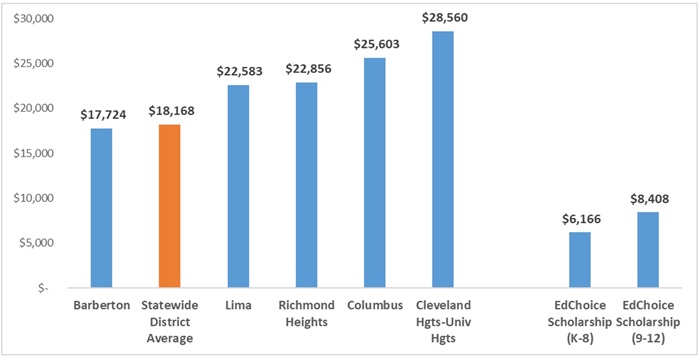
Let us first look at the overall funding levels—not cited anywhere in her opinion—of all named plaintiff school districts. Figure 1 shows the total per-pupil revenue (state, local, federal) received by Barberton, Lima, Richmond Heights, Columbus, and Cleveland Heights-University Heights school districts in FY24—data that are readily accessible on the Ohio Department of Education website. Four of the five districts received more than $20,000 per pupil last year, well above the average district in Ohio and multiples above the current maximum EdChoice scholarship (many recipients receive far less than the maximum amount). Only Barberton—a mixed-income suburban district—received slightly less than the state average, but even its per-pupil funding still far exceeds the scholarship amounts.

Figure 1: Overall revenue per pupil for plaintiff school districts, FY24

EdChoice lawsuit comment blog chart

In Judge Page’s opinion, she wrote this of Cleveland Heights-University Heights:

Inadequate funding has caused CH-UHCSD to lay off or suspend teachers and other staff members resulting in overcrowded classrooms and insufficient support for special education and English as a second language children.

That’s plain nonsense. The district receives an astronomical—by Ohio standards—$28,560 per student, the tenth highest in the state. That’s “inadequate”? Really? If indeed there are “overcrowded classrooms” and “insufficient support” for special-needs students, the fault lies with district administration, not EdChoice.

What does the judge focus on in her discussion of school funding? Rather than looking at the total funding picture—what really matters for educating students—she cites only state funding, which in turn allows her to decry that some districts’ state aid falls below the scholarship amounts.

This analysis is both simple and wrong. Ohio has long had a “hybrid” system whereby the state and local districts share responsibility for funding education. Under state law, districts must levy a minimum 20 mill (2 percent) property tax to help meet basic funding requirements.[2] Recognizing that wealthy districts have more tax capacity, the state rightly sends them less state aid. It’s a “progressive” system. As a result, wealthier districts like Columbus—one of the state’s most prosperous in terms of property values—receives relatively modest state aid ($4,800 per pupil in FY24). Focusing only on state dollars alone—while ignoring local funds, including the state-required millage—betrays either a poor understanding of school funding or (more deviously) an intentional misreading of the policy to arrive at a predetermined decision.

Last note on funding: Judge Page engages in some distasteful revisionist history when it comes to Ohio’s current funding formula. She faults state lawmakers for not fully funding the Cupp-Patterson formula over the past four years. It’s true—due to its exorbitant price tag—the formula has been phased in. But what the judge fails to acknowledge is that the legislative architects of the plan, and the districts and unions that supported it, agreed to the phase-in. But now, in a bizarre twist, she declares EdChoice unconstitutional because of the formula phase-in for public schools.[3]

Ignores the empirical evidence on EdChoice

As a final swing and miss, the judge chose to ignore evidence refuting districts’ claims that EdChoice has done them harm. Consider the research findings, much of which were included in expert testimony and a Fordham report by Professor Stéphane Lavertu of The Ohio State University.

  • EdChoice has had no discernable impact on districts’ per-pupil spending over time. As Dr. Lavertu concluded, “the plaintiffs’ claims of negative trends in inflation-adjusted funding before and after the introduction of the EdChoice program are demonstrably false.”

  • While academic results have not been a central issue in this case, research by Lavertu and other respected scholars have found that EdChoice has led to slight improvements in school district performance. Heighted competition from private schools is the mechanism likely driving those gains in the public school sector.

  • Again, though indirectly relevant to the case at hand, a recent study from the Urban Institute shows that EdChoice has given scholarship students a substantial boost in attending four-year colleges and completing degrees.

The evidence makes clear the negative consequences of following the judge’s opinion. Without EdChoice, Ohio would have a weaker K–12 education system, one in which complacency in the public school sector is acceptable and where Ohio students have diminished opportunities. Is that the “thorough and efficient” education system our constitutional framers sought?

* * *

Amped up by the education establishment and liberal media, private school choice has become one of the left’s favorite scapegoats. But the rhetoric falls far short of the reality. Sadly, Judge Page bought into the political theater while trampling on parents’ rights, court precedent, basic facts about school funding, and evidence showing that EdChoice improves public schools. With any luck, the appellate courts will put a quick end to this sad show. The sooner the better.


[1] A U.S. Commission on Civil Rights report cites thirty-eight states (including Ohio) as having a Blaine Amendment: https://www.usccr.gov/files/pubs/docs/BlaineReport.pdf (p. 53).

[2] Districts can, and many do, tax above that minimum rate with voter approval.

[3] The underlying assumption is that, if EdChoice had not existed, the legislature would have fully funded Cupp-Patterson from the start. But that’s a stretch, as the legislature could have simply used scholarship funds for other purposes (e.g., higher education, roads, parks, Medicaid, etc.). Moreover, the amount spend on scholarships was well below the spending required to fully fund Cupp-Patterson.

Policy Priority:
School Choice
Topics:
Private School Choice
Jeff Murray
7.18.2025
Ohio charter news logo
Listen to this article
Loading the Elevenlabs Text to Speech AudioNative Player...

Stories featured in Ohio Charter News Weekly may require a paid subscription to read in full.

“Fanatical” work rarely results in good work

In the wake of the state budget bill’s prohibition on school districts paying to bus students via public transit if their route requires transferring at a central hub, leaders of Dayton City Schools tell the media that they are “working fanatically” to come up with a new way to offer transportation to high school students for the upcoming school year. Yep. That’s what we’re all afraid of: a plan created on short notice by folks with a manic fixation on “we’ll show them” than on actually solving the “getting kids safely and efficiently to and from school” problem which has eluded them for more than a decade already.

Funding support for early literacy

Gov. DeWine and the Ohio Department of Education and Workforce yesterday announced $46 million in new grants to support continued implementation of the science of reading in public schools across the state. Three charter schools are included among the recipients, including one in Cleveland, which is mentioned in this coverage. In a press release, the governor said the money will fund daily reading instruction, literacy coaches, professional development for teachers and training to help families support literacy at home. Schools are also expected to partner with local organizations, like libraries and colleges, to reinforce learning beyond the classroom. Awesome stuff. You can check out the full list of recipients here.

School choice infrastructure in Ohio’s rural areas

Ohio State University professor and Fordham Institute Senior Research Fellow Stéphane Lavertu published a great piece this week looking at the landscape of school choice in Ohio’s low-income rural areas. Educational options look different outside the city, with more choices than you might think. Professor Lavertu also explains that the way families use those choices is different too. About three percent of children in rural areas attend charter schools, for example, and the vast majority of those attend online schools since brick-and-mortar charters are rare in those parts of the state. Interesting stuff.

Stopping the spin cold

Terry Ryan, CEO of the education nonprofit Bluum and Board Chair of the Idaho Charter School Network, published a commentary this week aimed at stemming the false narrative that the U.S. Supreme Court’s split decision on the St. Isidore Catholic charter school case opened the door for religious charters in Idaho. No idea who was touting such falsehoods in the Gem State, but Terry quotes chapter and verse to clearly spell out their inaccuracy.

Pre-gaming

Most charter schools in California will need to seek renewal in the next three years. In this piece from EdSource, charter advocates express concerns that a surge in complaints about and scrutiny into Golden State charters reflect a strategy by opponents to influence the process early. It seems the idea is for critics to take a handful of legitimate concerns about charter accountability and management and spin them into sector-wide criticisms as well as stringent new legislation that would ultimately serve to disadvantage as many schools as possible come renewal time. We should probably discover whether this troubling supposition is true soon enough.

*****

Did you know you can have every edition of the Ohio Charter News Weekly sent directly to your Inbox? Subscribe by clicking here.

Policy Priority:
School Choice
Topics:
Charter Schools
Jeff Murray
7.18.2025
Gadfly Bites logo
Listen to this article
Loading the Elevenlabs Text to Speech AudioNative Player...

News stories featured in Gadfly Bites may require a paid subscription to read in full. Just sayin’.

  1. Here is some great coverage of Fordham’s latest research report, authored by OSU professor Dr. Jay Plasman and looking in depth at the state of career-and-technical education in Ohio. Huge thanks for the thoughtful summary. In case you missed it, the full report is here. (Daily Advocate, 7/16/25)

  2. A chart from Fordham’s Ohio Education By the Numbers 2025 is reproduced and cited in this analysis from Patrick O’Donnell on the EdChoice voucher court verdict from earlier this month. It nice and all, but, honestly, you’d think we might be quoted somewhere in the text given all we have written about the misbegotten legal effort already. No matter. Something tells me we’ll be getting plenty of attention on the topic soon enough…. (The 74, 7/17/25)

  3. Here’s a look at how some non-sectarian private schools in central Ohio—two of the best and bougiest in the region—are handling cellphone policy among their students and, most critically I would say, the adults who run those schools. While the thrust of the piece is what these two schools are not doing—namely, voluntarily following the same bell-to-bell ban that public schools must—my take is that what they are doing—namely, teaching by rule and example how to productively integrate smart phones into academic life—is far more important. But that’s probably just me. (Columbus Dispatch, 7/17/25)

Did you know you can have every edition of Gadfly Bites sent directly to your Inbox? Subscribe by clicking here.

Policy Priority:
School Funding
Topics:
Governance
Chester E. Finn, Jr.
7.17.2025
Child drinking soda
Getty Images/Daisy-Daisy
Listen to this article
Loading the Elevenlabs Text to Speech AudioNative Player...

Writing in National Review, Audrey Fahlberg describes efforts by Republican governors in a growing number of states to ban candy and soda from purchases paid for with federal SNAP benefits—the program formerly known as Food Stamps.

Hurrah for them, I say, aware that they must get waivers (from the federal Food Nutrition Act) to do this and that the food industry fights back fiercely, with heavy lobbying both in Washington and in their state capitals. The waiver part appears to be getting easier—four more states have requests getting reviewed—under RFK’s “MAHA” initiative, but the lobbying isn’t getting any less intense.

Why are governors (and Kennedy) doing this? Sure, it will help a bit on the margin to make the population healthier—a good thing—but GOP leaders tend to shun “nanny state” practices. At least as important, they’re saying, is to curb government subsidies of bad nutrition with taxpayer dollars.

As HHS Secretary Kennedy recently put it at a rally with Oklahoma governor Kevin Stitt, “If you want to drink a bottle of soda, you should be able to have that right….[But] the federal government should not be paying for it through taxpayer money.”

What I’m wondering is whether GOP leaders—governors, especially, but also Education Secretary Linda McMahon—will apply the same standard to awful schools and fraudulent providers that are supported by payments generated by federal tax credits (from the “Big Beautiful” new measure) and state-level voucher and ESA programs. (Because it’s a tax provision, Treasury Secretary Bessent will have more to say than McMahon—but he will likely seek her advice when writing the regulations.)

The libertarian wing of the school-choice world—including smart and earnest folks like Robert Enlow and Michael McShane—appears to be as opposed to quality-control regulation of such programs as Coca-Cola is to soda bans.

Whereas Food Stamps got underway in 1961 and (as with school lunches) there’s much history and debate about what does and doesn’t qualify, the explosion of private-school choice programs—which now sometime include subsidies for home schooling and sundry education “supplements”—is a recent development, the more so with Congress having just entangled Uncle Sam in a potentially very big way even as Texas lawmakers created a vast new program in the Lone Star State.

What does and doesn’t qualify is, today, a hodgepodge of differing state definitions and rules. That’s not wrong, for states generally do and should decide these things. They license schools to operate in the first place and they determine what satisfies their “compulsory attendance” laws. So governors should engage with this issue, with what gets put into kids’ heads as well as what goes into their mouths.

What’s to be done with fraudulent education operators? With schools in which almost nobody learns to read or cipher? With schools (and “supplements”) that ignore U.S. history and civics? With rules so lax that ski trips may be charged as field trips?

If, as every serious economist believes, K–12 education serves a public purpose—creating an educated society—as well as private purposes determined by parents and designed to benefit individuals, then states and their leaders have an obligation to ensure that that happens.

Every state has a constitutional provision assigning itself the responsibility of delivering education to its residents. The wording varies but the obligation is omnipresent.

I’m particularly taken with Indiana’s phrasing:

Knowledge and learning, generally diffused throughout a community, being essential to the preservation of a free government; it shall be the duty of the General Assembly to encourage, by all suitable means, moral, intellectual, scientific, and agricultural improvement; and to provide, by law, for a general and uniform system of Common Schools, wherein tuition shall be without charge, and equally open to all.

Indiana governor Mike Braun is among those now pushing to block soda and candy from SNAP. Will he and his peers do the same for K–12 schooling purchased with state or federal assistance? How will Secretary McMahon—or Bessent—encourage them to?

How high should that bar be set? Governors working on SNAP aren’t saying that only organic products qualify or that bran flakes are the only breakfast cereal worthy of subsidy. They’re actually setting quite a low bar, just evicting the worst offenders.

When it comes to schooling, some of us would be thrilled to see states set the bar high, allowing only high-performing schools and providers to participate. But that edges into nanny state territory and may discourage the innovation and dynamism that K–12 education sorely needs.

Surely, though, there should be at least a low bar—and where exactly to set it should get serious discussion and gubernatorial attention. Should doughnuts qualify for SNAP? Should schools that fail to teach the basics qualify for tax credits? Even the much-more-heavily regulated charter sector continues to run into fraud problems. So let’s get these questions into high-level policy considerations, not just disputations among ed-wonks. A good place to begin is agreeing that it’s nuts to say there should be no bar at all!

Policy Priority:
High Expectations
Topics:
Accountability & Testing
Governance

Pagination

  • First page « First
  • Previous page ‹ Previous
  • Page 95
  • Page 96
  • Page 97
  • Page 98
  • Current page 99
  • Page 100
  • Page 101
  • Page 102
  • Page 103
  • Next page Next ›
  • Last page Last »
Fordham Logo

© 2026 The Thomas B. Fordham Institute
Privacy Policy
Usage Agreement

National

P.O. Box 110
Burke, VA 22009

202.223.5452

[email protected]

Ohio

P.O. Box 82291
Columbus, OH 43202

614.223.1580

[email protected]

Sponsorship

130 West Second Street, Suite 410
Dayton, Ohio 45402

937.227.3368

[email protected]