Mobile Navigation

  • National
    • Policy
      • High Expectations
      • Quality Choices
      • Personalized Pathways
    • Research
    • Commentary
      • Gadfly Newsletter
      • Flypaper Blog
    • Events
    • Scholars Program
  • Ohio
    • Policy
      • Priorities
      • Media & Testimony
    • Research
    • Commentary
      • Ohio Education Gadfly Biweekly
      • Ohio Gadfly Daily
  • Charter Authorizing
    • Application
    • Sponsored Schools
    • Resources
  • About
    • Mission
    • Board
    • Staff
    • Career
Home
Home
Advancing Educational Excellence

Main Navigation

  • National
  • Ohio
  • Charter Authorizing
  • About

National Menu

  • Topics
    • Accountability & Testing
    • Advanced Education
    • Career & Technical Education
    • Charter Schools
    • Curriculum & Instruction
    • ESSA
    • Evidence-Based Learning
    • Facilities
    • Governance
    • Personalized Learning
    • Private School Choice
    • School Finance
    • Standards
    • Teachers & School Leaders
    • Think Again
  • Research
  • Commentary
    • Gadfly Newsletter
    • Flypaper Blog
    • Gadfly Podcast
  • Events
  • Scholars Program

Topics

Displaying 2911-2940 of 18422 results
Commentary
2.26.2020
Curriculum & Instruction, Teachers & School Leaders

A case for giving teachers more budgetary autonomy

Trinady Maddock

With so many quick-fixes proposed to raise student achievement, it’s hard to tell who school reform is really for. Is it for superintendents trying to appease their school board? Is it for politicians who need to make themselves look re-electable?

Podcast
2.26.2020
Facilities, Charter Schools

The Education Gadfly Show: Community schools and disadvantaged families

On this week’s podcast, William Johnston, associate policy researcher at the RAND Corporation, joins Mike Petrilli and David Griffith to

Event
2.24.2020
Curriculum & Instruction, Governance, Advanced Education, Teachers & School Leaders

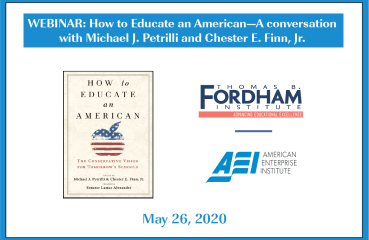
WEBINAR: How to Educate an American—A conversation with Michael J. Petrilli and Chester E. Finn Jr.

America’s schools have ceded significant ground to trendy nostrums and policy cure-alls that do little to adequately teach young people the skills and knowledge required to realize their full potential and emerge from school as fully-functioning citizens. The latest round of dire NAEP civics and U.S. history scores underscore our continuing failure on the citizenship front.

Commentary
2.24.2020

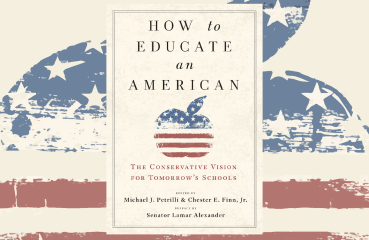
NEW BOOK: How to Educate an American: The Conservative Vision for Tomorrow's Schools

Featuring essays by twenty leading conservative thinkers, and anchored in tradition yet looking towards tomorrow, this book should be read by anyone concerned with teaching future generations to preserve the country’s heritage, embody its universal ethic, and pursue its founding ideals.

Book
2.24.2020
Governance

How to Educate an American: The Conservative Vision for Tomorrow's Schools

Michael J. Petrilli, Chester E. Finn, Jr.

Featuring essays by twenty leading conservative thinkers, and anchored in tradition yet looking towards tomorrow, this book should be read by anyone concerned with teaching future generations to preserve the country’s heritage, embody its universal ethic, and pursue its founding ideals.

Commentary
2.20.2020
Accountability & Testing, Curriculum & Instruction, Teachers & School Leaders

The biggest scandal in education is hiding in plain sight

Dan Weisberg

Kids hear all the time that working hard and earning A’s and B’s in school will open opportunities for them later in life. Families rely on those grades to tell them whether their kids are getting what they need out of school to become happy, successful adults.

Commentary
2.19.2020
Governance

Five reasons Congress should not block-grant the federal Charter Schools Program

Michael J. Petrilli

As a center-right think tank, we whole-heartedly support turning prescriptive federal programs into block grants. Among other things, they reduce bureaucratic inefficiency and trust states to decide what’s best for their unique circumstances. But there are exceptions to our adoration, and one of them is the Trump Administration’s proposal to include the federal Charter Schools Program in a new mega-block-grant.

Commentary
2.19.2020
Governance

The elite eight: The remaining Democratic presidential candidates and their views on education reform

Dale Chu

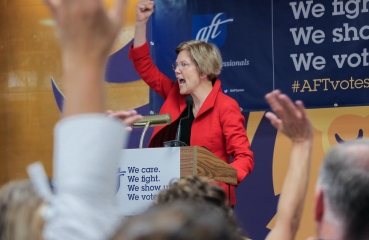
With Iowa and New Hampshire in the rearview mirror, the original field of nearly thirty Democratic presidential candidates has now been winnowed down to eight. Six of them will face off on the debate stage this evening in Las Vegas.

Commentary
2.19.2020
Teachers & School Leaders

Most school districts have little effect on academic mobility

Robert Pondiscio

A new report published in the journal The Annals of the Unsurprising reports that a child’s performance relative to other students on their third grade state tests in reading and math predicts where he or she will rank in tenth grade.

Commentary
2.19.2020

Simplifying the college application process benefits students and schools

Amber M. Northern, Ph.D.

The college admissions process comprises a number of moving parts that must be negotiated by high school students with varying degrees of assistance from parents, teachers, and guidance counselors. Gone are the days when the local “State U” was good enough for each generation of college-goers.

Podcast
2.19.2020
Curriculum & Instruction

The Education Gadfly Show: The barriers blocking students of color from challenging courses

On this week’s podcast, Ed Trust’s Ary Amerikaner and Kayla Patrick join Mike Petrilli to discuss why students of col

Commentary
2.18.2020
Curriculum & Instruction

The 1619 Project perpetuates the soft bigotry of low expectations

Ian Rowe

On March 18, 2008, then-presidential candidate Barack Obama began an oration that Andrew Sullivan at the Atlantic called a “searing, nuanced, gut-wrenching, loyal, and deeply, deeply Christian speech” and “the most honest speech on race in America in my adult lifetime.”

Commentary
2.18.2020
Curriculum & Instruction

Questions after that New York Times article on the teaching of reading? Here are some answers.

Daniel Willingham

Over the weekend the New York Times published an article on the front page about the teaching of reading. A friend posted in on Facebook saying “I won't know what to think about this until Dan comments on it.” I thought some background for people like my friend might be useful.

Commentary
2.12.2020
Charter Schools, Governance

Has Trump turned against charter schools?

Chester E. Finn, Jr.

The Trump administration’s proposed budget takes the Education Department’s $440 million program of financial assistance for charters and melds it with twenty-eight other programs into a big new K–12 block grant. Although there’s scant political likelihood that Congress will adopt the plan, the proposal itself will be interpreted and welcomed by charter foes as a sign that even Trump and his allies and supporters have lost their enthusiasm for these independent public schools of choice.

Commentary
2.12.2020
Curriculum & Instruction, Governance, Teachers & School Leaders

Training teachers to fail

Jasmine Lane, Jon Gustafson

There’s been a lot of talk recently about the reading crisis in U.S. schools.

Commentary
2.12.2020
Curriculum & Instruction, Advanced Education

AP versus the excellence gap

Chester E. Finn, Jr.

That K–12 education in the U.S. has long been plagued by “excellence gaps” is no secret, although the terminology may be just a decade old (and owes much to Jonathan Plucker and his colleagues).

Commentary
2.12.2020
Governance, Personalized Learning, Teachers & School Leaders

The harm of special education enrollment caps

Amber M. Northern, Ph.D.

A couple years ago, a high-profile dispute played out between the Texas Education Agency (TEA) and the federal Department of Education, with a January 2019 New York Times headline pronouncing,

Commentary
2.12.2020

Associate degrees and certificates are more valuable than you may think

Jessica Poiner

As its name suggests, the middle-skills pathway sits between a high school diploma and a bachelor’s degree. There are a wide variety of credentials associated with this pathway, but certificate and associate degrees are the most popular. In general, associate degrees include a mix of general education courses and career preparation, while certificates are almost exclusively career oriented.

Podcast
2.12.2020
Standards

The Education Gadfly Show: Why teachers with higher grading standards get better student outcomes

On this week’s podcast, Seth Gershenson, associate professor at American University, joins Mike Petrilli and Da

Policy Brief
2.11.2020
Accountability & Testing, Advanced Education

The Role of Advanced Placement in Bridging Excellence Gaps

Chester E. Finn, Jr., Andrew Scanlan

This report presents key findings from Learning in the Fast Lane: The Past, Present, and Future of Advanced Placement, by Chester E. Finn, Jr. and Andrew E. Scanlan, and published by Princeton University Press in 2019.

Commentary
2.6.2020
Governance, Teachers & School Leaders

Beware the Democrats’ new teachers-union-loyalty test

Derrell Bradford

In The Gulag Archipelago, Aleksandr Solzhenitsyn writes of a rally held for communist leader Josef Stalin. At the event’s end, a tribute to Stalin was called for. As Solzhenitsyn writes, “Of course, everyone stood up (just as everyone had leaped to his feet during the conference at every mention of his name)....

Commentary
2.6.2020
Governance

Lamar Alexander’s education legacy

Dale Chu

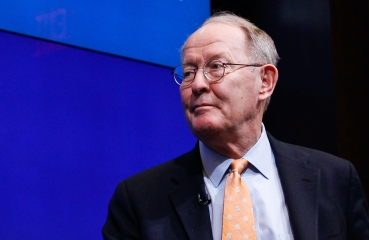
No sooner had Senator Lamar Alexander released his statement last Thursday on the impeachment witness vote than the handwringing began.

Commentary
2.5.2020
Accountability & Testing, Teachers & School Leaders

Students learn more from teachers with high grading standards

Amber M. Northern, Ph.D., Michael J. Petrilli

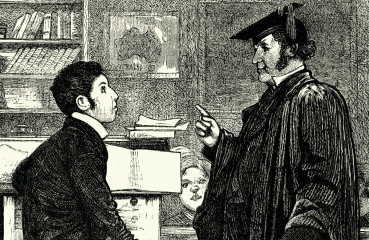
Fordham’s newest report, "Great Expectations," delves into high school grading practices and the impact they have on student outcomes. Turns out that higher standards benefit students of all types and in all kinds of schools. Whether black, Hispanic, white, male, or female, students learn more when taught by teachers with higher expectations. Unfortunately, American schools are gradually making it harder, not easier, for teachers to keep standards high.

Commentary
2.5.2020
Charter Schools, Private School Choice

The Florida LGBTQ controversy: A gut-check moment for school choice

Robert Pondiscio

Florida’s Tax Credit Scholarship program has provided more than 780,000 scholarships since its inception in 2001.

Commentary
2.5.2020
Curriculum & Instruction, Teachers & School Leaders

Do community schools benefit disadvantaged families?

Brandon L. Wright

Achievement gaps between affluent and low-income students are caused by much more than what happens in the classroom. Poverty is associated with a litany of social consequences that make learning more difficult, such as unstable housing, poor healthcare, and greater exposure to violence and other traumas.

Commentary
2.5.2020
Curriculum & Instruction

Civics education, civic activism, civic participation

Chester E. Finn, Jr.

Civics-education aficionados (and worriers) are generally acquainted with the 2018 issue brief from the Center on American Progress titled The State of Civics Education.

Podcast
2.5.2020
Charter Schools

The Education Gadfly Show: Finding the right school for your child

On this week’s podcast, Andrew Campanella, president of National School Choice Week, joins Mike Petrilli and David Griffith to discuss whether

Commentary
2.4.2020
Evidence-Based Learning

Why is it so hard to improve reading achievement?

Timothy Shanahan

Interesting question. Before I answer, let me ask one: What keeps Jeff Bezos, the founder of Amazon, up at night? You know Amazon, the trillion-dollar corporation that delivers something like a five billion packages a year. I’m at a professional meeting. The chair asks what “levers” we have for improving reading achievement in the U.S.

Report
2.4.2020
Accountability & Testing

Great Expectations: The Impact of Rigorous Grading Practices on Student Achievement

Seth Gershenson, Ph.D.

One indicator of teachers’ expectations is their approach to grading—specifically, whether they subject students to more or less rigorous grading practices. Unfortunately, “grade inflation” is pervasive in U.S. high schools, as evidenced by rising GPAs even as SAT scores and other measures of academic performance have held stable or fallen. The result is that a “good” grade is no longer a clear marker of knowledge and skills. This report examines to what extent teachers’ grading standards affect student success.

Commentary
2.4.2020
Teachers & School Leaders

NEW REPORT: Great Expectations: The Impact of Rigorous Grading Practices on Student Achievement

The Education Gadfly

One indicator of teachers’ expectations is whether they subject students to more or less rigorous grading practices. Unfortunately, “grade inflation” is pervasive in U.S. high schools, as evidenced by rising GPAs even as SAT scores and other measures of academic performance have held stable or fallen. A “good” grade is no longer a clear marker of knowledge and skills. This report examines how teachers’ grading standards affect student success.

Pagination

  • First page « First
  • Previous page ‹ Previous
  • Page 94
  • Page 95
  • Page 96
  • Page 97
  • Current page 98
  • Page 99
  • Page 100
  • Page 101
  • Page 102
  • Next page Next ›
  • Last page Last »

Type

  • Book (10)
  • Commentary (17507)
  • Event (51)
  • Podcast (383)
  • Report (258)
  • Video (98)

Topics

  • Accountability & Testing (504)
  • Advanced Education (267)
  • Career & Technical Education (84)
  • Charter Schools (1116)
  • Curriculum & Instruction (1593)
  • ESSA (129)
  • Evidence-Based Learning (835)
  • Facilities (25)
  • Governance (1413)
  • Personalized Learning (51)
  • Private School Choice (139)
  • School Finance (169)
  • Standards (190)
  • Teachers & School Leaders (1455)

Date

  • 2026 (375)
  • 2025 (427)
  • 2024 (411)
  • 2023 (411)
  • 2022 (440)
  • 2021 (468)
  • 2020 (444)
  • 2019 (421)
  • 2018 (495)
  • 2017 (531)
  • 2016 (650)
  • 2015 (554)
  • 2014 (665)
  • 2013 (523)
  • 2012 (403)
  • 2011 (2413)
  • 2010 (1941)
  • 2009 (1489)
  • 2008 (1923)
  • 2007 (501)
  • 2006 (512)
  • 2005 (448)
  • 2004 (441)
  • 2003 (524)
  • 2002 (610)
  • 2001 (319)
  • 2000 (9)
  • 1999 (5)
  • 1998 (11)
  • 1997 (1)
  • 1969 (57)
Fordham Logo

© 2026 The Thomas B. Fordham Institute
Privacy Policy
Usage Agreement

National

P.O. Box 110
Burke, VA 22009

202.223.5452

[email protected]

Ohio

P.O. Box 82291
Columbus, OH 43202

614.223.1580

[email protected]

Sponsorship

130 West Second Street, Suite 410
Dayton, Ohio 45402

937.227.3368

[email protected]