Cutting the cord: Early evidence on cellphone policy implementation
Most U.S. students currently or will soon attend a school with a cellphone policy.
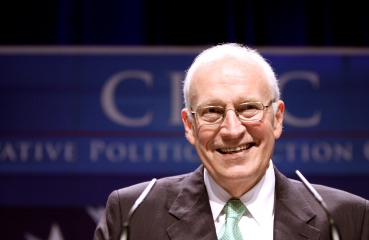
Dick Cheney passed away yesterday at the age of 84. As one of his domestic policy advisors during his time as Vice President, I was deeply saddened by the news; especially as I think about my own aging parents (my mom is 81 and my dad is 90).
Editor’s note: This essay is an entry in Fordham’s 2025 Wonkathon, which asked contributors to answer this question: “What needs to happen next—at the state, district, and school levels—for the science of reading revolution to fulfill its promise and ensure that far more
This week, we’re joined by Ohio State’s Stéphan
Editor’s note: This essay is an entry in Fordham’s 2025 Wonkathon, which asked contributors to answer this question: “What needs to happen next—at the state, district, and school levels—for the science of reading revolution to fulfill its promise and ensu
Editor’s note: This essay is an entry in Fordham’s 2025 Wonkathon, which asked contributors to answer this question: “What needs to happen next—at the state, district, and school levels—for the science of reading revolution to fulfill its promise and ensure that far more
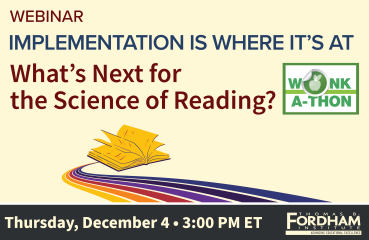
In state after state, governors and legislatures have enacted science of reading laws intended to overhaul how children are taught to read—mandating changes in curricula, teacher preparation, professional learning, and/or intervention. But in practice, will these laws live up to their potential? How can we support effective implementation?
Editor’s note: This essay is an entry in Fordham’s 2025 Wonkathon, which asked contributors to answer this question: “What needs to happen next—at the state, district, and school levels—for the science of reading revolution to fulfill its promise and ensure that far more
For decades, ACT has been testing students’ postsecondary readiness via two separate assessments: one aimed at measuring college readiness and a second that focuses on career-related skills and abilities.
Careers in science, technology, engineering, and math (STEM) fields tend to pay well, offering about double the average wages of non-STEM jobs. But even with that pay advantage, several STEM careers rank among the anticipated workforce shortage areas.
SCHOOLED is Michael J. Petrilli’s twice-weekly free Substack and email newsletter restarting the education-reform conversation. Click here to subscribe for: Sharp analysis of the week’s biggest K–12 debates
This week, Fordham’s President Emeritus Checker Finn joins the show to unpac
School boards—an elected group of community members that sets policy, approves the yearly budget, and establishes a vision for a school district—haven’t been around forever.
Discredited ideas don’t return to most professions.
Editor’s note: This essay is an entry in Fordham’s 2025 Wonkathon, which asked contributors to answer this question: “What needs to happen next—at the state, district, and school levels—for the science of reading revolution to fulfill its promise and ensure that far more
For the science of reading to succeed in elementary school classrooms, we need to prepare aspiring teachers in what it is, how to use it, how to measure it, and how to target it to meet the needs of individual learners. That means starting in teacher preparation programs.
Fordham’s latest study, "Who’s on Board? School Boards and Political Representation in an Age of Conflict," offers an unvarnished look at the nation’s school board members. The findings confirm that local school boards function less like independent oversight bodies and more like glorified parent-teacher associations.
For decades, high-achieving high school students have been told the surest way to impress selective colleges is to take calculus. In a recent national survey of 133 admissions officers, 74 percent said the College Board’s Advanced Placement calculus course is among the math classes that “carry the most weight” in admissions decisions.
During my second tour as a U.S. Navy officer, I served as a navigator aboard a test warship in San Diego. In port, navigators often have little to do other than prepare for the next deployment. But not every military job is created equal.
The types, amounts, and modes of testing done in our schools are subject to debate and analysis, with “too much,” “too often,” “too complex,” and “not helpful” among the many complaints.
Although teacher quality policies involving salaries, working conditions,
This week, we’re joined by Bryan Hassel, co-president of Public Impact, to discuss how r
Editor’s note: This was first published on the author’s Substack, The Bell Ringer. Last week, Eric Hirsch, the Chief Executive Officer of curriculum review nonprofit EdReports, announced he is stepping down in June of 2026.
Editor’s note: This essay is an entry in Fordham’s 2025 Wonkathon, which asked contributors to answer this question: “What needs to happen next—at the state, district, and school levels—for the science of reading revolution to fulfill its promise and ensure that far more
The headlines last month, as the newest results of the National Assessment of Education Progress (NAEP) were released, painted a dire picture of a massive ship taking on water. Indeed, the results were awful.