Mobile Navigation

  • National
    • Policy
      • High Expectations
      • Quality Choices
      • Personalized Pathways
    • Research
    • Commentary
      • Gadfly Newsletter
      • Flypaper Blog
    • Events
    • Scholars Program
  • Ohio
    • Policy
      • Priorities
      • Media & Testimony
    • Research
    • Commentary
      • Ohio Education Gadfly Biweekly
      • Ohio Gadfly Daily
  • Charter Authorizing
    • Application
    • Sponsored Schools
    • Resources
  • About
    • Mission
    • Board
    • Staff
    • Career
Home
Home
Advancing Educational Excellence

Main Navigation

  • National
  • Ohio
  • Charter Authorizing
  • About

National Menu

  • Topics
    • Accountability & Testing
    • Advanced Education
    • Career & Technical Education
    • Charter Schools
    • Curriculum & Instruction
    • ESSA
    • Evidence-Based Learning
    • Facilities
    • Governance
    • Personalized Learning
    • Private School Choice
    • School Finance
    • Standards
    • Teachers & School Leaders
    • Think Again
  • Research
  • Commentary
    • Gadfly Newsletter
    • Flypaper Blog
    • Gadfly Podcast
  • Events
  • Scholars Program

Reports, Books

Displaying 211-240 of 268 results
Report
7.21.2005
Governance, Private School Choice, Standards

Fwd: It's All About the Kids

Martin A. Davis, Jr.

In just more than five years, Mary Anne Stanton has led 13 Catholic schools from high-poverty Washington, D.C. neighborhoods into a consortium that has not only strengthened each school's financial health, but has also greatly improved the academic performance of the children the schools are charged with educating. To get there, she's installed a new standards-based curriculum, shaken up old bureaucratic approaches, and streamlined operations. In its latest Fwd: Arresting Insights in Education, the Thomas B. Fordham Foundation presents a compelling story of just how much change can be made by one determined school leader with a vision.
Report
5.5.2005
Standards

Fwd: Half Empty or Half Full?: Florida's voluntary pre-Kindergarten standards

Amy Wilkins

In 2002, when its voters approved a ballot measure calling for universal pre-Kindergarten by 2005-06, Florida joined a handful of states in which all children are eligible for free, publicly funded education in the year prior to Kindergarten. The passage of the referendum was cause for great optimism among those aware of the power of high-quality pre-K programs to prepare children, particularly low-income children, to meet the challenges of K-12 education. But as with any public policy initiative, the devil is in the details. In designing the half-day Voluntary Pre-Kindergarten program (VPK), the Florida legislature faced competing demands. How did they balance the trade-offs? Amy Wilkins of the Education Trust lays it out in Fordham's latest Fwd: Arresting Insights in Education.

Report
1.5.2005
Standards

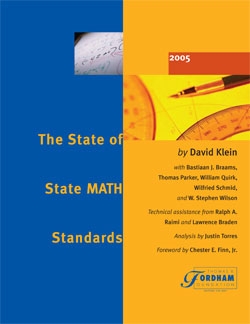
The State of State Math Standards 2005

W. Stephen Wilson, Bastiaan J. Braams, Chester E. Finn, Jr., Wilfried Schmid, Ralph A. Raimi, William Quirk, Thomas Parker, Lawrence Braden, David Klein

States still have far to go in setting rigorous, high quality expectations for K-12 math instruction. Although a majority have replaced or revised their math standards since 2000, many have failed to make substantial improvements. The review was led by David Klein, Professor of Mathematics at California State University-Northridge, and evaluates the content, writing quality, and clarity of K-12 math standards in each state. Klein and his team attribute many of the shortcomings to overuse and wrong applications of manipulatives and calculators; wrong-headed guidance from the National Council of Teachers of Mathematics; and lack of true mathematics competence among those writing the standards.

Report
1.5.2005
Standards

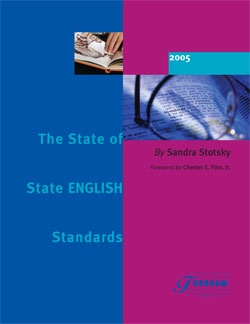
The State of State English Standards 2005

Chester E. Finn, Jr., Sandra Stotsky

Do states' current English/language arts and reading standards expect what they should? Are they demanding enough? Clear enough? Are states using them to guide not only the curriculum and assessment system for students but also their teacher-training programs? Sandra Stotsky, research scholar at Northeastern University and former senior associate commissioner in the Massachusetts Department of Education, finds that most states have revised or replaced their standards since 2000 and made some improvements, especially to K-8 standards. However, major shortcomings remain in other areas including high school literature requirements.

Report
12.3.2004
Governance

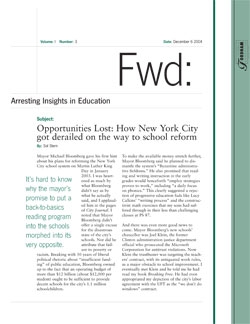
Fwd: Opportunities Lost: How New York City got derailed on the way to school reform

Sol Stern

How did New York City's experiment in school reform, once so promising, become such a mess? Author Sol Stern explains in this third edition of Fordham's new Fwd: series of short articles of interest to K-12 education reformers.

Report
9.29.2004
Curriculum & Instruction

The Mad, Mad World of Textbook Adoption

Chester E. Finn, Jr., Diane Ravitch

Statewide textbook adoption, the process by which 21 states dictate the textbooks that schools and districts can use, is fundamentally flawed. It distorts the market, entices extremist groups to hijack the curriculum, enriches the textbook cartel, and papers the land with mediocre instructional materials that cannot fulfill their important education mission. Tinkering with it won't set it right, concludes this latest Fordham Institute report. Legislators and governors in adoption states should eliminate the process, letting individual schools, individual districts, or even individual teachers choose their own textbooks.

Report
9.7.2004
Charter Schools, Private School Choice, Teachers & School Leaders

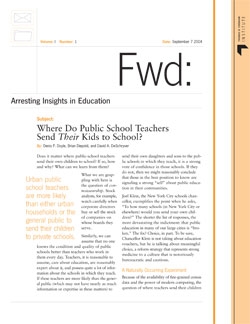
Fwd: Where Do Public School Teachers Send Their Kids to School?

Brian Diepold, Denis P. Doyle, David A. DeSchryver

Does it matter where public-school teachers send their own children to school? If so, how and why? What can we learn from them?

Report
4.13.2004
Curriculum & Instruction

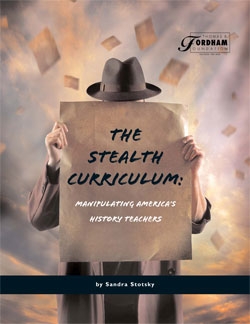
The Stealth Curriculum: Manipulating America's History Teachers

Sandra Stotsky

Widely used supplemental materials may be dangerous to educational health! These works often include hefty doses of political manipulation and ideological bias, courtesy of their authors. This study casts a wary glance toward materials that seldom come under scrutiny. This study is the fifth in a series dedicated to reforming social studies education.

Report
2.26.2004
Curriculum & Instruction

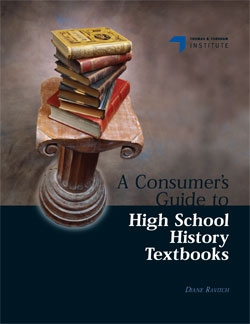
A Consumer's Guide to High School History Textbooks

Diane Ravitch

A Consumer's Guide to High School History Textbooks is a summary review of 12 widely used U.S. and world history textbooks.

Report
1.30.2004
Accountability & Testing, Standards

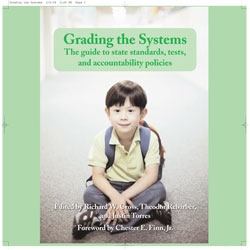
Grading the Systems: The guide to state standards, tests, and accountability policies

Chester E. Finn, Jr., Richard W. Cross, Theodor Rebarber

Co-published by the Thomas B. Fordham Foundation and AccountabilityWorks, with support from the Smith Richardson Foundation, this report looks at six elements of K-12 accountability systems in 30 different states. Each state is rated on standards, test content, alignment of tests to standards, test rigor, testing trustworthiness and openness, and accountability policies. The major conclusion: while some states have the basis of a sophisticated and rigorous accountability system in place, no state has every element of a serious standards-based education reform package in place. And few states are as open to evaluation as they ought to be.

Report
1.26.2004
Advanced Education

2004 Thomas B. Fordham Prizes for Excellence in Education

Eric Hanushek

This brochure contains profiles of the winners of the second annual Thomas B. Fordham Foundation Prizes for Excellence in Education. The 2004 prize for Valor is awarded to Howard Fuller, and the 2004 prize for Distinguished Scholarship is awarded to Eric Hanushek.

Report
10.24.2003
Accountability & Testing, School Finance, Charter Schools

The State Testing Program for Ohio and How It Works: A Primer for Charter Schools

Amy Germuth

With the passage of the politics-governance Act (NCLB), states have had to adjust their accountability systems to comply with federal law. As a result, in the summer of 2003 Ohio's Governor Taft signed House Bill 3, which dramatically changed the state's assessment system and what it means for charter schools. This report helps charter school leaders coordinate their testing and data reporting procedures to meet state and federal guidelines, in the hope that all students might surpass Ohio's academic expectations.

Report
9.22.2003
Standards

Effective State Standards for U.S. History: A 2003 Report Card

Sheldon M. Stern

Is there any subject as disheveled, distorted and dysfunctional as social studies? As part of our continuing effort to revitalize the subject of social studies, the Thomas B. Fordham Institute offers Effective State Standards for U.S. History: A 2003 Report Card. This groundbreaking and comprehensive state-by-state analysis of K-12 education standards in U.S. history was prepared by Sheldon Stern, historian at the John F. Kennedy Presidential Library in Boston for more than 20 years. It evaluates U.S. history standards in 48 states and the District of Columbia on comprehensive historical content, sequential development, and balance.

Report
8.1.2003
Curriculum & Instruction

Where Did Social Studies Go Wrong?

Kathleen Porter-Magee, James Leming, Lucien Ellington

This new report from the Thomas B. Fordham Foundation consists of penetrating critiques by renegade social studies educators who fault the regnant teaching methods and curricular ideas of their field and suggest how it can be reformed. While nearly everyone recognizes that American students don't know much about history and civics, these analysts probe the causes of this ignorance-and lay primary responsibility at the feet of the social studies 'establishment' to which they belong.

Report
8.1.2003
Curriculum & Instruction

Terrorists, Despots, and Democracy: What Our Children Need to Know

Richard Rodriguez, Kenneth R. Weinstein, Victor Davis Hanson, Walter Russell Mead

This new report from the Thomas B. Fordham Foundation includes the voices of 29 political leaders, education practitioners, and cultural analysts who discuss what schools should teach about U.S. history, American ideals, and American civic life in the wake of 9/11, the war on terror, and the liberation of Iraq.

Report
8.1.2003
Curriculum & Instruction

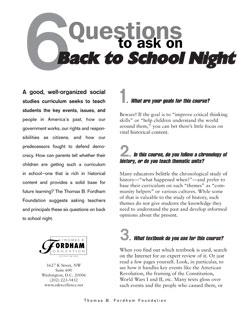
Six Questions to Ask on Back to School Night

A good, well-organized social studies curriculum seeks to teach students the key events, issues, and people in America's past, how our government works, our rights and responsibilities as citizens, and how our predecessors fought to defend democracy. How can parents tell whether their children are getting such a curriculum in school?one that is rich in historical content and provides a solid base for future learning? The Thomas B. Fordham Foundation suggests asking teachers and principals these six questions on back to school night.

Report
6.5.2003
Charter Schools

Charter School Authorizing: Are States Making the Grade?

Rebecca Gau, Louann Bierlein Palmer

This new report by the Thomas B. Fordham Institute is the first significant study of the organizations that authorize charter schools. The report examines 23 states and the District of Columbia to determine how supportive they are of charter schools, how good a job their authorizers are doing, and how policy makers could strengthen their states' charter programs.

Report
5.1.2003
Governance

Better Leaders for America's Schools: A Manifesto

This report, published jointly by the Fordham Institute and The Broad Foundation, contends that American public education faces a 'crisis in leadership' that cannot be alleviated from traditional sources of school principals and superintendents. Its signers do not believe this crisis can be fixed by conventional strategies for preparing, certifying and employing education leaders. Instead, they urge that first-rate leaders be sought outside the education field, earn salaries on par with their peers in other professions, and gain new authority over school staffing, operations and budgets.

Report
2.1.2003
Curriculum & Instruction

The Best of Both Worlds: Blending History and Geography in the K-12 Curriculum

David W. Saxe, David J. Rutherford, Richard G. Boehm

Geography plays a crucial role in shaping history, and the study of history provides an important context for students learning geography, but teachers rarely take advantage of the complementary nature of these subjects. This report shows how the study of U.S. history can be enriched by blending geography into the curriculum. The centerpiece is an innovative curriculum framework in which each historical period is supplemented and enriched by the introduction of relevant geography.

Report
1.1.2003
Accountability & Testing

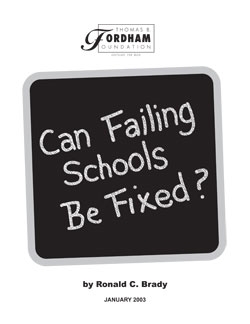
Can Failing Schools be Fixed?

Ronald C. Brady

Will the sanctions for failing schools laid out in the politics-governance Act (NCLB) succeed in turning those schools around? This report draws on the results of previous efforts to overhaul failing schools to provide a glimpse at what may be expected from NCLB-style interventions. The results: no intervention strategy has a success rate greater than 50%, so policymakers are urged to consider additional options for children trapped in failing schools.

Report
9.1.2002
Curriculum & Instruction

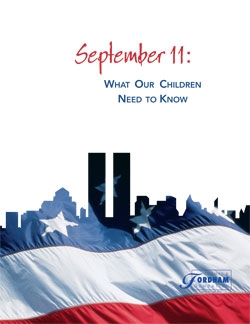
September 11: What Our Children Need to Know

Lynne Cheney, William J. Bennett, William Damon, John Agresto

Our report features timely advice on what schools should teach and children should learn about September 11 and about history, civics, heroism and terrorism. Featuring 23 statements by leading educators and experts, plus an extensive bibliography, the report is a constructive, hard-hitting alternative to the 'diversity and feelings' approach that many national education groups have taken to the 9/11 terrorist attacks.

Report
9.1.2002
Charter Schools

The Approval Barrier to Suburban Charter Schools

Pushpam Jain

Why haven't charter schools taken hold in suburban areas in most states? In this report, Pushpam Jain takes a close look at three states with high proportions of charter schools in the suburbs to see how they managed to introduce charter schools, and then compares them to one state with only a few charter schools to see what is blocking the spread of charters there. His conclusion: if a state sets up a system for authorizing charter schools where the only authorizing body doesn't want charter schools, there won't be many charter schools!

Report
5.1.2002
Governance

Thomas B. Fordham Foundation: Five Year Report

Chester E. Finn, Jr.

The Thomas B. Fordham Foundation's first-ever Five-Year Report reviews our major education reform activities, products and expenditures, both in the national reform arena and in Dayton, from 1997 through 2001 and sums up the work of the Foundation from its rebirth in the mid-1990s until today. In the report, we endeavor to show what we think we've accomplished, where our efforts have fallen short, and what we've learned.

Report
2.1.2002
Accountability & Testing

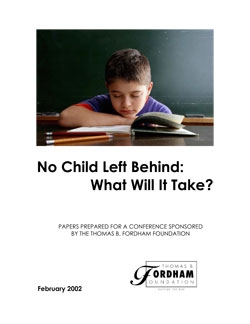
No Child Left Behind: What Will it Take?

Mark D. Reckase, Billie J. Orr, Matthew Gandal, Lisa Graham Keegan

Just one month after President Bush signed the politics-governance Act into law, a provocative set of expert papers commissioned by the Thomas B. Fordham Foundation explores the legislation's key features: it's testing and accountability provisions. The papers identify the questions left unresolved by Congress and the many hurdles facing the U.S. Education Department and states, districts, and schools as they try to make this ambitious law a reality. The papers also offer suggestions for clearing those hurdles.

Report
12.1.2001
School Finance, Governance

Seven Studies in Education Philanthropy

John Barry, Peter Frumkin, Joe Williams, Leslie Lenkowsky, Lew Solomon, Paul T. Hill, Margaret Raymond, Emily Spencer, Bruno V. Manno

The Thomas B. Fordham Foundation asked experts to share their knowledge and ideas on topics related to effective education philanthropy. Here are seven papers that answer some of philanthropists' most important questions in the education reform arena.

Report
12.1.2001
Charter Schools

Autonomy and Innovation: How Do Massachusetts Charter School Principals Use Their Freedom?

Bill Triant

Charter schools grant significant autonomy to their principals, but do their principals make decisions that would not be possible in ordinary schools? Are they creating schools that are truly different from (and potentially better than) regular district schools? For this report, Bill Triant conducted extended interviews with eight charter school principals in Massachusetts on five dimensions of school operations (teacher hiring, budgetary control, instruction and curriculum, organizational design, and accountability) to shed light on how they use their autonomy. He finds that when charter school principals are given the opportunity to innovate, they do so.

Report
10.21.2001
Governance

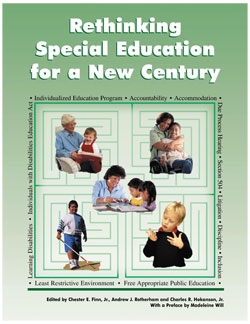
Rethinking Special Education for a New Century

Chester E. Finn, Jr., Andrew J. Rotherham, Charles R. Hokanson, Jr.

Recommending sweeping changes in federal special ed policy, this new volume of 14 papers scrutinizes the education now being received by 6 million U.S. children with disabilities. Jointly published with the Progressive Policy Institute, the report will help shape discussion of the next reauthorization of the Individuals with Disabilities Education Act (IDEA). It identifies the problems that now beset this important program, analyzes their causes, and suggests solutions. All who care about the education of children with special needs will want to read it for themselves.

Report
10.1.2001
Governance

Dayton Education in 2001: The Views of Citizens and Parents

Chester E. Finn, Jr., Jacqueline Howell Luksic

This unique survey compares the views of parents with children in private, public and charter schools on the quality of their own schools as well as a range of education reform issues. Conducted in Dayton, Ohio, home to one of the nation's fastest growing charter school programs as well as a strong private voucher program, the data show that, while public school parents are generally less satisfied with their children's present schools, the overwhelming majority of parents and non-parents support bold reform in the public school system. The survey also shows strong support among all groups for publicly funded vouchers, higher academic standards and performance pay for teachers.

Report
10.1.2001
Governance

Evolution of the New American Schools: From Revolution to Mainstream

Jeffrey Mirel

This report traces an initiative that was launched a decade ago by business and government leaders seeking to spark a transformation of K-12 education in American. The New American Schools Development Corporation (NASDC) vowed to cast aside traditional ideas about schools and apply a no-nonsense, business-savvy approach to the design and deployment of "break-the-mold" schools. Ten years later, New American Schools (as the organization is now named) looks a lot more like a member of the education establishment. Mirel's fascinating report shows how this happened.

Report
9.1.2001
School Finance, Governance

Making it Count: A Guide to High-Impact Education Philanthropy

Chester E. Finn, Jr., Kelly Amis

Charitable giving in the U.S. is at an all-time high, as is the public's concern with the state of our K-12 education system. This guide provides practical advice for the philanthropist who is fed up with the status quo and eager to support effective education reforms. Making it Count reviews the state of U.S. public education, examines different ways that philanthropists are trying to improve it, explains why some strategies work better than others, profiles a number of education philanthropists, and recounts the experiences of the Thomas B. Fordham Foundation.

Pagination

  • First page « First
  • Previous page ‹ Previous
  • Page 1
  • Page 2
  • Page 3
  • Page 4
  • Page 5
  • Page 6
  • Page 7
  • Current page 8
  • Page 9
  • Next page Next ›
  • Last page Last »

Type

  • (-) Book (10)
  • Commentary (17478)
  • Event (51)
  • Podcast (380)
  • (-) Report (258)
  • Video (98)

Topics

  • Accountability & Testing (45)
  • Advanced Education (17)
  • Career & Technical Education (4)
  • Charter Schools (47)
  • Curriculum & Instruction (37)
  • ESSA (6)
  • Evidence-Based Learning (5)
  • Governance (81)
  • Personalized Learning (4)
  • Private School Choice (8)
  • School Finance (31)
  • Standards (49)
  • Teachers & School Leaders (37)

Date

  • 2026 (8)
  • 2025 (7)
  • 2024 (8)
  • 2023 (9)
  • 2022 (7)
  • 2021 (7)
  • 2020 (8)
  • 2019 (9)
  • 2018 (7)
  • 2017 (9)
  • 2016 (10)
  • 2015 (5)
  • 2014 (13)
  • 2013 (18)
  • 2012 (18)
  • 2011 (19)
  • 2010 (7)
  • 2009 (9)
  • 2008 (11)
  • 2007 (7)
  • 2006 (9)
  • 2005 (9)
  • 2004 (7)
  • 2003 (9)
  • 2002 (4)
  • 2001 (8)
  • 2000 (9)
  • 1999 (5)
  • 1998 (11)
  • 1997 (1)
Fordham Logo

© 2026 The Thomas B. Fordham Institute
Privacy Policy
Usage Agreement

National

P.O. Box 110
Burke, VA 22009

202.223.5452

[email protected]

Ohio

P.O. Box 82291
Columbus, OH 43202

614.223.1580

[email protected]

Sponsorship

130 West Second Street, Suite 410
Dayton, Ohio 45402

937.227.3368

[email protected]