Mobile Navigation

  • National
    • Policy
      • High Expectations
      • Quality Choices
      • Personalized Pathways
    • Research
    • Commentary
      • Gadfly Newsletter
      • Flypaper Blog
    • Events
    • Scholars Program
  • Ohio
    • Policy
      • Priorities
      • Media & Testimony
    • Research
    • Commentary
      • Ohio Education Gadfly Biweekly
      • Ohio Gadfly Daily
  • Charter Authorizing
    • Application
    • Sponsored Schools
    • Resources
  • About
    • Mission
    • Board
    • Staff
    • Career
Home
Home
Advancing Educational Excellence

Main Navigation

  • National
  • Ohio
  • Charter Authorizing
  • About

National Menu

  • Topics
    • Accountability & Testing
    • Advanced Education
    • Career & Technical Education
    • Charter Schools
    • Curriculum & Instruction
    • ESSA
    • Evidence-Based Learning
    • Facilities
    • Governance
    • Personalized Learning
    • Private School Choice
    • School Finance
    • Standards
    • Teachers & School Leaders
    • Think Again
  • Research
  • Commentary
    • Gadfly Newsletter
    • Flypaper Blog
    • Gadfly Podcast
  • Events
  • Scholars Program

The Education Gadfly Weekly

Sign Up to Receive Fordham Updates

We'll send you quality research, commentary, analysis, and news on the education issues you care about.
Thank you for signing up!
Please check your email to confirm the subscription.

The Education Gadfly Weekly: Robert Pondiscio: Some things I’ve learned

Volume 21, Number 19
5.13.2021
5.13.2021

The Education Gadfly Weekly: Robert Pondiscio: Some things I’ve learned

Volume 21, Number 19
view
High Expectations

Some things I’ve learned

Two decades into what was supposed to be a two-year public service stint in education, I’ve learned a few lessons as a teacher, a writer, and an ed reformer. They include the following: teaching has to be a job that ordinary people can do well; innovation is an overrated virtue; and there’s no such thing in education as a magic bullet—but there might be magic buckshot. Read more.

Robert Pondiscio 5.13.2021
NationalFlypaper

Some things I’ve learned

Robert Pondiscio
5.13.2021
Flypaper

In praise of Robert Pondiscio, the Education Gadfly’s gadfly

Michael J. Petrilli
5.13.2021
Flypaper

Improving assessments and accountability in the post-Covid era

Chester E. Finn, Jr.
5.13.2021
Flypaper

How school district consolidation affects student outcomes and economic efficiency

Amber M. Northern, Ph.D.
5.13.2021
Flypaper

First, do no harm: The initial impact of the Common Core on student learning

Victoria McDougald
5.13.2021
Flypaper

The Education Gadfly Show #769: Should we break up behemoth school districts?

5.13.2021
Podcast

Cheers and Jeers: May 13, 2021

The Education Gadfly
5.13.2021
Flypaper

What we're reading this week: May 13, 2021

The Education Gadfly
5.13.2021
Flypaper
view

In praise of Robert Pondiscio, the Education Gadfly’s gadfly

Michael J. Petrilli 5.13.2021
Flypaper
view

Improving assessments and accountability in the post-Covid era

Chester E. Finn, Jr. 5.13.2021
Flypaper
view

How school district consolidation affects student outcomes and economic efficiency

Amber M. Northern, Ph.D. 5.13.2021
Flypaper
view

First, do no harm: The initial impact of the Common Core on student learning

Victoria McDougald 5.13.2021
Flypaper
view

The Education Gadfly Show #769: Should we break up behemoth school districts?

Michael J. Petrilli, David Griffith, Ph.D., Amber M. Northern, Ph.D., Howard Husock 5.13.2021
Podcast
view

Cheers and Jeers: May 13, 2021

The Education Gadfly 5.13.2021
Flypaper
view

What we're reading this week: May 13, 2021

The Education Gadfly 5.13.2021
Flypaper
view

Some things I’ve learned

Robert Pondiscio
5.13.2021
Flypaper

In his lovely piece announcing my transition from my full-time role at Fordham, my friend, colleague, and now-former boss Mike Petrilli calls me a contrarian. This is one time I won’t argue with him. But I came by it honestly. Unlike a lot of people in this game, I was an indifferent student who might do his homework if there wasn’t something good on TV (or in front of it if there was). I was a B-student on my best days, and took a “semester off” from college that lasted twenty years. Even when I became a teacher, it was supposed to be a two-year, public-service stint, not the start of a second career in education.

But after two decades, and as I start my next phase, there are a few things I think I’ve learned about teaching, writing, and education reform. And please forgive me if I’m being contrary:

  • Every conversation about education either gets quickly to “it’s complicated” or it’s not worth having. There are always trade-offs in any program or policy. Always.

  • If you’re not serious about literacy, you’re not serious about equity.

  • The best classroom management advice for elementary school teachers is “never reward attention-seeking behavior with attention.” It works surprisingly well with adults, too.

  • Schooling is conservative; education is progressive. This paradox explains why our biggest fights occur when we stray too far from familiar models of schooling, or get too prescriptive about long-term goals.

  • No field has a worse grasp of its own history than education.

  • The most important relationships to cultivate are with people who disagree with you vehemently. They give you the honest feedback your friends and colleagues often won’t.

  • There are nearly four million teachers in America. A number that large means, by definition, a workforce comprised of ordinary people of average abilities. Teaching must be a job that they can do well. There aren’t enough saints and superstars to go around and never will be.

  • The best writing comes not when you’re trying to persuade others, but when you’re persuading yourself.

  • There is no such thing as a magic bullet in education, but there might be magic buckshot—a powerful blast of small projectiles all headed in the same direction. This is why you get better results from changes at the school, district, or CMO level: Buckshot is effective at close range. The further you get from the target, the more it scatters.

  • I’d rather my child’s teacher be a devoted disciple of a curriculum or pedagogy that I cannot stand than be forced to use one that I love, but do it half-heartedly.

  • There is someone in your movement who damages your cause or issue by being obnoxious or pugnacious, alienating people who might otherwise help advance your program or policy. Taking that person aside and telling them, “You’re not helping,” is a good use of your time.

  • It never would have occurred to parents of previous generations to blame teachers for their children’s lack of interest or effort. We’ve reversed this almost entirely, making student motivation and engagement the teacher’s job. That change was needed, but the pendulum has swung too far.

  • The soft bigotry of low expectations is still with us. We just apply it to parents when we assume they are not capable of choosing the right school for their children, or that we know better than them when they support schools that we want to close.

  • You will never regret not engaging with someone on social media.

  • If you are asking schools and teachers to take on a new initiative or priority without taking something off their plate, you’re making things worse. Pay no attention to those who blithely say, “we should be able to walk and chew gum at the same time.”

  • The most addictive drug in the opinion-making business is applause. Once you’re hooked on it, you’ll say anything to get your next fix.

  • “Innovation” is an overrated virtue. If the basic model of school—kids in classrooms; teacher in front of the room—hasn’t changed in 100 years, it’s not because we can’t innovate. It’s because we like it that way and that it serves an important purpose.

  • If your child goes to a school where you don’t worry about her physical safety, count your blessings. You have no business judging parents for whom safety is their number one concern—including getting to and from school safely every day.

  • Successful movements seek converts; unsuccessful movements hunt heretics. Ed reform was at the peak of its prestige and moral authority when it had a youthful, optimistic, energy. Disappointing results damaged its confidence. Angry wokeness and purity tests are destroying it.

  • Ed reformers used to insist “demographics isn’t destiny.” We’re getting dangerously close to promoting exactly the opposite belief. Both morally and politically, it’s poisonous.

  • Jefferson famously said that he would not hesitate to choose newspapers without government over a government without newspapers. The same is true of schools without sports versus sports without schools. Coaches teach the habits and skills that matter most: showing up, hard work, commitment, personal accountability, and teamwork. They are among the best and least-heralded teachers we have.

  • The most valuable experience you can have is to see a school or teacher doing exactly what you want and realize it’s awful. That’s the day you stop blaming implementation and learn humility.

  • There should be term limits (at least self-imposed ones) on education activists and advocates. If you spend half your life banging the same drum, you’re either ineffective or you’ve become too deeply invested in the problem to see or acknowledge progress. Beware becoming the person you signed up to replace.

  • People who describe themselves as thought leaders, change agents, innovators, or influencers aren’t. Some titles you can’t confer on yourself.

  • E.D. Hirsch, Jr. is still the only educational theorist whose work described exactly what I saw in my South Bronx classroom every day: children who can “read” but struggle to comprehend. The issue wasn’t student engagement, child-centered pedagogy, or culturally-relevant curriculum. It was lack of background knowledge. Period.

  • Everyone gets the reputation they deserve. Just give it time.
view

In praise of Robert Pondiscio, the Education Gadfly’s gadfly

Michael J. Petrilli
5.13.2021
Flypaper

After a fantastic seven-year run at the Thomas B. Fordham Institute, our colleague Robert Pondiscio is heading to the more spacious pasture of the American Enterprise Institute, where he will join Rick Hess and many of our other friends, colleagues, and partners. We’re thrilled that Robert will remain a Senior Visiting Fellow at Fordham, as well, writing regularly for Gadfly and Flypaper. Readers may not notice much of a change at all.

But for me and the rest of our team, Robert’s quasi-departure will leave a big hole, not just because he’s a fantastic editor and contributor, but especially because he’s been the consummate “thought partner”—and yes, occasional sparring partner—during his tenure here.

It’s no secret that those of us at Fordham have never been afraid to air our disagreements in public. Indeed, we relish it. It’s what makes us a lively (and we hope provocative) think tank and not an advocacy group. There’s no party line, no single policy deity that all must worship and praise. We “think out loud” in the attempt to constantly weigh the research evidence, on the ground experience, and common sense to develop sound guidance on education policy and practice.

Checker and I, for example, have forever disagreed about the relative importance of proficiency rates versus growth measures when evaluating school effectiveness and designing education accountability systems. (I’m obviously right and he’s obviously wrong.) And Robert and I have enjoyed—and I believe have both profited from—debating our own set of issues over the years, from age-old questions about testing to newer controversies around “anti-racist education.”

That latter one hasn’t always been easy, given how heated the entire issue has become in recent months. Robert is convinced that the writings of scholar Ibram X. Kendi are having a widespread and deleterious effect on the education field. I share his concerns about Kendi’s views (especially on education). But I suspect that when most educators espouse “anti-racism,” they’re not necessarily reflecting Kendi’s dogmatic definition. I’m also not convinced that the many misguided, and sometimes patently offensive, practices that sometimes fly under that banner of “anti-racism” are all that common, though it’s really hard to know.

But what’s most obvious—and has been most valuable—about Robert’s time at Fordham is that he has changed our minds on important subjects. This is most clear when it comes to the intersection of “structural reforms” and instructional practice. As he wrote in 2018:

A conceptual failure lies at the heart of ed reform’s underperformance: the mistaken assumption that education policy, not classroom practice, is the most important lever to pull to drive enduring improvement. But educational failure is not a tale of unaccountable and union-protected layabouts refusing to do right by children. More often than not, it’s well-intended people trying hard and failing—and not despite their training, but because of it. In short, we have a product and practice failure more than a policy and process failure.

And more so than anyone else in the world of K–12 education, Robert has chronicled those “product and practice failures”—and the rare successes—for our readers. Success was of course the topic of his magnificent book about Success Academy, one of the finest and proudest products of anyone associated with Fordham in the past two decades. It’s a story that has policy implications, for sure, but it’s mostly about Eva Moskowitz, this generation’s most talented, most driven educator, and her relentless work to imbue a strong culture and effective practices in her schools.

But he’s tackled these topics in his weekly writing, too. Some of his best include:

  • “How We Make Teaching Too Hard for Mere Mortals.” Robert explains that we need to make the job doable by the 3.7 million people we have, and stop asking them to do more and more things.

  • “Leveled reading: The making of a literacy myth.” Classic Pondiscio: a post that examines and upends the conventional wisdom about common classroom practice that is simple, seductive...and wrong.

  • “Direct Instruction: The Rodney Dangerfield of curriculum.” A hugely important issue—and an illustration of Robert’s ability to frame an issue and come up with an analogy that sticks. 

It took me longer than it should have, but gradually I have come to understand that Robert was always right about the off-kilter balance between policy and practice in ed reform, which has led me to yearn for a Golden Age of Instructional Practice, at least if we want to actually improve teaching and learning. And in the aftermath of this year’s pandemic, we also need to accelerate learning via evidence-based practices if we want to address the massive unfinished learning faced by so many children nationwide.

—

I admire Robert even as he sometimes drives me crazy. I suspect he sometimes drives some of our readers crazy, too. Contrarians are like that. But if I’m honest, I’ll admit that he’s been one of the best teachers I’ve ever had—surely about smart instructional practice, but also how to write well, how to think clearly, and how to never stop questioning every assumption, at least if we want to keep getting closer to the truth. Robert has had more than one career and may yet have more, but at heart he is a teacher, and a damned fine one.

I’m a wee bit envious of AEI, but look forward to Fordham’s—and my own—continued association with Robert. I know he’s not about to stop doing what he does best. And I know that American education will continue to benefit for it.

view

Improving assessments and accountability in the post-Covid era

Chester E. Finn, Jr.
5.13.2021
Flypaper

As U.S. schools reopen in the fall, a year and a half after nearly all of them closed due to the pandemic panic, what should be different? What needs to change if kids are actually to catch up? What’s important to retrieve from pre-Covid days? And what other changes, changes that should have been made pre-Covid, is there now a rare opportunity to initiate?

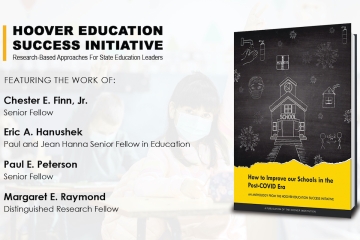
Several colleagues and I at the Stanford-based Hoover Education Success Initiative suggest answers to those key questions in a brand-new book, How to Improve Our Schools in the Post-Covid Era, edited by Margaret (Macke) Raymond and hot off the (virtual) presses. Its ten chapters are primarily aimed at state-level education leaders, many of whom—members of the Initiative’s “practitioners council”—supply comments that are incorporated into those chapters, turning them into unusual (and often lively) dialogues on important policy challenges. Where the think tank meets the road, one might say.

Two of those chapters are mine. They shorten, update and sharpen policy guidance on the future of assessments and accountability, some of which you may previously have encountered in a long HESI paper on that topic. What’s changed is deeper understanding of the consequences of the 2020 assessment “holiday” that Secretary DeVos granted states and of the damaging and unrecoverable data gap that will follow if we lack 2021 data, too. We know, of course, that the Biden administration has pushed states to test this spring (though not to use the results of those assessments for accountability purposes), but we also know that the U.S. Department of Education has been cutting them a lot of slack to do it differently and, in a few cases, not to test at all. Without this assessment data, which I term “education’s indispensable GPS,” policy leaders would be lost come autumn as to which kids and schools need what kinds of catch-up. While the diagnostic tests that a number of districts are using will inform teachers and parents about immediate learning gaps and needs, they’re not very useful for monitoring students’ progress in relation to state standards.

Restarting orderly statewide assessments of reading and math is just the beginning, however. My chapters also delve into needed changes going forward in what and how we measure, and how we judge student learning and school performance. Those test scores should be just the beginning Along the way, I get some great feedback from the likes of Colorado state board chair Angelika Schroeder and 50CAN veep Derrell Bradford.

Rick Hanushek, Paul Peterson, and Macke Raymond each authored two of the other substantive chapters (and Macke soloed with the book’s introduction and conclusion).

Besides addressing immediate post-pandemic challenges, all look beyond to the more fundamental rebooting that our K–12 system needs. Hanushek focuses on smarter district budgeting (those federal relief dollars aren’t going to last forever!) and overhauling our whole approach to engaging, deploying, evaluating, and compensating teachers.

Peterson tackles school choice broadly, including new forms that erupted during the shutdown. He also looks closely at the pros and cons of “portfolio” districts. And Raymond grapples both with the extensive learning losses that schools must contend with in the near term and the long-overdue need to reinvent the high school experience and put significance back into the diploma.

All three also receive (and the book presents) perceptive commentary—some supportive, some critical—from the veteran practitioners that have been advising the HESI project. For example, Raymond’s plea that high schools finally replace seat time and Carnegie units with flexible measures of student competency drew this comment from Arkansas education secretary Johnny Key: “The most significant hurdle is overcoming the comfort with the Carnegie Unit and seat time. Through legislation, we eliminated the seat-time requirement in Arkansas high schools in 2017, yet school leaders have difficulty knowing how to design a high school experience that does not retain some element of seat time.”

Peterson’s case for wholesale expansion of the portfolio district model got this endorsement from veteran school executive Don Shalvey, now CEO of a Stockton-based education group called San Joaquin A+: “There is a real push from communities across the country for schools to be better preparing students for jobs in health care, agriculture, education, and other industries that are a bridge to the future. Portfolio options can help address that stakeholder voice, particularly in communities where schools haven’t always been so responsive. In my local community, I am hearing calls for new types of schools that will better prepare students for the workforce.”

As Macke Raymond observes in the conclusion:

[E]ven before the pandemic there was vigorous discussion of how the schools could deal with new demands from the economy and do so in a more equitable way. The pandemic has amplified the need for picking up on this prior discussion and for making desired improvements a reality.

There is both quantitative and qualitative evidence that the school closures that began in March 2020 and the subsequent hesitant restart of schools during the 2020–21 school year harmed an entire cohort of students.... The virus-induced learning impacts will haunt these students throughout their work lives and will also result in a future U.S. economy that will suffer from a less-skilled workforce—unless a way is found to make up for the effects of the pandemic....

The challenges mount when we realize that the losses aren’t the same for every child. Raymond goes on to explain that:

The pandemic underscores a number of areas where we need to move beyond our pre-pandemic starting point. First, it is almost certainly the case that both learning and its mirror—learning loss—have not been evenly distributed. More-advantaged students with a broader set of supporting resources have on average done much better than less-advantaged students.... The pandemic experience also strongly suggests that schools will need to move to more individualized instruction that meets the student at the proper level, not some rough average for a student based on time spent in school.... [S]chools will [also] need to recognize the new variety in delivery, attendance, and mode of instruction. Most likely, many schools will want to—or will be forced to—mix traditional classroom-based instruction with hybrid instruction in at-times remote environments....

Will fundamental changes in K–12 education be easier or harder to make in the wake of the pandemic? Indeed, Raymond asks, “Are changes possible, or should we simply be satisfied with returning as much as possible to the pre-pandemic schools of February 2020?”:

Practitioners rightfully warn of the difficulties and time involved in making any significant changes in the structure and operation of schools. But, beyond the social imperative of helping the current students, it is also the case that parents have become more involved in the schooling process. The hope for clear and continuing improvement of the schools rests significantly on parents pushing for the kinds of quality improvements that will bring us successfully out of the pandemic-era quagmire.

The single biggest education question out there today is whether American K–12 education’s goal for the fall is restoration of what was or breakthroughs to what should be. Our new book insists that both are needed.

view

How school district consolidation affects student outcomes and economic efficiency

Amber M. Northern, Ph.D.
5.13.2021
Flypaper

Between 1940 and 2018, the number of public school districts in the U.S. declined from 117,108 to 13,551 due to consolidation, whereby smaller districts merged with each other or with a larger neighbor to boost economies of scale in the resource-intensive business of running schools. Despite this massive decrease, little research exists to support the prevailing notion that consolidations result in increased economic efficiency, to say nothing of their academic impact on students. A recent study conducted by a trio of University of Arkansas scholars is the opening salvo of a much-needed effort to build a stronger research base studying school district consolidation.

That districts and schools are not randomly selected for consolidation is one factor which has made this a difficult topic to study. But in this case, analysts are able to leverage a natural experiment via the enactment of Arkansas Act 60, passed in 2004, that was the result of school finance litigation in the late 90s and early 2000s. After the Arkansas Supreme Court ruled that the state’s funding system was unconstitutional, the governor proposed school district consolidation as a remedy to reduce district administrative cost and “provide greater opportunity for students.” The law required consolidation of all districts that had enrollment of less than 350 students for two consecutive years. This clear enrollment threshold allowed analysts to make use of a sharp regression discontinuity design, whereby students in districts with enrollment of less than 350 in the two years immediately prior to the passage of the law are assigned to the treatment group and students in the remaining districts to the control group. The idea is that districts just above the Act 60 enrollment cut off should be essentially the same as the consolidated districts just below it.

They limit their analysis to consolidations that occurred in 2005, immediately after the passage of the law, to prevent any potential gaming of enrollment data in later years. The first year that the law was in effect, fifty-nine districts were required to consolidate, impacting districts in every region of the state. School buildings were not required to close per se, but sixteen closures occurred in consolidated districts in 2005 and 105 closures occurred by 2011.

The key finding is that consolidation has null or very small positive impacts in both math and English language arts. The researchers also looked to see if impacts vary over time, under the premise that students may require several years to adjust to their new surroundings. But again, impacts are mostly insignificant or modest over four years post-consolidation.

Unfortunately, the regression discontinuity model cannot be used to examine the financial impact on economies of scale because most districts merged with others above the threshold and it is impossible to disentangle the finances of each after the consolidation. Instead, they conduct a descriptive analysis comparing the expenditure trends for districts affected by consolidation (both the consolidated and receiving districts) to unaffected districts to see if the affected districts show substantial changes that deviate from broader state trends. They do not. Both affected and unaffected districts, for example, see comparable increases in spending per pupil. They also have similar shares of certified teachers and other staff. There are a number of possible explanations for this seemingly-incongruous finding—for example, the low number of initial school closures might mean that building and central office staff were retained even after consolidation—which points to an undermining of the intended boost in efficiency.

The researchers conclude, at this point at least, that Act 60 did not appear to have helped students much but didn’t harm them either. But further research in this area—especially a rigorous analysis of costs with more and better data—should help clear up a good many of the key questions still remaining.

SOURCE: Josh B. McGee, Jonathan N. Mills, & Jessica S. Goldstein, “The Effect of School District Consolidation on Student Achievement: Evidence from Arkansas,” retrieved from Annenburg Institute at Brown University (January 2021).

view

First, do no harm: The initial impact of the Common Core on student learning

Victoria McDougald
5.13.2021
Flypaper

Ever since their creation and adoption over a decade ago, the Common Core State Standards (CCSS) have been hotly debated and intensely villainized. The backlash to the CCSS initially took many advocates and supporters by surprise, as state education standards have existed in the U.S. since the early 1990s, and the CCSS, which were originally developed by experts and state leaders in forty-eight states and the District of Columbia, innocuously aimed to raise academic expectations for all students, in the hopes of better preparing them for success in college or career.

We at Fordham have long conducted impartial and independent evaluations of states’ academic standards, and in 2010, we found the CCSS to be “clearer and more rigorous” than most states’ previous mathematics and English language arts standards. And tellingly, despite the ongoing political backlash against them, our most recent analysis found that the CCSS, or close variants, are still in use by most states today.

Of course, high-quality academic standards are only one, albeit critical, piece of the puzzle when it comes to improving student learning. How standards are actually implemented in schools and classrooms matters hugely, including whether teachers receive high-quality, standards-aligned, and subject-specific professional development and are using high-quality, standards-aligned curriculum materials, and whether states are assessing learning via the use of high-quality, standards-aligned assessments.

A new study conducted by Joshua Bleiberg, Post-Doctoral Research Associate at the Annenberg Institute at Brown University, contributes to the small but growing body of research on the Common Core’s impact on student outcomes, and how these may vary by student characteristics. It seeks to answer two main questions: To what extent did the CCSS affect student achievement? And to what extent did they close or exacerbate achievement gaps?

In the analysis, Bleiberg uses student-level National Assessment of Educational Progress (NAEP) data to estimate the initial effect of the Common Core on student outcomes. Specifically, Bleiberg analyzes biennial fourth and eighth grade math and reading scores over a ten-year period (from 2003 to 2013) for over 80,000 students for each subject year. He then compared data for states that were early Common Core implementers (classified as implementing the standards between 2011 and 2013) to late implementers (2014–15), based on state documents such as waiver applications and implementation timelines, which corroborate when the CCSS were adopted and ultimately implemented in each state. To explore the Common Core’s impact on achievement gaps, or disparities in academic performance between various groups of students, Bleiberg used NAEP student survey data and controlled for student characteristics, such as gender, eligibility for free or reduced-price lunch (FRPL), race/ethnicity, and age. He also controlled for prior school achievement based on schools’ adequate yearly progress (AYP) status in 2003.

Bleiberg finds that, just a year or so after their adoption, the CCSS had a small but statistically significant positive effect on math scores (between 4 percent and 10 percent of a standard deviation) but no effect on reading scores, and that the benefits of the CCSS were strongest in fourth grade math. Bleiberg theorizes that this difference across subjects may be because “factors like home environment, other coursework, and extracurricular activities have a greater influence on reading relative to math outcomes.”

In terms of the standards’ impact on achievement gaps, or disparities in academic performance between various groups of students, Bleiberg finds that across all race and ethnic groups, the Common Core “contributes to the closure of achievement gaps.” Specifically, he finds “the White-Black achievement gap is about 5 percent of [a standard deviation] smaller after the CC in fourth-grade math and about 6 percent of [a standard deviation] smaller in fourth-grade reading. In fourth- and eighth-grade math, CC shrinks the White-Hispanic achievement gap by about 16 percent of [a standard deviation]. Fourth-grade math outcomes for FRPL eligible students decline by 6% of [a standard deviation] after CC.” He finds similar results for math for students that are English learners, and saw no effect on reading scores.

Interestingly, when Bleiberg explored effects for economically advantaged versus economically disadvantaged students, as measured by eligibility for FRPL, he finds “the positive effect of CC was larger for economically advantaged White and Black students than the effect of CC for economically disadvantaged White and Black students in math.” But “the CC had a larger positive effect (0.1 [of a standard deviation]) for economically disadvantaged Hispanic students than for economically advantaged Hispanic students in fourth-grade math.” As before, he did not detect a statistically significant effect of the Common Core on economically disadvantaged students’ reading outcomes. Based on these findings, Bleiberg concludes that “for students from economically disadvantaged families that faced other barriers to academic success, the CC backfired... Higher expectations provide the greatest benefit to students when students also have the resources needed to succeed.”

While somewhat underwhelming at face value, Bleiberg’s findings are not surprising and, at least to this reader, underscore that effective standards implementation is difficult and takes time. Notably, this study uses data from 2003 to 2013, as Bleiberg explains, “to remove the endogeneity from changes to content standards after 2013.” But as a result, it does not capture any longer-term effects of the Common Core. This is an important caveat, as many states didn’t even begin implementing the standards until the 2012 to 2015 school years. What’s more, Common Core–aligned assessments, PARCC and SBAC, weren’t administered in states until 2015. And until just a few years ago, the need for standards-aligned curricula was still a top cited Common Core challenge for states, districts, and schools. As Bleiberg himself notes, “Given the limited window in which I observe posttreatment outcomes, it is unlikely that teachers had enough time to change their instruction.”

The study is also not nationally representative, as only states that had “low rigor” content standards prior to the Common Core were included. (Bleiberg relied upon ratings from two prior Fordham state standards reviews conducted in 2006 and 2010.) In addition to states that had “high rigor” standards prior to Common Core, those that never adopted the Common Core and those that made substantive revisions to the Common Core were also excluded from the analysis. And finally, as Bleiberg also stresses, though his analysis controlled for key education reforms adopted during this period, such as changes to teacher evaluation and ESEA waivers, it’s not possible to rule out that other differences in state capacity (such as education resources or political capital) may account for the results detected.

Despite these limitations, this study’s finding of “small positive correlations between the CC and student outcomes...and no evidence that student outcomes declined due to the implementation of CC” is consistent with and adds to prior research.

Bleiberg concludes that, at least in the initial year or two following its adoption, the Common Core may not have helped all students equally across school contexts, and “understanding what causes those differences is key to improving the next generation of content standards.” To be sure, schools should do more to support economically disadvantaged students and help them meet the rigorous academic standards called for by the Common Core. And it’s not surprising that, at least initially, students whose skills were furthest from the lofty goals of these higher standards struggled the most. But in our most recent analysis of state standards, we advised states with solid standards “to devote their resources to implementing them well... standards are only words on paper if they don’t inspire great instruction in the classroom.” Now is no time to walk away from our commitment to high standards for all children, and the important progress we’ve made over the past decade in providing teachers with high-quality curricular resources and assessments with which to support their implementation. Additional research on how classroom instruction continues to evolve will help provide a clearer picture of Common Core’s longer-term impact.

SOURCE: Joshua Bleiberg, Does the Common Core Have a Common Effect? An Exploration of Effects on Academically Vulnerable Students, AERA Open (April 26, 2021).


view

The Education Gadfly Show #769: Should we break up behemoth school districts?

5.13.2021
Podcast
 

On this week’s podcast, Howard Husock, adjunct scholar in Domestic Policy Studies at AEI, joins Mike Petrilli and David Griffith to discuss his new report, “The case for breaking up big urban school systems.” On the Research Minute, Amber Northern examines children’s learning outcomes when they read on paper versus digital devices. 

Amber's Research Minute

May Irene Furenes, Natalia Kucirkova, & Adriana G. Bus, "A Comparison of Children’s Reading on Paper Versus Screen: A Meta-Analysis," Review of Educational Research (March 8, 2021).

If you listen on Apple Podcasts, please leave us a rating and review - we'd love to hear what you think! The Education Gadfly Show is available on all major podcast platforms. 

view

Cheers and Jeers: May 13, 2021

The Education Gadfly
5.13.2021
Flypaper

Cheers

  • The pandemic forced schools to find better ways to serve English learners and their families. Let’s hope they hold on to those lessons. —The74
  • “When I applied to college, I didn’t want to ‘sell my pain.’” —New York Times
  • A Colorado bill to make districts’ approaches to reading instruction more transparent is getting closer to becoming law. —Chalkbeat Colorado
  • Florida Governor DeSantis signed a bill to expand private school vouchers to 60,000 more students. —AP News

Jeers

  • Hundreds of Catholic schools are going under during the pandemic, with some turning to GoFundMe just to stay afloat. —WSJ
  • In Newark, New Jersey, charter schools are facing a legal challenge by opponents for serving too many Black students. —Star-Ledger (NJ)
view

What we're reading this week: May 13, 2021

The Education Gadfly
5.13.2021
Flypaper
  • Here are some thoroughly debunked—but hard-to-kill—myths about schooling. —Educational Leadership
  • Federal education policy needs to give teachers the tools and flexibility to address pandemic learning loss through acceleration and remediation. —Joel Rose
  • A poll finds that so-called “anti-racist education” and slow school reopenings could hurt the Democratic party, with repercussions for state and local elections. —National Journal
  • “Philly’s Black-led charters schools have alleged bias by the district. Now the claims will be investigated.” —Philadelphia Inquirer
Fordham Logo

© 2026 The Thomas B. Fordham Institute
Privacy Policy
Usage Agreement

National

P.O. Box 110
Burke, VA 22009

202.223.5452

[email protected]

Ohio

P.O. Box 82291
Columbus, OH 43202

614.223.1580

[email protected]

Sponsorship

130 West Second Street, Suite 410
Dayton, Ohio 45402

937.227.3368

[email protected]