Mobile Navigation

  • National
    • Policy
      • High Expectations
      • Quality Choices
      • Personalized Pathways
    • Research
    • Commentary
      • Gadfly Newsletter
      • Flypaper Blog
    • Events
    • Scholars Program
  • Ohio
    • Policy
      • Priorities
      • Media & Testimony
    • Research
    • Commentary
      • Ohio Education Gadfly Biweekly
      • Ohio Gadfly Daily
  • Charter Authorizing
    • Application
    • Sponsored Schools
    • Resources
  • About
    • Mission
    • Board
    • Staff
    • Career
Home
Home
Advancing Educational Excellence

Main Navigation

  • National
  • Ohio
  • Charter Authorizing
  • About

National Menu

  • Topics
    • Accountability & Testing
    • Advanced Education
    • Career & Technical Education
    • Charter Schools
    • Curriculum & Instruction
    • ESSA
    • Evidence-Based Learning
    • Facilities
    • Governance
    • Personalized Learning
    • Private School Choice
    • School Finance
    • Standards
    • Teachers & School Leaders
    • Think Again
  • Research
  • Commentary
    • Gadfly Newsletter
    • Flypaper Blog
    • Gadfly Podcast
  • Events
  • Scholars Program

The Education Gadfly Weekly

Sign Up to Receive Fordham Updates

We'll send you quality research, commentary, analysis, and news on the education issues you care about.
Thank you for signing up!
Please check your email to confirm the subscription.

The Education Gadfly Weekly: The endless, rocky path to reading science

Volume 20, Number 4
1.29.2020
1.29.2020

The Education Gadfly Weekly: The endless, rocky path to reading science

Volume 20, Number 4
view
High Expectations

The endless, rocky path to reading science

The National Council on Teacher Quality just released its third review of America’s elementary teacher prep programs, seeking to determine, among other things, whether ed schools provide adequate instruction in scientifically-based reading instruction. The first investigation of this question, back in 2013, resulted in most programs receiving D’s and F’s, and just 35 percent earning A’s and B’s. But this year, slightly more than half of traditional prep programs received honors grades. That’s progress. But there are still miles to go.

Chester E. Finn, Jr. 1.29.2020
NationalFlypaper

The endless, rocky path to reading science

Chester E. Finn, Jr.
1.29.2020
Flypaper

Enduring math woes jeopardize America’s standing in the world

Brandon L. Wright
1.29.2020
Flypaper

Hiding in plain sight: Advancing SEL by tackling today’s urgent problems

Chester E. Finn, Jr.
1.29.2020
Flypaper

Using screen-time to boost children’s science and engineering knowledge

Brandon L. Wright
1.29.2020
Flypaper

The case for focusing SEL on social-network building

Tran Le
1.29.2020
Flypaper

The Education Gadfly Show: School Choice Week 2020

1.29.2020
Podcast
view

Enduring math woes jeopardize America’s standing in the world

Brandon L. Wright 1.29.2020
Flypaper
view

Hiding in plain sight: Advancing SEL by tackling today’s urgent problems

Chester E. Finn, Jr. 1.29.2020
Flypaper
view

Using screen-time to boost children’s science and engineering knowledge

Brandon L. Wright 1.29.2020
Flypaper
view

The case for focusing SEL on social-network building

Tran Le 1.29.2020
Flypaper
view

The Education Gadfly Show: School Choice Week 2020

Michael J. Petrilli, David Griffith, Ph.D., Mike Magee, Amber M. Northern, Ph.D. 1.29.2020
Podcast
view

The endless, rocky path to reading science

Chester E. Finn, Jr.
1.29.2020
Flypaper

Maybe the “reading wars” will never end, no matter how definitive the research on what works with beginning readers and what doesn’t. Back in dark ages when I was a graduate student (1967), the late, great Jeanne Chall published Learning to Read: The Great Debate, which should have put an end, then and forever, to arguments over “phonics versus ‘whole language’” and which foreshadowed the definitive 2000 report of the National Reading Panel, which spelled out the elements of what today is commonly referred to as “scientific reading instruction.” For the vast majority of children starting to learn to read, the Panel made clear—as Chall had done thirty-three years earlier—that the best instructional approach includes:

  • Explicit instruction in phonemic awareness.
  • Systematic phonics instruction.
  • Vocabulary instruction.
  • Methods to improve fluency.
  • Ways to enhance comprehension.

There is no reason to expect a nascent elementary teacher to arrive knowing this, much less how to do these things effectively in a classroom full of squirming five- or six-year-olds who come with widely varying degrees of exposure to books, reading, being read to, vocabulary, and much more. Hence systematic preparation of those who will be teaching the early grades matters as much as the systematic phonics instruction they must provide once on the job.

Thus it feels like a no-brainer to lodge scientific reading instruction at the center of what elementary teachers are being prepared to do. Getting their young charges to be fluent readers with good comprehension is their foremost instructional responsibility. Period.

Yet when Education Week surveyed 530 professors in late 2019 who teach early-reading courses, the majority of them, 57 percent, turn out to “ascribe [sic] to what’s known as a balanced literacy philosophy” while barely one in five “said their philosophy of teaching early reading centered on explicit, systematic phonics with comprehension as a separate focus.”

“Balanced literacy” sounds great, of course—sort of like “balanced diet” or “balanced budget”—but in fact it balances a multitude of good and not-so-good things and most of the time does not emphasize—or even include—the first two bullets above, which is to say it slights the core of scientific reading instruction. (Picture a protein-free “balanced diet.”)

Somewhat more encouraging data emerged the other day when the National Council on Teacher Quality released its most recent review of the curricula of a thousand programs, both undergraduate and graduate, traditional and “alternative,” that prepare elementary teachers for what lies ahead. This is the third time NCTQ has done this, and a key element of its inquiry is whether those preparation programs “provide adequate instruction in each of the five components of scientifically-based reading.” The good news—as far as it goes—is that, for the first time, this review showed that slightly more than half of the traditional programs deserved honors grades in this realm, meaning that at least four of the five elements were satisfactorily covered. Non-traditional programs fared less well and, interestingly, undergraduate programs did markedly better than post-graduate.

In 2013, when NCTQ first excavated this information, most programs got D’s and F’s, while just 35 percent received A’s and B’s. So this is progress. In NCTQ’s terminology, “the field of teacher education is at an inflection point, with the momentum favoring the science of reading.”

I’m on NCTQ’s board and view its courageous, no-holds-barred analyses of teacher preparation and related state policies absolutely vital for the renewal of American K–12 education. And I’ve never deviated from Chall’s or the Reading Panel’s findings. So of course I’m pleased that the NCTQ team has detected some “momentum” in the right direction, and of course I hope it accelerates. But for Pete’s sake, how are we to view the 49 percent of teacher-prep programs that still equip their alums with three or fewer of the five pillars of reading science? And how are we to view the 57 percent of professors in this field who (Education Week says) favor “balanced literacy” instead? How long must we wait for more momentum to build? After all, just 35 percent of fourth graders were “proficient” readers on the 2019 round of NAEP—actually down a bit from 2017 and identical to 2013 when NCTQ first reviewed teacher-prep programs in search of reading science.

Another way to say it: The curricula that NCTQ examines have undoubtedly improved on this front, but so far that hasn’t translated into better reading proficiency among fourth graders. Could it be because the professors who prepared their teachers maybe aren’t changing their ways at the same (slow) pace as their syllabi, textbooks, and test questions would suggest?

If almost half the prep programs aren’t teaching it, and two-thirds of the kids aren’t getting it, we’ve got an awful lot of inflecting still to do. Is it time to take this injustice to the courtroom, as Mike Petrilli has suggested?

view

Enduring math woes jeopardize America’s standing in the world

Brandon L. Wright
1.29.2020
Flypaper

Considerable research suggests that “math skills better predict [individuals’] future earnings and other economic outcomes than other skills learned in high school,” report Eric A. Hanushek, Paul E. Peterson, and Ludger Woessmann. What’s true of people is also true of countries: “Growth in the economic productivity of a nation is driven more clearly by the math proficiency of its high school students than by their proficiency in other subjects,” they add. And no students are better poised to turn their mathematics education into economic advancement for the country as well as themselves than high-ability kids. They’re the young people who hold perhaps the greatest promise for making major advances in science, technology, medicine, and more.

Yet America’s high achievers have fared poorly for decades on international math tests, particularly in the upper grades, before they enter college and the workforce. The latest results of the Program for International Student Assessment (PISA), released late last year, suggest that—despite heroic efforts by school leaders, teachers, parents, policymakers, and reformers—nothing’s changed.

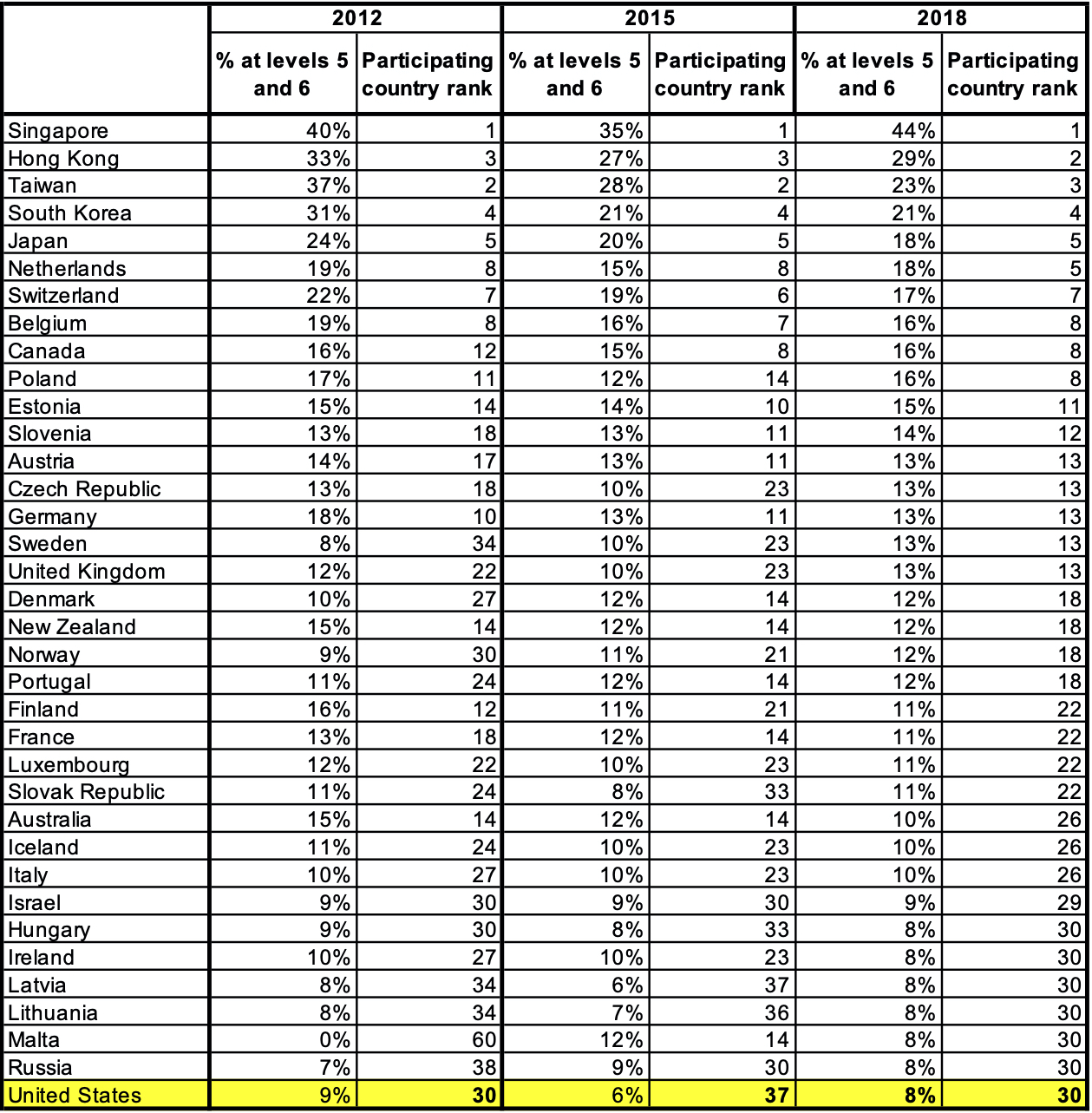
PISA assesses fifteen-year-olds and organizes its scores into seven levels from 0 to 6, with high scorers commonly defined as those reaching levels 5 and 6. Table 1 shows the percentage of test-takers who reached those levels in math over PISA’s last three iterations for the United States and every country whose results were the same or better than ours in 2018, as well as each country’s international rank in each of those years. (The list is ordered by countries’ performance on the 2018 round.)

Table 1: Percentage of high scorers on PISA math and rank among participating countries, 2012–2018, for countries matching or exceeding U.S. results
wright table1

As is immediately clear, the United States has consistently fared worse than virtually all of our competitors, often by a wide margin. A whopping twenty-nine countries have a larger percentage of high achievers—including almost the whole of Europe and East Asia, Canada, and a smattering of countries elsewhere around the globe.

Moreover, despite some recovery from 2015’s somehow-even-grimmer results, our proportion of high achievers is a point lower than in 2012. And our rank is the same, placing us on the negative end of the year-to-year-progress spectrum: twenty of the thirty-five countries improved their rank; just eight fell, and all but one of them still outscore us. In fact, our percentage of students scoring at levels 5 and 6 hasn’t improved in almost two decades. Back in 2003, 2006, and 2009, our results were 10, 7, and 10 percent, respectively.

The problem is also deeper than these aggregate results are able to show. Five years ago, Checker Finn and I wrote a book about these very issues. Failing Our Brightest Kids: The Global Challenge of Educating High-Ability Students relied heavily on PISA math results, but also looked at TIMSS scores, which report on fourth- and eighth-graders, and dug into a number of socioeconomic indicators. Our conclusion then was more than alarming on both equity and excellence grounds:

Be it PISA or TIMSS…SES status, parent education, or the language spoken at home, America’s secondary students never do better than most of our competitors—not once. And we’re often at or near the bottom of the list, a deficit that deepens when we examine disadvantaged populations.

Yet here we are, a half decade later, evidently no better off.

Our book also examined reasons for this dismal situation, but those don’t appear to have changed, either. For starters, the United States has fared poorly at producing high achievers because we haven’t made this a priority. One-third of American schools don’t have any gifted programming at all, meaning they do nothing different or special for these kids during school, after school, or on the weekend. Among the two-thirds of schools that do something, many supply just small “enrichments” for an hour or two, better than nothing, of course, but unlikely to make much difference in students’ achievement. Among those that manage to offer more robust gifted programming, many staff it with teachers or non-teachers who have not been trained to educate bright students. And in the relative handful of schools that avoid the preceding pitfalls, many under-identify and under-serve low-income, black, Hispanic, and Native American children.

Yet the failure arises from more than simple oversight and neglect. Its roots include disputes over ideology, disagreement over the definition of “gifted” and how to identify children who meet that definition, squirrely data, feeble political support, fretting about “elitism,” and more.

Yes, there are a couple of bright spots. Given America’s large population, we have a greater total number of high achievers than many other individual countries—though, importantly, not the European Union as a whole, and perhaps not China. Recent fourth and eighth grade scores on the Nation’s Report Card also suggest that we’re doing something right for these kids, particularly in math, and maybe those results can be sustained in high school. But there’s little historical support for that. And we’re never going to truly turn around this big and persistent problem until we acknowledge it and set out purposefully and diligently to tackle it. That we should do for at least two big reasons. First, high achievers, especially those from disadvantaged circumstances, need and deserve our help. Second, better results are essential if America is to continue competing successfully in the global marketplace. As it stands, our place in the world is threatened by our educational shortcomings.


view

Hiding in plain sight: Advancing SEL by tackling today’s urgent problems

Chester E. Finn, Jr.
1.29.2020
Flypaper

Partisans of social-emotional learning are wont to make their case in utopian terms: Create better learning environments and good things will happen to kids, to academic achievement, to the society in which we live, etc.

From the home page of the Collaborative for Academic, Social, and Emotional Learning (CASEL):

Our work is critical at a time when educators, parents, students, and employers increasingly recognize the value of SEL. Together, we are united in our call for schools to educate the whole child, equipping students for success in school and in life.

Here’s how Aspen’s National Commission on Social, Emotional, and Academic Development began its final report a year ago:

After two decades of education debates that produced deep passions and deeper divisions, we have a chance for a fresh start. A growing movement dedicated to the social, emotional, and academic well-being of children is reshaping learning and changing lives across America. On the strength of its remarkable consensus, a nation at risk is finally a nation at hope.

Even when addressing policymakers, the utopian impulse remains strong. The Commission developed an entire separate “policy roadmap” aimed at those folks and urging to advance the cause. Here’s its pitch:

Policy can play an essential role in moving efforts to support the whole learner from the periphery to the mainstream of American education, and from the realm of ideas to implementation. This document is rooted in the belief that policy should create enabling conditions for communities to implement locally crafted practices that drive more equitable outcomes by supporting each and every student’s social, emotional, and academic development.

Nothing wrong with any of that, except…that’s not actually how policymakers tend to think or set priorities for actual actions that are within their power to take. Keep in mind how concrete and finite are almost all of those actions. They can pass laws, issue regulations, hire people, create budgets and appropriations—and sometimes use their bully pulpits and hearings and such to draw attention to things.

That’s about all the weapons in their arsenals. But what do they deploy them against? By and large it’s not against utopian goals and ambitious change-the-world schemes and top-to-bottom institutional rebootings, no matter how worthy. There’s very little constituency for such things.

What they are motivated to attack are concrete problems in the here and now, the kind that worry their constituents, that have some political payoff, that rectify injustices, advance tangible goals, and boost positive metrics that people notice and care about.

Concrete problems, immediate challenges, visible irritants, attainable goals—things that are clear and present and mostly tangible. Not utopian.

That, I believe, is the big divide between most SEL proponents and their policy language, and bona fide policymakers and the sorts of things they focus on.

But it’s a bridgeable divide, bridgeable if the SEL crowd will recognize that a nontrivial number of the clear-and-present problems already on the minds of policymakers would, if successfully addressed, advance the SEL cause in big ways. Not just “recognize” this but also strategize with policy folks about tangible solutions to here-and-now problems that, viewed another way, are manifestations of the need to do something about SEL (and, often, students’ mental health, safety, and wellbeing).

Let me illustrate with six examples. Remember: Start with the problem that’s already on people’s minds, not a grand vision of how to make the education world a better place:

  • Bullying, violence, weapons, and discipline. These could be viewed together or separately, and there’s not always a consensus on policy remedies. Yet almost everyone agrees that schools need to be safe places for kids, both physically and emotionally. Nobody wants weapons (much less shooters) in school, kids hurt by other kids, or classrooms so disrupted that learning is interrupted. Easing any—much less all—of these problems in schools would be a huge boost for SEL.

  • Drugs—opioids especially, plus vaping and other addictions. The generic “drug problem” has been on the policy agenda for a long time, and there are sundry school-related programs to address it, as well as much research, mainly in the medical arena. (See, for example, “The Role of Schools in Combating Illicit Substance Abuse” from the American Academy of Pediatrics.) But today’s opioid crisis is tearing apart families and communities, with dire consequences for kids and schools. As with so many big challenges, much of it arises outside school, and it’s not something that schools alone can solve. But it would behoove the SEL crowd (and the many educators who want to advance it) to ally themselves with broader efforts to curb the drug problem.

  • Homelessness. Schools can’t solve the underlying problem here, either, but many actions within their power can ameliorate its education effects, such as enabling kids to remain in the same school when they move or enter a shelter. Longer school days and help with food, clothing and hygiene are also beneficial.

  • Over-testing and over-reliance on test scores to judge schools, kids, etc. This is obviously a hot issue, much on parents’ minds as well as teachers’, and a nontrivial part of the push for SEL and whole-child education stems from concern that U.S. education policy is too narrowly focused on the things that tests purport to measure—and in just a few subjects. Among the problems on my list, this one is most squarely within the purview of ed policy, yet changing anything major would require coordinated efforts across all levels of government, as well as substantial changes in school structures and practices.

  • Drop-outs. There are umpteen efforts to reduce drop-out rates and boost graduation rates. Some—such as ersatz credit recovery—introduce their own problems. But top-notch, fully-aligned schools and systems that are able to serve kids successfully, engage their interests and meet their needs from K (or pre-K) through high school, often customizing and personalizing their school experiences, are the best possible antidote. And by engaging their interest and meeting their needs—social and emotional, as well as academic—much good will be done for those kids, their peers, their families, and our society.

  • Civics, citizenship, and character. These can get controversial within SEL ranks, but there’s huge policy interest across the country now in better civics education and in developing young people into good citizens, with all that that entails. There’s also much parental concern with children developing sound character and values. As I see it, the case for SEL will be strengthened in many quarters if the explicit linkages are made and—once again—if SEL promoters ally themselves with purposeful efforts to advance character and civics education.

Whatever you think of these particulars, I hope the strategic point is by now obvious: The policymakers that SEL devotees seek to engage in advancing their mission are more likely to resonate with an approach based on problems that they (and their constituents) already recognize and want to do something about than an approach that basically portrays an idealized form of education and urges them to help make it happen.

view

Using screen-time to boost children’s science and engineering knowledge

Brandon L. Wright
1.29.2020
Flypaper

Children’s screen-time is an important issue. The American Academy of Pediatrics recommends that kids from ages two to five consume only high-quality programming, and only for an hour a day. And studies demonstrating the potential harm of too much screen-time are released regularly, such as one from Cincinnati Children’s Hospital Medical Center late last year that found that exceeding AAP’s limits was associated with reductions of brain structures that “support language and emergent literacy skills.”

Yet alongside the stern warnings and unsettling findings is evidence that screen-time, when used smartly and in moderation, can have significant benefits, and that a big part of reaping them is choosing good content. To that end, the Education Development Center and SRI Education enlisted Todd Grindal and a team of researchers to examine how a single multi-platform media property—TV show, app, website, physical materials—focused on science and engineering education impacted the learning of young, disadvantaged children.[i]

The researchers picked The Cat in the Hat Knows a Lot About That!, which comprises videos, digital games, hands-on activities, and printed descriptions of science and engineering activities. Content areas include friction, sound and soundwaves, inclines, bridges, buildings, object sorting, using all five senses, and making observations. Big, well-known corporations were involved in its development, including PBS, the Corporation for Public Broadcasting (both non-profit organizations), Random House, and Portfolio Entertainment, a private firm that distributes television programming to more than ninety countries.

Grindal et al. randomly assigned 454 low-income four- and five-year-olds from five large American metropolitan areas to receive either the Cat in the Hat material or alternative content. Both groups received a tablet computer and eight weeks of internet access and data. The treatment group’s tablet had access to the Cat in the Hat materials, while the control group had that and similar content blocked. Parents in both groups were asked to have their children watch and interact with educational content, and all moms and dads were provided with study information, basic tips for using the tablets, and text message reminders. Using assessments and a parent survey, the team collected data on the subjects’ science and engineering knowledge and practices before the experiment and then again eight weeks after it commenced.

The researchers found that, compared to the control group, “exposure to The Cat in the Hat Knows a Lot About That! resources had meaningful impacts on four- to five-year-old children’s physical science knowledge and their ability to engage with science and engineering practices.” This was particularly true in the kids’ understanding of how the strength and length of physical materials affect the stability of structures, and how texture and friction affect an object’s movement down an incline. The exposure also had a clear and positive impact on the children’s interest and engagement in science.

Despite the study’s rigorous experimental design, it has limitations that reduce its generalizability. The sample is not nationally representative. Families were also recruited on social media, so they could be different than families who aren’t on such platforms. And the entire experiment is based on kids having both a tablet and regular internet access, which isn’t true for millions of families, especially low-income ones.

Still, the study’s findings are noteworthy. They suggest, as the team writes, that “educational media designed to focus on critical science and engineering concepts and skills can help young children understand science and engineering concepts and practices.” High-quality screen-time can also improve young kids’ content knowledge—something that’s essential to teaching reading, as E.D. Hirsch argued for thirty years and cognitive scientists like Dan Willingham have later proved. Grindal et al. rightly add that “These findings are especially important given the relative scalability and low per-child cost of media-based interventions.” Technology is ubiquitous, and the degree to which it permeates our lives will only increase in the future. It’s vital that we develop methods of using that it that help rather than harm—especially when it involves our children and their education. This study suggests we can.

SOURCE: Todd Grindal et al., “Early Science & Engineering: The Impact of The Cat in the Hat Knows a Lot About That! on Learning,” Education Development Center and SRI Education (November 2019).


[i] According to lead author Todd Grindal, “The study was conducted as part of the Ready To Learn Initiative, which is funded through the U.S. Department of Education. Ready To Learn supports a range of public media developed to serve the needs of children living in low-income communities. This study is part of a series of studies that have been conducted by researchers at EDC and SRI to support this goal.”

view

The case for focusing SEL on social-network building

Tran Le
1.29.2020
Flypaper

While education reform conversations about social and emotional learning (SEL) often include the value of interpersonal skills in creating and maintaining relationships, a new report from the American Enterprise Institute calls for increased emphasis on expanding student access to relationships and networks. From peer mentoring to group projects, discussions with guest speakers to video chats with experts, or job shadows and internships, schools can provide opportunities for students to form new relationships. In this way, SEL can unlock access to social and professional networks that would otherwise be out of reach.

Author Julia Freeland Fisher examines the potential harm in concentrating on SEL skills at the expense of network building. She claims that even if students possess the interpersonal and intrapersonal competencies to thrive socially, they can’t put those skills to use if they’re not a member of existing networks. And because one’s access to networks largely depends on one’s family, community, and geography, the focus placed on improving skills perpetuates a “myth of meritocracy,” ignoring the role that relationship access plays in increasing opportunity.

She also cautions that excessive attention to improving school climates—without cultivating students’ out-of-school relationships—may lead to school buildings that are insular to the point of isolationist. Although developing tight-knit relationships and school communities is one important goal of SEL, another should be forming connections beyond school to broaden students’ long-term options in their professional lives and build their social capital.

Fisher offers five recommendations for achieving balance between teaching SEL skills and opening up access to relationships. One is to expand our perception of relationships—treat them as SEL outcomes, rather than as sole inputs for skill development. Another is to utilize SEL tools that teach and assess skills in authentic peer-to-peer and student-teacher relationships instead of through simulations (to level the playing field for students with fewer opportunities and less robust networks). Third is to diversify students’ professional networks through connections with community members and industry experts. Fourth involves determining which relationships and SEL competencies align with one another so that schools can adopt SEL approaches with specific intent, e.g., empathy fosters tolerance, and communication skills enable productive participation. Finally, Fisher suggests that SEL researchers conduct studies at the intersection of SEL, youth development, and social network analysis in order to gather data on the interaction of skill and network development.  

For advocates, practitioners, and leaders, this report shows how SEL can be used as a tool for alleviating (or exacerbating) inequality. Framing the national SEL conversation around the development of skills alongside increased access to networks could help ensure that all students gain the social competencies and supportive connections needed to succeed in their academic, personal, and professional lives. Thus, future investment in SEL should mean investing in skills and relationships.

SOURCE: Julia Freeland Fisher, “Can social and emotional learning models aim to create relationships?” American Enterprise Institute (January 2020).

view

The Education Gadfly Show: School Choice Week 2020

1.29.2020
Podcast

On this week’s podcast, Mike Magee, CEO of Chiefs for Change, joins Mike Petrilli and David Griffith to discuss National School Choice Week. On the Research Minute, Amber Northern examines how teachers who specialize instead of teaching all subjects affect elementary school outcomes.

Amber's Research Minute

Kevin C. Bastian and C. Kevin Fortner, “Is Less More? Subject-Area Specialization and Outcomes in Elementary Schools,” Education Finance and Policy (December 17, 2018).

Fordham Logo

© 2026 The Thomas B. Fordham Institute
Privacy Policy
Usage Agreement

National

P.O. Box 110
Burke, VA 22009

202.223.5452

[email protected]

Ohio

P.O. Box 82291
Columbus, OH 43202

614.223.1580

[email protected]

Sponsorship

130 West Second Street, Suite 410
Dayton, Ohio 45402

937.227.3368

[email protected]