
In recent years, the traditional grading practices of U.S. schools have been criticized for failing to correct longstanding social inequities. Proposed “reforms”—which supposedly promote “equity”—include awarding half-credit for assignments that are never completed, allowing students to retake tests and quizzes without penalty, and giving no credit for homework or classroom participation.
Anecdotal evidence suggests that many teachers have adopted some of these practices, as have a non-trivial minority of departments, schools, and districts where so-called “no zeros” policies are effectively mandatory. Yet, to our knowledge, there has been almost no research on the prevalence or efficacy of “grading for equity.” So we asked Fordham analysts David Griffith and Adam Tyner to craft a few questions about this topic for RAND’s nationally representative teacher panel, which lead to our latest study, “Equitable” Grading Through the Eyes of Teachers.
As shown in Figure 1, the results suggest that teachers are skeptical of the five “equitable” practices that are the new report’s focus, at least one of which (those same results suggest) has now been adopted by no less than half of America’s public schools and nearly three-quarters of the country’s “majority minority” middle schools.
Figure 1. Teachers are skeptical of most “equitable” grading practices.
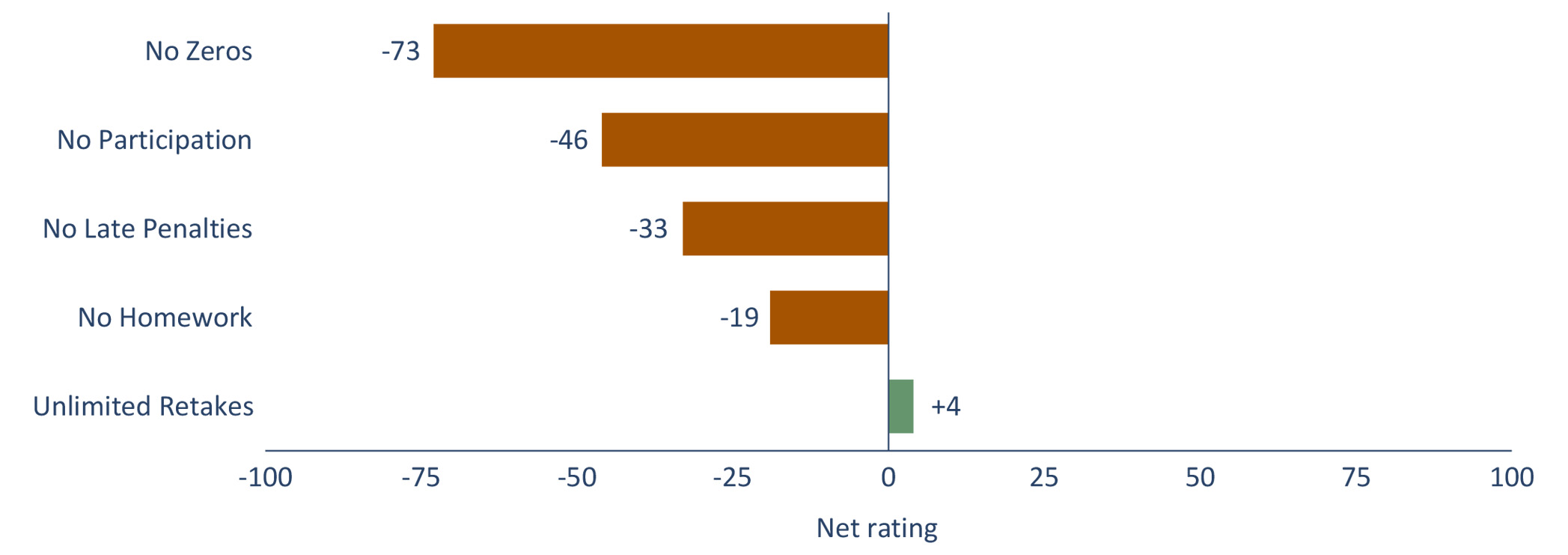
Turns out, teachers don’t like it when the powers that be take a sledgehammer to their few sources of leverage over student motivation and effort. Nor do they like giving students grades they don’t deserve.
So how did we get here?
Although debates over grading aren’t new, there are two sides to the most recent chapter of this story—one well-meaning, the other indefensible.
The sorta-kinda-understandable take, advanced by consultant Joe Feldman among others, is that traditional grading practices don’t focus enough on student learning, and that “standards-based grading” would more accurately reflect whether students have mastered the knowledge and skills articulated in state standards (and encourage them to keep at it until they do). Therefore, we shouldn’t include homework or class participation in students’ grades (as these reflect effort and diligence, not achievement), and we should allow re-takes and re-dos of tests and assignments until students demonstrate mastery.
That’s all well and good except that—as Tyner and colleague Meredith Coffey argued last year in their policy brief, Think Again: Does “equitable” grading benefit students?—in practice, these policies “tend to reduce expectations and accountability for students, hamstring teachers’ ability to manage their classrooms and motivate students, and confuse parents and other stakeholders who do not understand what grades have come to signify.”
The wholly indefensible arguments that lurk beneath the recent push for “equitable” grading, meanwhile, represent little more than a return to the “soft bigotry of low expectations.” Stemming from the writings of scholars such as Ibram X. Kendi and Tema Okun, this pseudo-intellectual approach seeks to close whatever racial gaps it encounters by shooting the messenger. For example, by Kendi’s reasoning, any racial disparity—such as the fact that the average Black student’s GPA is nearly half a point lower than the average White student’s—is a sign of racism. Therefore, something must be wrong with the grades.
Or consider Okun’s offensive assertion that “punctuality” is a feature of “white supremacy”—a claim that still shows up in teacher professional development nationwide—and that regards as racist any grading of students on factors such as attendance or participation. It’s hard to know what to say to this claim except that, if we truly believe in all our students’ potential, it is obviously wrong, as are policies that give Black students tacit permission to skip class.
Given the influence that such ideas achieved during the “Great Awokening,” it’s not surprising that evidence-free arguments for “equitable” grading have gained some purchase. But despite the fact that Peak Woke seems to be behind us, the data suggest that many places are still dealing with “reformed” grading practices that teachers simply don’t support.
So, rather than continue to pay unwitting homage to ideas that most Americans reject, we should listen to teachers and go back to tried and true methods that reflect high expectations for all students.
After all, it’s not unrealistic or racist to expect students to come to class and do the work. Nor is it unreasonable or cruel to assign grades that accurately reflect their lack of effort or mastery when the alternative is allowing them to exert minimal effort and consequently fall further behind.
Otherwise, how often should we expect the one in four U.S. students who are chronically absent to come to class if there is no reward for participation or penalty for late work? How hard should we expect the typical middle schooler to try if they can get a C by completing less than half of their assignments? Does anyone really believe that inflated GPAs will help high school students who haven’t really learned anything to land high-paying jobs after they graduate?
In short, if our goal is to prepare them to succeed in the real world, don’t we owe the millions of American students whose futures depend on a solid K–12 experience at least a few zeros?