With elections over and the next state budget process around the corner, school funding will soon be top of mind for Ohio lawmakers. On the campaign trail, Governor-elect Acton has promised more funding for public schools, but the level of increase and how dollars are allocated to schools will certainly be subject to negotiation. Statehouse discussions are apt to center around the funding formula and the amounts provided to traditional districts.
Yet districts are not the only public schools educating Ohio students. In 2025–26, roughly 86,000 Ohio students attended 323 brick-and-mortar public charter schools—independently run, tuition-free, and publicly accountable alternatives to traditional districts.[1] Approximately three in four of these charter students attended schools in the Ohio Eight cities: Akron, Canton, Cincinnati, Cleveland, Columbus, Dayton, Toledo, and Youngstown. Funding the education of these students—most of whom are low-income—also merits serious consideration in the coming debates.
Regrettably, Ohio has long treated charter students as second-class citizens. Studies conducted between 2005 and 2019 found that urban brick-and-mortar charter students received approximately 30 to 40 percent less in education funding than their local district counterparts. These inequities were deeply unfair to charter students and their families who paid a penalty because of their educational choices. They also had real-world consequences for charter schools, such as impeding their ability to pay competitive teacher salaries and discouraging plans for expansion.
The funding gap was rooted in policy structures disadvantaging charters. Despite being public schools serving the community, charters have never had access to local taxpayer funds (with only a limited exception in Cleveland). Meanwhile, the state has struggled to fully offset the absence of these local dollars and bring charters to parity with local districts. In a 2019 report, we at Fordham called on Ohio lawmakers to equalize charter funding by “either ponying up more money from the state budget or requiring local school boards to share locally generated revenue.”
Since then, Ohio has taken commendable steps to narrow the charter funding gap via enhanced state funding. Starting in FY20, high-performing charters have received additional aid through the Quality Community School Support Fund (QCSSF). Research by Ohio State University professor Stéphane Lavertu has demonstrated the importance of these funds, as charters used them to boost teacher pay and stabilize their workforce. The program has also generated a strong return on investment, with the dollars yielding achievement gains for students attending qualifying charters.
The high-quality program also put a dent in the funding gap. In my analyses of the Ohio Eight schools, the average disparity narrowed to just 11 percent in FY24 for high-performing charters. This notable gap reduction coincided with an enhanced QCSSF award ($3,000 per economically disadvantaged pupil instead of $1,750).[2] It was also the first year in which both high-quality charters and nonqualifying schools received additional state aid through an equity supplement of $650 per pupil. As Figure 2 indicates, these initiatives narrowed the overall charter funding gap to 23 percent by FY24.
Figure 1. Ohio Eight average charter school funding gap, by high-quality (HQ) status
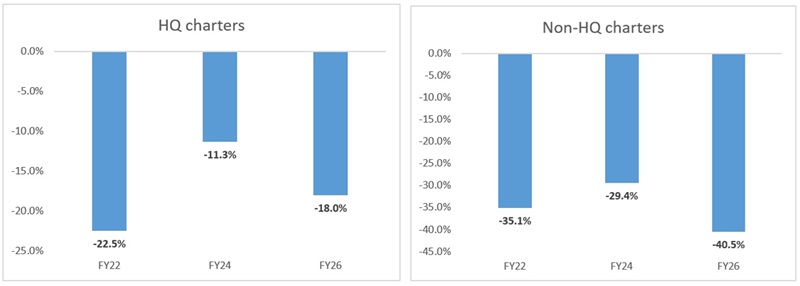
Figure 2. Overall Ohio Eight average charter school funding gap
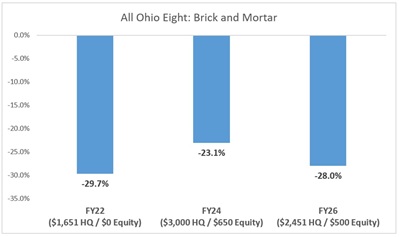
As evident in the figures above, the momentum stalled out between FY24 and FY26, something we predicted with chagrin after lawmakers passed the state budget in 2025. In fact, the gap has noticeably widened, with charter schools qualifying for QCSSF dollars receiving 18 percent less than districts and non-qualifying schools funded at a startling 40 percent less. The overall charter funding disparity in the Ohio Eight rose to 28 percent, just shy of the FY22 gap. What happened?
Two factors help explain this troubling reversal.
- In FY26, charters received significantly diminished per-pupil funding through QCSSF and the equity supplement—the two funding streams that do the heavy lifting in closing the gap. Reduced QCSSF amounts ($2,451 per economically disadvantaged pupil in FY26 compared to $3,000 in FY24) are due to the “prorations” required to avoid exceeding the program appropriation. Had charters received the maximum award, qualifying schools would have experienced a 13 percent shortfall, instead of 18 percent. The equity supplement also declined from $650 to $500 per pupil in FY26; it will fall again to $400 per pupil in FY27.
- Traditional districts in the Ohio Eight—the comparison group in these analyses—have enjoyed strong local tax revenue growth driven by rising property values. In FY24, the Ohio Eight districts collected $1.61 billion in local revenue and $1.80 billion two years later—a 10.2 percent increase in nominal terms. None of these gains were shared with public charter schools, thus further widening the funding disparities between districts and charters.
Governor-elect Acton and the 137th General Assembly will need to devise a fiscally responsible budget that positions Ohioans for success and treats citizens fairly. Among Ohio’s youngest citizens, 86,000 attend public charter schools, and those students merit a high-quality education—and the resources that enable their schools to deliver it. With the funding gap widening, policymakers must redouble their efforts to provide fair and equitable funding by increasing the state’s investment in the high-quality charter fund and the charter equity supplement.
[1] Another 36,000 students attend public online charter schools, which are funded slightly differently than site-based charters.
[2] $1,750 was the maximum award but due to an appropriations cap, the actual amount qualifying charters received between FY20 and FY23 was less (e.g., $1,416 per economically disadvantaged pupil in FY23). Qualifying schools received $1,000 per non-disadvantaged pupil between FY20 and FY23 and $2,250 starting in FY24 (these amounts are also subject to reductions).