After years of mounting concern about students and screens, the techlash came to a head in June when the Los Angeles Unified School District made headlines for approving a new screen-time policy for students.
The policy is blunt by design. It limits students’ school-assigned screen time on district-issued devices (such as laptops and tablets),[1] counting both in-school use and homework. Students in pre-K through first grade cannot use school devices for instruction at all, while older elementary students are limited to 60 minutes per day. Middle and high schools have subject-specific limits; for example, high schoolers may spend no more than 90 minutes per subject per week on screens, up to a weekly maximum of 600 minutes or ten hours.
Opinions were predictably mixed on whether LAUSD got it right. Some welcomed the limits, while others thought tech deserved a more nuanced accounting of its virtues.
Yet whatever one thinks of America’s second-largest school district’s attempt to limit the downside of technology, one thing is clear: LAUSD tapped into the national zeitgeist. Weary of children transfixed by devices, isolated from peers and adults alike, district leaders responded to parental pressure and essentially said, “Enough is enough! There has to be a better way.”
Though we might quibble about the details, we at Fordham agree with the impulse. It sure seems, from the outside, that technology has transformed the school experience, especially during high school, and not necessarily for the better. But to find out for sure, we decided to ask the kids themselves. We wanted to know whether students see technology as useful to their learning—or whether they’re weary of tapping keys and scrolling screens. (Some recent polls pointed to the latter.)
We also wanted their sense of just how pervasive technology use is in schools and what misuse on their part might look like. More specifically, how have school-issued devices contributed to distraction and academic dishonesty? How do grading policies and artificial intelligence exacerbate those challenges? And most important, what can schools do now—long after the genie has escaped her proverbial bottle—to preserve the benefits of technology and AI while reducing their harms?
A new Fordham report, High Tech, Low Standards: High School in the Age of Distraction, answers these questions. It draws on a nationally representative survey of 1,011 current high school students and 1,013 recent graduates, fielded by Impact Research and UpONE Insights, with Fordham’s Brian Fitzpatrick leading the analysis and report writing.
The investigation yielded four big findings.
First, illicit tech use is rampant.
Seventy-six percent of respondents report personally engaging in at least one form of illicit technology use on a daily basis during high school, including scrolling social media, messaging friends, and shopping or gambling online (Figure 1). Roughly one-third report daily YouTube viewing or recreational gaming, while more than one in five say they use AI without permission.
Figure 1. Taken together, 76 percent of respondents report some kind of daily illicit tech use during high school.
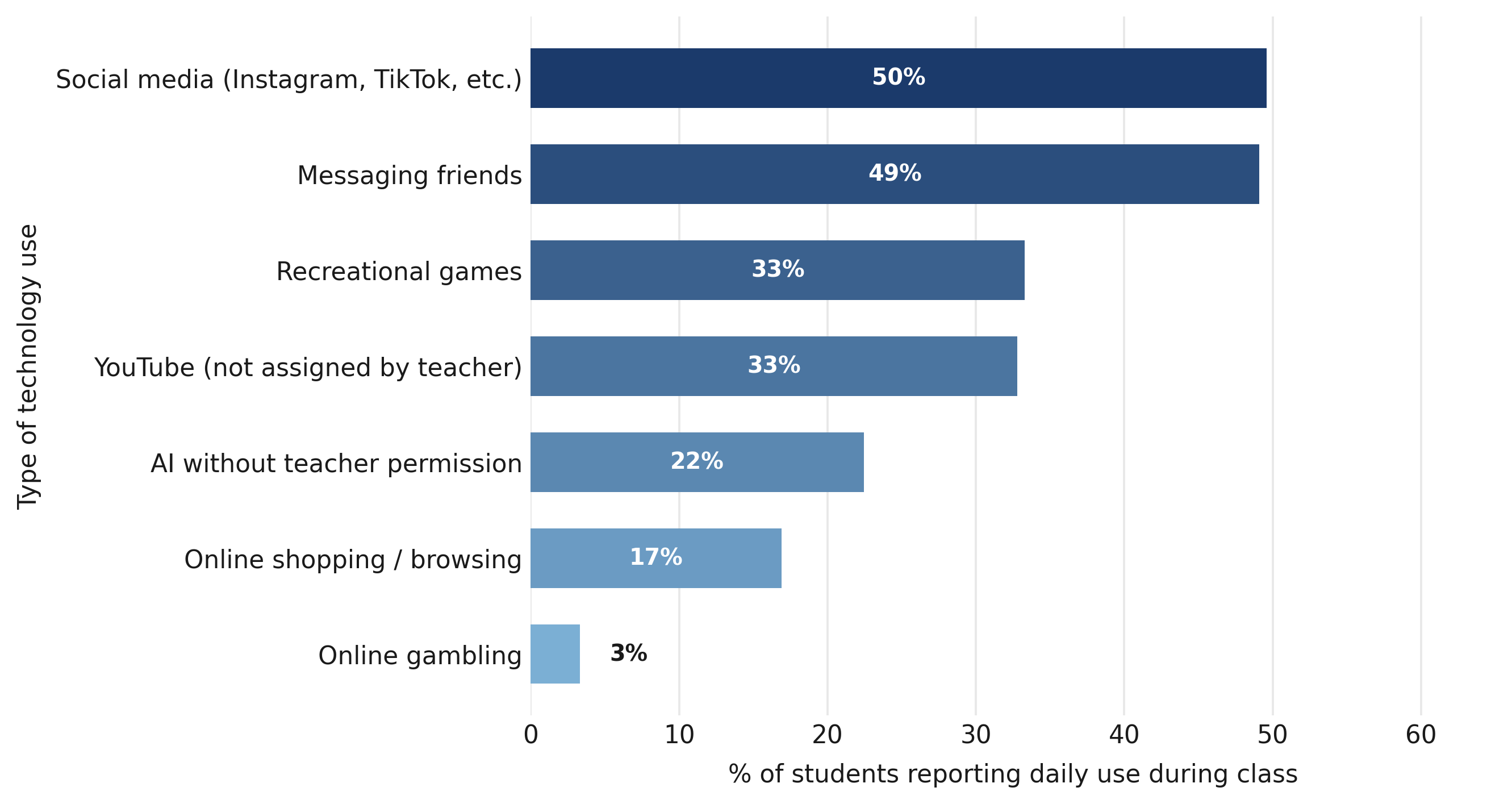
Note: Each bar represents the percentage of respondents who report that they use each technology “multiple times a day” or “once a day” during school hours. Because respondents could select all that apply, the 76 percent figure reflects the share who reported at least one of these behaviors daily.
Second, AI is undermining the high school experience.
Many students are using AI not to support their learning but to bypass it altogether (Figure 2). While roughly half of respondents say they use AI to explain difficult concepts and brainstorm ideas, that same proportion say they use it to “solve math problems.” One-third (36 percent) use it to summarize books or other texts to avoid reading them, 29 percent to write the first draft of an essay or report, and 26 percent to help during quizzes or tests. Lest the point be missed: those uses sound an awful lot like cheating.
Figure 2. The most common uses of AI are legitimate, but many students also use it to cheat.

Note: Bars display percentages of respondents who report using AI for each task during high school.
Third, most U.S. high school students and recent graduates say they spend the majority of class time on school-provided devices.
Illicit use and sanctioned use are hard to tell apart. When so much of the school day runs through screens, it becomes difficult for teachers to know whether a student is completing an assignment or scrolling TikTok.
Figure 3 reveals that 62 percent of respondents spend more than half of their in-class time on school-issued devices. Let’s compare that to the new screen limits in Los Angeles. Under a typical six-hour school day, LAUSD’s cap would allow high school students to spend no more than about one-third of instructional time on screens. Based on our survey data, however, a student who spends at minimum half of class time on a school-issued device would log 900 minutes per week in this hypothetical schedule—50 percent more than LAUSD’s 600-minute weekly limit, and that doesn’t include doing homework on school devices.
Figure 3. Most respondents report spending between half and three-quarters of their school day on a school-issued device.
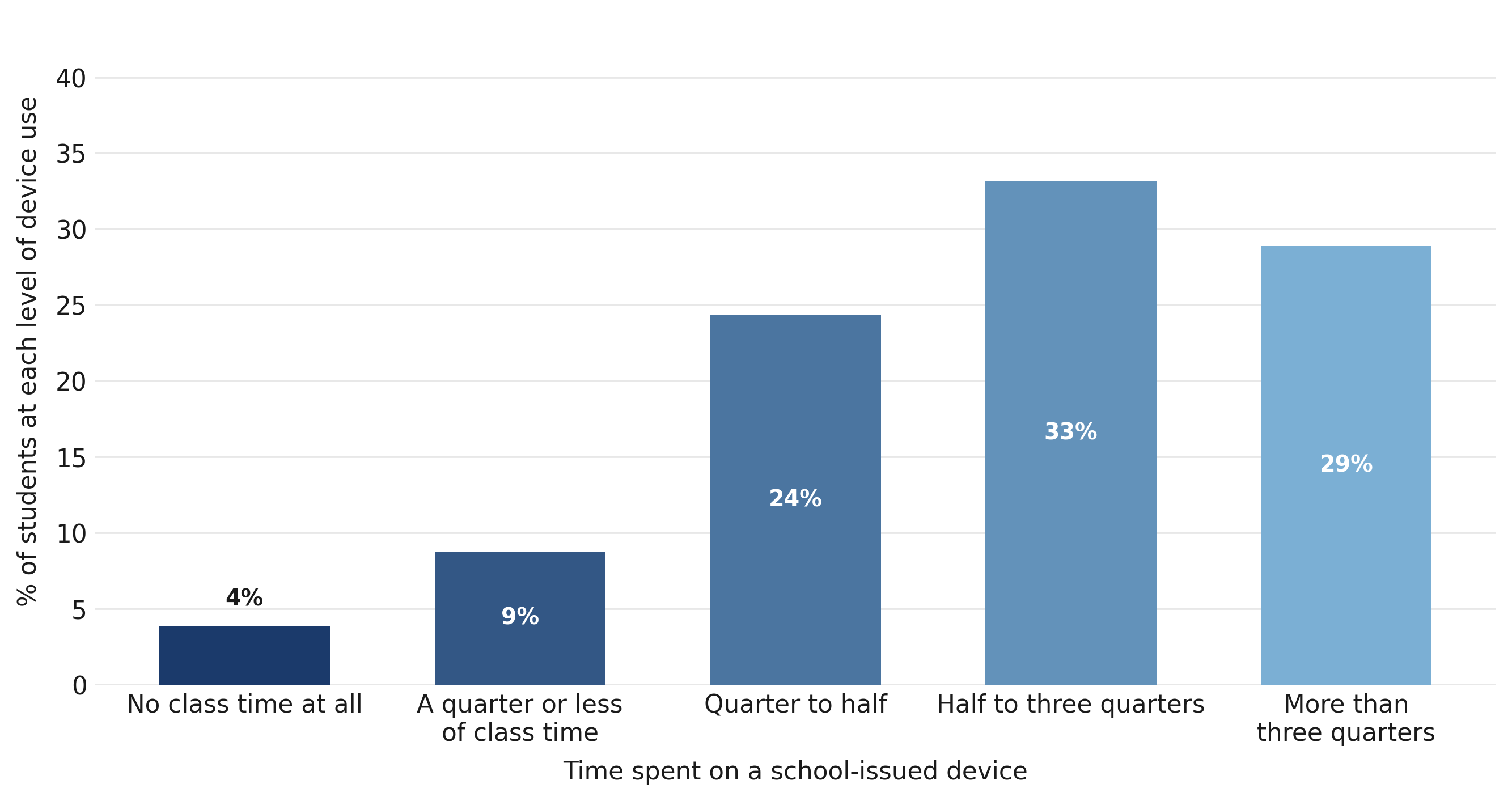
Note: Bars display the percentage of respondents at each level of self-reported device use in response to the question, “In a typical day, how much of your class time do/did you spend working on a device provided by your high school, such as a laptop or tablet?”
Finally, weak grading standards make distraction and AI misuse worse.
Many respondents report grading practices in their schools that lighten the consequences of not doing the work: partial credit for missing assignments, late-work policies that result in little penalty, and broad access to test retakes.
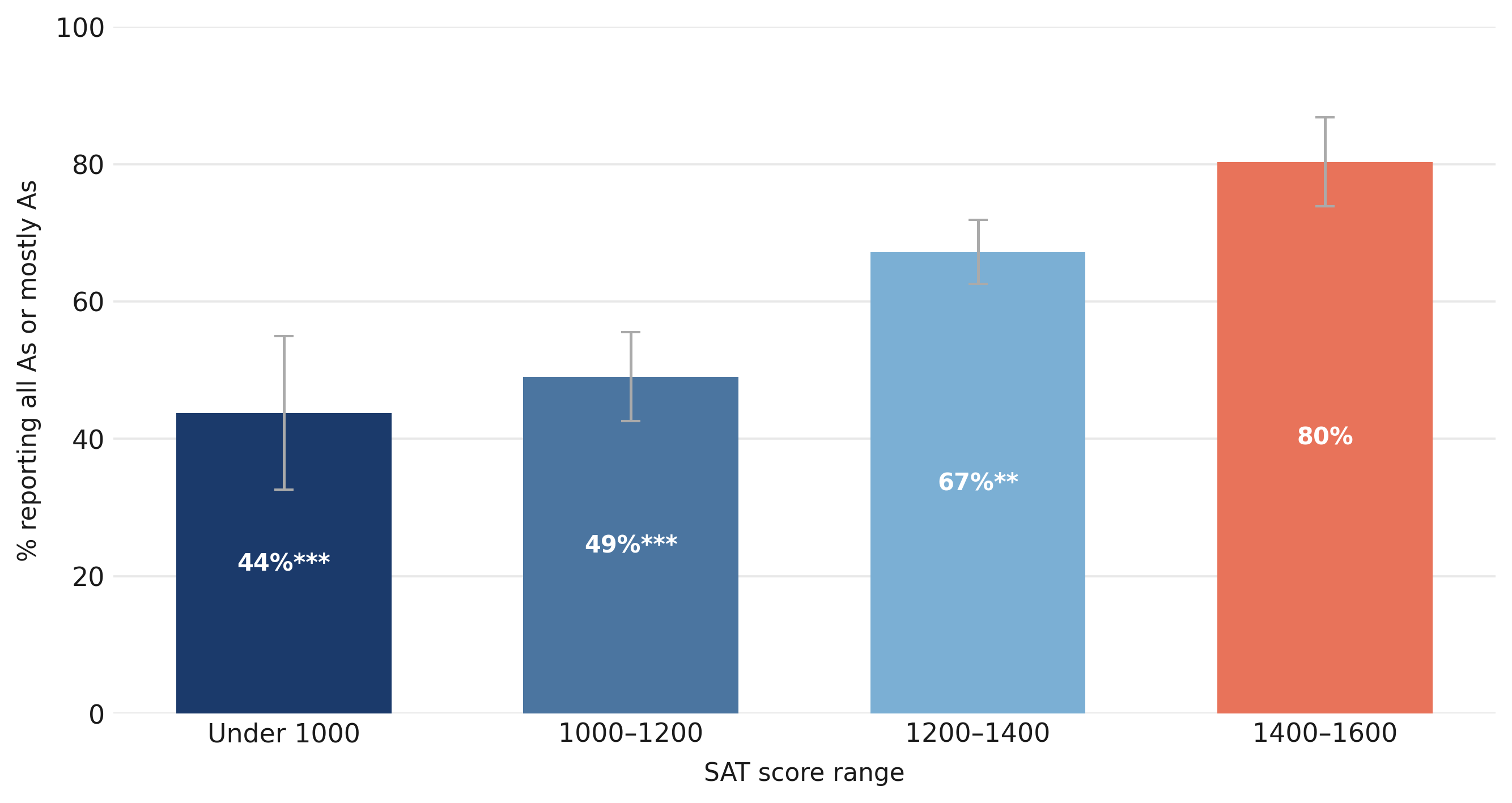
At the same time, grades are heavily concentrated at the top. Fifty-seven percent of respondents report earning all A’s or mostly A’s, including many whose SAT or ACT scores place them in the bottom half of the national achievement distribution (Figure 4). Put simply, high grades don’t always mean students have mastered the material.
Figure 4. A sizable minority of respondents at the bottom of the SAT and ACT score distributions still report getting all or mostly A’s.
Panel A
Panel B
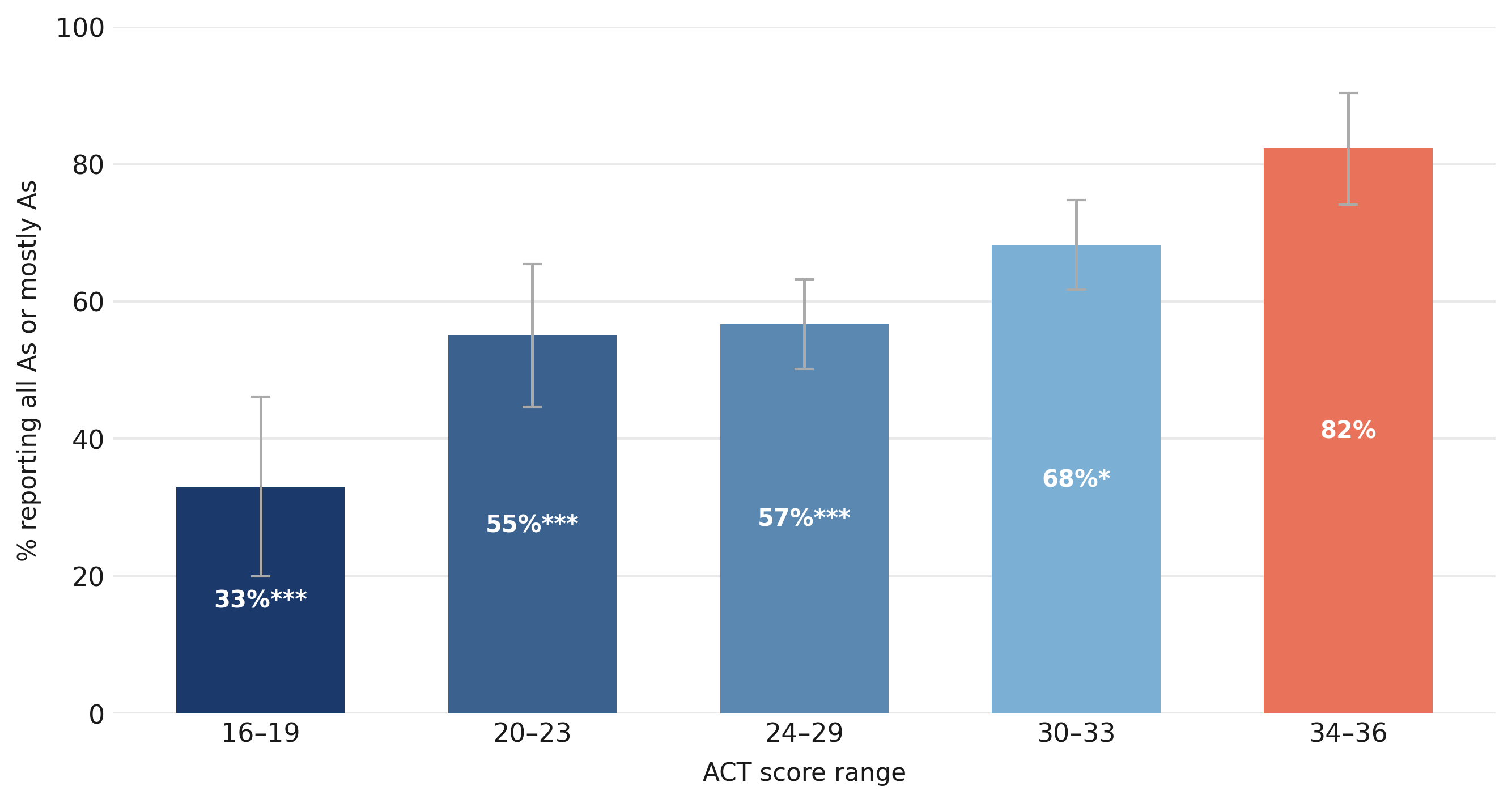
Note: Bars display the percentage of respondents who report earning all or mostly A’s in high school by self-reported SAT or ACT score range. The salmon-colored bar indicates the reference category (the highest SAT/ACT score range); confidence intervals calculated at the 95 percent level; + = p < 0.1, * = p < 0.05, ** = p < 0.01, and *** = p < 0.001.
Taken together, the findings suggest that American high school students are caught up in—and often contribute to—a disturbing and interconnected set of problems: rampant distraction, widespread AI misuse, heavy dependence on screens, and grading practices that make it easier to earn high marks without mastering the material.
What to do? Fitzpatrick urges states, districts, and schools to take five steps (some of which echo LAUSD’s policy):
- Reduce the amount of time students spend on devices.
- Place greater reliance on supervised, in-class, paper-and-pencil, and oral exams.
- Make grading expectations school-wide and explicit by eliminating routine retakes and enforcing valid consequences for late work.
- Ensure that school-device firewalls work.
- Adopt stricter bans on cell phones and other personal devices.
We of course agree, but here are three additional observations.
First, device-delivered education runs the risk of diminishing the role of the teacher. In the hands of a less skilled instructor, technology can shift the teacher’s role from knowledgeable expert who sets high expectations and builds trusting relationships to a classroom monitor who watches students work on screens and tries to enforce on-task behavior. When technology endeavors to replace effective teaching rather than support it, districts and schools need to tap (or slam!) the brakes.
Second, this whole thing brings to mind the late Theodore Sizer’s much-lauded 1984 book, Horace’s Compromise, named for fictional high school teacher Horace Smith, who tacitly agrees not to push his students too hard if they agree to sit quietly and cause no trouble. Sizer summed it up as, “Give a little, and get along.” Today, Horace’s students would have screens to help them sit quietly, making the compromise even easier. In other words, today’s kids can be sitting in class and still be somewhere else entirely.
And that, in our view, is the deeper danger with overreliance on screens and AI, in combination with weaker expectations and easier grading. Students can “check out” without leaving the classroom. Over time, that means that precious few will develop the knowledge, concentration, and self-discipline they need to reach their full academic and cognitive potential in life and in service of society.
Third, the combination of AI-driven cheating, tech-enabled distraction, and equity-minded grade inflation is hollowing out the American high school experience. Today it’s beginning to seem more performative than substantive. Yes, high schools have always included some amount of hoop-jumping, box-checking, and authority-pleasing; that’s the nature of any large bureaucratic organization, and young people have to learn to deal with it. (One of us—guess who—facetiously calls it the “bull-shittification of high school!”) But that doesn’t mean we have to keep piling it on. If classes can be endured by zoning out on screens, assignments evaded through cheating, and high grades awarded without mastery, then we have to ask ourselves: What are we even doing here?!
If we listen to young Americans, we hear that the high school experience is not working as it should—and that the problems go deeper than tinkering around the edges. Screen-time limits and such might help, but only if paired with a major rethinking of the high school experience. Yes, that means going back to pencil-and-paper assignments, recalibrating what it takes to get an A, and putting the Chromebooks back in their carts. All that will help. But it also means asking our teenagers to do cognitive work that really matters to their futures, whether of the traditional college-prep variety or something more career-oriented.
In other words, we will only solve these problems by restoring the basic conditions for learning: attention, effort, honest work, and adults willing to hold adolescents to high expectations.