
The latest twelfth-grade results from the National Assessment of Educational Progress are awful, as so many outlets pointed out over the last week. Average math and reading scores hit their lowest levels on record—going back to 2005 for math and 1992 for reading—with the bottom of the score distribution faring the worst. This, rightly, is where most of the commentary and policy efforts will focus. But it shouldn’t be the only focus—because marks at the high end were bad, too.
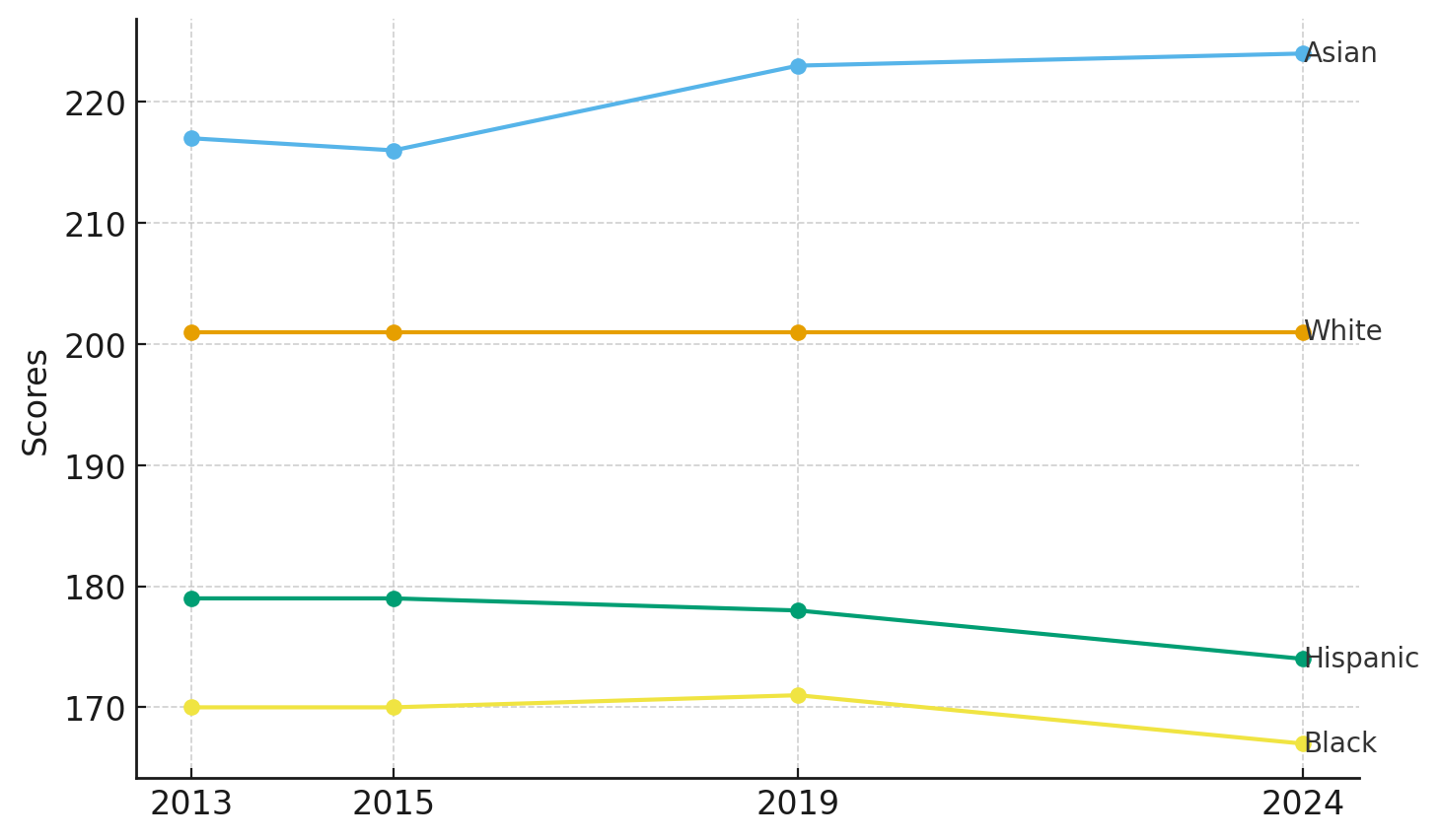
Math performance at the Advanced achievement level and the 90th percentile is flat, and there were notable declines for top-decile Hispanic and Black students (see figure 1). Drops among those two groups are alarming, if not surprising. Since NAEP has been administered, the percentage of Hispanic students at Advanced has hovered around 0.5 and Black students have rounded to 0 percent—compared to, in the most recent results, 4 percent for White students and 15 percent for Asian students.
Figure 1. NAEP math scores, 90th percentile, by race/ethnicity, 2013–24
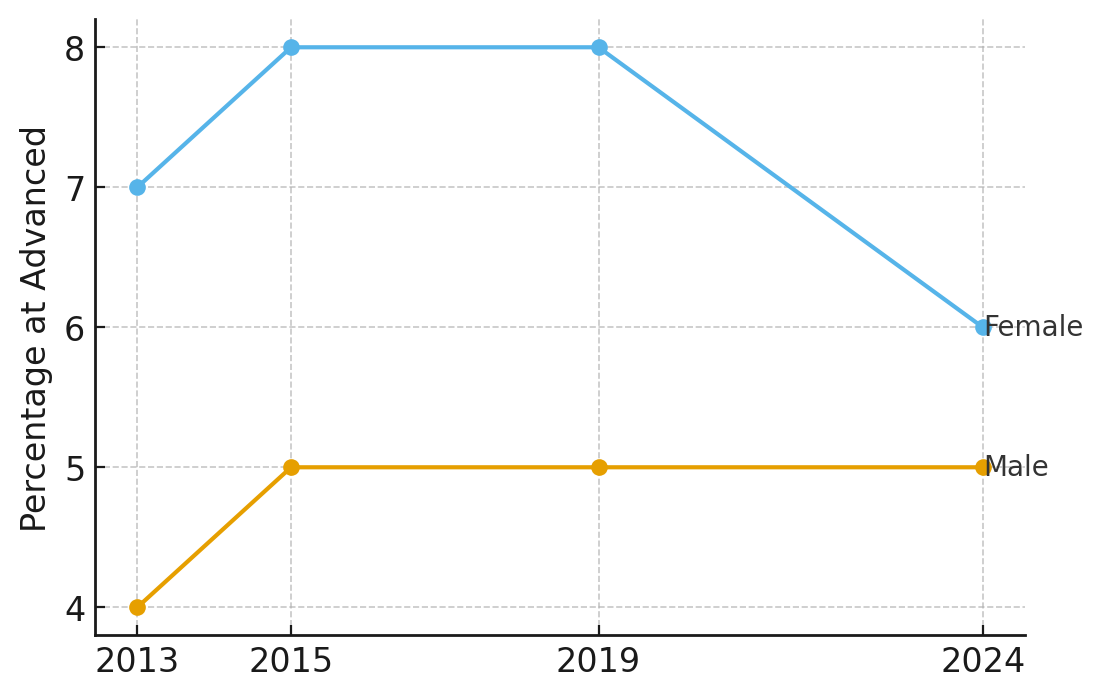
In reading, the percentage of students at the Advanced achievement level actually fell. And the decline, rather puzzlingly, seems to have been driven mostly by girls and kids whose families are middle class or higher—groups that historically have done better than their less affluent and male peers, respectively. The percentage of non-economically-disadvantaged students at the Advanced level fell from 9 to 7 (see figure 2), and the 90th percentile score also saw a statistically significant drop—while both metrics held steady for their economically disadvantaged peers. Likewise, girls dropped from 8 percent at Advanced to 6 percent (see figure 3), and their top-decile score declined significantly, while boys stayed flat in both.
Figure 2. NAEP reading scores, percentage at Advanced achievement level, by economically-disadvantaged status, 2013–24
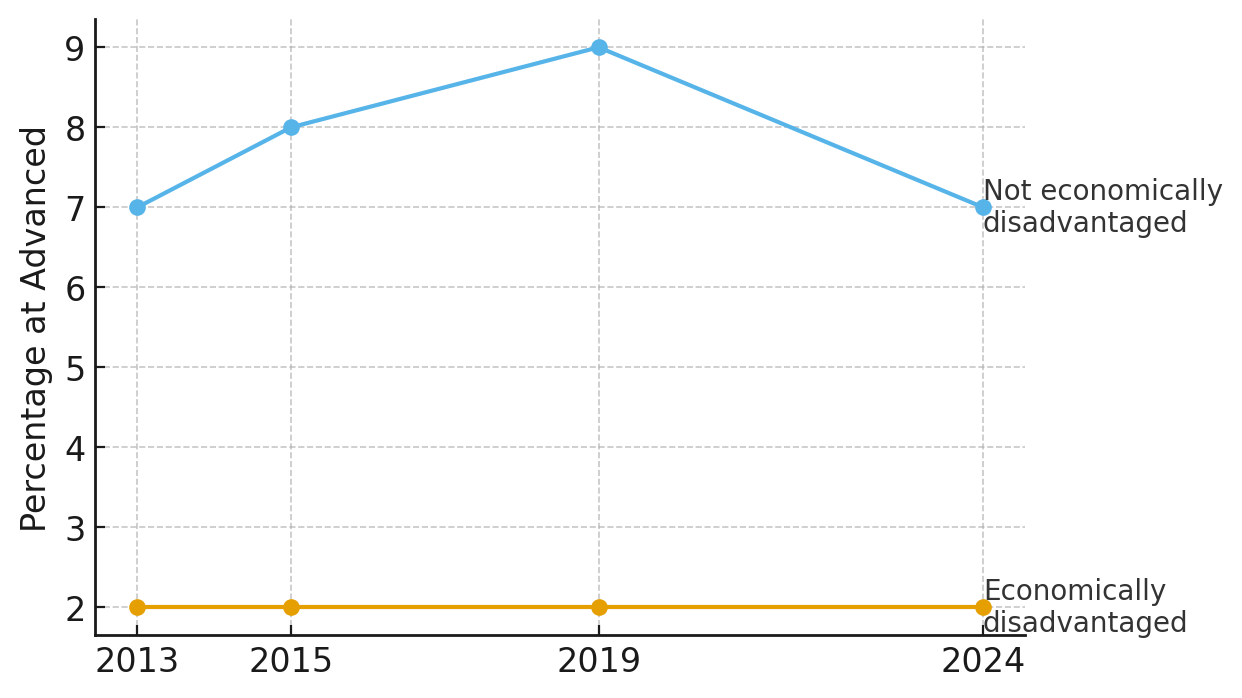
Figure 3. NAEP reading scores, percentage at Advanced achievement level, male and female, 2013–24
Yes, these trends are better—in some cases far better—than those for other subgroups and students in general. But as I’ve argued consistently and frequently over the years, that’s no reason to ignore high achievers. They, like every child, are entitled to an education in which they’re nurtured and challenged and get to fulfill their potential. Leaving them to stagnate is its own form of neglect. It also matters for the country. Our economy, scientific progress, and military competitiveness hinge disproportionately on the students who reach the highest levels of skill and knowledge. And on international tests like PISA and TIMSS, the U.S. already trails gobs of similarly affluent and developed countries that are systematically cultivating their most talented students. We should do the same or else risk falling further behind.
As for the subgroups who saw the worst results at the high end—Hispanic and Black students in math and female and non-economically-disadvantaged students in reading—they call for two rather different reactions. For the former, we generally know what’s going on and what to do. School systems just tend not to do it. These students of color are more likely to live in poverty and have less access to healthcare, healthy food, safe streets, early childhood education, and more. Their schools more often suffer from crowded and unruly classrooms with less experienced teachers who are more likely to transfer or quit. Such disadvantages lead to big differences in baseline achievement and preparation for advanced instruction. Worse—and rather ironically, in the name of equity—this advanced instruction is less likely to exist in their schools, and when it does, flawed designs often favor less-marginalized peers.
The solution, then, is to build wider, more diverse pipelines of advanced learners, starting in elementary school, with universal screening for advanced instruction and then automatic enrollment into advanced education, at least by middle school.
The reading results are much more of a conundrum. Why would non-economically-disadvantaged students and girls, in particular, be slipping? We can’t yet know the answer to that question, but some plausible explanations stand out. Pandemic burnout hit girls especially hard. Many experienced higher levels of stress and anxiety than boys, and those lingering effects may be showing up in their scores. Social media is another likely culprit. The time and attention it consumes—and the unique pressures it places on girls—leaves less space for long-form reading. And the broader cultural decline in reading for pleasure only sharpens the problem. Surveys show teenagers read far fewer books now than a generation ago, and that trend is steepest among girls. Most of these possible explanations also involve tech devices that students from higher-income families are significantly more likely to possess and have access to than their less affluent peers, perhaps explaining why declines only happened among more-economically-advantaged teens.
If these tech-based explanation are accurate, then the growing call for schools to ban cellphones and limit other tech devices as much as possible will help some. As for reading, schools could try to follow the advice of my colleague Meredith Coffey: protect time for in-class reading, set school-wide expectations for longer assigned readings, and rethink test prep. Expectations for the impact schools can make should be tempered, though. Principals and teachers could plead with parents to better police screen time at home. But our broader culture is still a strong, major force here, and only so much can happen in our classrooms.
More generally, amid the worst NAEP scores in history, it should be understood that our high achievers are in trouble, too. So, by all means, address the tragic, near-universal declines, especially among our lowest-performing students. But don’t let that focus lead to neglect at the top. Both-and, not either-or.