For those of us who have long pushed for charter schools to receive fair funding, progress has been slow, uneven, and hard-won. That’s why we at the Thomas B. Fordham Institute have spent decades documenting where the gaps remain largest.
More than twenty years ago, we published a landmark study, Charter School Funding: Inequity’s Next Frontier, which was then the most comprehensive state-by-state analysis of how public charter schools are funded and how their revenues compare with those of district-run schools. The gaps were striking: At the time, in the average state, the shortfall was $1,801, meaning charters got 78 cents on the dollar compared to similar district schools. The gap was largest in Missouri, where charters received $3,638 less per student.
In the years since, the Show Me State has preserved its reputation as one of the country’s worst offenders. So, we took notice when, in 2022, Missouri lawmakers surprised many observers by enacting a bill aimed at eliminating the longstanding funding gap between the state’s charter and traditional public schools.
On its face, HB 1552 looked like the largest funding shock in the history of the charter school movement. After all, by 2024–25, it had increased the total state and local revenues of Missouri charter schools—all of them located in Kansas City or St. Louis[1]—by nearly $4,000 per pupil. That’s enough to offset most of the roughly 25 percent funding gap they faced before the law took effect. Understandably, its passage was hailed by Missouri choice advocates as a “great relief for charter school students.”
Naturally, we at Fordham wanted to understand its effects on charter spending and achievement, so we turned to three scholars steeped in charter finance research to conduct our latest study, Moving Target: The Success and Failure of Missouri’s Charter School Funding Surge: Andrew Camp, senior research associate at the Annenberg Institute; Collin Hitt, executive director of the Policy Research in Education Center at St. Louis University; and David Griffith, national research director at Fordham.
Because of the number of moving pieces in recent years, including the addition of Elementary and Secondary School Emergency Relief (ESSER) funds, we weren’t sure what to expect. But the real-world story turned out to be more complicated than we imagined.
To be sure, HB 1552 seems to have made a difference for Missouri charters, with much of the new money devoted to additional teachers, more support staff, and/or raises for existing staff (in part resulting from improved teacher retention). And there is preliminary evidence that these additional resources have boosted charter students’ achievement in math (though not in English language arts).
But what complicates the narrative is that even the enormous infusion of new dollars provided by HB 1552 hasn’t led to funding parity because the underlying formula keeps recreating the very gap it’s meant to close.
As always, we encourage interested parties—in Missouri and beyond—to consult the full report for the gory details. But for those in a hurry, we urge attention to three points.
First, prior to HB 1552, Missouri charter schools received almost 30 percent less in total revenues per pupil than traditional public schools in the same city.
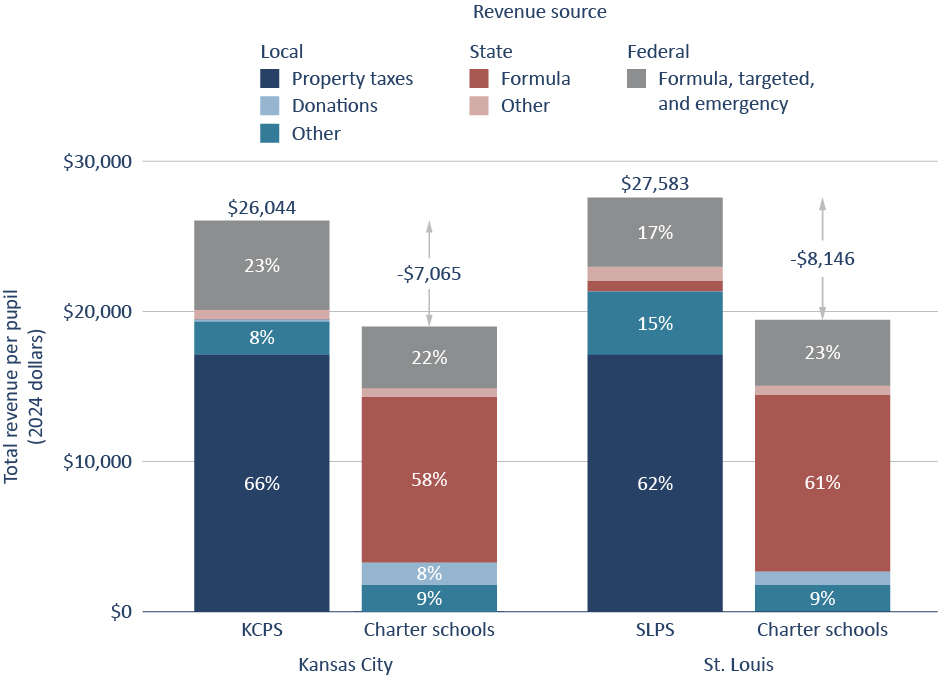
Kansas City charters received $7,065 (27 percent) less per pupil in 2021–22 while St. Louis charters received $8,146 (30 percent) less (Figure 1). As discussed in the report, neither excluding federal funding nor adjusting for student demographics has much effect on these figures, which are remarkably similar to the findings of our 2005 study.[2]
Figure 1. Prior to HB 1552, Missouri charter schools received almost 30 percent less revenue per pupil than traditional public schools in the same city.[3]
Second, despite providing charters with a large fiscal windfall, HB 1552 has mostly failed to close the district-charter funding gap.
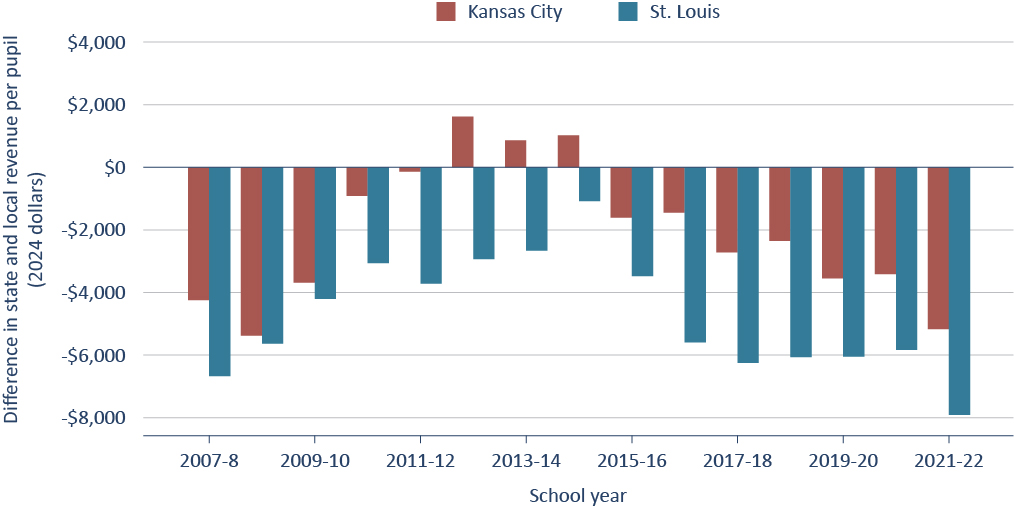
A year after HB 1552 kicked in, its effects on its primary target—the gaps in state and local funding per pupil in Kansas City and St. Louis—were nearly invisible (Figure 2). As discussed in the report, that’s largely because district schools have been allowed to keep nearly all the local dollars they receive despite educating ever fewer students—plus the law creates a two-year lag, leaving charter funding perpetually chasing district funding rather than catching up to it.
While this might seem like a win-win—more money for all public schools in Kansas City and St. Louis!—it means that charters will continue to struggle to compete with traditional public schools with respect to teacher pay and other inputs. Plus, it’s surely not a win for taxpayers.
Figure 2. HB 1552 has mostly failed to close Missouri’s district-charter funding gap.[4]
Third, to no one’s surprise, HB 1552 is likely unsustainable in its current form.
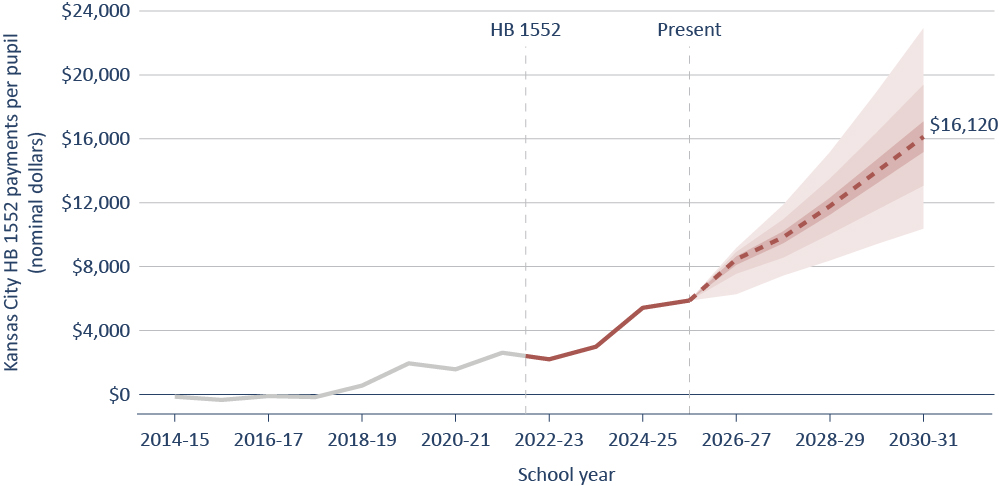
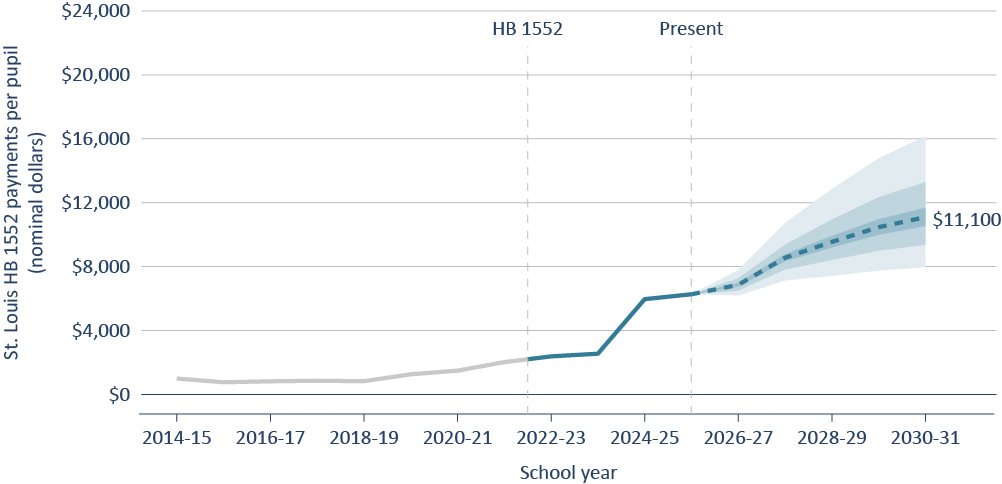
In the authors’ median forecast—the midpoint of their projected outcomes—HB 1552 payments to Kansas City charters will increase from about $6,000 per pupil in 2025–26 to about $16,000 per pupil by 2030–31, a roughly 170 percent increase (Figure 3). Similarly, payments to St. Louis charters will increase from a little over $6,000 per pupil to roughly $11,000 per pupil.
Figure 3. HB 1552 payments per pupil are likely to keep growing, particularly in Kansas City.[5]
Panel A: Forecasts of HB 1552 revenue for Kansas City
Panel B: Forecasts of HB 1552 revenue for St. Louis
If you think about it, this makes sense. After all, when district enrollment falls but local revenues don’t, district funding per pupil rises. And the design of HB 1552 leaves the state responsible for making up the gap between what districts and charters receive without requiring districts to pitch in.
In the end, the state must make ever-larger payments to charters just to keep pace, creating an upward spiral that effectively subsidizes all public schools in just two charter-heavy cities while leaving taxpayers and students elsewhere in Missouri to bear more of the cost.
Yes, some of this was foreseeable, though the pace at which it’s occurring is a little surprising. No, Missouri isn’t the only jurisdiction with some version of this problem, though HB 1552’s design makes it easier to see.
So, what is to be done?
If you’re into prediction markets, the smart wager might be that Missouri will respond with yet another Rube Goldberg fix—one that trims the cost of HB 1552 while continuing to hold district schools harmless. But the forecasts above show where that sort of contraption-minded thinking leads.
So, before that becomes the new normal, policymakers in Missouri and other charter-heavy jurisdictions should do the obvious thing, which is also the fair thing: Ensure that local funding follows students to the public schools they actually attend, whether charter schools or district-operated schools. Otherwise, policymakers and charter schools will forever be chasing a moving target.
[1] In 2024, the Missouri General Assembly passed a law allowing charter schools to operate in Boone County, despite opposition from Columbia Public Schools. The district later sued the state and its education board, alleging the law is unconstitutional. See Rudi Keller, “Columbia Schools Sue to Block Law Expanding Reach of Missouri Charter Schools,” Missouri Independent, December 15, 2025, https://missouriindependent.com/2025/12/15/columbia-schools-sue-to-block-law-expanding-reach-of-missouri-charter-schools/.
[2] Compared with the 2005 report, those percentage gaps are remarkably similar to today’s figures (27–30 percent), but the dollar gaps have roughly doubled in nominal terms—from roughly $3,500–$3,800 to $7,000–$8,100.
[3] Note: This figure shows per pupil revenues for charter and traditional public schools in St. Louis and Kansas City by source for the 2021–22 school year. Federal revenues include Elementary and Secondary School Emergency Relief (ESSER) dollars in addition to formula grants. “Other state” revenues include funding for transportation, early childhood special education, and adult literacy. “Other local” revenues include monies from the School District Trust Fund (Prop C), the M&M surtax, and the city sales tax (in the case of St. Louis). County revenues that function as property taxes (e.g., state-assessed taxes on railroads and utilities) are included as property taxes while county revenues from fines and penalties are included in “other local.”
[4] Note: Figure shows the unadjusted differences in combined state and local revenue per pupil between charter schools and traditional public schools in Kansas City (red) and St. Louis (blue). Each bar represents the charter–district funding gap in a given school year. Negative values indicate that charter schools received less state and local revenue per pupil than traditional public schools in the same city. The uneven pattern in the middle years reflects year-to-year changes in local revenues, enrollment, a series of large donations to Kansas City area charters, and the two-year lag built into HB 1552’s charter payment formula, which means charter funding adjusts after district revenues have already changed.
[5] Note: This figure shows the projected growth in HB 1552 payments per pupil for Kansas City and St. Louis if current policies and trends persist. Quantities that exhibit year-to-year variation, such as district and charter enrollment (measured in formula-weighted average daily attendance) and total local tax revenue are modeled stochastically using vector autoregression, which captures both the persistence of each series over time and the dynamic interdependencies among them. Probabilistic forecasts are generated via Monte Carlo simulation.