America is wasting much of its human capital. That’s because many high-achieving, low-income students—we call them HALO students—fall off the education track and never reach the gates of our top colleges and universities. Regrettably, these capable young people won’t reap the benefits of a four-year degree, which remains a generator of upward mobility and career success. Their families, communities, and states won’t benefit from maximizing their capabilities. This represents a tragic loss of potential, while also leaving our best colleges and—later—our most promising occupations bereft of socioeconomic diversity and looking less like the nation writ large.
We at the Thomas B. Fordham Institute have long been troubled by this leaky pipeline from K–12 to higher education. Through various empirical studies, we have drawn attention to the disappointing outcomes of high achievers from less advantaged backgrounds. We have also worked to develop and widely share policies and practices that would help more high achievers reach their full potential.
Our latest study, The Leaky Pipeline: Assessing the college outcomes of Ohio’s high-achieving low-income students, builds on those efforts to strengthen advanced education in U.S. schools, both generally and particularly in the Buckeye State. We commissioned Ohio State University professor and Fordham research fellow Stéphane Lavertu to focus on the educational experiences and outcomes of HALO students in Ohio. His analysis addresses three main questions:
1. What does the K–12 education experience look like for Ohio’s HALO students?
2. How many of them attend four-year colleges, including more selective “top colleges”?[1]
3. What K–12 education factors best predict their college attendance?
To examine these questions, Dr. Lavertu used anonymous student-level records to study the trajectories of HALO students from elementary school into college (in and out of state).[2]
Key findings
This report presents irrefutable evidence that Ohio’s HALO students are underserved by most school systems, and that too many fail to reach college after high school. Compared to similarly scoring students from more affluent backgrounds, Ohio’s HALO students are:
- 26 percent less likely to take advanced math—primarily Algebra I—during middle school.
- 34 percent less likely to complete an Advanced Placement (AP), International Baccalaureate (IB), or dual-enrollment course during high school.
- 44 percent less likely to receive gifted services (e.g., accelerated coursework or enrichment) during middle or high school.
This systemic neglect has ramifications for their college-going. Figure A shows that only two in five HALO students enroll in any four-year college within two years of high school, and fewer than one in ten attends a top college. These college-going rates are far lower than those of high-achieving, high-income (HAHI) students. Specifically, Ohio’s HALO students are 42 percent less likely to attend a four-year college and 66 percent less likely to attend a top college than their similarly-scoring but more affluent peers.[3]
Figure A. HALO students attend college at much lower rates than their more affluent, similarly-scoring peers.
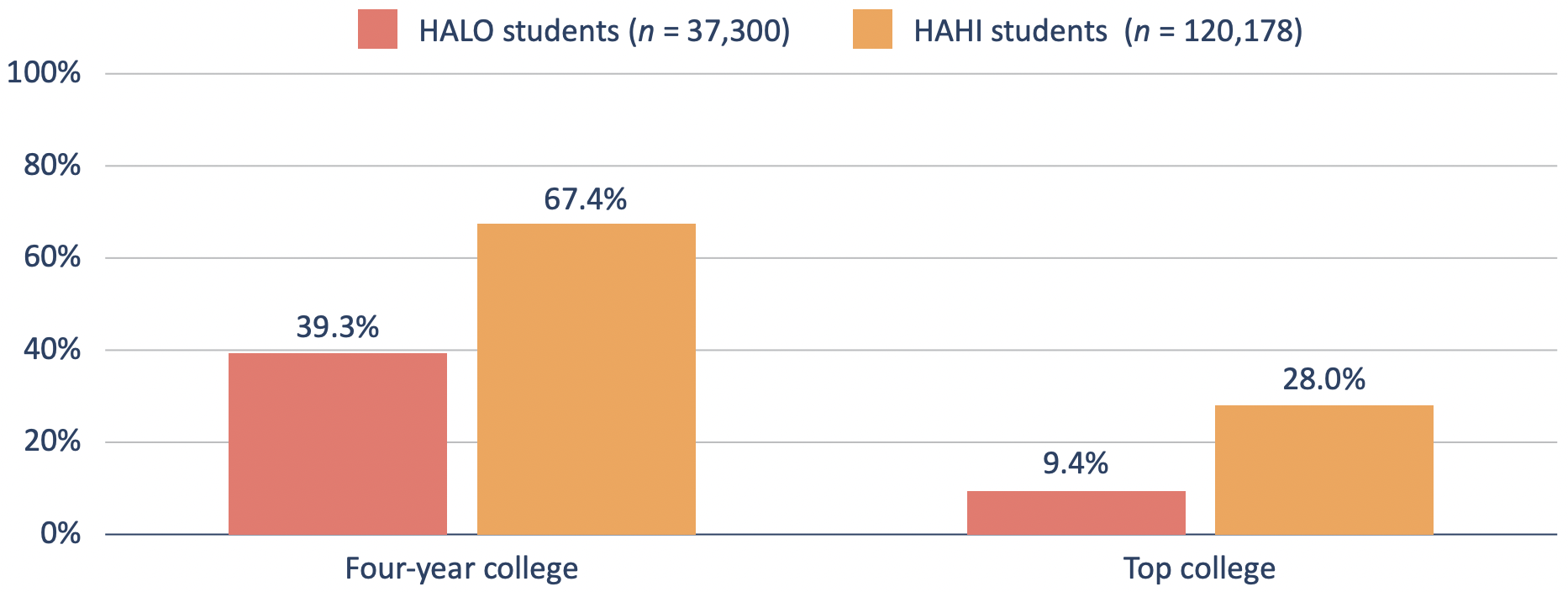
Note: The number of HALO and HAHI students identified in this analysis (37,300 and 120,178, respectively) is a combined total based on six years of third-grade test score data (2008–09 to 2013–14). Due to data limitations, the analysis was unable to track all HALO students into college (e.g., students moving out of Ohio), and thus their college-going rates are likely to be slightly understated.
Underscoring how leaky this pipeline is for HALO students, consider this: While they are outnumbered 3-to-1 by their more affluent counterparts in the top achievement quintile in third grade, a decade later they are outnumbered 6-to-1 in four-year colleges and a staggering 10-to-1 in top colleges.
What would keep more HALO students on-track for college? Figure B shows that AP or IB and dual-enrollment course-taking during high school makes a difference in their college-going prospects, as do advanced math courses during middle school and gifted services in English language arts or math. For instance, HALO students who completed an AP or IB course had four-year college-going rates that are 29 percentage points higher than HALO students who did not complete such courses. These results provide compelling evidence that advanced learning opportunities are critical to keeping students on a college pathway.[4]
Figure B. HALO students who participate in advanced learning opportunities have higher four-year college attendance rates than HALO students who do not.
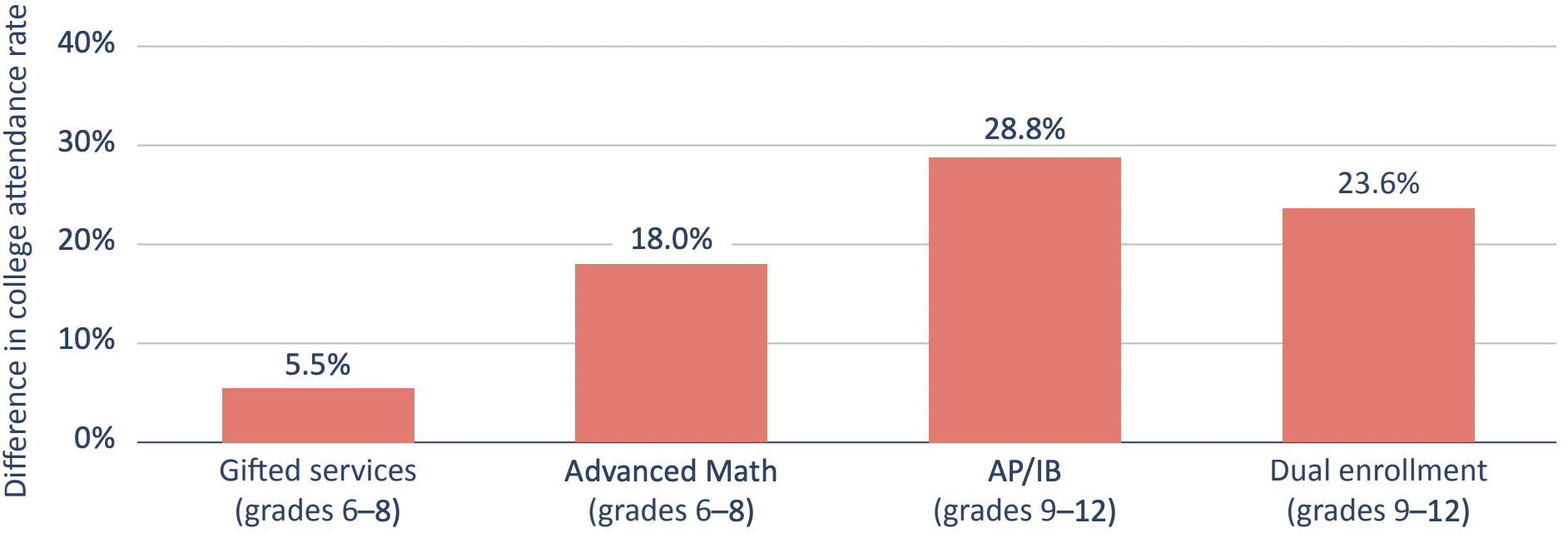
Note: This figure displays the differences in attendance rates at any four-year college. See Table 6 in the report for results for top colleges.
Policy implications
What should state and local policymakers do? Many solid recommendations were recently made by a national working group on advanced education, which can be found in this Fordham report. Here, let us highlight five ideas.
1. Ensure early identification of high-achieving students and provision of advanced education during elementary school. It’s hard for schools and teachers to provide advanced learning opportunities to HALO students if they don’t know who they are. Commendably, Ohio (and several other states) require universal screening in the elementary grades for gifted and talented programs (using non-state tests). Policymakers should go a step further and also require identification when students score at the highest levels on state exams—an important marker of academic ability. But identification alone won’t do students much good unless schools provide them opportunities to accelerate and advance. Here, states also have a role to play. They should require schools to provide advanced opportunities to identified students—and enforce that requirement through an audit-type process.
2. Promote automatic enrollment of high achievers in advanced middle school and high school math courses. A few states, including North Carolina and Texas, have automatic enrollment policies that guarantee placement in advanced math courses based on students’ prior-year test scores. For instance, under this type of policy, high-performing seventh graders are automatically placed in eighth grade Algebra I, which is key to more advanced math in high school. Tying course placement to objective measures of achievement ensures that HALO students are in advanced courses—far more reliable than systems that rely primarily on subjective judgments or recommendations for such placements.
3. Expand access to AP and IB coursework into more high-poverty high schools. This goal has long been on the education-reform agenda, but there’s still much to be done to bring such challenging course options into schools that serve the most HALO students (e.g., high-poverty rural or urban campuses). This can be done in many ways, including, for example, “itinerant” programs, whereby an AP teacher covers classes in multiple schools or school districts, or virtual options that bring advanced coursework into classrooms anywhere in the state. Another possibility is to offer schools or teachers financial incentives when students pass AP or IB exams, as North Carolina does. A “weighted” bonus that provides additional funds when low-income students pass these exams could further strengthen the incentive for educators to start programs in schools that have not traditionally offered advanced coursework.
4. Help more HALO students access suburban public schools. In analyses pinpointing which Ohio districts most effectively boost the college-going odds of HALO students, we find several wealthy suburban districts—Solon, Mason, and Dublin among them—topping the charts (see here). That is good news for the handful of low-income students who live in those districts. However, many suburban districts, including two of the three mentioned above, prohibit non-resident pupils from attending their schools. States should require all districts, including suburban, to participate in statewide interdistrict open enrollment, a policy that enables students to cross district boundaries to attend school. This would put suburban public schools—and the advanced opportunities they typically offer—within greater reach of HALO students residing in nearby cities.
5. Launch specialized magnet schools for high achievers. When it comes to Ohio’s best high schools for HALO students (see here for overall rankings and here for rankings focused on top colleges), this varied mix includes a handful of urban district high schools, such as Walnut Hills in Cincinnati and Cleveland School of Science and Medicine, both of which have selective admissions. Also near the top are a few non-district options, such as Dayton Early College Academy, a public charter school that Fordham authorizes, and Metro High School, an independent STEM school in Columbus. Unfortunately, such schools are rare. School districts should work to create specialized, “early college” schools for high achievers—open to students regionally—as could charter or STEM school developers. Following in the footsteps of Illinois, North Carolina, and Oklahoma, states themselves could also create, and directly fund, a residential, competitive public high school that enrolls high-achieving students from all corners of the state.
HALO students have demonstrated their potential to reach college and use it as a springboard to the American dream. Yet due to widespread neglect of their talents, our education system allows too many of them to fall through the cracks. There is a clear pathway that can better nurture HALO students. It includes early identification and acceleration in elementary school, access to advanced math coursework starting in middle school, and enrollment in high schools with strong college-prep curricula and college-going cultures. The playbook is there. Now the question is whether states and school systems can execute those plays and give HALO students the challenge and rigor that prepares them to compete for spots at our top universities.
[1] A “top college” in this report is one in which the average student scores in the top 20 percent on college admissions exams. Among Ohio institutions of higher education, this includes Case Western University, Cedarville University, College of Wooster, Kenyon College, Miami University, Oberlin College, Ohio State University, University of Cincinnati, and University of Dayton.
[2] HALO students are identified based on their characteristics in third or eighth grade, depending on the analysis. Specifically, they are students who scored in the top 20 percent statewide on math and ELA exams and who were identified as “economically disadvantaged,” which is largely based on their eligibility for free or reduced-price lunch.
[3] These college-going gaps reflect not only uneven in-school opportunities, but also factors not directly observed in this study such as college affordability and parents’ educational backgrounds, which a recent study from North Carolina indicates contributes to excellence gaps.
[4] These are not precise “causal” estimates, as unobserved factors, like an effective counselor, might have led students to take advanced courses in the first place.