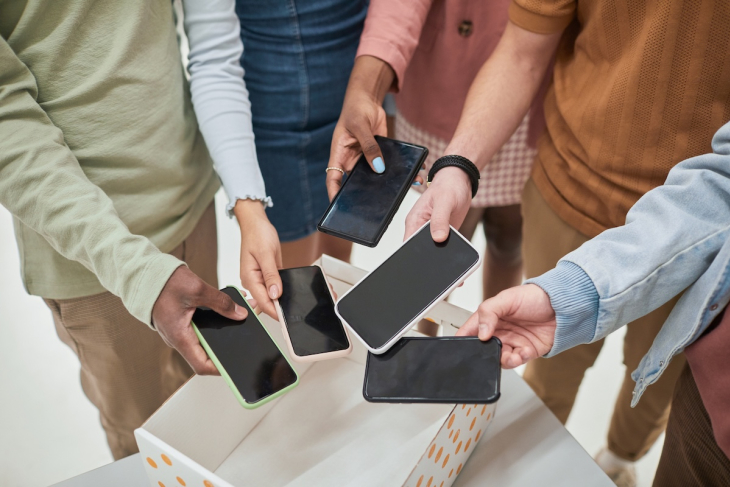
Over the six years I taught high school, I tried every response to student cellphone use that was available to me: one warning, three warnings, no warnings; reacting to the mere sight of a phone, looking the other way if the use wasn’t conspicuous; calling the front office, calling the counselor, revisiting “classroom norms,” emailing parents, buying one of those class cellphone organizers that looks like it’s for shoes. None of these efforts worked particularly well, and they were all draining.
That’s why, since I left the classroom in 2022, I’ve been heartened to see the wave of school cellphone bans across districts and states. Unlikely bedfellows from teachers unions to Moms for Liberty have allied in support, and a study last year suggested promising initial results around attendance and academic achievement.
However, a new study from researchers from Stanford, Duke, Penn, and Michigan offers a different set of findings, which have received attention from the New York Times, the Washington Post, and NPR (not to mention Fordham’s own Amber Northern). The study analyzes the effects of a single popular phone ban mechanism: Yondr pouches. Adopted in almost five thousand schools, these magnetically sealed cases allow students to maintain possession of their phones while physically preventing access during the school day. Admittedly, the new study’s results aren’t the slam-dunk some of us might’ve hoped for, yet I’m inclined to agree with Emily Oster that they’re not as discouraging as some reports have declared.
The researchers, including prominent names such as Tom Dee and Angela Duckworth, rely on data from a variety of sources: private companies Yondr and Advan Research (the latter for phone GPS data); administrative education data from the National Center for Education Statistics, the Education Data Center, the Stanford Education Data Archive, state education agencies, and school-level records; and results from surveys of teachers, parents, and students. The study examines the effects of this particular approach to phone banning—Yondr pouch adoption—on academic, attendance, disciplinary, and social-emotional outcomes. Using a staggered difference-in-differences study design, they compare outcomes for middle and high schools that adopted Yondr pouches between 2023 and 2025 with outcomes for middle and high schools that either never adopted Yondr pouches or did so in 2026. The study’s largest analytic sample included over 40,000 schools, though it was not nationally representative.
The first finding—that cellphone use in schools declined—is already pretty encouraging. Some might think it obvious that locking up phones decreases their use, but in fact, anecdotes of Yondr hacks abound, with some arguing that the pouches aren’t ultimately effective. In defiance of such claims, this study used GPS data and teacher reports to determine that phone activity during school hours declined substantially. (The researchers hesitate to put a specific number on students’ activity decrease, since the detectable rate of phone “pings” is subject to factors like phone privacy settings and activity on school staff’s phones.) Don’t we, in general, want kids to be less glued to their phones, especially during the school day? Simply having students on their phones for less of the day is a win unto itself.
Two other outcomes briefly worsened but then rebounded: student discipline and student well-being. Upon Yondr adoption, schools experienced a 16 percent increase in suspensions, but by the following year, suspensions had returned to baseline levels. This short-term shock makes sense: Some of the infractions probably resulted from cellphone use that wasn’t previously prohibited, and some probably resulted from students prone to misbehaving no longer using their phones to “self-anesthetize,” as study co-author Dee has said.
That language might sound melodramatic to those who haven’t been in a classroom in a while, but it’s on point. I had students who tried to fight because one looked at another the wrong way; if you’re looking at a phone, then you’re not giving the stink-eye to your classmate. I had students who wanted to use their phones to listen to music during independent work time; if you can’t hear the kid making rude comments or an irritating pencil noise, then you’re not going to get annoyed and shout at them. Teachers experiencing recent phone bans have told me that their students are now forced to interact face-to-face throughout the entire class period—genuinely a first for many of them. Still, as one teacher told me, the payoff will be worth what she and her colleagues see as short-term “growing pains.”
Students’ self-reported well-being also dropped sharply upon Yondr adoption but soon rebounded and even improved. Imagine being 15 years old and never having experienced school without notification-induced dopamine hits or your favorite Spotify playlist. And yet, this finding shows that students are overcoming the shock and adapting.
The other outcomes all suggest that, at least within the initial years of Yondr use, schools and students are breaking even. There was no statistically significant effect on self-reported classroom attention, perceived likelihood of cyberbullying, or absenteeism.
What’s drawn much of the attention to this study, however, is the finding that Yondr pouches haven’t yet moved the needle on academic outcomes. Most of the academic effects were close to null, although there were small improvements in high school math and very small setbacks in middle school math. That’s not the stunning endorsement that some of us might’ve wanted, but it’s also early days of implementation. The earliest Yondr adoptions included in the study took place in 2022–23, and the others took place even more recently. That’s not much time to heal from what Jonathan Haidt has called “the damage from distraction and fragmented attention [that] has been compounding for years.”
In the coming years, longer-term studies will become possible and may well reveal different results for academic achievement or any of these other outcomes. In the meantime, also helpful would be research on other types of phone bans, as well as work examining phone bans’ impact on teacher recruitment and retention. The present study saw teacher satisfaction increase with Yondr adoption, and a recent Ed Week survey suggests that stricter phone policies have improved recruitment. If I hadn’t spent my teaching career stuck in an unending loop of cellphone Whac-A-Mole, I might not have burned out so quickly. And improved teacher outcomes matter for students.
Though I expect to see more phone ban benefits over time, we may not—but that doesn’t mean we should perceive this study as an indictment of phone bans. Disappointment around the “mixed” results comes across as emblematic of the tendency in education to expect a single, silver-bullet policy or practice to “fix” everything overnight. But if you heard about an intervention that decreased students’ time on their phones, measurably improved their well-being, didn’t cause any apparent harm, and only cost $30 per student, wouldn’t that be appealing? Just because Yondr pouches aren’t an instant cure-all doesn’t mean they aren’t worthwhile.
SOURCE: Hunt Allcott, E. Jason Baron, Thomas Dee, Angela L. Duckworth, Matthew Gentzkow, and Brian Jacob, “The Effects of School Phone Bans: National Evidence from Lockable Pouches,” National Bureau of Economic Research (April 2026).