Mobile Navigation

  • National
    • Policy
      • High Expectations
      • Quality Choices
      • Personalized Pathways
    • Research
    • Commentary
      • Gadfly Newsletter
      • Flypaper Blog
    • Events
    • Scholars Program
  • Ohio
    • Policy
      • Priorities
      • Media & Testimony
    • Research
    • Commentary
      • Ohio Education Gadfly Biweekly
      • Ohio Gadfly Daily
  • Charter Authorizing
    • Application
    • Sponsored Schools
    • Resources
  • About
    • Mission
    • Board
    • Staff
    • Career
Home
Home
Advancing Educational Excellence

Main Navigation

  • National
  • Ohio
  • Charter Authorizing
  • About

National Menu

  • Topics
    • Accountability & Testing
    • Advanced Education
    • Career & Technical Education
    • Charter Schools
    • Curriculum & Instruction
    • ESSA
    • Evidence-Based Learning
    • Facilities
    • Governance
    • Personalized Learning
    • Private School Choice
    • School Finance
    • Standards
    • Teachers & School Leaders
    • Think Again
  • Research
  • Commentary
    • Gadfly Newsletter
    • Flypaper Blog
    • Gadfly Podcast
  • Events
  • Scholars Program

Reports, Books

Displaying 121-150 of 268 results
Report
3.13.2013
Accountability & Testing, Charter Schools

Searching for Excellence: A Five-City, Cross-State Comparison of Charter School Quality

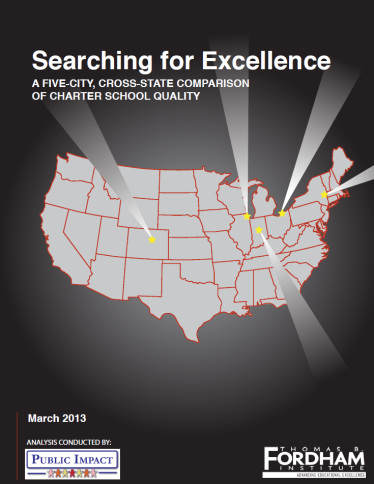
Conducted jointly by the Thomas B. Fordham Institute and Public Impact, the new research study Searching for Excellence: A Five-City, Cross-State Comparison of Charter School Quality sheds light on charter performance — in Albany, Chicago, Cleveland, Denver, and Indianapolis. These cities were highlighted because they have relatively large numbers of charter schools and charter school students. These are cities where charters have been part of the educational landscape for a decade or more. Read this exciting report today!
Report
2.14.2013
School Finance, Governance

When Teachers Choose Pension Plans: The Florida Story

Matthew M. Chingos, Martin R. West

In an era of budgetary belt tightening, state and local policy makers are finally awakening to the impact of teacher pension costs on their bottom lines. Recent reports demonstrate that such pension programs across the United States are burdened by almost $390 billion in unfunded liabilities. Yet, most states and municipalities have been taking the road of least resistance, tinkering around the edges rather than tackling systemic (but painful) pension reform. Is the solution to the pension crisis to offer teachers the option of a 401(k)-style plan (also known as a "defined contribution" or DC plan) instead of a traditional pension plan? Would this alternative appeal to teachers? When Teachers Choose Pension Plans: The Florida Story sets out to answer these questions.

Report
2.4.2013
Standards

Commentary & Feedback on Draft II of the Next Generation Science Standards

Paul Gross, Douglas Buttrey, Ursula Goodenough, Noretta Koertge, Lawrence S. Lerner, Martha Schwartz, Richard Schwartz, William H. Schmidt, W. Stephen Wilson

The Thomas B. Fordham Institute has provided big-picture feedback and detailed, standard-specific commentary for the second draft of the Next Generation Science Standards—standards that done right, set a firm foundation upon which the rest of science education across the states will be constructed. In our comments on the first draft, we concluded that “the NGSS authors have much to do to ensure that the final draft is a true leap forward in science education.” In comments on Draft II, we address to what extent NGSS writers have moved closer to a set of K–12 science standards that even states with strong standards of their own would do well to adopt.

Report
1.23.2013
Charter Schools, Governance, Private School Choice

School Choice Regulations: Red Tape or Red Herring?

David A. Stuit, Sy Doan

Many proponents of private school choice take for granted that schools won’t participate if government asks too much of them, especially if it demands that they be publicly accountable for student achievement. Were such school refusals to be widespread, the programs themselves could not serve many kids. But is this assumption justified? A new Fordham Institute study—to be released on January 29—provides empirical answers. Do regulations and accountability requirements deter private schools from participating in choice programs? How important are such requirements compared to other factors, such as voucher amounts? Are certain types of regulations stronger deterrents than others? Do certain types schools shy away from regulation more than others?

Report
1.10.2013
Governance

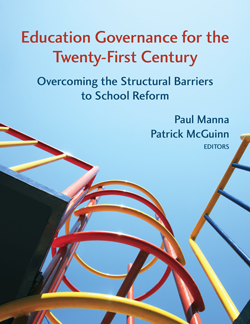
Education Governance for the Twenty-First Century: Overcoming the Structural Barriers to School Reform

Paul Manna, Patrick McGuinn

America’s fragmented, decentralized, politicized, and bureaucratic system of education governance is a major impediment to school reform. In Education Governance for the Twenty-First Century: Overcoming the Structural Barriers to School Reform, a number of leading education scholars, analysts, and practitioners show that understanding the impact of specific policy changes in areas such as standards, testing, teachers, or school choice requires careful analysis of the broader governing arrangements that influence their content, implementation, and impact.

Report
12.11.2012
School Finance, Governance, Teachers & School Leaders

Strategies for Smarter Budgets and Smarter Schools

Nathan Levenson

This new policy brief by Nathan Levenson, Managing Director at the District Management Council and former superintendent of Arlington (MA) Public Schools, offers informed advice to school districts seeking to provide a well-rounded, quality education to all children in a time of strained budgets. Levenson recommends three strategies: prioritize both achievement and cost-efficiency; make staffing decisions based on student needs, not student preferences; and manage special-education spending for better outcomes and greater cost-effectiveness.

Report
10.29.2012
Governance, Teachers & School Leaders

How Strong Are U.S. Teacher Unions? A State-By-State Comparison

Amber M. Northern, Ph.D., Janie Scull, Dara Zeehandelaar Shaw, Ph.D.

This timely study represents the most comprehensive analysis of American teacher unions’ strength ever conducted, ranking all fifty states and the District of Columbia according to the power and influence of their state-level unions.

Book
9.28.2012
Curriculum & Instruction

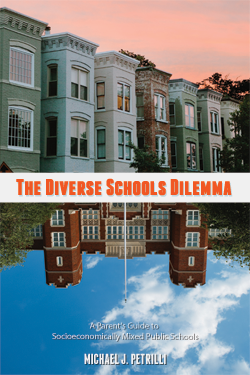
The Diverse Schools Dilemma

Michael J. Petrilli

Lots of parents favor sending their sons and daughters to diverse schools with children from a variety of racial and socioeconomic backgrounds. But can such schools successfully meet the educational needs of all those different kids? How do middle class children fare in these environments? Is there enough challenge and stimulation in schools that also struggle to help poor and immigrant children reach basic standards? Is there too much focus on test scores? And why is it so hard to find diverse public schools with a progressive, child-centered approach to education? These quandaries and more are addressed in this groundbreaking book by Michael J. Petrilli.

Report
8.28.2012
Governance

Boosting the Quality and Efficiency of Special Education

Nathan Levenson

This groundbreaking study uses the largest database of information on special education spending and staffing ever assembled to uncover significant variance in how districts staff for special education. The report concludes that if the high-spending districts studied reduce their staffing in this area to the national median the public could save $10 billion and offers clear recommendations for improving special-education quality and efficiency.

Report
7.31.2012
Advanced Education

Exam Schools: Inside America's Most Selective Public High Schools

Chester E. Finn, Jr., Jessica Hockett

What is the best education for exceptionally able and high-achieving youngsters? There are no easy answers but, as Chester Finn and Jessica Hockett show, for more than 100,000 students each year, the solution is to enroll in an academically selective public high school. Exam Schools is the first-ever close-up look at this small, sometimes controversial, yet crucial segment of American public education.

Report
7.20.2012
School Finance, Governance

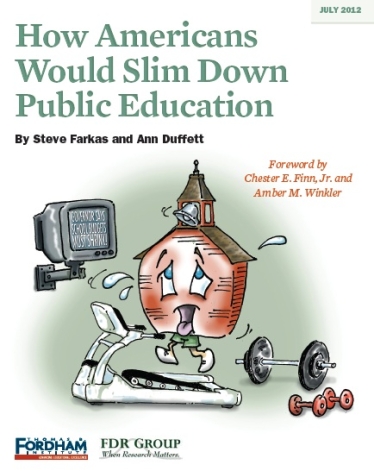
How Americans Would Slim Down Public Education

Steve Farkas, Ann Duffett

Education budgets are tight and state and district leaders must make tough decisions about where to save. But is the public willing to accept cuts? If so, where? According to the results of this new survey, many Americans are open—selectively open—to dramatic changes in how school districts do business.

Report
6.20.2012
Standards

Commentary & Feedback on Draft I of the Next Generation Science Standards

Paul Gross, Lawrence S. Lerner, John Lynch, Martha Schwartz, Richard Schwartz, W. Stephen Wilson

In May, Achieve unveiled and solicited comments on the first draft of the Next Generation Science Standards, the product of months of work by a team of writers from twenty-six states. This document provides commentary, feedback, and constructive advice that Fordham hopes the NGSS authors will consider as they revise the standards before the release of a second draft later this year.

Report
5.24.2012
School Finance, Governance

Putting a Price Tag on the Common Core: How Much Will Smart Implementation Cost?

Patrick J. Murphy, Elliot Regenstein

The Common Core State Standards (CCSS) for English language arts and mathematics represent a sea change in standards-based reform and their implementation is the movement’s next—and greatest—challenge. Yet, while most states have now set forth implementation plans, these tomes seldom address the crucial matter of cost. This report estimates the implementation cost for each of the forty-five states (and the District of Columbia) that have adopted the Common Core State Standards and shows that costs naturally depend on how states approach implementation.

Report
4.20.2012
Governance

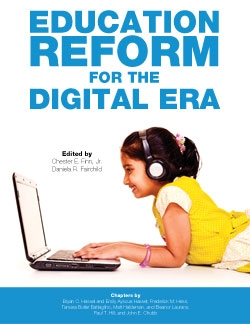
Education Reform for the Digital Era

Bryan C. Hassel, Emily Ayscue Hassel, Tamara Butler Battaglino, Matt Haldeman, Paul T. Hill, John E. Chubb

Can we be smarter about taking high-quality online and blended schools to scale—and to educational success? Yes, says this volume, as it addresses such thorny policy issues as quality control, staffing, funding, and governance for the digital sector. Read on to learn more.

Texas math standards review
Report
4.17.2012
Standards

Review of Draft Texas Mathematics Standards 2012

W. Stephen Wilson

In April 2012, Texas adopted new math standards. Fordham reviewed the draft standards and found them to be a modest improvement. But not by much, and they remain inferior to the Common Core math standards. Download the review to learn more.

Texas math standards review
Report
4.11.2012
School Finance, Governance

How School Districts Can Stretch the School Dollar

Michael J. Petrilli

The "new normal" of tougher budget times is here to stay for American K-12 education. So how can local officials cope? This policy brief, by Mike Petrilli, provides a useful tool for navigating the financial challenges of the current school-funding climate, complete with clear dos and don'ts for anyone involved in or concerned with local education budgets.

Report
4.2.2012
Accountability & Testing, Standards

Defining Strong State Accountability Systems: How Can Better Standards Gain Greater Traction?

Eileen Reed, Janie Scull, Gerilyn Slicker, Amber M. Northern, Ph.D.

Rigorous standards and aligned assessments are vital tools for boosting education outcomes but they have little traction without strong accountability systems that attach consequences to performance. This pilot study lays out the essential features of such accountability systems, intended to add oomph to new common standards and aligned assessments.

Report
3.14.2012
Governance, Teachers & School Leaders

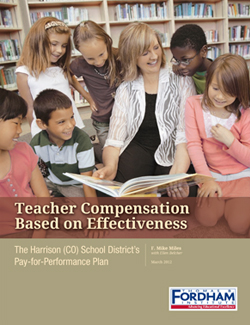
Teacher Compensation Based on Effectiveness: The Harrison (CO) School District's Pay-for-Performance Plan

This report, authored by Superintendent Mike Miles, takes a detailed look at the Harrison (CO) School District 2's Pay-for-Performance Plan. The Harrison Plan confronted the dual challenges of defining an effective teacher and identifying all the things that demonstrate her effectiveness. This how-to guide is meant to serve as a tool and model for Ohio’s school districts.

Report
2.6.2012
Governance

Overcoming the Governance Challenge in K-12 Online Learning

John E. Chubb

In this paper, John Chubb examines how local school district control retards the widespread use of instructional technologies. He argues that the surest way to break down the system’s inherent resistance to technology is to shift control from the local district—and thus the school board—and put it in the hands of states. Download the paper to read the ten steps Chubb argues will get us to this brave new governance system.

Report
1.30.2012
Standards

The State of State Science Standards 2012

American science performance is lagging as the economy becomes increasingly high tech, but  our current science standards are doing little to solve the problem.

Report
1.9.2012
School Finance

The Costs of Online Learning

The latest installment of Fordham's Creating Sound Policy for Digital Learning series investigates one of the more controversial aspects of digital learning: How much does it cost? In this paper, the Parthenon Group uses interviews with more than fifty vendors and online-schooling experts to estimate today's average per-pupil cost for a variety of schooling models, traditional and online, and presents a nuanced analysis of the important variance in cost between different school designs.

Report
1.9.2012
Accountability & Testing, Governance

Quality Control in K-12 Digital Learning: Three (Imperfect) Approaches

Will the move toward virtual and “blended learning” schools in American education repeat the mistakes of the charter-school movement, or will it learn from them? The Thomas B. Fordham Institute, with the support of the Charles and Helen Schwab Foundation, has commissioned five deep-thought papers that, together, address the thorniest policy issues surrounding digital learning. The goal is to boost the prospects for successful online learning (both substantively and politically) over the long run. In this first of six papers on digital learning commissioned by the Thomas B. Fordham Institute, Frederick M. Hess explores the challenges of quality control.

Report
1.9.2012
Governance, Teachers & School Leaders

Teachers in the Age of Digital Instruction

Will the move toward virtual and “blended learning” schools in American education repeat the mistakes of the charter-school movement, or will it learn from them? The Thomas B. Fordham Institute, with the support of the Charles and Helen Schwab Foundation, has commissioned five deep-thought papers that, together, address the thorniest policy issues surrounding digital learning. The goal is to boost the prospects for successful online learning (both substantively and politically) over the long run.

Report
12.28.2011
Accountability & Testing

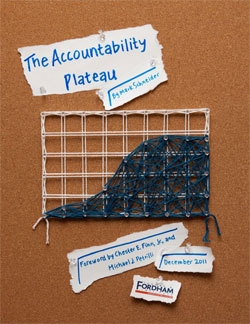
The Accountability Plateau

Mark Schneider

After more than ten years under NCLB, that law’s legacy continues to be fiercely contested. This analysis of NAEP scores—focusing on Texas and on the entire nation—by former NCES commissioner Mark Schneider finds that solid gains in math achievement coincided with the advent of "consequential accountability," first in the trailblazing Lone Star State and a few other pioneer states, then across the land with the implementation of NCLB. But Schneider warns that the recent plateau in Texas math scores may foreshadow a coming stagnation in the country’s performance. Has the testing-and-accountability movement as we know it run out of steam? How else might we rekindle our nation’s education progress?

Report
12.9.2011
Governance

Rethinking Education Governance for the Twenty-First Century

School reforms abound today, yet even the boldest and most imaginative among them have produced—at best—marginal gains in student achievement. What America needs in the twenty-first century is a far more profound version of education reform. Instead of shoveling yet more policies, programs, and practices into our current system, we must deepen our understanding of the obstacles to reform that are posed by existing structures, governance arrangements, and power relationships. Yet few education reformers—or public officials—have been willing to delve into this touchy territory.

Report
12.8.2011
Charter Schools

Better Choices: Charter Incubation as a Strategy for Improving the Charter School Sector

Terry Ryan

In this policy brief, Public Impact??s Joe Ableidinger and Julie Kowal examine the merits of the incubation model, outline specific strategies for supporting it, and profile organizations around the U.S. putting it into practice. The authors explain that through the strategic recruitment, selection, and training of talented leaders???and support of them as they launch or expand new charter schools???incubators offer charter school advocates an important tool in guaranteeing quality school choice.

Report
11.16.2011
School Finance

School Finance in the Digital-Learning Era

Paul T. Hill

Will the move toward virtual and “blended learning” schools in American education repeat the mistakes of the charter-school movement, or will it learn from them? The Thomas B. Fordham Institute, with the support of the Charles and Helen Schwab Foundation, has commissioned five deep-thought papers that, together, address the thorniest policy issues surrounding digital learning. The goal is to boost the prospects for successful online learning (both substantively and politically) over the long run.

Report
10.21.2011
Governance

Now What? Imperatives and Options for Common Core Implementation and Governance

Chester E. Finn, Jr., Michael J. Petrilli

This Fordham Institute publication—co-authored by President Chester E. Finn Jr. and VP Michael J. Petrilli—pushes folks to think about what comes next in the journey to common education standards and tests. Most states have adopted the Common Core English language arts and math standards, and most are also working on common assessments. But...now what? The standards won't implement themselves, but unless they are adopted in the classroom, nothing much will change. What implementation tasks are most urgent? What should be done across state lines? What should be left to individual states, districts, and private markets? Perhaps most perplexing, who will govern and own these standards and tests ten or twenty years from now?

Report
10.21.2011
Governance

Cracks in the Ivory Tower? The Views of Education Professors Circa 2010

Steve Farkas, Ann Duffett

This national survey of education school professors finds that, even as the U.S. grows more practical and demanding when it comes to K-12 education, most of the professoriate simply isn't there. They see themselves more as philosophers and agents of social change, not as master craftsmen sharing tradecraft. They also resist some promising reforms such as tying teacher pay to student test scores. Still, education professors are reform-minded in some areas, including tougher policies for awarding tenure to teachers and financial incentives for those who teach in tough neighborhoods. Read on to find out more.

Report
10.21.2011
Charter Schools

Charter School Autonomy: A Half-Broken Promise

Jacob L. Rosch, Dana Brinson

The typical U.S. charter school lacks the autonomy it needs to succeed, once state, authorizer, and other impositions are considered. For some schools—in some states, with some authorizers—the picture is brighter but for many it's bleak. State-specific grades for charter autonomy range from A to F.

Pagination

  • First page « First
  • Previous page ‹ Previous
  • Page 1
  • Page 2
  • Page 3
  • Page 4
  • Current page 5
  • Page 6
  • Page 7
  • Page 8
  • Page 9
  • Next page Next ›
  • Last page Last »

Type

  • (-) Book (10)
  • Commentary (17478)
  • Event (51)
  • Podcast (380)
  • (-) Report (258)
  • Video (98)

Topics

  • Accountability & Testing (45)
  • Advanced Education (17)
  • Career & Technical Education (4)
  • Charter Schools (47)
  • Curriculum & Instruction (37)
  • ESSA (6)
  • Evidence-Based Learning (5)
  • Governance (81)
  • Personalized Learning (4)
  • Private School Choice (8)
  • School Finance (31)
  • Standards (49)
  • Teachers & School Leaders (37)

Date

  • 2026 (8)
  • 2025 (7)
  • 2024 (8)
  • 2023 (9)
  • 2022 (7)
  • 2021 (7)
  • 2020 (8)
  • 2019 (9)
  • 2018 (7)
  • 2017 (9)
  • 2016 (10)
  • 2015 (5)
  • 2014 (13)
  • 2013 (18)
  • 2012 (18)
  • 2011 (19)
  • 2010 (7)
  • 2009 (9)
  • 2008 (11)
  • 2007 (7)
  • 2006 (9)
  • 2005 (9)
  • 2004 (7)
  • 2003 (9)
  • 2002 (4)
  • 2001 (8)
  • 2000 (9)
  • 1999 (5)
  • 1998 (11)
  • 1997 (1)
Fordham Logo

© 2026 The Thomas B. Fordham Institute
Privacy Policy
Usage Agreement

National

P.O. Box 110
Burke, VA 22009

202.223.5452

[email protected]

Ohio

P.O. Box 82291
Columbus, OH 43202

614.223.1580

[email protected]

Sponsorship

130 West Second Street, Suite 410
Dayton, Ohio 45402

937.227.3368

[email protected]