Will Mississippi muddy the waters on testing and accountability?
Mississippi has earned well-deserved plaudits for its outsized literacy gains in recent years, ranking first


Over the next several weeks, more than 500,000 students across the country will take an updated version of the National Assessment of Educational Progress (NAEP) in math and reading, but more improvements may be on the way.
Dear governor, Do you want to be remembered for your leadership on education? Your state may be spending nearly half its budget on schools, and yet test scores continue to fall, especially for the students who need the most help.
Last month, pundits debated the validity of Mississippi’s remarkable gains in student achievement.
Another tall education-reform tree fell the other day when Lou Gerstner passed away. The super-chief of IBM and overall business savant also spearheaded a memorable era when corporate tycoons, governors, leading educators—and U.S. presidents—joined together to get stuff done in the K–12 realm.
Students in short-term workforce education programs will soon get some help covering tuition costs. The recently-passed One Big Beautiful Bill Act expands Pell Grants to workforce programs as short as eight weeks or 150 clock hours in duration.
Recent national test scores show historic declines in American students’ academic achievement in reading and mathematics.
In recent years, homeschooling has quietly become one of the fastest-growing corners of the school choice movement.
A few weeks ago, Mike Petrilli asked readers of his SCHOOLED Substack: “Are high school graduation standards too low?” The initial responses from Dan Goldhaber, Checker Finn, and Matt Gandal were a consisten
A new study published in The Economic Journal in the United Kingdom attempts to untangle the intertwined influences of cognitive skills and human capital development on adult wages over a person’s lifetime.
For decades, ACT has been testing students’ postsecondary readiness via two separate assessments: one aimed at measuring college readiness and a second that focuses on career-related skills and abilities.
Mark Twain famously said that there are three kinds of falsehoods: “lies, damned lies, and statistics.” We need to add a fourth to that list: state-issued report cards on schools. Drafted with good intentions, these accountability measures have been redrafted into glorified district propaganda and are in need of not just reformation, but a complete restructuring.
Critics contend that the National Assessment Governing Board, which sets policies for the Nation’s Report Card, sets the bar too high—that the definition of “proficient” is too challenging. This aligns with moves to lower the bar in parts of the country, including efforts in some states to make it easier for kids to pass end-of-year assessments or to eliminate those tests completely. This line of thinking and these polices are deeply misguided.
As a Los Angeles Unified School District parent during the pandemic, I had a front row seat as my fellow Democrats and their teachers union allies lit the match that turned a global health crisis into an education inferno.
Last week, the Houston Chronicle’s editorial board looked into claims by the Mikes (Mike Miles and Mike Morath) about the many Space City schools going from D’s or F’s to A’s and B’s on the state report card, thanks to the sweeping reforms undertaken in the d
There’s been a lot of smart analysis of the dismal NAEP results released last week. But here’s an alarming fact that you probably haven’t seen before: The cohort of students who scored at record-low levels in twelfth grade reading were part of the same generation of kids who scored at record-high levels in fourth grade. So what happened?
The latest twelfth-grade results from the National Assessment of Educational Progress are awful, as
As we broaden the scope of what we judge schools for without radically expanding their footprint on the lives of children, are we not setting everyone up for failure? And will we not also—inevitably—slack off on the modest versions of results-driven accountability that we’re barely managing to hold onto today?
Nearly twenty years ago, Hurricane Katrina devastated New Orleans. Among other sweeping institutional changes, the unprecedented school reforms enacted in the immediate aftermath have left long-lasting effects on the city’s K–12 public education system. But are New Orleans schools still operating in the way that reformers intended?
My son came home from football practice the other night and showed me the “key performance indicators” from his position coach. This season, a missed tackle results in a “fine” of twenty burpees; a dropped interception is followed by twenty push-ups; and a missed assignment will be punished with fifty squat jumps.
Michael Petrilli recently made a sensible case for charter school regulation—not for its own sake, but because charter authorizers should concern themselves with how our public schools are being run.
First a bit of history: Before he got canceled during the #Me-Too Movement, Garrison Keillor headlined a very popular public radio variety show called “A Prairie Home Companion.” Most weeks, he regaled listeners with stories from the fictional Lake Wobegon, Minnesota; I remember lis
Many pundits claim that the charter schools sector once had great potential for innovation, but because of dastardly authorizers and other red-tape-loving bureaucrats, charters instead became overly cautious, impeding innovation in a way that has hamstrung and limited the entire charter school movement. Is that true?
One could argue that the University of Virginia cognitive psychologist Daniel Willingham is one of the most influential Americans of the 21st century. Willingham has observed that we have learned more about how people learn in the last 25 years than in the previous 2,500 combined.
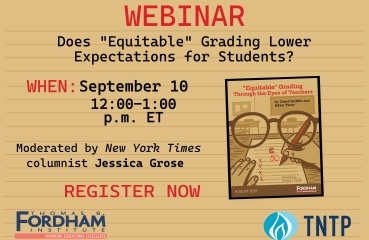
Over the last several years, so-called “equitable” grading reforms have generated controversy in many of the school districts across the country that have adopted them. Although their advocates claim that policies like "no zeros" for assignments, eliminating late penalties, and allowing unlimited retakes can make classrooms more equitable, critics argue that they effectively codify lower expec
Writing in National Review, Audrey Fahlberg describes efforts by Republican governors in a growing number of states to ban candy and soda from purchases paid for with federal SNAP benefits—the program formerly known as Food Stamps. Will they apply the same standard to awful schools and fraudulent providers that are supported by payments generated by federal tax credits and state-level voucher and ESA programs?
Rigorous education is far less popular on the ground than many policy wonks believe. Of course, everyone pays lip service to high academic and behavioral expectations in general. But when it comes to the particulars, many people—parents, teachers, and administrators alike, most kids, too—bristle at what rigorous education means in practice.
Close low-performing, underenrolled schools. Expand high-performing, in-demand schools.
This terrific “working paper” by distinguished AEI demographer Nicholas Eberstadt concludes with a fascinating (and worrying) appraisal of educational performance in China—perhaps no surprise, since he and his team wrote it with support from the Pentagon’s Office of Net Assessment.
Dr. Amber Northern, Fordham’s longtime research chief, has been tapped to redesign the Institute of Education Sciences at the U.S. Department of Education. As she begins this important work, Checker Finn outlines the history of IES, highlighting progress, shortcomings, and the challenges she faces in this new role