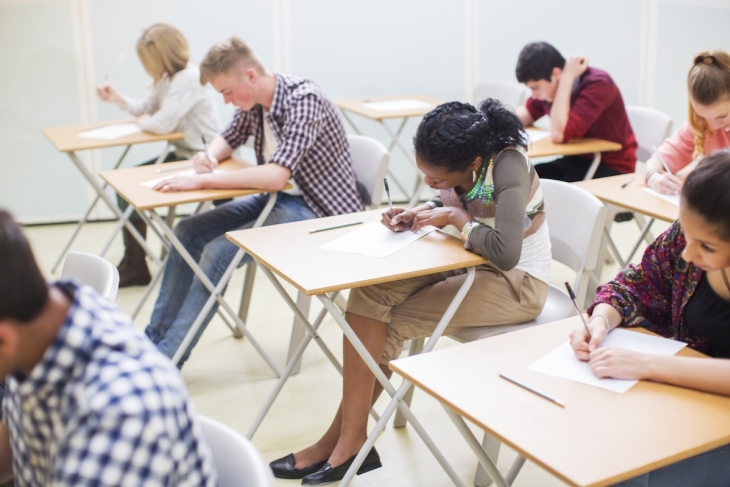
The just-released Nation’s Report Card showing score declines for eighth graders in science and downward trends in reading and math for 12th graders is eliciting a range of reactions. The one we don’t have time for, given the extent of student needs, is skepticism.
Critics contend that the National Assessment Governing Board (NAGB), which I serve on and which sets policies for the Nation’s Report Card, sets the bar too high. My colleagues and I have identified the NAEP (National Assessment of Educational Progress) “Proficient” level as the goal. There’s a Proficient level—as well as “Basic” and “Advanced” levels—for every subject that NAEP assesses. Attaining it means that students have demonstrated competence over challenging material.
Criticism of NAEP as “too challenging” aligns with trends to lower the bar in parts of the country. That has included efforts in some states to make it easier for kids to pass end-of-year assessments or to eliminate those tests completely.
Who that helps is unclear to me. As a cross-country coach, my runners will be ill-prepared if my evaluation of their performance at practice is exclusively drawn from running less than two miles when the actual competitions cover a distance of 3.1 miles. Similarly, NAEP’s challenging yet realistic expectations help evaluate how prepared students are for the ultimate competition of experiencing success beyond school.
I also believe that calls to lower the bar on NAEP threaten the assessment’s unique capacity to serve as a measure of academic progress. The Governing Board avoids changes to assessments that would weaken our ability to compare results from prior years, especially in math and reading.
This unique design makes the 2024 results in 12th grade reading and math especially concerning. Regardless of where you think the goalpost should be, a downward trend is a downward trend. The measuring stick hasn’t changed. The results follow a string of other NAEP releases showing declines since the pandemic and falling scores that began even earlier, around 2015, in some grades and subjects.
On the latest NAEP tests, students working at different achievement levels lost ground compared to 2019 except for the highest-performers among them. Those results mirror my experience working with my Advanced Placement U.S. Government class. Last year, all my students scored 3 or above on the AP exam, the standard typically required for college credit. But I’m also a parent to teens, a coach, and an active member of my community. I care about all the kids our school serves, and I worry about their future.
I’ve been teaching for 21 years. The students who will graduate in 2026 will encounter a far more complicated world than those who left in 2005. It doesn’t bode well if they’re leaving school with less knowledge and fewer skills.
They’ll need to evaluate arguments, wade through competing information, and vie for entry-level positions amid AI-fueled shifts in the economy. Even roles that might not require a college degree call for technical abilities and problem-solving skills. When our home’s air conditioning went down this summer, the technician used new, computer-based technology to assess the problem and digital apps to communicate with and invoice us. If kids are losing ground in STEM and literacy, they’ll be less equipped to succeed in nearly any industry as well as daily life.
A higher percentage of students are now working below NAEP Basic, which is itself a way station en route to proficiency. High school seniors who don’t reach Basic likely can’t make inferences to show they understand elements of a reading passage or apply their knowledge of percentages to solve a real-world problem.
We have to respond with urgency. That starts with efforts to tackle chronic absenteeism. Students on NAEP surveys report more absences, and there’s a correlation between poor attendance and score declines. Approaches that boost attendance include improving data collection and reporting, fostering belonging, and tapping community partners for help. States like Rhode Island that are trying these strategies are making progress.
I’m also glad to see that states adopting strong, evidence-based policies around reading, including teaching phonics and building student knowledge on topics like history and civics, are seeing gains, particularly at the elementary level. I want more students to have access to rigorous high-school coursework, and that requires a strong literacy foundation.
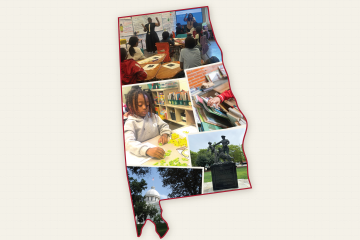
In South Carolina this year, there was a 43 percent drop in third graders failing to meet expectations on the state’s reading assessment. On the other hand, Louisiana, which is also focused on using literacy practices backed by research, has returned to pre-pandemic achievement levels in reading on the fourth-grade NAEP. Alabama did that in math and has similarly focused on evidence-based approaches. I hope this focus on what works becomes the norm throughout public education.
This is personal. One of my daughters is graduating this year, and many kids I’ve watched grow up are doing the same. We’re sending them into environments—whether they’re going to college, careers, or the military—that look different from the past.
We can’t get distracted by questions like whether we’re asking too much of students. Instead, I would challenge every adult who cares about the future success of children to ask what else can we do to ensure that every student reaches their full potential.