
My son came home from football practice the other night and showed me the “key performance indicators” from his position coach. This season, a missed tackle results in a “fine” of twenty burpees; a dropped interception is followed by twenty push-ups; and a missed assignment will be punished with fifty squat jumps. But the harshest penalty by far—ten 110s, or wind sprints from the goal line to the 10-yard line and back, then to the 20 and back, then to the 30 and back, and so on, repeated ten times—is for what he calls “swagger slacker.” In other words, not putting in enough effort.
I love that so much, because it sends a clear message to the impressionable boys on the team: effort is what matters most. Yes, it’s a cliché, but it’s one too many people in the worlds of education policy and practice forget. We continue to come up with ways to make life easier for students, as if learning can happen without some degree of exertion and struggle. Doesn’t work in football; doesn’t work in class.
The discussion around artificial intelligence is one prominent example. ChatGPT, also known as CheatGPT, is on call 24/7 to take away the blood, sweat, and tears of writing a school essay or doing practically any other homework assignment.
And there are “leveled readers” for young children, which Tim Shanahan explains in a new book. They rest on the faulty premise: the idea that too much struggle is somehow bad for kids.
But the best example comes from the push for so-called “equitable” grading practices, a push that’s been sweeping the education nation in recent years. I refer to policies like the No Zeros rule, also known as the “gifty fifty,” along with bans on grading homework or class participation and mandates requiring unlimited retakes on assessments and assignments.
The somewhat understandable rationale for all of this, advanced by consultant Joe Feldman among others, is that traditional grading practices don’t actually reward student learning, and that “standards-based grading” more accurately reflects whether students have mastered the knowledge and skills set forth in state standards and encourages them to keep at it until they do. Hence, we shouldn’t count homework or class participation in students’ grades (since these reflect effort, not achievement), and we should allow retakes and redos of tests and assignments until students demonstrate mastery.
That’s all well and good, except that—as my Fordham Institute colleagues Adam Tyner and Meredith Coffey argued last year in their policy brief, Think Again: Does “Equitable” Grading Benefit Students?—in practice these policies “tend to reduce expectations and accountability for students, hamstring teachers’ ability to manage their classrooms and motivate students, and confuse parents and other stakeholders who do not understand what grades have come to signify.”
As Fordham fellow Robert Pondiscio quipped the other day, these insights deserve to be printed in the “Journal of the Obvious and Intuitive.”
Whatever their potential merit, such grading practices seem perfectly designed to diminish student effort. Why bother doing homework if it doesn’t count? Why study for a test if you can simply retake it after failing? Why even come to class if you already have a strong A, there are only a few assignments left in the semester, and the worst you can do is score 50 on each of them?
That’s not just my cynicism talking. It’s also the view of a majority of American teachers, according to a new survey fielded by RAND and written up by my colleagues Tyner and David Griffith, “Equitable” Grading Through the Eyes of Teachers.
Per Figure 1, the results suggest that teachers are skeptical of the five equitable practices that form the focus of the report.
Figure 1: Teachers are skeptical of most "equitable" grading practices.
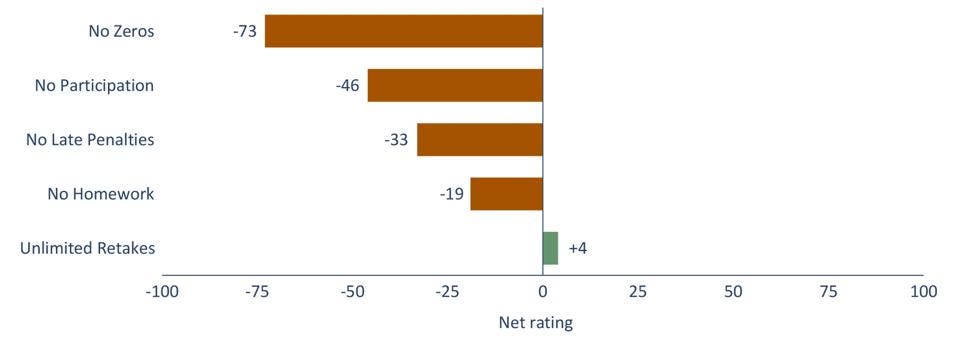
Overall, teachers’ responses suggest that “equitable” grading practices, however well intentioned, are harmful to academic engagement, some more so than others. For example, 81 percent of teachers say giving partial credit for assignments never turned in (the No Zeros policy) is “harmful” to engagement, with 51 percent saying it is “very harmful” and just 8 percent saying it is “helpful” or “very helpful” (Figure 2).
Figure 2: The overwhelming majority of teachers say “giving partial credit for assignments that are never turned in” is harmful to academic engagement.
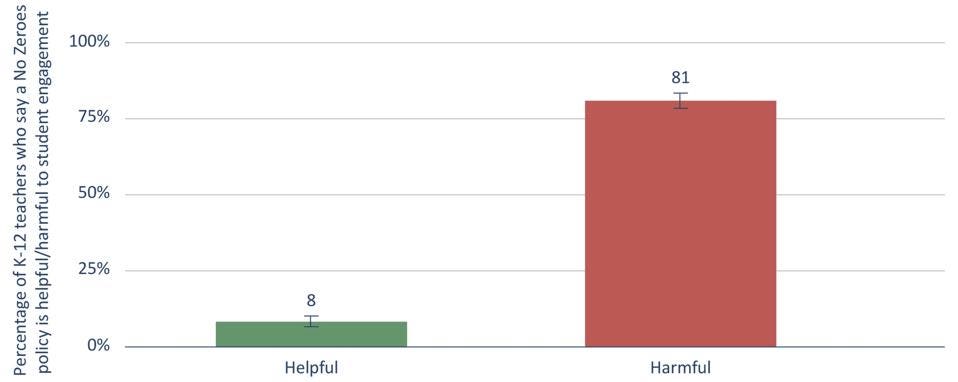
Consistent with that result, more than fifty teachers used the survey’s open-response section to express their personal opposition to No Zeros, making it the most mentioned—and most widely ridiculed—grading policy. Here are some examples of their comments:
“We have the 50 percent rule, which I think is ridiculous.”
“Being given a 50 percent for doing nothing seems to enable laziness.”
“Everybody gets at least a 50 percent is insulting to the students who work.”
“We have gone to the ‘Do nothing, get a 50’ grade policy. Students have figured out that, if they work hard for a quarter (usually the first) they can ‘coast’ the rest of the year and get a D.”
“Forcing teachers to give students half-credit on assignments that have not been completed and/or turned in is a disservice to students.”
“Most teachers can’t stand the gifty fifty.”
“I am an educator with thirty-three years in the classroom, and I see a terrible trend… Students are starting to feel entitled to points for nothing.”
“Equity grading is not leveling the playing field… It is simply lowering standards so that school districts look like they are meeting kids where they are, when in fact they are hiding their failures behind ‘equitable’ policies.”
Turns out, teachers don’t like it when administrators take a sledgehammer to their few sources of leverage over student motivation and effort. Nor do they like handing out grades that students haven’t earned.
So, for the love of learning, I beg my fellow pundits and policymakers, and so-called experts to stop coming up with prescriptions that reduce student effort. We want kids giving 110 percent when they play sports; we shouldn’t want anything less in the classroom.
Editor’s note: This was first published by Forbes.