Commentary


Teacher pay has become a big contender in the education reform space, with growing agreement that paying educators a

We need to talk about accommodations. Like puppies or grandma’s cookies, they are treated as unmitigated goods—at least in my experience. Should we not support all students? Should we not provide differentiated instruction? Who in their right mind could oppose offering accommodations, leveling the playing field, and helping students with special needs?

When 20 percent of Harvard and Brown students and 38 percent of Stanford’s are eligible for accommodations even as just 3–4 percent of students in community colleges are, we have a crisis of trust in testing, fairness, and equity.
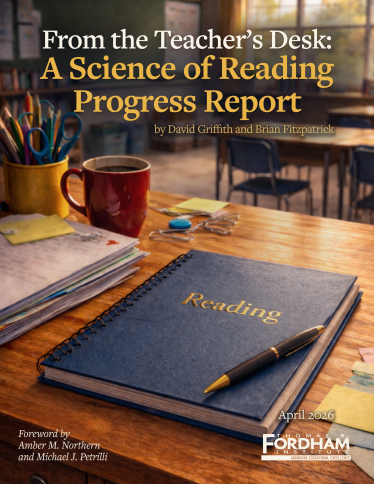
In recent years, states and districts have made a concerted effort to align early elementary school instruction with “the science of reading.” But how much progress has actually been made? To find out, Fordham researchers David Griffith and Brian Fitzpatrick analyzed results from a nationally representative survey of K–3 teachers that examined their knowledge of reading science and its relationship to the policies that shape instruction. One disturbing finding: Teachers in high-poverty schools appear less committed to the science of reading than their peers.
On this week’s episode, Mike Petrilli is joined by David Gr
Reading instruction is shifting toward the science of reading, and teachers are making progress. But gaps in training, materials, and implementation remain—especially in high-poverty schools.
For all the talk about preparing students for college and career, American education still struggles with one of its most important jobs: helping young people make a confident first move into adult life. We ask students to make big decisions about college, work, and training, but give them weak maps for what comes next.



With school phone bans of various sorts now underway in 41 states and counting, debates on classroom screen time have shifted focus to the devices ostensibly being used for educational purposes: Chromebooks, iPads, and the like. In response to all the tech backlash, state policymakers are taking swift action, some of which is warranted, but much of which bears signs of legislative haste.

Fifteen years have passed since Indiana took home the Fordham Institute’s “Education Reform Idol” crown, a recognition earned through a

Editor’s note: This is the first in a three-part series written by Elainah Elkins and Jill Hoppe, born in 1999 and 2000, respectively. There is growing discourse surrounding Gen Z, but the voices of Gen Zers themselves are often missing from the conversation. This is their response.

It’s been six years since the Covid-19 pandemic began disrupting education, and a varying number of years
Approximately 7.5 million U.S. students receive special education services in public schools—more than one in seven pupils nationwide.



As novels disappear from language arts classrooms, their many distinctive benefits are disappearing, too. So argues Daughtery, a former teacher and lifelong lover of the artform. This is a civilization loss that schools should work to reverse.

At a White House summit last month, first lady Melania Trump turned heads by entering alongside a humanoid robot, promising a future where machines might tutor children in art, philosophy, and other intellectual pursuits.

“If teachers can’t manage student behavior today, they must be worse than they used to be.” It’s a claim I’ve heard often, particularly from people who have never worked in a school. As a former teacher, this claim makes me furious. The belief is simplistic and wrong. Teachers are not worse than they used to be.
Communities In Schools (CIS) is a program that addresses not only academic needs but also the personal, familial, and community barriers that hinder student success.
Jay Plasman of The Ohio State University joins t


Hiring a superintendent is the most important decision a school board makes. Superintendents are not just the district’s CEO. They are (or ought to be) the de facto chief academic officer, responsible for setting the instructional direction of the system.

It’s not often that a conservative education secretary and a progressive teachers union boss see eye to eye.

I’m a longtime zealot for school choice. I think students, families, schools, and communities benefit when we have a variety of education options and parents get to match their kids to learning environments.
Hot on the heels of a recent report that postulated a lower-than-commonly-believed economic benefit of formal schooling comes a brand new analysis that offers more proof of high marginal returns to education. Who is winning the battle of the impact estimates?