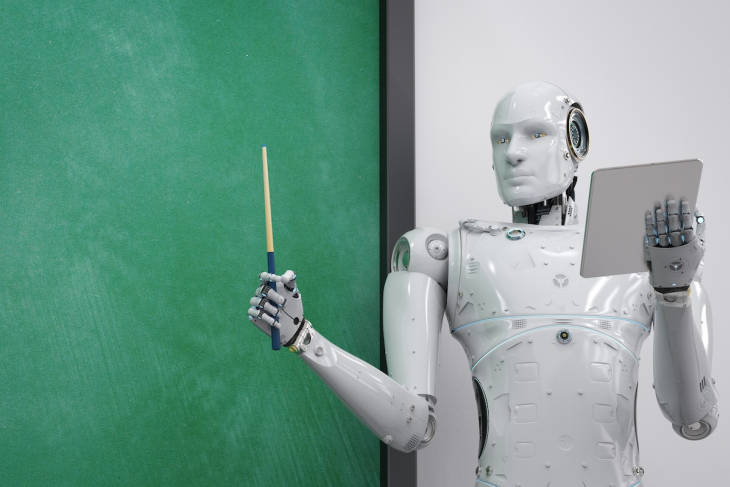
At a White House summit last month, first lady Melania Trump turned heads by entering alongside a humanoid robot, promising a future where machines might tutor children in art, philosophy, and other intellectual pursuits. “Our children will develop deeper critical thinking and independent reasoning abilities. The AI-powered [robot] will boost analytical skills and problem solving and adapt in real time to a student’s pace, prior knowledge, and even emotional state,” she said. The idea is dazzling—and it made for some striking photos—but it raises a more specific question than is often asked: not what AI can do in education, but whether humanoid robots themselves are likely to play a meaningful role in schools.
The most likely near-term use cases for robots lie in low-paid sectors and professions that are struggling to attract enough workers to meet need—like, quite sadly, elder care. They would fill gaps in such systems under the reasoning that a robot may be better than nothing at all.
There is no comparable problem in the supply of adults willing and capable of teaching children; educator shortages are more localized and uneven than is often suggested. So long as human teachers are available, it is therefore hard to imagine humanoid robots being chosen instead. That does not mean, however, that robots have no role to play in schools. It simply means that role is likely to be far more limited, and far less glamorous, than the first lady’s vision of robot philosophers and tutors suggests.
If anything, the more plausible uses for humanoid robots in education are in the kinds of jobs that are harder to staff, lower paid, or more transactional in nature. In most districts, school support staff (e.g., cafeteria workers, bus drivers, custodians, playground monitors) represent a substantial share of school employees. These roles are also subject to higher turnover. If humanoid robots can reliably take on some of these harder-to-staff positions, they could help stabilize school operations, and potentially free up resources to better compensate teachers or invest in intensive tutoring and other student supports.
To be sure, a robot that can monitor a hallway, supervise a lunchroom, or assist with routine logistics may not be ideal. But in a situation where schools struggle to hire and retain staff for these roles, it is arguably better than leaving those functions understaffed, unsupported, or shifted onto already stretched teachers. Humanoid robots are unlikely to take center stage in the classroom. Their foothold, if any, will be at the margins of how schools function.
At the same time, caution is warranted. Schools are social institutions that help shape norms, relationships, and a sense of community. The presence of adults in hallways, cafeterias, and playgrounds contributes to a culture of supervision, care, and belonging that cannot be easily replicated by machines. Replacing too many human roles risks eroding the very fabric that makes them work.
This points to a broader challenge. The question is not simply where robots can be deployed, but where they should be. The same logic that makes robots attractive in moments of scarcity can, if applied too broadly, lead to a gradual hollowing out of human institutions. What begins as a practical response to labor shortages can, without discipline, evolve into a default preference for automation, even in contexts where human interaction matters most.
For education, that would be a mistake. Schools will always need talented people to do the work of teaching well. In fact, the rise of AI may create an opportunity to do just that. As automation reshapes the labor market, more young people may find themselves searching for stable, fulfilling work. As my colleague Mike Petrilli has argued, teaching could become a more attractive option, particularly if policymakers focus on improving working conditions and compensation.
However far the technology advances, the image of a robot instructor entering a classroom captures both the appeal and the limits of the idea. It is easy to imagine machines layered into the routines of schooling, especially where tasks are repetitive and predictable. It is far harder to imagine them displacing the relationships at the center of teaching and learning. The more likely future in education is not one in which robots replace humans, but one in which they remain peripheral tools—useful in discrete ways, but never central to how children are taught or how schools are run.